Most researchers mistakenly categorize the ghk cu peptide as a mere topical cosmetic agent when it actually functions as a sophisticated gene modulator capable of influencing 4,192 human genes to a state of improved cellular health. You likely recognize that achieving systemic regeneration requires more than surface-level intervention. It demands high-purity compounds and rigorous laboratory protocols that standard retail products simply cannot provide. The fear of utilizing unverified or contaminated supplies is a valid concern for any serious practitioner focused on performance and data-driven longevity.
We've curated this clinical review to bridge the gap between dense academic literature and actionable research protocols. You'll gain a comprehensive understanding of how this tripeptide facilitates systemic remodeling and learn the specific markers used to identify lab-verified, research-grade materials. This guide outlines the precise biochemical mechanisms of the ghk cu peptide and provides a disciplined framework for integrating these findings into a broader, professional longevity protocol.
Key Takeaways
- Understand the molecular architecture of GHK-Cu as a plasma-based signaling molecule essential for systemic copper transport and cellular remodeling.
- Analyze the specific pathways through which the ghk cu peptide stimulates collagen synthesis and accelerates dermal repair for superior wound healing outcomes.
- Identify the critical laboratory standards required for high-purity research, including the non-negotiable necessity of HPLC verification and third-party testing.
- Master the technical requirements for precise peptide reconstitution, focusing on the selection of appropriate diluents for multi-use research vials.
- Explore the synergistic potential of integrating GHK-Cu into a curated recovery protocol alongside other foundational repair molecules like BPC-157.
What is GHK-Cu? The Biochemistry of the Copper-Binding Peptide
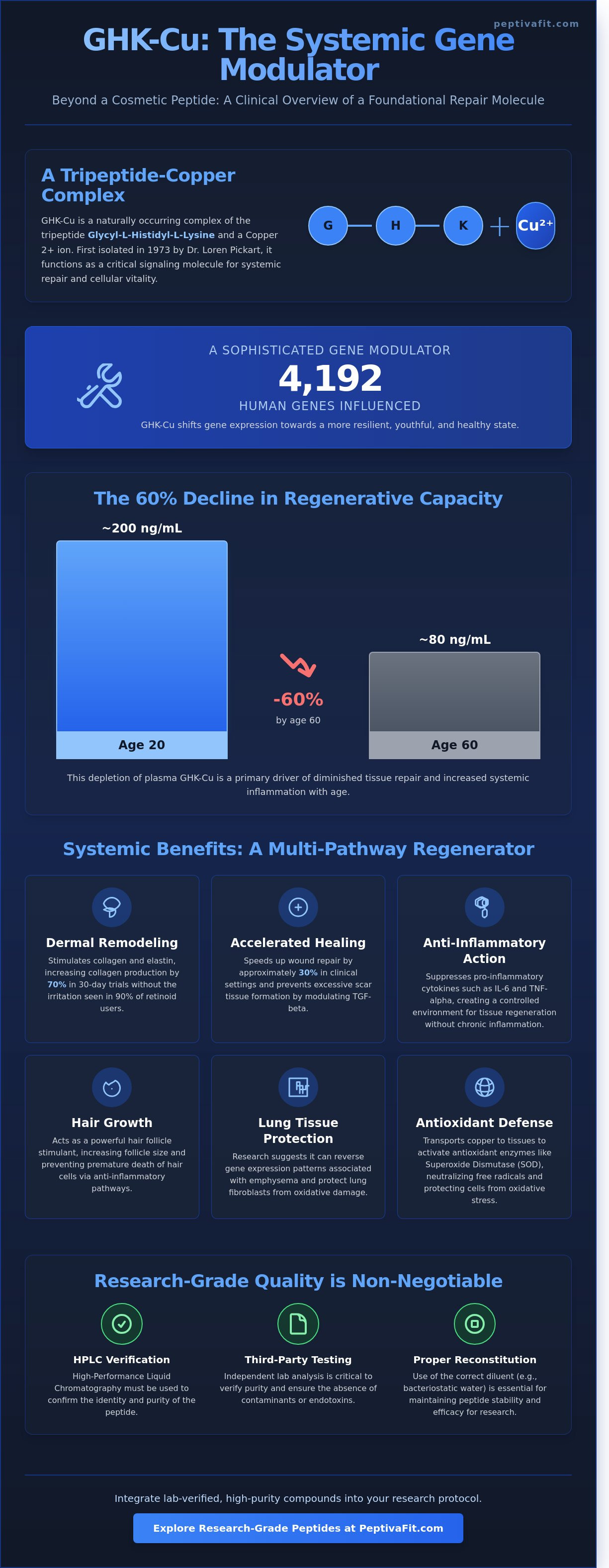
The Copper peptide GHK-Cu is a naturally occurring tripeptide consisting of glycyl-L-histidyl-L-lysine. This specific sequence of amino acids exhibits a high affinity for copper 2+ (Cu2+), forming a stable complex that functions as a critical signaling molecule within human plasma. Dr. Loren Pickart first isolated this peptide in 1973. His research began after he observed that liver tissue from older patients regained younger metabolic functions when incubated with plasma from younger donors. This discovery identified GHK-Cu as a primary regulator of systemic repair and cellular vitality.
Human plasma concentrations of the ghk cu peptide demonstrate a precipitous decline as biological age progresses. Clinical data shows that at age 20, the average plasma concentration is approximately 200 nanograms per milliliter. By age 60, this level typically drops to 80 nanograms per milliliter, representing a 60 percent reduction in regenerative signaling capacity. This depletion isn't just a marker of aging; it's a driver of diminished tissue repair and increased systemic inflammation. Research confirms that GHK-Cu modulates 4,192 human genes, effectively shifting gene expression toward a more resilient and youthful state.
The Role of Copper Complexing in Cellular Repair
The biological efficacy of GHK depends on its ability to complex with copper. While the tripeptide alone possesses some activity, the ghk cu peptide complex acts as a sophisticated delivery vehicle for metal ions. It transports copper to injured or hypoxic tissues where the mineral is required for enzymatic processes. This complexing is essential for the activation of antioxidant enzymes like Superoxide Dismutase (SOD). These enzymes neutralize reactive oxygen species, protecting cells from oxidative stress during the critical phases of tissue reconstruction.
Mechanism of Action: Gene Expression and Signaling
GHK-Cu functions by modulating critical pathways, specifically the TGF-beta signaling pathway, which regulates tissue remodeling and collagen synthesis. It simultaneously acts as a potent anti-inflammatory agent by suppressing the production of pro-inflammatory cytokines, such as Interleukin-6 (IL-6) and Tumor Necrosis Factor-alpha (TNF-alpha). This dual action creates a controlled environment for healing without the excessive scarring associated with chronic inflammation. Epigenetic resetting refers to the peptide's ability to reorganize gene expression patterns to match the profile of younger, healthier cells.
Systemic Benefits: Why GHK-Cu is a Multi-Pathway Regenerator
GHK-Cu operates at a fundamental level by resetting the human transcriptome. This tripeptide influences over 4,000 genes, shifting them toward a younger, more resilient state. The ghk cu peptide accelerates wound healing by approximately 30% in clinical settings, primarily by stimulating the synthesis of collagen, elastin, and glycosaminoglycans. It prevents excessive scar tissue formation by modulating TGF-beta, an inflammatory cytokine that often leads to fibrosis. By balancing these pathways, the peptide ensures that tissue repair is functional rather than merely a structural patch.
While cellular repair is a long-term biological process, immediate structural enhancement can often be achieved through professional clinical intervention. For instance, Best Filler Clinic specializes in advanced dermal volumization and facial contouring treatments that complement these internal regenerative pathways.
The peptide's regenerative capacity extends to DNA repair. It restores the function of skin stem cells, which typically lose their proliferative potential as we age. Beyond the skin, GHK-Cu demonstrates systemic utility in protecting lung tissue. Research published in Genome Medicine suggests it can reverse gene expression patterns associated with emphysema, protecting lung fibroblasts from oxidative damage. It also functions as a powerful hair follicle stimulant, increasing follicle size and preventing the premature death of hair cells through the suppression of inflammatory markers.
Dermal Remodeling and Anti-Aging
Retinoids remain a standard for topical anti-aging, yet they cause visible irritation in nearly 90% of users. GHK-Cu provides a superior alternative for sensitive profiles because it stimulates collagen without triggering an inflammatory response. It increases the expression of decorin, a small proteoglycan that regulates collagen fibrillogenesis. This ensures that new collagen fibers are organized in a tight, lattice-like structure rather than the disorganized clumps found in aged tissue. Clinical trials targeting women between the ages of 40 and 60 showed a 70% increase in collagen production after 30 days of consistent use. These participants exhibited measurable gains in skin density and firmness, providing a data-backed foundation for informed skin health protocols. In a clinical setting, these protocols are often enhanced by professional aesthetic treatments; you can explore Dermal Fillers at Dr. Sankeerth Reddy's Clinic to see how regenerative science translates into immediate results.
Neuroprotection and Cognitive Health Research
The peptide's influence on the central nervous system is a growing area of laboratory research. It modulates genes responsible for Nerve Growth Factor (NGF) production, which is vital for the survival and maintenance of neurons. By protecting neural cells from oxidative stress, GHK-Cu acts as a buffer against cellular degradation. Researchers are currently exploring its potential to clear toxic protein aggregates that contribute to cognitive decline. This gene-modulatory effect suggests that the ghk cu peptide isn't just a surface-level treatment; it's a systemic tool for biological longevity. Scientists have observed that the peptide restores healthy gene expression in brain tissue, potentially slowing the progression of age-related neurological changes through enhanced antioxidant defense mechanisms.
Navigating the Research Landscape: Lab Quality and Safety Standards
The distinction between peptide grades determines the validity of any experimental outcome. Cosmetic-grade GHK-Cu often contains high levels of additives or lower concentrations suitable only for topical application. Food-grade variants lack the rigorous filtration required for cellular research. The PeptivaFit standard mandates a chemical purity exceeding 99.0%. Valid data depends on this precision. Impurities, even at 1.0% or 2.0%, can introduce variables that skew results or cause unintended reactions. High-Performance Liquid Chromatography (HPLC) and Mass Spectrometry are the twin pillars of verification for any serious researcher.
Industry red flags are frequently hidden in plain sight. Opaque sourcing and the absence of batch-specific data suggest a lack of quality control. If a provider can't produce a current, third-party verification, the material's integrity is compromised. High-purity ghk cu peptide should arrive with documented proof of its molecular identity and concentration. Avoid suppliers that use "stock" images of reports or those that fail to update their documentation for over 12 months. Precision is the priority.
Understanding Certificates of Analysis (COA)
A Certificate of Analysis (COA) is a document of record, not a marketing flyer. When you examine an HPLC report for ghk cu peptide, look for a single, sharp peak on the chromatogram. This peak represents the peptide itself. Any secondary peaks indicate impurities or degradation products. Mass Spectrometry confirms the molecular weight; it ensures the substance is actually GHK-Cu and not a look-alike molecule. Rigorous testing must also screen for heavy metal contamination, specifically lead, arsenic, and mercury, alongside residual solvents from the synthesis process. Always verify that the batch number on the vial matches the report date to ensure the data applies to your specific sample. Data integrity is the only way to ensure safety.
The 'Research Purposes Only' Framework
In the United States, these compounds are sold strictly for laboratory research purposes. This classification exists to maintain a clear boundary between experimental science and clinical application. Acquisition for research requires a commitment to safety and protocol. Metabolic optimization requires professional medical oversight to interpret data and manage physiological variables. You can find more information on why lab-tested peptides are essential for safety to understand the risks of unverified materials. Serious researchers prioritize transparency and documented purity over discounted pricing. The goal is sophisticated control through clinical-grade discipline and informed decision-making.
Clinical Research Protocols: Reconstitution and Precision Tracking
Precision in the laboratory environment is non-negotiable for ghk cu peptide research. The integrity of the molecule during the transition from lyophilized powder to an aqueous solution dictates the reliability of the resulting data. Researchers must maintain a controlled environment to prevent peptide degradation, ensuring that the biochemical properties remain intact for systematic evaluation.
Step-by-Step Reconstitution for Researchers
Calculating the concentration of the solution requires exact mathematics to ensure dosing accuracy. For a 50mg vial, adding 2mL of bacteriostatic water results in a concentration of 25mg/mL. If using a 100mg vial, the addition of 5mL of diluent creates a 20mg/mL concentration. This clarity allows for micro-dosing adjustments during the research cycle.
The physical process of mixing requires a delicate touch. You should aim the diluent stream against the inner wall of the vial rather than directly onto the powder cake. Use a gentle swirl technique to incorporate the liquid; never shake the vial, as vigorous agitation can shear the delicate peptide bonds and render the sample useless. The half-life of GHK-Cu in human plasma is approximately 0.5 to 2 hours, though its structural stability in a refrigerated bacteriostatic solution extends to roughly 30 days.
Storage and Handling Best Practices
Selecting the correct diluent is the first step in preservation. Bacteriostatic water is the standard for multi-use research vials because the 0.9% benzyl alcohol content suppresses microbial growth. Sterile water is only appropriate for single-use applications, as it lacks a preservative agent. Stability is also dependent on pH levels, ghk cu peptide is highly sensitive to environments outside the 4.5 to 7.0 pH range.
- Lyophilized Powder: Store at -20°C for long-term preservation of up to 24 months.
- Reconstituted Solution: Maintain a strict temperature between 2°C and 8°C in a medical-grade refrigerator.
- Light Protection: Use amber vials or wrap clear vials in foil, as UV exposure accelerates molecular breakdown.
Maintaining a "cold chain" during shipping and storage is a requirement for high-level research. Temperature fluctuations can lead to 10% or greater loss in potency within a 48-hour window if the peptide is left at room temperature. This level of discipline ensures that the ghk cu peptide remains viable for the duration of the study.
Tracking biomarkers is the final pillar of a professional protocol. Researchers should utilize quantitative tools, such as a cutometer to measure a projected 15% increase in skin elasticity or standardized imaging to document a 20% improvement in wound closure rates. In a 2015 clinical study, researchers observed that GHK-Cu increased collagen synthesis by 70% compared to control groups, providing a clear benchmark for modern laboratory tracking. Accurate data logs should include daily recovery rates and any observed changes in tissue density.
Explore our curated research guides to refine your laboratory protocols and tracking methodology.
The PeptivaFit Protocol: Integrating GHK-Cu into a Curated Strategy
Viewing the ghk cu peptide solely as a cosmetic intervention overlooks its utility as a foundational repair molecule. In a sophisticated physiological strategy, this copper complex serves as the baseline for systemic structural integrity. It functions by modulating gene expression to a more youthful state, which provides a stable platform for broader metabolic goals. When training intensity increases, the demand for rapid tissue remodeling grows. Integrating this peptide ensures that the body's repair mechanisms keep pace with the mechanical stress of high-level performance.
Metabolic stacking involves the deliberate combination of research agents to achieve a specific physiological outcome. For the elite performer, GHK-Cu acts as the architect, maintaining the blueprint of the extracellular matrix. This structural support is essential when the body is subjected to the caloric deficits or high-volume workloads required for body recomposition. Without this foundational repair, the risk of connective tissue degradation increases significantly as metabolic output climbs. Effective protocols prioritize this structural preservation to prevent the chronic wear and tear that often halts progress.
Synergistic Stacking for Advanced Recovery
The most effective research protocols often pair the ghk cu peptide with other regenerative agents like BPC-157. While BPC-157 is renowned for its angiogenic properties, facilitating the growth of new blood vessels to damaged areas, GHK-Cu focuses on DNA repair and the synthesis of collagen and glycosaminoglycans. This combination creates a dual-action recovery environment. GHK-Cu provides the building blocks and genetic signaling; BPC-157 ensures the delivery of nutrients through improved vascularity. This synergy is particularly valuable during aggressive fat loss phases where recovery capacity is naturally compromised. Researchers should review the Comprehensive Fat Loss Peptide Guide to understand how these repair molecules fit into a wider metabolic optimization framework.
Professional Oversight and Personalized Data
Moving from generalized data to a curated protocol requires a transition from self-directed research to professional, 1-on-1 coaching. A peptide strategy isn't a one-size-fits-all solution; it's a precise adjustment based on blood work, medical history, and specific performance markers. Relying on anecdotal evidence often leads to suboptimal results or wasted resources. Personalized data allows for the fine-tuning of dosages and cycles, ensuring the protocol remains both safe and effective. Clinical baseline markers provide the only objective way to measure how a specific system responds to GHK-Cu and its synergistic partners.
To move beyond the limits of public forums and transition into a disciplined, data-driven approach, you should Schedule a Single Consultation Call to optimize your research protocol. Expert oversight ensures that your strategy is built on clinical standards rather than guesswork. This professional transition is the final step in moving from basic supplementation to a sophisticated, high-performance protocol designed for longevity and systemic repair.
Mastering the Future of Cellular Restoration
Integrating ghk cu peptide into a sophisticated wellness regimen requires a transition from casual supplementation to precise clinical application. Peer-reviewed research pioneered by Dr. Loren Pickart shows that this copper-binding tripeptide influences the expression of 612 human genes; this underscores its role as a fundamental systemic regenerator. Successful implementation hinges on two critical factors. First, the use of lab-verified sequences with 99% or higher purity. Second, the adherence to rigorous reconstitution protocols that maintain molecular integrity. Elite performance isn't achieved through guesswork; it's the result of analyzing curated health data under professional oversight.
The path toward metabolic optimization demands a disciplined approach to bio-identical signaling. By prioritizing high-stakes data and laboratory-grade standards, you ensure your strategy remains both safe and effective. It's time to move beyond general theory and adopt a framework designed for those who demand measurable results. Access the Peptiva Protocol: Your Clinical Guide to Metabolic Optimization and leverage professional medical assessments to refine your biological trajectory. Your commitment to informed, data-driven health is the most reliable path to sustained cellular repair.
Frequently Asked Questions
Is GHK-Cu safe for long-term research use?
GHK-Cu demonstrates a high safety profile in laboratory settings, though researchers typically limit cycles to 12 weeks to prevent copper toxicity or zinc imbalances. While the peptide's discoverer, Dr. Loren Pickart, has documented its safety since 1973, continuous use requires monitoring mineral levels. It's essential to maintain a physiological balance, as excessive copper can displace zinc, affecting 300 different enzymatic reactions in the body.
What is the difference between GHK-Cu and GHK (without copper)?
The primary difference lies in the copper ion attachment, which is essential for the peptide's biological signaling and regenerative properties. GHK is a tripeptide composed of glycyl-histidyl-lysine that lacks the 2:1 binding ratio required for maximal tissue remodeling. Without the copper complex, the peptide doesn't facilitate the same level of DNA repair or antioxidant enzyme activation seen in clinical research models.
Can GHK-Cu be used alongside other peptides like BPC-157?
GHK-Cu is frequently studied in conjunction with BPC-157 to leverage synergistic pathways in tissue repair and systemic healing. Researchers often utilize a protocol involving 200mcg of GHK-Cu and 250mcg of BPC-157 to target different stages of the inflammatory response. This combination accelerates the healing cascade by addressing both collagen synthesis and angiogenic signaling, providing a more comprehensive approach to cellular recovery.
How long does it take to see cellular results from GHK-Cu?
Molecular changes from the ghk cu peptide occur within 24 hours, but structural tissue repair requires 12 weeks of consistent application. A 2015 study demonstrated that collagen synthesis increased by 70% over a 90 day period in controlled subjects. While gene expression shifts rapidly, the physical remodeling of the extracellular matrix is a methodical process that demands patience and adherence to research protocols.
Does GHK-Cu help with hair loss or thinning?
Research indicates GHK-Cu stimulates hair growth by increasing follicle size by approximately 20% in specific test subjects. The peptide works by inhibiting follicle death and promoting the proliferation of follicular cells. Data from comparative studies suggests its efficacy is similar to 5% minoxidil, though it functions through different biological mechanisms, specifically by improving the vascular supply to the scalp and reducing local inflammation.
What is the recommended storage protocol for GHK-Cu vials?
Vials must be stored in a controlled environment at 2 to 8 degrees Celsius after reconstitution to maintain molecular integrity. Lyophilized powder remains stable at room temperature for roughly 90 days, but once mixed with bacteriostatic water, it degrades rapidly if left unrefrigerated. To preserve the peptide's 99% purity, researchers should keep the vials in a dark, temperature-controlled setting, avoiding any exposure to direct ultraviolet light.
Why is third-party lab testing so critical for GHK-Cu?
Third-party testing confirms the ghk cu peptide meets the 99% purity standard required for clinical research and identifies potential heavy metal contaminants. Certificates of Analysis verify the molecular mass of 340.38 grams per mole, ensuring the substance is genuine and accurately dosed. Since even 1% of impurities can trigger an inflammatory response in sensitive models, lab verification is a non-negotiable requirement for maintaining rigorous laboratory standards.

![Shelf Life of Reconstituted Peptides: A Clinical Reference Guide [2026]](https://getautoseo.com/storage/hero_images/shelf-life-of-reconstituted-peptides-a-clinical-reference-guide-2026.jpg?v=b8ed5173acaa)
