
What if the reason you can't shift stubborn belly fat has nothing to do with how hard you're working, and everything to do with your biology? If you've tried disciplined dieting and consistent training only to watch that visceral fat hold its ground, you're not imagining things. Stubborn abdominal fat is physiologically resistant to conventional methods, and for a growing number of serious individuals, peptides for stubborn belly fat are emerging as a scientifically grounded avenue worth understanding.
You already know that not every solution is built for every body. The challenge isn't a lack of options; it's the overwhelming noise surrounding which peptides are actually effective, which are genuinely safe, and how to build a protocol that reflects your individual metabolic profile rather than someone else's results.
This guide cuts through that confusion. Drawing on current clinical evidence and the principles behind personalized peptide therapy, you'll gain a clear, structured understanding of how specific peptides work, what quality and lab verification actually mean in practice, and how to approach fat loss with the precision it demands. What follows is a comprehensive breakdown designed to help you make informed, data-driven decisions, not reactive ones.
Key Takeaways
- Peptides for stubborn belly fat operate through precise metabolic mechanisms that fundamentally differ from conventional fat loss methods, making them a scientifically distinct category worth understanding on its own terms.
- Tesamorelin is one of the most clinically documented peptides for targeting visceral fat specifically, with evidence-backed protocols that distinguish it from generalized weight loss compounds.
- Quality verification through third-party lab testing and Certificates of Analysis is non-negotiable - the peptide market carries significant risks for those who bypass these standards.
- The Peptiva Protocol offers a structured, individualized approach to fat loss that integrates personalized medical assessment with expert coaching rather than a one-size-fits-all solution.
- Informed decision-making in peptide therapy requires understanding both the clinical evidence and the quality benchmarks that separate effective, safe protocols from unverified alternatives.
Understanding Peptides and Their Role in Fat Loss
Peptides are short chains of amino acids, typically comprising between two and fifty residues, that function as biological signaling molecules within the body. Unlike broad-spectrum interventions such as caloric restriction or thermogenic supplements, peptides operate with remarkable specificity: they bind to targeted receptors and trigger precise physiological responses, including the modulation of hormone secretion, cellular metabolism, and lipid mobilization. This specificity is exactly what makes them a fundamentally different category from conventional fat loss methods.
Traditional approaches to fat loss work systemically. They reduce overall energy availability or increase expenditure without distinguishing between fat depots. Peptide therapy, by contrast, can be calibrated to influence particular metabolic pathways, making it especially relevant for individuals whose visceral fat resists standard interventions. That distinction matters enormously when evaluating peptides for stubborn belly fat as a clinical option rather than a lifestyle trend.
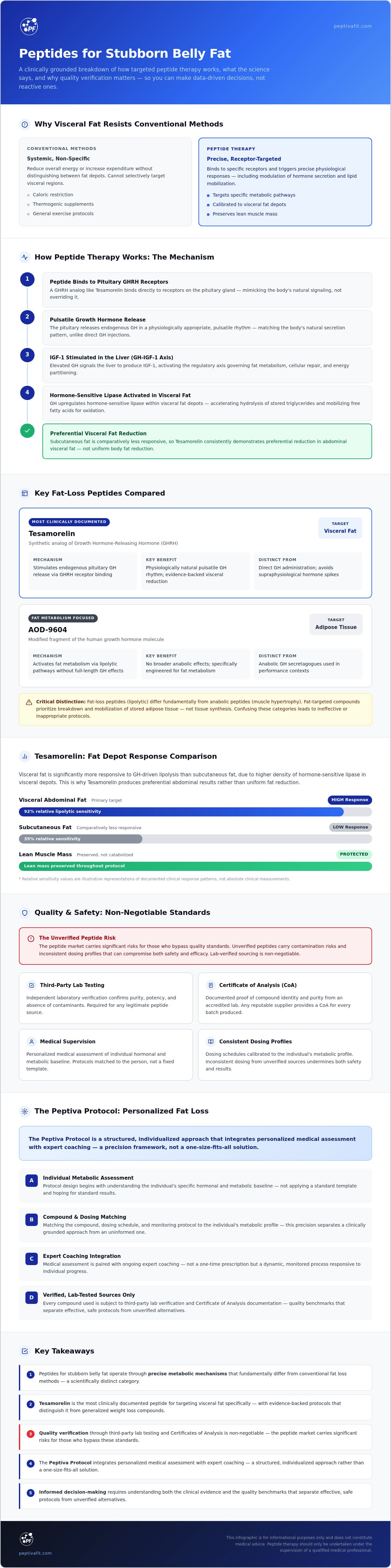
It's also critical to separate fat-loss peptides from anabolic peptides. Compounds designed primarily for muscle hypertrophy, such as certain growth hormone secretagogues used in performance contexts, operate through mechanisms that prioritize tissue synthesis over lipolysis. Fat-targeted peptides work differently: their primary function centers on stimulating the breakdown and mobilization of stored adipose tissue, particularly in metabolically active visceral regions.
Types of Peptides for Fat Loss
Two peptides with the most documented relevance to abdominal fat reduction are Tesamorelin and AOD-9604. Tesamorelin is a synthetic analog of growth hormone-releasing hormone (GHRH) that stimulates endogenous growth hormone production, driving preferential reduction in visceral adipose tissue. AOD-9604 is a modified fragment of the human growth hormone molecule, specifically engineered to activate fat metabolism without the broader anabolic effects of full-length GH. Both compounds work through lipolytic pathways, but their receptor targets and clinical profiles differ in meaningful ways. Regardless of which compound is under consideration, lab-verified sourcing is non-negotiable. Unverified peptides carry contamination risks and inconsistent dosing profiles that can compromise both safety and efficacy.
The Science Behind Peptide Therapy
At a molecular level, peptide therapy functions by engaging the growth hormone-IGF-1 axis, a regulatory system governing fat metabolism, cellular repair, and energy partitioning. When GHRH analogs like Tesamorelin bind to pituitary receptors, they prompt a pulsatile release of growth hormone, which subsequently stimulates IGF-1 production in the liver. This cascade promotes lipolysis in adipose tissue while preserving lean mass. Clinical evidence indicates that targeted peptide protocols can produce measurable reductions in visceral fat volume, particularly when protocols are individualized to a patient's specific hormonal and metabolic baseline rather than applied as a standardized regimen.
This is the foundation of personalized peptide therapy: matching the compound, dosing schedule, and monitoring protocol to the individual's metabolic profile rather than applying a fixed template. That precision is what separates a clinically grounded approach from an uninformed one.
The Mechanism of Tesamorelin in Targeting Belly Fat
Tesamorelin doesn't work the way most fat loss compounds do. Rather than suppressing appetite or broadly accelerating metabolism, it operates upstream, at the level of the hypothalamic-pituitary axis. As a synthetic analog of growth hormone-releasing hormone, it binds directly to GHRH receptors on the pituitary gland, prompting a pulsatile, physiologically appropriate release of endogenous growth hormone. That distinction matters: the resulting GH release mirrors the body's natural secretion rhythm, which is a key reason its safety profile differs from direct GH administration.
The downstream effect is highly specific to visceral adipose tissue. Growth hormone upregulates hormone-sensitive lipase activity within visceral fat depots, accelerating the hydrolysis of stored triglycerides and mobilizing free fatty acids for oxidation. Subcutaneous fat is comparatively less responsive to this mechanism, which explains why Tesamorelin consistently demonstrates preferential reduction in abdominal visceral fat rather than uniform body fat reduction. For individuals confronting the kind of metabolically entrenched belly fat that resists dietary intervention, this selectivity is clinically significant.
Timing and dosage precision are not optional variables. Standard protocols involve subcutaneous injection administered in the evening, aligned with the body's natural nocturnal GH secretion peak. Deviating from this timing can blunt efficacy. Dosing must be calibrated to the individual's baseline IGF-1 levels and hormonal status, which reinforces why a personalized medical assessment is foundational to any responsible protocol rather than an optional add-on.
Clinical Studies on Tesamorelin
The clinical evidence base for Tesamorelin is more robust than for most peptides discussed in fat loss contexts. Randomized controlled trials have demonstrated statistically significant reductions in visceral adipose tissue volume in participants receiving Tesamorelin compared to placebo groups, with effects observed over treatment periods ranging from several months to one year. Ongoing monitoring of IGF-1 levels throughout therapy is essential: elevations above the physiologically normal range signal a need for dosage adjustment and represent the primary safety checkpoint in a well-managed protocol. Side effects, which can include fluid retention, joint discomfort, and transient insulin sensitivity changes, are generally dose-dependent and manageable under clinical supervision.
Combining Tesamorelin with Other Peptides
Synergy in peptide therapy isn't theoretical. Pairing Tesamorelin with AOD-9604 addresses complementary lipolytic pathways: Tesamorelin drives GH-mediated fat mobilization while AOD-9604 directly activates beta-3 adrenergic receptors in adipose tissue, enhancing fatty acid oxidation without anabolic interference. Some protocols also incorporate peptides that support insulin sensitivity to counteract the mild glucose metabolism shifts that can accompany GH elevation. The specific composition of any stack should be determined by individual metabolic data, not generalized templates.
For those evaluating peptides for stubborn belly fat through a rigorous, evidence-based lens, understanding these mechanisms is the prerequisite to building a protocol that actually performs. Explore the Peptiva Protocol to see how personalized assessment translates these clinical principles into a structured, individually calibrated approach.
Safety and Quality Standards for Peptides
The peptide market operates with far less regulatory oversight than pharmaceutical drug channels, and that gap creates significant risk for anyone sourcing compounds without a rigorous verification framework. Efficacy is irrelevant if the compound reaching you is contaminated, mislabeled, or dosed inconsistently. For those seriously evaluating peptides for stubborn belly fat, quality verification isn't a supplementary consideration; it's the prerequisite to everything else.
Understanding Certificates of Analysis (COA)
A Certificate of Analysis is the primary document confirming what a peptide product actually contains, as verified by an independent third-party laboratory. Reading one correctly requires knowing what to look for: purity levels, identity confirmation, and contaminant screening results. Pharmaceutical-grade research peptides should demonstrate purity levels at or above 98%, confirmed through high-performance liquid chromatography (HPLC) testing. Mass spectrometry analysis should confirm the compound's molecular identity against its theoretical structure.
Several red flags indicate an unreliable source:
- No COA available on request. Any legitimate supplier provides documentation without hesitation.
- COAs issued by the supplier's own internal lab. Third-party verification is non-negotiable; self-issued documents carry no independent credibility.
- Purity figures below 98%. Lower purity introduces unknown impurities whose physiological effects are uncharacterized.
- Missing contaminant panels. A complete COA screens for residual solvents, heavy metals, and microbial contamination, not just active compound concentration.
- Pricing significantly below market norms. Synthesis and third-party testing carry real costs. Unusually low pricing signals corners have been cut.
Mitigating Risks in Peptide Use
Compound quality is only one variable. How peptides are handled before administration matters equally. Lyophilized peptides require reconstitution using bacteriostatic water, performed under sterile conditions: clean hands, alcohol-swabbed vial tops, and dedicated sterile syringes for each preparation. Cross-contamination during reconstitution introduces infection risk that no amount of upstream quality control can compensate for.
Baseline blood work before initiating any protocol is essential, not optional. IGF-1 levels, fasting glucose, lipid panels, and a comprehensive metabolic profile establish the physiological reference points against which all downstream changes are measured. Without that baseline, it's impossible to distinguish a therapeutic response from an adverse one, or to catch early signals of dosage misalignment before they become clinical problems.
Professional oversight throughout a protocol isn't a formality. Side effects including fluid retention, transient joint discomfort, and shifts in insulin sensitivity are manageable under clinical supervision but can escalate without it. Regular monitoring appointments allow for dosage calibration based on objective data rather than subjective experience alone.
Responsible use of peptides for stubborn belly fat demands the same disciplined approach applied to any serious medical intervention: verified sourcing, sterile handling, baseline data, and ongoing professional assessment. Learn how the Peptiva Protocol integrates lab-verified peptides with personalized medical oversight to ensure every element of your protocol meets clinical standards from the outset.
The Peptiva Protocol: A Tailored Approach to Fat Loss
Understanding the science behind peptides for stubborn belly fat is necessary, but it's not sufficient. Knowledge without a structured implementation framework produces inconsistent results at best and clinical risk at worst. The Peptiva Protocol exists precisely to bridge that gap: it's a comprehensive, individually calibrated approach to fat loss that integrates lab-verified peptides, personalized medical assessment, and expert coaching into a single coherent system rather than a collection of disconnected interventions.
What separates this approach from generic peptide programs is its foundational premise: no two metabolic profiles are identical, and no fixed protocol can account for the biological variation that determines how any individual responds to peptide therapy. The Peptiva Protocol is built around that reality.
Personalized Medical Assessments
A personalized assessment within the Peptiva Protocol isn't a formality. It's the diagnostic foundation that determines everything downstream: which compounds are appropriate, at what dosing schedule, and against which biomarkers progress will be tracked. The assessment evaluates your current hormonal baseline, IGF-1 levels, fasting glucose, lipid panel, and comprehensive metabolic profile. These data points don't just inform the initial protocol; they create the reference framework that makes ongoing calibration possible. Without this foundation, dosage decisions become guesswork, and guesswork in peptide therapy carries real physiological consequences.
Data-driven decision-making is the mechanism through which the protocol remains responsive rather than static. As your body adapts, the protocol adapts with it.
Integrating Peptide Therapy with Lifestyle Changes
Peptides amplify a well-structured foundation; they don't replace one. The Peptiva Protocol's 1-on-1 coaching component addresses this directly by helping clients align their nutrition strategy, training approach, and recovery practices with the specific demands of their peptide protocol.
Practically, this means:
- Nutritional alignment: Protein intake and meal timing influence IGF-1 sensitivity and fat oxidation rates, making dietary structure a functional variable rather than a background consideration.
- Training calibration: Resistance training and strategic cardiovascular work enhance the lipolytic effects of GH-axis peptides by increasing receptor sensitivity in adipose tissue.
- Recovery optimization: Sleep quality directly governs endogenous GH secretion patterns, which interact with the pulsatile release mechanisms that compounds like Tesamorelin are designed to amplify.
This holistic integration is what distinguishes a protocol that produces durable body composition changes from one that generates temporary results. Serious individuals evaluating peptides for stubborn belly fat deserve a structured system that accounts for the full picture, not just the compound itself.
Explore the Peptiva Protocol to understand how personalized assessment, lab-verified peptides, and expert coaching combine into a clinically grounded approach built around your specific metabolic profile.
Take Control of Your Fat Loss with the Right Protocol
Stubborn belly fat doesn't respond to effort alone. It responds to precision. Throughout this guide, you've seen why peptides for stubborn belly fat represent a scientifically distinct category, how Tesamorelin's mechanism targets visceral adipose tissue with specificity that broad-spectrum methods simply can't match, and why quality verification through third-party lab testing is the non-negotiable foundation of any responsible protocol.
The gap between understanding the science and achieving real results comes down to implementation. That means lab-verified peptide supplies, a personalized medical assessment that grounds every decision in your actual metabolic data, and expert coaching that keeps your nutrition, training, and recovery aligned with your protocol's demands.
You've done the research. Now the next step is a structured system built around your biology, not a generic template.
Frequently Asked Questions About Peptides for Stubborn Belly Fat
How do peptides specifically target stubborn belly fat?
Peptides work by engaging precise biological signaling pathways rather than producing generalized metabolic effects. Compounds like Tesamorelin stimulate pulsatile growth hormone release, which upregulates hormone-sensitive lipase activity specifically within visceral adipose depots. This receptor-level specificity is why visceral fat responds to peptide therapy in ways it doesn't respond to caloric restriction or conventional exercise protocols.
Are peptides safe for weight loss?
Safety in peptide therapy is directly contingent on three factors: compound quality, appropriate dosing, and professional oversight. Lab-verified peptides sourced with third-party Certificates of Analysis carry a fundamentally different risk profile than unverified compounds. Baseline blood work, ongoing IGF-1 monitoring, and regular clinical assessment are the structural safeguards that keep a protocol safe. Skipping any of these steps introduces risks that the compounds themselves don't inherently carry.
What are the side effects of using peptides for fat loss?
Side effects vary by compound and individual metabolic profile, but commonly reported ones with GH-axis peptides include transient fluid retention, mild joint discomfort, and modest shifts in insulin sensitivity. These effects are generally dose-dependent, meaning they're manageable through dosage calibration rather than protocol discontinuation. Catching these signals early is precisely why regular monitoring appointments matter throughout a protocol, not just at initiation.
How long does it take to see results from peptide therapy?
Measurable changes in visceral fat volume typically require sustained protocol adherence over several months. Clinical trials examining Tesamorelin have observed statistically significant reductions over treatment periods ranging from roughly three months to one year. Results depend heavily on individual hormonal baseline, lifestyle alignment, and protocol consistency. Anyone expecting rapid transformation within weeks is misaligned with how these mechanisms actually operate biologically.
Do I need a prescription for peptides?
The regulatory status of specific peptides varies by jurisdiction and evolves over time, so verifying current legal requirements in your location before initiating any protocol is essential. Some peptides used in clinical fat loss contexts are prescription-regulated compounds. A legitimate personalized medical assessment, like the one integrated into the Peptiva Protocol, addresses this directly by ensuring that any recommended compounds are appropriate within the applicable regulatory framework for your situation.
Can I combine different peptides for better results?
Combining peptides for stubborn belly fat can address complementary lipolytic pathways simultaneously, but this doesn't mean more compounds automatically produce better outcomes. Each addition to a stack introduces new variables that require individual metabolic justification, not generalized logic. The composition of any combination protocol should be determined by objective biomarker data and clinical assessment, not by forum recommendations or anecdotal results from individuals with different hormonal profiles.
What should I consider before starting peptide therapy?
The foundational prerequisites are a comprehensive baseline blood panel, a clear understanding of your current hormonal status, and access to professional oversight throughout the protocol. Beyond the clinical requirements, it's worth honestly evaluating whether your nutrition, training, and sleep practices are structured well enough to support the therapy. Peptides amplify a solid foundation; they don't compensate for a disorganized one. Entering a protocol without these elements in place limits both safety and efficacy.
Is there a risk of dependency with peptide use?
Physiological dependency in the traditional sense isn't a well-documented concern with peptides like Tesamorelin, which work by stimulating the body's own endogenous hormone production rather than replacing it. That said, discontinuing a protocol without a structured tapering plan can result in a return of baseline conditions, including visceral fat accumulation, particularly if the lifestyle factors supporting the therapy aren't maintained independently. This distinction between dependency and protocol discontinuation effects is clinically important and worth discussing with your supervising clinician.

![Shelf Life of Reconstituted Peptides: A Clinical Reference Guide [2026]](https://getautoseo.com/storage/hero_images/shelf-life-of-reconstituted-peptides-a-clinical-reference-guide-2026.jpg?v=b8ed5173acaa)
