
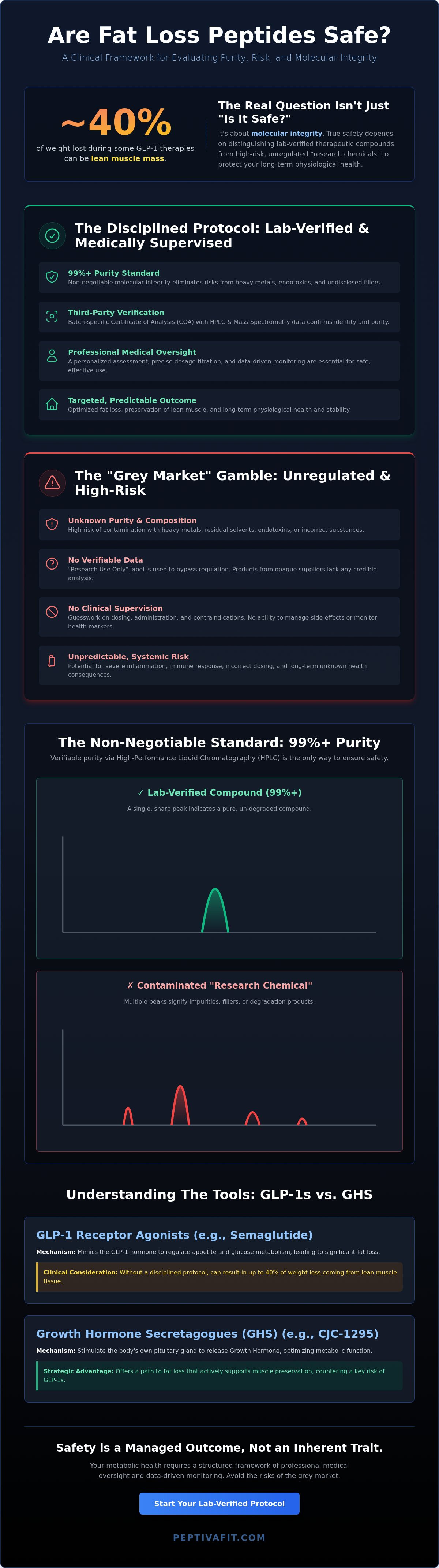
Nearly 40% of the total weight lost during GLP-1 agonist therapy can consist of lean muscle tissue, a clinical reality that fundamentally changes how we ask: are fat loss peptides safe? For the individual serious about metabolic optimization, the primary concern isn't just the compound itself, but the molecular integrity and the disciplined oversight governing its use. You're likely navigating a landscape of conflicting medical opinions and the legitimate fear of under-dosed, contaminated products sourced from unregulated "research chemical" channels.
We understand that true performance enhancement requires a level of precision and privacy that mass-market advice cannot provide. This review replaces marketing hype with a clinical framework for identifying high-purity peptides and understanding the necessary contraindications for safe use. We'll provide a disciplined roadmap for administration and a clear look at the 2026 FDA regulatory shifts that affect access to compounds like BPC-157 and CJC-1295. By the end of this review, you'll have the data required to distinguish between high-risk gray market substances and a lab-verified metabolic protocol designed for long-term physiological health.
Key Takeaways
- Establish the non-negotiable standards for molecular integrity, requiring 99%+ purity to eliminate risks from heavy metals, endotoxins, and undisclosed fillers.
- Determine the clinical reality of the question—are fat loss peptides safe—by distinguishing between high-risk gray market chemicals and lab-verified therapeutic compounds.
- Compare the safety profiles and metabolic mechanisms of GLP-1 receptor agonists versus growth hormone secretagogues to align treatment with your physiological goals.
- Learn disciplined risk mitigation protocols, including precise dosage titration and the essential role of a personalized medical assessment before initiation.
- Understand how the Peptiva Protocol replaces the "quick fix" mentality with a structured framework of professional medical oversight and data-driven monitoring.
Defining Safety in the Context of Peptide Therapy
Safety in peptide therapy isn't a binary state. It's a variable dependent on molecular identity and the rigor of bio-identical synthesis. When individuals ask are fat loss peptides safe, they're often looking for a universal guarantee that doesn't exist in clinical science. Instead, safety is defined by how closely a peptide mimics endogenous signaling molecules. Unlike traditional weight loss stimulants that force systemic changes through the central nervous system, peptides act as targeted messengers. They initiate specific biological pathways without the broad, often volatile, impact of foreign chemical compounds.
Establishing a safety profile requires more than reading a label. It demands a comprehensive understanding of an individual's baseline metabolic health. A peptide that's effective for one subject may be contraindicated for another based on pre-existing blood markers, such as fasting insulin levels or renal function. This is why a personalized medical assessment is the baseline for any disciplined protocol. Safety is a managed outcome, not an inherent trait of the substance. It requires a high level of personal responsibility and a commitment to data-driven monitoring.
The Biological Mechanism of Signaling Peptides
Peptides function by binding to specific receptors to trigger physiological responses like lipolysis. This targeted approach is best exemplified by Semaglutide (Wegovy, Ozempic), which mimics the GLP-1 hormone to regulate appetite and glucose metabolism. Because these molecules are designed for high receptor affinity, they minimize "off-target" side effects. You aren't introducing a foreign stimulant; you're optimizing an existing biological conversation. This molecular precision allows for significant fat loss while maintaining a higher degree of physiological stability than previous generations of metabolic drugs.
Regulatory Status vs. Clinical Efficacy
The landscape of peptide therapy is complicated by the "Research Use Only" (RUO) designation. Many compounds with robust clinical trial data haven't yet received formal FDA approval for specific fat loss indications. This gap creates a divide between scientific reality and regulatory status. While RUO peptides are frequently used in investigative settings, their safety in a personal protocol depends entirely on professional oversight. Clinical supervision acts as the primary bridge, ensuring that research-grade data is applied with the same discipline found in pharmaceutical-grade environments. Without this oversight, the risk of using under-dosed or contaminated products increases substantially.
Molecular Integrity: The Critical Role of Lab Testing
The fundamental answer to the question are fat loss peptides safe rests almost entirely on the molecular integrity of the compound in question. In an unregulated "grey market," the risks extend far beyond simple under-dosing. Products sold without rigorous verification frequently contain heavy metals, residual solvents, and endotoxins. These contaminants can trigger severe systemic inflammation or unpredictable immune responses. For the disciplined individual, safety isn't a matter of trust; it's a matter of verifiable data. High-stakes metabolic optimization requires a zero-tolerance policy for anything less than 99% purity. Any percentage below this threshold represents unknown chemical entities that have no place in a human biological system.
Batch-specific third-party testing is the only mechanism to ensure that what's on the label matches what's in the vial. While the FDA approval of Wegovy established a clear safety profile for pharmaceutical-grade semaglutide, that safety doesn't translate to "research chemicals" sourced from opaque suppliers. You must demand a Certificate of Analysis (COA) that includes both High-Performance Liquid Chromatography (HPLC) and Mass Spectrometry. This level of transparency is a hallmark of the lab tested peptides utilized by those who prioritize long-term health over convenience.
Verifying Purity Through HPLC and Mass Spectrometry
HPLC testing provides a visual representation of purity by separating the components of a sample. A high-quality report will show a single, sharp peak; multiple peaks indicate the presence of impurities or degradation products. Mass Spectrometry complements this by confirming the exact molecular weight and sequence of the peptide. Red flags in these reports are often subtle. You should scrutinize documents for missing dates, redacted batch numbers, or testing performed by "internal" laboratories rather than independent third-party facilities. If a supplier cannot provide a clear, dated HPLC report for the specific batch you're using, the compound's safety remains an unverified assumption.
The Risks of Lyophilization and Storage Failures
Molecular integrity is also a function of post-synthesis processing. Lyophilization, or freeze-drying, is a delicate procedure that stabilizes peptides for transport. Improper lyophilization can leave residual moisture, leading to rapid degradation and loss of biological activity. Furthermore, peptides are highly sensitive to temperature fluctuations. A vacuum-sealed vial is essential for maintaining sterile integrity and preventing oxidation. If the vacuum seal is compromised or if the product has been exposed to excessive heat during transit, the peptide's primary structure may break down. This results in a product that's at best ineffective and at worst immunogenic.
Clinical Comparison: GLP-1s vs. Growth Hormone Secretagogues
Understanding the physiological distinctions between peptide classes is essential to answering the core question: are fat loss peptides safe for your specific biological profile? Clinical safety profiles vary significantly between GLP-1 receptor agonists and growth hormone secretagogues. While both pathways lead to metabolic optimization, they utilize different signaling mechanisms that require distinct monitoring protocols. GLP-1s primarily address glycemic control and satiety, whereas secretagogues target the pulsatile release of endogenous growth hormone. A disciplined approach recognizes that these compounds aren't interchangeable. They demand specific clinical oversight to mitigate class-specific risks and ensure long-term metabolic health.
The cardiovascular safety of GLP-1 agonists was established in a landmark clinical trial, which demonstrated a reduction in major adverse cardiovascular events in high-risk populations. However, moving from pharmaceutical-grade applications to personal optimization requires a deeper look at secondary effects. Stacking these peptides, which involves combining different classes for synergistic results, introduces significant complexity. Without a personalized medical assessment, the risk of compounding side effects like suppressed appetite and altered glucose sensitivity increases. Safety is found in the data, not in anecdotal protocols found on public forums or unverified social media channels.
GLP-1 Safety: Beyond the Digestive System
Gastrointestinal distress is a common, albeit manageable, side effect of GLP-1 therapy. A more significant clinical concern is the risk of sarcopenia, or muscle wasting. Data indicates that muscle loss can account for 25% to 40% of the total weight lost during aggressive GLP-1 administration. Preserving lean tissue is vital for long-term metabolic health and hormonal balance. This requires a protocol that prioritizes high protein intake and resistance training. Monitoring thyroid markers and maintaining a disciplined titration schedule are also necessary to ensure that rapid weight loss doesn't compromise endocrine stability or lead to rebound weight gain once the protocol concludes.
This need for clinical precision is especially acute when managing weight loss in younger populations. Facilities like Nusbaum Medical Centers specialize in providing the medical oversight necessary to ensure that weight loss interventions are both effective and developmentally appropriate.
GHRH and GHRP: Pulse Frequency and Safety
Growth Hormone Releasing Hormones (GHRH) like Tesamorelin and CJC-1295 offer a different safety profile focused on visceral fat reduction. Tesamorelin is specifically noted for its ability to reduce ectopic fat without the same gastrointestinal burden as GLP-1s. Ipamorelin, a selective Growth Hormone Releasing Peptide (GHRP), is often preferred over older secretagogues because it avoids the "hunger spike" associated with GHRP-2 and GHRP-6. Monitoring IGF-1 levels is the only way to objectively answer the question: are fat loss peptides safe when utilized in a secretagogue-heavy protocol? Keeping IGF-1 within a physiological range prevents the risks associated with supraphysiological growth hormone levels. Our 1-on-1 coaching emphasizes these data-driven boundaries to ensure fat loss remains a healthy, sustainable process.
Risk Mitigation Protocols: Dosages and Monitoring
Safety in peptide administration is a disciplined practice of risk mitigation rather than a passive state. To answer the question are fat loss peptides safe, one must look at the protocols governing their use. A personalized medical assessment is the non-negotiable first step. This evaluation identifies baseline contraindications, such as a personal or family history of medullary thyroid carcinoma or MEN 2 syndrome, which would immediately disqualify a candidate from certain therapies. Beyond initial screening, safety is maintained through a strict titration schedule. By starting at the lowest effective dose, you allow the body’s receptors to adapt, minimizing gastrointestinal distress and preventing systemic shock.
Sterile technique is equally critical. Using bacteriostatic water, which contains 0.9% benzyl alcohol as a preservative, inhibits bacterial growth within the vial. Rotating injection sites between the abdomen, thigh, and upper arm prevents the development of lipohypertrophy or localized tissue scarring. These are not merely suggestions; they're the foundational requirements of a high-level protocol. Maintaining this level of clinical rigor ensures that the signaling process remains targeted and therapeutic.
The Importance of Reconstitution Precision
Peptides are delicate amino acid chains held together by fragile bonds. Improper handling during the transition from lyophilized powder to liquid solution can lead to molecular shearing. Vigorous shaking or direct high-pressure streams of diluent can denature the compound, rendering it ineffective or potentially immunogenic. For technical steps on maintaining stability, consult our guide on how to reconstitute peptides. Once reconstituted, these molecules have a limited shelf-life and must be stored at consistent refrigerated temperatures.
Monitoring Metabolic Biomarkers
A data-driven protocol requires consistent blood work to monitor how your physiology responds to signaling changes, providing a definitive answer to the question: are fat loss peptides safe for your specific profile? Key biomarkers include HbA1c, fasting insulin, and comprehensive lipid panels. These metrics provide a clear picture of metabolic shifts before they manifest as physical symptoms. Identifying early signs of systemic inflammation or an allergic response is vital for long-term safety. Additionally, "cycling" peptides—incorporating planned breaks—is a necessary strategy to prevent receptor desensitization and maintain the body's natural homeostatic balance. To begin your journey with clinical precision, schedule a personalized medical assessment today.
The Peptiva Protocol: A Disciplined Approach to Fat Loss
The transition from investigative research to clinical application requires a framework that prioritizes physiological stability over rapid, unchecked weight loss. When evaluating are fat loss peptides safe, the answer isn't found in a specific vial, but in the discipline of the protocol governing its use. The Peptiva Protocol is designed for individuals who reject the "quick fix" mentality in favor of scientific-grade metabolic optimization. By integrating lab-tested peptides with rigorous professional oversight, we transform a complex biochemical process into a controlled, data-driven journey toward peak performance. This approach ensures that every signaling molecule introduced to your system serves a precise, verified purpose.
Long-term success in peptide therapy depends on your ability to adjust parameters in real-time based on physiological feedback. Our 1-on-1 coaching provides the necessary expertise to interpret subtle shifts in energy, appetite, and body composition. This isn't mass-market advice; it's a sophisticated partnership rooted in data monitoring and specialized education. We empower you to take control of your metabolic health through a deep understanding of peptide mechanisms, ensuring that your protocol remains effective while maintaining the highest safety standards. This level of individual attention is what separates elite optimization from standard consumer-grade experimentation.
Why Medical Assessments Are Non-Negotiable
A protocol is only as effective as its alignment with your unique hormonal and metabolic profile. Attempting to self-administer research chemicals without a baseline understanding of your blood markers is a high-risk endeavor. Professional oversight mitigates these risks by identifying contraindications and tailoring dosages to your specific needs. This structured transition from research to results is detailed in our comprehensive fat loss peptide guide. Without a clinical starting point, you're merely guessing with your long-term health.
Accessing Lab-Verified Supplies
Molecular purity is the cornerstone of our methodology. We maintain a zero-tolerance policy for impurities, demanding 99%+ purity through comprehensive batch testing. PeptivaFit bridges the gap between high-end research and personal optimization by serving as a gatekeeper for quality. We provide the transparency that the grey market lacks, ensuring that the question of are fat loss peptides safe is answered through verified HPLC reports and sterile manufacturing standards. Your metabolic future demands a commitment to quality that excludes compromise. Secure your metabolic future and establish your baseline by scheduling a personalized medical assessment today.
Mastering Your Metabolic Trajectory
The determination of whether are fat loss peptides safe rests upon the intersection of molecular integrity and clinical discipline. Safety isn't a static property of a compound. It's a managed outcome achieved through 99%+ purity standards and rigorous personal responsibility. By shifting from unregulated "grey market" substances to lab-verified protocols, you eliminate the risks associated with contaminants and imprecise dosing. True optimization requires moving beyond the "quick fix" mentality toward a data-driven approach that respects your unique biological markers and metabolic baseline.
The science-backed Peptiva Protocol offers the structure needed for those serious about their long-term health and performance. We provide the personalized clinical oversight necessary to navigate complex signaling pathways with absolute confidence. It's time to replace uncertainty with scientific-grade precision and elite-level support. Secure Your Professional Medical Assessment and Peptide Protocol and take the first step toward a more sophisticated, controlled version of your metabolic self. Take command of your physiological future with the precision your performance deserves.
Frequently Asked Questions
Are fat loss peptides FDA approved for weight loss?
Certain peptides, specifically GLP-1 receptor agonists like semaglutide and tirzepatide, are FDA-approved for chronic weight management. Other compounds, such as Tesamorelin, carry approval for specific indications like reducing visceral fat in HIV-associated lipodystrophy. Many other peptides currently operate under a "Research Use Only" designation or are transitioning between regulatory categories, which makes professional oversight essential for clinical application.
What are the most common side effects of peptides like Tesamorelin or Semaglutide?
Semaglutide frequently causes gastrointestinal issues including nausea, diarrhea, and delayed gastric emptying. A critical clinical concern with GLP-1 agonists is the potential for muscle loss, which can range from 25% to nearly 40% of total weight lost. Tesamorelin side effects typically include injection site reactions, joint pain, and potential shifts in glucose metabolism. Monitoring these physiological responses is a core component of disciplined protocol management.
How do I know if a peptide lab is legitimate and safe?
A legitimate laboratory must provide batch-specific Certificates of Analysis (COA) featuring High-Performance Liquid Chromatography (HPLC) and Mass Spectrometry. These reports verify that the compound meets a 99%+ purity standard and contains the correct molecular sequence. You should avoid any supplier that provides "internal-only" testing or redacted documents. These are significant red flags regarding molecular integrity and sterile manufacturing standards.
Can peptides cause long-term damage to my natural hormone production?
Peptides function as signaling molecules that typically mimic or stimulate endogenous production rather than suppressing it entirely. Unlike exogenous hormones such as testosterone, they generally don't cause a permanent shutdown of natural endocrine loops. However, prolonged use without planned breaks can lead to receptor desensitization. This makes the "cycling" strategy essential for maintaining long-term hormonal sensitivity and physiological balance.
Is it safe to stack multiple fat loss peptides at once?
Stacking multiple peptides can be a safe strategy when the compounds utilize different biological pathways, such as combining a GLP-1 with a growth hormone secretagogue. This approach requires advanced clinical knowledge to manage synergistic side effects and prevent over-stimulation of specific receptors. Determining are fat loss peptides safe in a stack depends entirely on the precision of the dosage titration and the quality of the personalized medical assessment.
What happens if I use unverified research peptides?
Using unverified research peptides exposes you to significant risks from heavy metals, endotoxins, and residual solvents. These contaminants can trigger systemic inflammation or unpredictable immune responses that aren't present with pharmaceutical-grade compounds. Because these products lack manufacturing oversight, the actual concentration often deviates from the label. This leads to ineffective results or accidental overdosing that can compromise your metabolic health.
How long can I safely stay on a fat loss peptide protocol?
The duration of a safe protocol varies based on the specific peptide class and your individual metabolic response. GLP-1 agonists are often utilized for extended periods to manage chronic weight; however, growth hormone secretagogues are typically cycled in 8 to 12-week durations to prevent receptor fatigue. Long-term safety is maintained through consistent monitoring of blood markers such as HbA1c and fasting insulin to ensure the body remains in optimization.
Do I need a doctor's supervision to use peptides safely?
Professional medical supervision is the primary bridge between investigative research and safe clinical application. A qualified expert provides the personalized medical assessment necessary to identify contraindications and adjust protocols in real-time. This oversight ensures that your use of lab tested peptides remains within safe physiological boundaries. It prioritizes long-term health and data-driven results over the risks associated with unmonitored self-administration.

![Shelf Life of Reconstituted Peptides: A Clinical Reference Guide [2026]](https://getautoseo.com/storage/hero_images/shelf-life-of-reconstituted-peptides-a-clinical-reference-guide-2026.jpg?v=b8ed5173acaa)
