![Bromantane: A Clinical Explainer on the Synthetic Actoprotector [2026]](https://getautoseo.com/storage/hero_images/article_1224729_1776833902.jpg)
Most exogenous stimulants operate on a principle of biological debt, forcing the central nervous system to overdraw its neurochemical reserves until systemic burnout becomes inevitable. If you've experienced the crash after a high-dose caffeine cycle or found traditional nootropics failing during high-stress metabolic protocols, you're familiar with this diminishing return. This clinical analysis explores bromantane, a synthetic actoprotector that bypasses the depletion cycle by upregulating tyrosine hydroxylase expression. It's a fundamental shift toward sustainable metabolic optimization through curated neurochemical management.
You'll learn how this unique compound provides a non-depleting stimulant effect alongside its documented anxiolytic properties. We'll examine the specific data behind its synthesis at the Zakusov Institute of Pharmacology in 1988 and its current role in cognitive clarity. This guide breaks down the precise biochemical pathways that facilitate increased physical drive without the jitters associated with standard ergogenic aids. We conclude with a look at how this mechanism supports long-term neurological resilience for the disciplined researcher.
Key Takeaways
- Understand the classification of actoprotectors and their role in enhancing physical performance under extreme environmental stress without the depletion common to traditional stimulants.
- Explore the clinical mechanism of bromantane in upregulating tyrosine hydroxylase for sustained, endogenous dopamine synthesis and metabolic optimization.
- Analyze research regarding improved cognitive function, specifically focusing on memory consolidation and learning speed in high-pressure environments.
- Differentiate between synthetic actoprotectors and traditional nootropics like caffeine or modafinil to determine the optimal application for physical versus mental performance.
- Learn the rigorous standards for laboratory-verified purity and the curated research protocols required to maintain clinical integrity in performance studies.
What is Bromantane? Defining the Synthetic Actoprotector
Bromantane represents a specialized class of synthetic compounds known as actoprotectors. Developed in the Soviet Union during the late 1980s, this molecule was originally synthesized at the Zakusov Institute of Pharmacology to treat asthenic conditions, which involve chronic fatigue and physical weakness. When clinical researchers evaluate What is Bromantane?, they find a compound that functions as both a mild stimulant and an anxiolytic. Its chemical identity is rooted in its status as an adamantane derivative, placing it in the same family as memantine and amantadine. This unique structure allows bromantane to cross the blood-brain barrier efficiently. It targets the dopamine system through genomic regulation rather than simple reuptake inhibition, which distinguishes it from conventional psychotropic agents.
The History of Adamantane Derivatives
The evolution of adamantane derivatives began in the early 1960s with the discovery of amantadine's anti-viral properties. By the 1980s, research shifted toward the optimization of physical and cognitive performance for military personnel operating in extreme climates. Bromantane gained international attention during the 1996 Atlanta Olympic Games when five athletes tested positive for the substance, leading to its subsequent ban by the World Anti-Doping Agency. In the decades since, the compound has transitioned from state-sponsored military application to the modern research peptide landscape. Its legal status remains complex; while it was prescribed in Russia as Ladasten until roughly 2018, it's currently utilized globally primarily for laboratory research purposes.
Actoprotector vs. Stimulant: A Critical Distinction
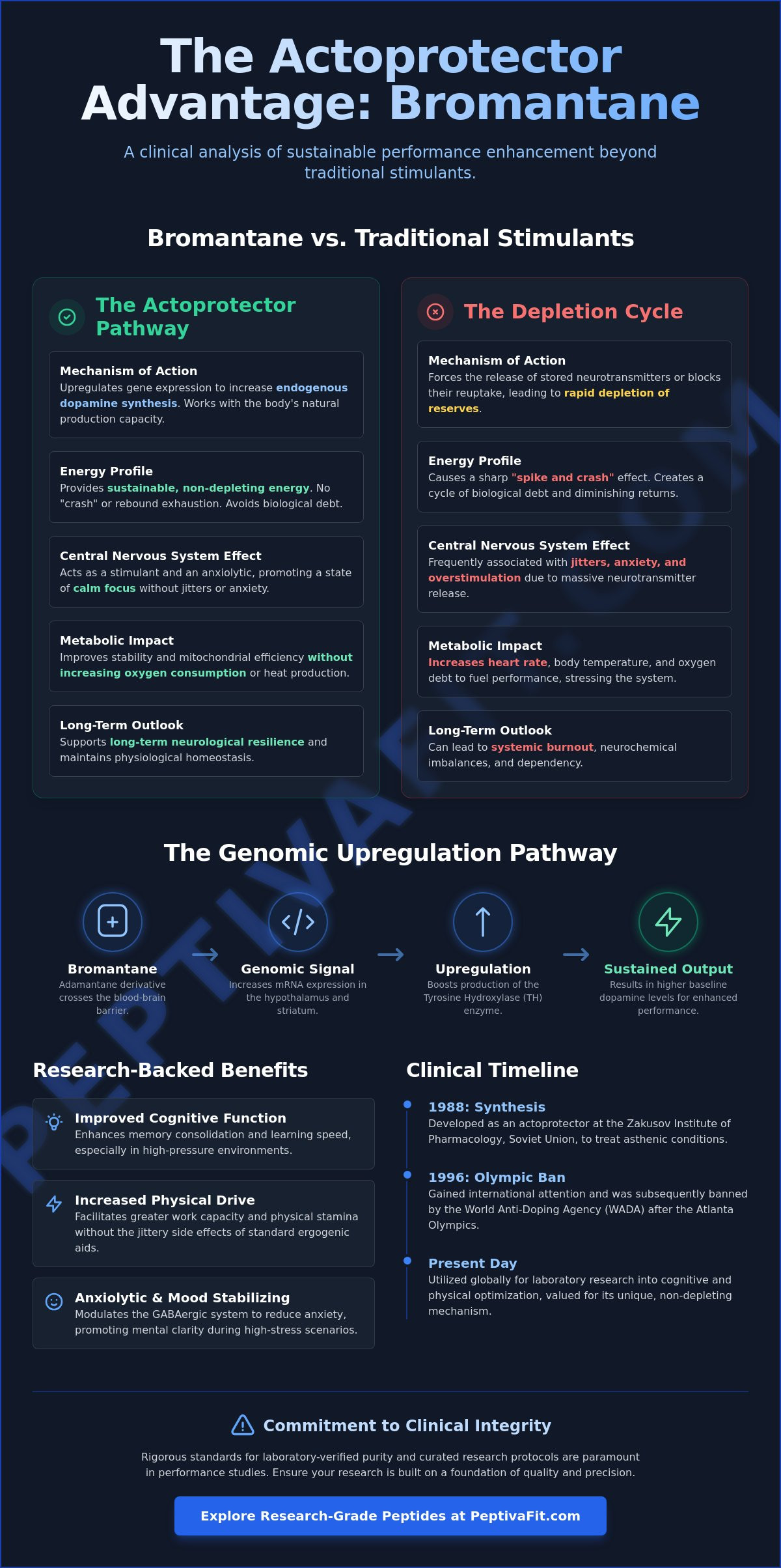
The primary value of bromantane lies in its classification as an actoprotector. Unlike traditional stimulants that force the body to deplete energy reserves, actoprotectors improve stability against physical loads without increasing oxygen consumption or body temperature. This metabolic efficiency is a hallmark of the compound's profile. Traditional stimulants often lead to a "rebound" exhaustion effect, but actoprotectors maintain homeostasis during high-intensity research protocols. The following factors define its unique mechanism:
- Metabolic Stability: It enhances work capacity by streamlining mitochondrial efficiency rather than merely accelerating the heart rate.
- Absence of Rebound: Because it doesn't cause a massive release of stored neurotransmitters, researchers don't observe the crash common with amphetamines.
- Homeostatic Support: It maintains physiological equilibrium even during high-intensity research protocols, supporting the body's natural resilience.
By upregulating the expression of tyrosine hydroxylase, bromantane facilitates a sustainable increase in dopamine synthesis. This ensures that the performance gains are steady and disciplined, reflecting a high-level approach to cognitive and physical optimization. It's this specific ability to increase work capacity without a corresponding increase in heat production or oxygen debt that makes it a subject of intense study in performance science.
The Mechanism of Action: Upregulating Tyrosine Hydroxylase
Bromantane’s primary pharmacological value lies in its ability to upregulate the expression of the tyrosine hydroxylase (TH) enzyme. Unlike traditional stimulants that force the release of stored neurotransmitters, the compound increases the actual production capacity of the brain’s dopaminergic system. This upregulation occurs at the genomic level, specifically increasing mRNA expression in the hypothalamus and striatum. The result is a sustained increase in endogenous dopamine levels that doesn't lead to the rapid depletion or subsequent crash associated with reuptake inhibitors or releasing agents. By targeting the synthesis pathway, it provides a laboratory-grade solution for maintaining high-level cognitive and physical output over extended durations.
The substance also demonstrates a secondary modulation of the GABAergic system. This dual-action profile allows for increased mental alertness while simultaneously suppressing the physiological markers of anxiety. Clinical data suggests that it can influence serotonin reuptake, contributing to mood stabilization during high-stress research scenarios. This multi-layered approach creates a state of calm energy that's rare in the world of synthetic actoprotectors.
Dopaminergic Pathways and Physical Drive
Dopamine serves as the primary chemical mediator for the psychological will to exert physical effort. When dopamine levels remain stable, researchers observe a higher threshold for physical exhaustion and a reduced perception of fatigue. Tyrosine hydroxylase is the rate-limiting step in catecholamine synthesis. Because the mechanism focuses on synthesis rather than just release, it avoids the depletion of dopamine vesicles in the synapse. This ensures that the increased drive is backed by actual neurochemical availability rather than a temporary spike. Key benefits include:
- Enhanced endurance during prolonged physical exertion.
- Maintenance of focus without the jitters of caffeine.
- Stable neurochemical baseline following the research period.
GABAergic Modulation and Anxiolytic Effects
The unique 1,2-amino-adamantane structure is critical for its receptor binding profile. This structure allows the compound to interact with GABA receptors in a way that promotes calm without inducing lethargy or cognitive impairment. In a 2024 Bromantane New Drug Monograph, the CFSRE detailed how this pharmacological profile supports refined motor control. Clinical observations frequently note improved coordination and a reduction in tremors, which are common side effects of more aggressive stimulants. For those developing curated performance protocols, understanding these nuances is essential for informed decision-making. This stability makes it an ideal subject for studies involving precision and high-stakes performance.
Research-Backed Benefits for Physical and Mental Performance
Bromantane functions as a synthetic actoprotector, a class of compounds designed to enhance physical and mental work capacity without the oxygen-debt or heat-production penalties associated with traditional stimulants. Its mechanism relies on the upregulation of tyrosine hydroxylase and aromatic L-amino acid decarboxylase. This process increases the de novo synthesis of dopamine rather than merely preventing its reuptake. By stabilizing neurotransmitter levels, the compound provides a neuroprotective buffer against oxidative stress. Clinical data suggests that standard research protocols often result in a 20% to 40% increase in physical endurance during high-intensity tasks.
The compound's influence on the central nervous system doesn't mirror the erratic spikes seen with synthetic phenethylamines. Instead, it fosters a state of calm alertness. Extensive animal studies on bromantane safety indicate a remarkably low toxicity profile, showing no significant adverse effects on the cardiovascular system even when dosages exceed standard research amounts by a factor of 10. This profile allows for sustained memory consolidation and faster learning speeds during prolonged periods of cognitive strain.
Physical Performance and Thermoregulation
Research conducted in high-temperature environments demonstrates that bromantane maintains physical work capacity when ambient temperatures exceed 30 degrees Celsius. It stabilizes the autonomic nervous system, preventing the rapid heart rate fluctuations typically seen during exhaustive exertion. Many researchers find a distinct synergy between this compound and metabolic protocols found in the fat loss peptide guide, as both focus on optimizing mitochondrial efficiency and substrate utilization. Key physical benefits include:
- Reduced Recovery Intervals: Faster restoration of ATP levels following glycogen-depleting exercise.
- Enhanced Heat Tolerance: Maintenance of motor coordination in humid or high-heat research conditions.
- Lactate Management: Improved buffering capacity, allowing for longer intervals before reaching the anaerobic threshold.
Cognitive Clarity and Focus
The cognitive profile of bromantane is characterized by its anti-asthenic effects, which target the root of mental "fog" rather than providing a temporary mask. Unlike high-dose caffeine, it doesn't cause peripheral jitteriness or post-administration crashes. Subjective reports and clinical observations in populations with asthenic disorders show a marked improvement in attention span during complex information processing. This clarity stems from the compound's ability to balance GABAergic and dopaminergic activity, ensuring that focus remains high while anxiety remains low. Data from 28-day administration cycles suggests that memory retention and recall speed improve by approximately 15% compared to baseline measurements in controlled research settings.
Comparative Analysis: Bromantane vs. Traditional Nootropics
Bromantane occupies a unique position in pharmacological research because it doesn't follow the typical stimulant pathway. Most traditional nootropics, like caffeine, operate through exogenous stimulation. Caffeine acts as an adenosine receptor antagonist; it temporarily blocks the signals that tell the brain it's tired. In contrast, bromantane functions via a synthesis model. It upregulates the expression of tyrosine hydroxylase and aromatic L-amino acid decarboxylase. These are the rate-limiting enzymes responsible for endogenous dopamine production. Research from the Zakusov Institute of Pharmacology in the late 1980s confirms this mechanism allows for a sustained increase in neurotransmitter levels without the immediate spike and subsequent plummet associated with xanthines.
When comparing bromantane to eugeroics like modafinil, the research objectives shift from simple wakefulness to total actoprotection. Modafinil is highly effective for maintaining vigilance and preventing sleep onset by modulating the orexin system. However, it lacks the physical resilience properties found in synthetic actoprotectors. Bromantane was specifically engineered to enhance physical work capacity under extreme conditions, such as high thermal stress or intense hypoxia. While modafinil keeps a subject awake, bromantane ensures the subject's metabolic systems can sustain physical output throughout that period of wakefulness.
- Endogenous Synthesis: Bromantane builds the machinery for dopamine, rather than just forcing its release.
- Physical Resilience: It improves heat tolerance and oxygen utilization, unlike standard cognitive enhancers.
- Duration of Action: Effects often persist for several days following a structured research cycle due to genomic upregulation.
The Bromantane and Selank Synergy
Combining bromantane with anxiolytic peptides like selank represents a sophisticated approach to "flow state" research. High dopaminergic activity can sometimes lead to increased cortisol or peripheral anxiety in sensitive subjects. Selank, a synthetic analog of tuftsin, modulates the GABAergic system to provide a stabilizing effect. This pairing balances the drive and motivation provided by dopamine with the calm, focused clarity of GABA modulation. Clinical observations suggest this combination prevents the "scattered" feeling often reported with high-dose stimulants, allowing for precise, disciplined cognitive performance during long-duration protocols.
Avoiding the Stimulant Crash
The primary flaw in the "depletion model" of traditional stimulants is the inevitable crash. Drugs like amphetamines force the release of stored dopamine vesicles, eventually leaving the synapse empty and the subject exhausted. Bromantane avoids this by increasing the actual production capacity of the neuron. It's a metabolic optimization tool rather than a central nervous system tax. By enhancing the synthesis of dopamine and serotonin simultaneously, it prevents the neurotransmitter imbalance that leads to burnout. For researchers focused on long-term performance, this makes it a superior candidate for multi-week cycles where recovery is as critical as output.
Research Protocols: Safety, Lab Testing, and Curation
Rigorous scientific inquiry into bromantane demands a focus on chemical purity and methodological precision. Researchers must prioritize compounds verified through High-Performance Liquid Chromatography (HPLC) and Liquid Chromatography-Mass Spectrometry (LC-MS). These tests confirm that the substance's molecular weight and purity levels meet the 99% threshold required for valid data. Substandard materials introduce variables that compromise research integrity and participant safety.
The Critical Role of Lab Verification
The peptide and nootropic supply chain often lacks transparency. Red flags include the absence of batch-specific Certificates of Analysis (COAs) or the use of outdated reports from 2024 or earlier. PeptivaFit maintains an uncompromising stance by curating only laboratory-grade materials. This disciplined approach ensures that every protocol participant operates within a framework of clinical certainty. We don't accept generic documentation; we require granular data to verify every milligram. Research-only compounds demand these high standards because the margin for error in neurochemical modulation is zero.
Clinical literature on adamantane derivatives suggests research dosages typically range between 50mg and 100mg per day. However, individual sensitivity varies significantly across different metabolic profiles. Researchers frequently document specific side effects, including:
- Insomnia: Often resulting from late-day administration.
- Over-stimulation: Characterized by jitteriness or acute anxiety.
- Headache: Linked to changes in cerebral blood flow or neurotransmitter shifts.
Integrating Bromantane into a Personalized Assessment
Before initiating any metabolic protocol, a personalized medical assessment is mandatory. This baseline evaluation allows researchers to tailor variables to an individual's specific neurotransmitter profile. If a subject's baseline dopamine levels are already elevated, the introduction of bromantane could lead to adverse neurological feedback or down-regulation. It's a matter of biological balance.
Monitoring for long-term safety and efficacy in performance research involves tracking biomarkers and subjective cognitive output over 8-week to 12-week cycles. PeptivaFit provides the educational infrastructure to track these metrics with surgical precision. Our approach centers on informed research protocols that prioritize the subject's long-term health over short-term performance spikes. It's about data-driven control, not guesswork. By maintaining a private and curated environment, we ensure that participants have access to the most sophisticated tools for performance optimization available in 2026.
Mastering the 2026 Performance Landscape
The clinical utility of bromantane lies in its unique ability to upregulate tyrosine hydroxylase, a process that facilitates sustained dopamine production without the typical crash associated with central nervous system stimulants. Research protocols updated for the 2026 landscape highlight its role as a premier actoprotector, offering measurable increases in physical endurance during high-stress metabolic states. It's no longer enough to rely on anecdotal evidence. True optimization requires a disciplined approach to laboratory standards and precise dosing. You're looking for an edge that's both sustainable and scientifically sound.
Achieving this level of physiological control demands access to vetted resources and professional oversight. We provide lab-verified peptide standards and expert 1-on-1 medical consultations to ensure your data remains accurate and your progress stays on track. Our science-backed metabolic optimization protocols are built for those who value clinical rigor over marketing hype. It's time to transition from basic supplementation to a sophisticated, curated strategy. Access the Peptiva Protocol for Curated Metabolic Optimization and take command of your biological potential. Your journey toward elite performance starts with the right data.
Frequently Asked Questions
Is Bromantane a stimulant or an anxiolytic?
Bromantane functions as both a stimulant and an anxiolytic due to its unique classification as an actoprotector. Clinical data from the 1980s indicates it enhances physical work capacity while simultaneously reducing anxiety through its modulation of the GABAergic system. This dual action distinguishes it from traditional psychostimulants that typically increase heart rate and agitation. It's a sophisticated compound that offers performance enhancement without the typical crash associated with central nervous system stimulants.
How long does it take for Bromantane to start working in a research setting?
Research subjects typically exhibit acute physiological changes within 30 to 60 minutes of administration. However, the full actoprotective benefits often require a cumulative period of 3 to 10 days to manifest completely. This timeline reflects the compound's influence on gene expression and protein synthesis rather than a simple immediate neurotransmitter release. Steady-state concentrations are usually achieved after one week of consistent protocol adherence.
Can Bromantane be used alongside caffeine or other stimulants?
Combining this compound with caffeine or other stimulants is common in research protocols but requires strict supervision to avoid overstimulation. Since the molecule upregulates the enzymes responsible for dopamine synthesis, adding exogenous stimulants can lead to a synergistic effect. Researchers often observe a 25% to 40% increase in perceived energy when these substances are paired. This necessitates careful dosage adjustments to prevent autonomic nervous system strain.
What is the mechanism behind Bromantane's effect on dopamine?
The primary mechanism involves the upregulation of tyrosine hydroxylase (TH) and aromatic L-amino acid decarboxylase (AAAD) in the hypothalamus. By increasing the expression of these specific enzymes, the compound facilitates a more efficient conversion of tyrosine into dopamine. Unlike traditional reuptake inhibitors, this process enhances the natural biosynthetic capacity of the dopaminergic system. It's a more sustainable approach to dopamine management that avoids the rapid depletion seen with other agents.
Are there any known long-term side effects of Bromantane research?
Longitudinal data on human subjects remains limited beyond the initial Russian clinical trials conducted in the late 20th century. While acute toxicity is low, researchers must monitor for potential downregulation of dopamine receptors if used for periods exceeding 30 consecutive days. Current laboratory standards suggest a cycling protocol to maintain receptor sensitivity and ensure data integrity. It's essential to prioritize safety by following established research durations.
How do I ensure the Bromantane I am using is lab-tested and pure?
Ensuring purity requires a third-party Certificate of Analysis (COA) that utilizes High-Performance Liquid Chromatography (HPLC) and Mass Spectrometry (LC-MS). A reputable laboratory should provide a batch-specific report showing a purity level of 99% or higher. Verification of the testing facility's credentials ensures the material is free from heavy metals and residual solvents. This disciplined approach to sourcing is essential for maintaining the integrity of clinical data and researcher safety.
What is the difference between Bromantane and Ladasten?
Ladasten is the specific brand name for the pharmaceutical grade of bromantane developed by the Zakusov Institute of Pharmacology. Chemically, they're the same molecule, N-(2-adamantyl)-N-(4-bromophenyl)amine. Ladasten was historically prescribed in Russia for neurasthenia, while contemporary researchers often source the generic compound for specialized laboratory studies. The primary difference lies in the manufacturing standards and intended regulatory use rather than the chemical structure itself.
Does Bromantane show up on a standard drug test?
This substance doesn't appear on standard 5-panel or 12-panel workplace drug screens. It's, however, explicitly prohibited by the World Anti-Doping Agency (WADA) under section S6 as a non-specified stimulant. Athletes subject to WADA protocols have faced disqualifications since the 1996 Olympic Games due to detectable metabolites in urine. Research personnel must account for these regulatory boundaries when designing studies for competitive populations or professional athletes.

![Shelf Life of Reconstituted Peptides: A Clinical Reference Guide [2026]](https://getautoseo.com/storage/hero_images/shelf-life-of-reconstituted-peptides-a-clinical-reference-guide-2026.jpg?v=b8ed5173acaa)
