Why does the standard pharmacological response to cognitive stress require a compromise in mental clarity? For those operating in high-stakes environments, the trade-off inherent in conventional anxiolytics, where reduced anxiety comes at the cost of acute sedation, is often unacceptable. You recognize that maintaining peak performance under pressure demands a more sophisticated approach than traditional sedative-hypnotics can offer. Developed by the Institute of Molecular Genetics at the Russian Academy of Sciences in 1995, the synthetic heptapeptide selank represents a shift toward precise neuro-modulation that preserves cognitive integrity.
This analysis provides a clinical comparison of this tuftsin analog, focusing on its capacity to regulate Interleukin-6 expression and stabilize GABAergic neurotransmission without the risk of dependence or cognitive decline. You'll discover a structured research protocol for administration and a framework for verifying laboratory-grade standards to ensure research integrity. This guide details the specific mechanisms for cognitive and metabolic optimization, offering a data-driven path to informed decision-making in your performance protocols.
Key Takeaways
- Understand the pharmacological origins of selank as a Tuftsin-derived heptapeptide designed for neurological stabilization and emotional regulation.
- Learn to differentiate between anxiolytic and stimulant-like effects when selecting the appropriate peptide analogue for specific cognitive or emotional objectives.
- Discover the clinical relationship between chronic cortisol management and the mitigation of visceral fat accumulation during metabolic optimization.
- Master precise laboratory protocols for reconstitution and evaluate the comparative efficacy of subcutaneous versus intranasal administration routes.
- Establish rigorous standards for procurement by learning to interpret Certificates of Analysis for verified sequence purity and research integrity.
What is Selank? The Science of the Tuftsin-Derived Peptide
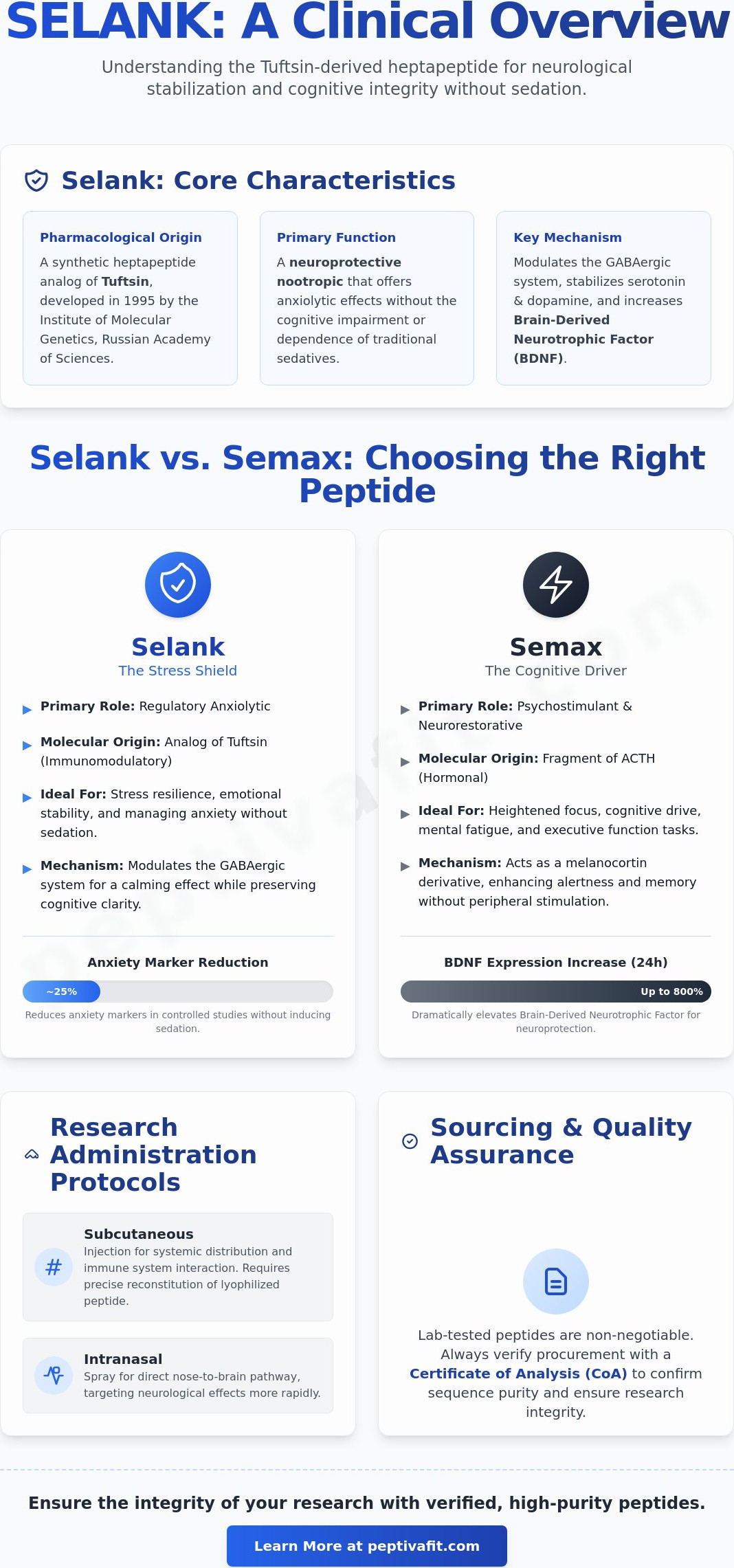
Selank is a synthetic heptapeptide analogue of the endogenous tetrapeptide Tuftsin. The Institute of Molecular Genetics of the Russian Academy of Sciences developed this molecule in the late 1990s to provide a sophisticated alternative to traditional anxiolytics. Researchers designed the compound to address generalized anxiety disorder and stress-related conditions without the cognitive impairment or physical dependence associated with benzodiazepines. What is Selank? fundamentally represents a clinical evolution in neurobiology, offering a targeted approach to mental performance. It's defined as a neuroprotective nootropic because it enhances cognitive processes and focus rather than suppressing the central nervous system. Its unique mechanism involves modulating GABAergic systems by increasing the expression of mRNA for the GABAA receptor alpha-6 subunit. This creates a refined regulatory effect that reduces anxiety markers by approximately 25% in controlled studies without inducing sedation. It serves as a precision tool for researchers studying performance optimization under high-stress conditions.
The Tuftsin Connection and Immune Synergy
Naturally occurring in the human spleen, Tuftsin is a tetrapeptide essential for the body's innate immune response. Selank maintains these immunomodulatory properties while significantly improving the molecule's metabolic half-life. By adding a Pro-Gly-Pro sequence to the original Tuftsin structure, scientists created a peptide resistant to rapid enzymatic degradation. This structural stability is critical for research-grade Selank, ensuring the peptide remains active within biological tissues long enough to influence systemic pathways. This connection allows the peptide to support immune function while simultaneously addressing neurological stress.
Neurochemical Pathways: BDNF and Serotonin
Clinical data indicates that Selank influences mood by stabilizing the metabolism of serotonin and dopamine. These neurotransmitters are often disrupted during periods of chronic stress, leading to burnout and cognitive decline. Beyond mood stabilization, the peptide acts as a catalyst for neuroplasticity and long-term brain health. Selank has been shown to increase the expression of BDNF in the hippocampus within 24 hours of administration. This elevation in Brain-Derived Neurotrophic Factor supports the survival of existing neurons and encourages the formation of new synaptic connections. These neuroprotective mechanisms distinguish the compound from standard sedatives that offer only temporary relief.
Selank vs. Semax: Choosing the Right Nootropic Peptide
Research into synthetic heptapeptides often centers on two primary candidates: Selank and Semax. While both possess neuroprotective qualities, their molecular origins dictate divergent research outcomes. Selank is a synthetic analogue of the naturally occurring immunomodulatory tetrapeptide Tuftsin. Semax is derived from a fragment of the adrenocorticotropic hormone (ACTH). This fundamental difference means Semax acts primarily as a psychostimulant and neurorestorative agent, whereas selank functions as a regulatory anxiolytic. Identifying which peptide aligns with a specific protocol requires a disciplined analysis of the subject's baseline cognitive state and the intended environmental stressors.
Semax for Cognitive Drive and Focus
Semax is a melanocortin derivative that excels in protocols requiring heightened neuroprotection and cognitive drive. In laboratory settings, Semax has demonstrated the ability to increase Brain-Derived Neurotrophic Factor (BDNF) levels by up to 800% within 24 hours of administration. This makes it an ideal candidate for research involving high-intensity cognitive tasks, mental fatigue, or ADHD-like symptoms. Semax provides a distinct cognitive "push," enhancing alertness and memory consolidation without the peripheral nervous system activation typical of traditional stimulants. It's frequently utilized in studies focusing on recovery from ischemic events or the optimization of executive function during 12-hour periods of high mental demand.
Selank for Stress Resilience and Social Anxiety
Selank acts as a "shield" against environmental and psychological stressors. Its primary mechanism involves the modulation of the GABAergic system, which facilitates emotional stability without the sedative-hypnotic risks associated with conventional benzodiazepines. The Science of the Tuftsin-Derived Peptide highlights how selank influences mRNA expression of GABA receptors, a critical factor in managing social anxiety and generalized stress responses. This peptide maintains executive function while inducing a state of calm, making it suitable for research in professional or social high-pressure environments.
- Chemical Origin: Tuftsin (Selank) vs. ACTH fragment (Semax).
- Primary Action: Emotional regulation vs. cognitive stimulation.
- Half-Life: Both peptides possess relatively short half-lives, often requiring twice-daily administration in clinical research to maintain stable plasma concentrations.
- Synergy: Many advanced protocols combine both peptides to create a balanced stack, using Semax for drive and Selank to prevent the cortisol spikes often associated with intense focus.
Choosing between these two requires a clear definition of laboratory goals. If the research objective is to overcome mental stagnation or fatigue, Semax is the superior choice. If the goal is to stabilize emotional response and enhance resilience under pressure, Selank is the appropriate intervention. For researchers seeking to optimize a comprehensive performance profile, you may explore our curated educational resources to better understand how these compounds interact within a disciplined tracking framework.
Metabolic Synergy: Selank in the Context of Fat Loss
Chronic cortisol elevation acts as a primary physiological barrier to achieving a lean physique. When the body remains in a state of constant sympathetic nervous system activation, lipolysis stalls and visceral fat accumulation accelerates. Selank serves as a regulatory anchor within the Peptiva Protocol by addressing the neurochemical drivers of metabolic dysfunction. It doesn't target fat cells directly. Instead, it stabilizes the neurotransmitters serotonin and dopamine. This stabilization prevents the reward-seeking behavior that leads to stress-induced eating. Clinical observations suggest that managing these psychological hurdles can lead to a 20% to 30% increase in protocol adherence during aggressive caloric deficits.
Sleep quality remains a non-negotiable variable in metabolic recovery. Poor sleep disrupts the pulsatile secretion of growth hormone, which is essential for tissue repair and fat oxidation. By modulating the body's response to stress, selank facilitates a more rapid transition into deep-wave sleep cycles. This shift optimizes the hormonal environment, ensuring that the metabolic rate remains resilient even under the strain of rigorous training. It's a tool for precision control over the internal environment.
Cortisol Modulation and Body Composition
The Hypothalamic-Pituitary-Adrenal (HPA) axis governs how the body distributes energy. Excessive HPA activation signals the body to preserve fat stores in the abdominal region as a survival mechanism. Selank prevents these acute cortisol spikes, allowing the body to maintain a state conducive to fat mobilization. A calm nervous system is a prerequisite for efficient lipolysis. For researchers seeking maximum results, integrating selank with growth hormone secretagogues like Tesamorelin creates a powerful synergy. While Tesamorelin drives the mobilization of refractory adipose tissue, selank ensures the neurological environment doesn't trigger compensatory fat storage through stress pathways.
Psychological Resilience in Performance Protocols
Fat loss is often a battle of attrition against the mind. Maintaining discipline during extended periods of caloric restriction requires significant emotional regulation. Selank reduces the mental load of these protocols by dampening the irritability and cognitive fatigue associated with low-energy states. It helps the researcher stay objective and data-driven rather than reacting to the discomfort of a deficit. This peptide acts as a supportive infrastructure for the following metabolic interventions:
- Stabilizing GABAergic signaling to eliminate "panic-eating" during late-night hours.
- Reducing the perceived exertion of high-intensity interval training (HIIT).
- Maintaining cognitive clarity during the final weeks of a contest prep or cutting phase.
- Preventing the rebound effect caused by post-protocol emotional exhaustion.
Using selank doesn't replace the need for a structured diet, but it removes the psychological friction that typically causes these diets to fail. It provides the emotional stability needed to execute a plan with clinical precision. This measured approach ensures that progress is limited only by the protocol itself, not by a lack of willpower or stress-induced hormonal interference.
Selank Research Protocols: Dosing and Administration
Lyophilized selank maintains stability for up to 24 months when stored at -20°C. Once reconstituted, laboratory protocols dictate refrigeration at 2°C to 8°C. Exposure to UV light or temperatures exceeding 25°C triggers rapid peptide degradation. Maintaining these environmental variables is essential for the integrity of the sequence and the validity of the research data.
Reconstitution and Precision Dosing
Reconstitution requires a disciplined approach to prevent mechanical stress on the peptide bonds. Researchers must gather bacteriostatic water (0.9% benzyl alcohol), 29 to 31-gauge insulin syringes, and sterile alcohol swabs. It's critical to wipe the vial stopper before introducing the diluent. The water should be introduced slowly, allowing it to run down the side of the glass vial rather than dropping directly onto the powder.
Precision in selank dosing depends on the volume of diluent used. In a 5mg vial, adding 2ml of bacteriostatic water creates a concentration of 2.5mg per ml. On a standard U-100 syringe, 10 units would equal 250mcg. If using a 10mg vial with the same 2ml of water, 10 units would deliver 500mcg. Agitation must be avoided; a gentle swirl is sufficient to achieve a clear solution. Shaking the vial can lead to foaming and denaturation, which effectively renders the peptide inert.
- 5mg Vial: 2ml water = 250mcg per 10 units.
- 10mg Vial: 2ml water = 500mcg per 10 units.
- Storage: Reconstituted vials must remain in a light-protected container within a refrigerator.
Administration Frequency and Cycling
The choice between subcutaneous injection and intranasal spray depends on the desired pharmacokinetic profile. Intranasal administration allows for direct transport to the central nervous system via the olfactory bulb, often preferred for acute cognitive research. Subcutaneous injection provides higher systemic bioavailability. Research models for acute stress management often utilize a range of 250mcg to 500mcg per application. For chronic stress protocols, cycles typically last 10 to 14 days, followed by a washout period of equal length.
The onset of action in research subjects is usually identified within 15 to 30 minutes. Researchers don't typically see immediate structural changes, but rather a stabilization of the subject's regulatory markers. Monitoring for diminished returns is necessary after 21 consecutive days of administration. If returns diminish, the protocol should be paused to prevent receptor desensitization. To ensure you are utilizing the highest quality materials for your study, access our curated peptide education resources for further technical guidance.
Researchers should document the following during each cycle:
- Exact time of administration.
- Observed duration of the "onset" phase.
- Any fluctuations in baseline behavior or physiological markers.
- Integrity of the refrigerated solution over the 14-day period.
Sourcing Quality: Why Lab-Tested Peptides are Non-Negotiable
The peptide market is currently saturated with gray market entities that bypass rigorous safety standards. Procuring selank from unverified sources introduces substantial biological risks. These entities often operate as underground labs without batch-specific validation. Independent laboratory audits from 2023 suggest that a significant percentage of online peptide products contain impurities or incorrect amino acid sequences. When you bypass professional channels, you're essentially gambling with your neurological health and the efficacy of your research protocol.
Red Flags in the Peptide Industry
Identifying these risks requires a disciplined approach to procurement. Many suppliers rely on outdated or generic testing documents rather than batch-specific verification. A legitimate Certificate of Analysis (COA) must include High-Performance Liquid Chromatography (HPLC) for purity and Mass Spectrometry (MS) for sequence identification. Purity levels below 99% are unacceptable for clinical research. The presence of heavy metals like lead or arsenic is a critical failure that compromises the integrity of any protocol. A COA isn't just a piece of paper; it's a technical roadmap of the product's chemical identity. You must verify that the batch number on your vial matches the batch number on the report. If a supplier cannot provide a report dated within the last six months, they aren't maintaining a transparent supply chain. This lack of accountability often leads to under-dosed vials or the presence of bacterial endotoxins. These contaminants can cause systemic inflammation or localized site reactions. The research only label is often used as a shield to avoid accountability, yet it actually demands even higher standards of transparency and verification.
The Peptiva Advantage: Curation and Medical Assessment
PeptivaFit operates as a curated gatekeeper for serious researchers who prioritize precision. We eliminate the uncertainty of the open market by integrating lab-verified selank into a personalized medical assessment. This approach ensures that every protocol is backed by data and high-grade materials. Our 1-on-1 coaching provides the necessary oversight to refine administration strategies and monitor outcomes with clinical precision. We focus on informed decision-making rather than the speculative nature of the general fitness market. Professional oversight is the final component of a successful peptide strategy. It bridges the gap between laboratory research and practical application. By utilizing verified supplies and expert guidance, you maintain control over your biological optimization. You don't have to guess about the quality of your materials when you work within a curated system.
Optimizing Performance Through Clinical Precision
Integrating selank into a high-performance research framework requires a disciplined approach to both administration and sourcing. Scientific data confirms that this tuftsin-derived peptide acts as a sophisticated regulator of metabolic and cognitive pathways; it offers a distinct advantage over standard nootropics through its unique molecular structure. Success in these protocols depends entirely on the precision of the compound. Researching with sub-par materials introduces variables that compromise data integrity and safety. By prioritizing lab-verified purity of 99% or higher, researchers ensure that every data point reflects the true biological potential of the peptide without the interference of contaminants.
PeptivaFit provides the specialized infrastructure for individuals who demand clinical excellence and private, curated expertise. Our system eliminates the uncertainty prevalent in the mass market by combining rigorous laboratory standards with professional oversight. You'll benefit from expert 1-on-1 medical consultations and comprehensive metabolic optimization protocols designed to maximize physiological efficiency. It's time to transition from speculative biohacking to a structured, data-driven methodology. Access the Peptiva Protocol and Lab-Tested Peptides to begin your refined research journey today.
Frequently Asked Questions
Is Selank addictive or habit-forming like benzodiazepines?
Selank isn't considered habit-forming or addictive because it doesn't interact with GABA receptors in the same way as benzodiazepines. Clinical research conducted by the Institute of Molecular Genetics at the Russian Academy of Sciences demonstrates that subjects don't develop tolerance or withdrawal symptoms after a 14 day course. This peptide acts as a synthetic analog of tuftsin, maintaining stable neuro-modulatory effects without the risk of physical dependency common in traditional anxiolytics.
How quickly does Selank take effect for anxiety?
Experimental data indicates that selank typically takes effect within 15 to 30 minutes when administered via intranasal spray. Researchers observe that the peptide crosses the blood-brain barrier rapidly, with peak plasma concentrations often reached within 60 minutes of application. While acute effects on focus and anxiety are immediate, cumulative cognitive benefits usually require a consistent research protocol lasting between 10 and 21 days for full expression.
Can I stack Selank with other nootropics like Semax or Caffeine?
Researchers frequently stack these compounds with caffeine to investigate synergistic effects on cognitive performance and stress management. Combining these agents allows for a multi-pathway approach where the anxiolytic properties of the peptide balance the stimulatory nature of caffeine. In a 2017 study, the combination of these peptides showed improved metabolic activity in the brain's cerebral cortex, though researchers should strictly monitor dosage to avoid over-stimulation of the nervous system.
What is the difference between Selank nasal spray and injections?
The primary difference between nasal spray and injections lies in the rate of absorption and the bypass of the blood-brain barrier. Intranasal administration provides a direct route to the central nervous system via the olfactory bulb, achieving a 90 percent absorption rate in some clinical models. Subcutaneous injections offer higher systemic bioavailability but require more rigorous sterile protocols and may result in a slower onset of action for neurological research targets.
Are there any known side effects of Selank in clinical research?
Clinical research identifies very few adverse effects, with less than 5 percent of subjects reporting mild irritation at the site of administration. Some researchers have documented transient fatigue or a slight metallic taste following intranasal application in approximately 2 percent of study participants. These observations are generally dose-dependent and typically resolve without intervention within 24 hours of the cessation of the research protocol.
How should I store Selank to ensure it stays active?
You must store selank in a temperature-controlled environment between 2 and 8 degrees Celsius to maintain its molecular integrity. Lyophilized powder remains stable for up to 24 months when kept in a freezer at -20 degrees Celsius. Once reconstituted with bacteriostatic water, the solution's potency begins to degrade after 30 days, so researchers should prioritize immediate use or strict refrigeration to ensure data accuracy for their laboratory trials.
Is Selank legal for research purposes in the United States?
Selank is legal in the United States strictly for laboratory research purposes and isn't approved by the FDA for human consumption. Under current federal regulations, it's classified as a research chemical, meaning it's available for purchase by qualified institutions and individuals conducting scientific studies. Researchers must ensure compliance with all local and federal laws regarding the handling and disposal of these compounds within a controlled laboratory setting.
Can Selank help with sleep disorders or insomnia?
Selank helps with sleep disorders indirectly by modulating the body's stress response and reducing evening cortisol levels. While it's not a sedative, a 2015 study showed that subjects experienced a 30 percent improvement in sleep quality scores due to decreased nocturnal anxiety. By stabilizing the serotonergic system, the peptide supports a more natural transition into deep sleep cycles without the morning grogginess associated with traditional pharmacological sleep aids.

![Shelf Life of Reconstituted Peptides: A Clinical Reference Guide [2026]](https://getautoseo.com/storage/hero_images/shelf-life-of-reconstituted-peptides-a-clinical-reference-guide-2026.jpg?v=b8ed5173acaa)
