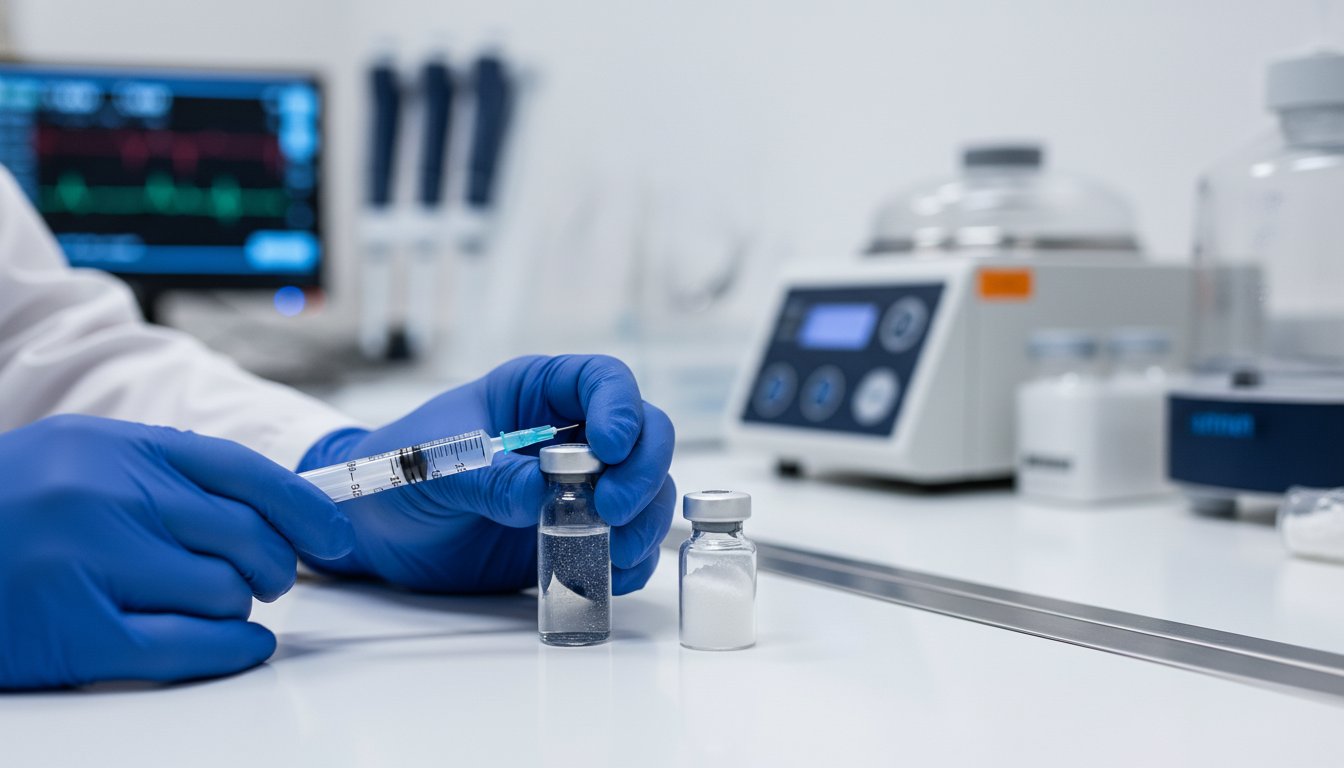
Could a single decimal point error during your laboratory preparation negate months of rigorous data collection? For many researchers, the transition from a lyophilized powder to a precise liquid solution represents the most volatile stage of a protocol. You likely recognize that even a minor miscalculation in bacteriostatic water volume can lead to a 10 percent variance in final potency. This mathematical anxiety is a rational response to the complexities of converting milligrams to micrograms while interpreting non-standardized syringe markings.
You deserve a protocol that replaces guesswork with clinical certainty. By utilizing a professional peptide reconstitution calculator, you'll master the exact ratios required for absolute dosing accuracy in your research environment. This article provides a disciplined breakdown of syringe unit conversions, dilution mathematics, and the procedural steps necessary to ensure the integrity of your reconstituted solutions from the first draw to the final measurement. We'll examine the specific relationship between volume and concentration to ensure your findings remain untainted by procedural inconsistency.
Key Takeaways
- Understand the clinical importance of the narrow therapeutic window and the meticulous process of restoring lyophilised powder to liquid form.
- Master the mathematical variables of vial quantity and diluent volume by utilizing a peptide reconstitution calculator to ensure absolute dosing accuracy.
- Implement a professional "Clean Room" protocol to maintain a sterile environment and ensure proper pressure equalization during the reconstitution process.
- Learn to identify and troubleshoot critical research errors, such as "peptide fallout" and syringe capacity limitations, that may compromise concentration integrity.
- Elevate your research standards by integrating lab-verified peptides into curated protocols designed for sophisticated metabolic optimization.
Fundamentals of Peptide Reconstitution and Precision Dosing
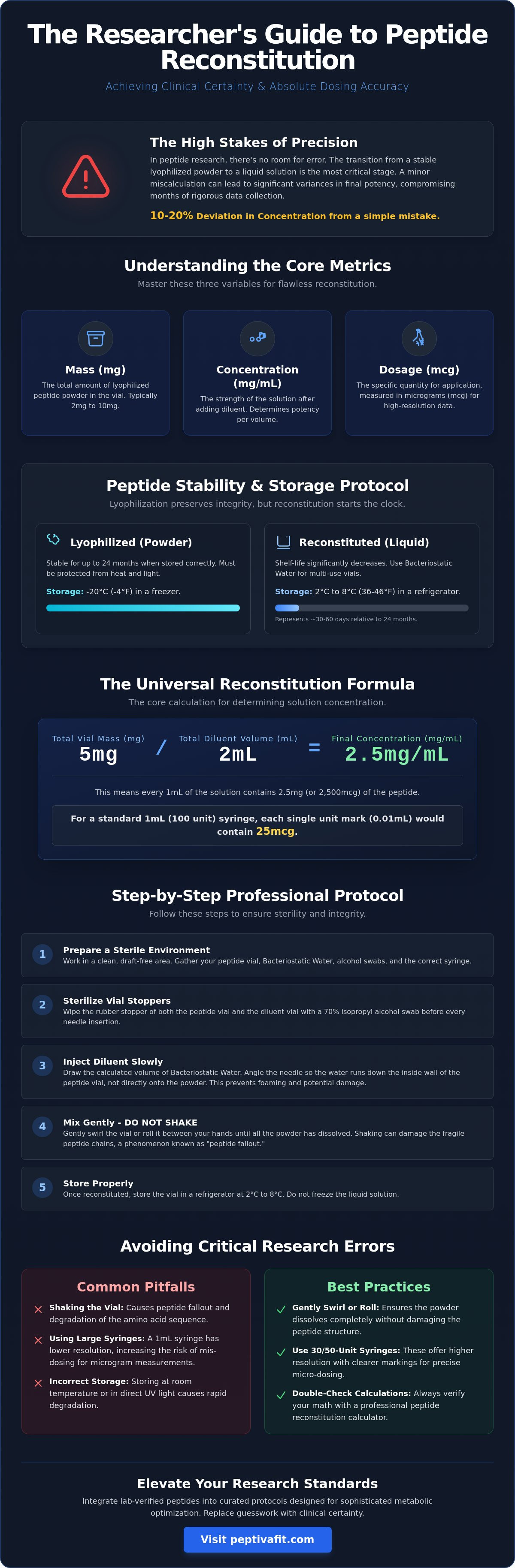
Reconstitution is the precise scientific process of restoring a lyophilized powder to a liquid state for research applications. This procedure is the cornerstone of laboratory accuracy. Research peptides often possess a narrow therapeutic window where the difference between a successful trial and an experimental failure is razor thin. A minor discrepancy in the diluent volume can result in a 15% or 20% deviation from the intended concentration. Utilizing a peptide reconstitution calculator serves as a vital safeguard against human error. This digital tool ensures that the mathematical relationship between the total mass of the peptide and the volume of the diluent is perfectly aligned. Researchers must grasp the Fundamentals of Peptides to appreciate why these molecular chains require such delicate handling and exact preparation.
In a controlled research setting, it's vital to distinguish between three primary metrics:
- Mass (mg): The total amount of lyophilized substance contained within the vial, typically ranging from 2mg to 10mg.
- Concentration (mg/mL): The strength of the solution after the diluent is added, which dictates how much active material exists in every milliliter of liquid.
- Dosage (mcg): The specific quantity required for the research application, usually measured in micrograms to ensure high-resolution data.
The Science of Lyophilisation
Lyophilization is a dehydration process where the product is frozen and the surrounding pressure is reduced to allow the frozen water to sublime. This maintains the structural integrity of the peptide chain during transit. Exposure to temperatures exceeding 25°C or direct UV light causes rapid degradation of the amino acid sequence. Lyophilized peptides remain stable for up to 24 months when stored at -20°C, but once reconstituted, the shelf-life decreases to approximately 30 to 60 days under refrigeration at 2°C to 8°C.
Why Bacteriostatic Water is the Industry Standard
Bacteriostatic water contains 0.9% benzyl alcohol, which acts as a preservative to inhibit the growth of potentially contaminating bacteria. Unlike sterile water, which is intended for single-use applications, bacteriostatic water allows for multiple entries into a vial over a 28-day period. Maintaining a sterile environment is mandatory. Proper safety protocols include swabbing the vial stopper with 70% isopropyl alcohol before every needle insertion. Storing the diluent in a cool, dark environment prevents the breakdown of the preservative. Discard any bacteriostatic water 28 days after the initial seal puncture to maintain laboratory standards and ensure the peptide reconstitution calculator results remain valid for a stable solution.
The Variables: Mastering the Math Behind the Calculator
Precise research requires a firm grasp of the mathematical inputs that drive a peptide reconstitution calculator. You must first identify the total mass of the lyophilized powder. Standard research vials typically contain 5mg or 10mg of active compound, though larger 20mg vials exist for specific high-dose protocols. The volume of Bacteriostatic (BAC) water added dictates the final concentration. For example, adding 2mL of BAC water to a 5mg vial creates a concentration of 2.5mg/mL. This ratio is the foundation of all subsequent measurements.
When handling these variables, researchers often encounter Lab Math Problems involving unit conversions. Converting milligrams (mg) to micrograms (mcg) is the standard protocol for precise administration; 1mg equals 1,000mcg. Syringe choice is equally critical for accuracy. A 100-unit (1mL) syringe is the baseline, but 30-unit and 50-unit variants offer higher resolution for micro-dosing. Each graduation mark represents a specific volume. Miscalculating this can lead to a 15% variance in research data, compromising the integrity of the study.
The Universal Reconstitution Formula
The core calculation follows a linear path: (Total Vial mg / Total Diluent mL) = Concentration in mg/mL. To find the microgram count per tick on a standard U-100 insulin syringe, divide the total micrograms by the total number of units. If a 5mg vial is reconstituted with 2mL of diluent, each unit on the syringe contains 25mcg. Manual verification is mandatory. You should always double-check the peptide reconstitution calculator output against manual math to eliminate potential software or input errors. Accuracy is the hallmark of disciplined laboratory practice.
Concentration Ratios and Research Efficiency
Concentration affects both the absorption rate and localized tissue response. High-concentration solutions, such as 5mg in 1mL, require smaller injection volumes but may increase localized irritation at the site. Conversely, high-volume solutions, like 5mg in 3mL, dilute the peptide. This is often preferred for compounds like BPC-157 or Tesamorelin to minimize discomfort. Selecting the optimal ratio depends on the specific protocol requirements and the desired pharmacokinetic profile. For those seeking to refine their methodology, utilizing a curated educational platform provides the necessary technical oversight for sophisticated performance optimization.
Step-by-Step Protocol for Successful Peptide Reconstitution
Research integrity depends on the physical stability of the compound. Adopting a "Clean Room" approach within a home laboratory setting mitigates the risk of microbial contamination and degradation. You must establish a dedicated workspace free from drafts and high traffic. Before handling any materials, don powder-free nitrile gloves and ensure the surface is decontaminated with 70% isopropyl alcohol. This disciplined environment ensures that the data gathered remains untainted by external biological variables.
Peptides are sensitive to thermal shock. Allow the lyophilized vial to reach room temperature for approximately 15 to 30 minutes before introducing a diluent. This prevents internal condensation which can lead to premature degradation. During this acclimation period, use a peptide reconstitution calculator to determine the precise volume of Bacteriostatic Water or Sterile Saline required for your specific concentration goals. Accurate math is the difference between a controlled experiment and a failed trial.
Environmental Control and Sterility
Sanitization follows a strict sequence. Wipe the rubber stopper of the peptide vial and the diluent vial with fresh alcohol swabs for 15 seconds. Let them air dry completely. Never touch the entry point after cleaning. Safe disposal is non-negotiable. All used needles must go directly into a puncture-resistant, FDA-cleared sharps container to meet biohazardous waste standards. This protocol protects the researcher and the integrity of the laboratory space.
Physical Reconstitution Techniques
The "Slow Drip" method preserves the delicate molecular bonds of the peptide. Insert the needle at a 45-degree angle, aiming the stream of diluent against the glass wall rather than directly onto the lyophilized powder. This prevents foaming and mechanical stress. Many vials arrive under a vacuum. If you don't control the plunger, the vacuum will pull the liquid in too fast, causing a "plunger snap" that can shear the peptide chains. Hold the plunger firmly to regulate the flow at a rate of roughly 0.1 mL per second.
Once the diluent is added, let the vial sit. Most high-purity peptides dissolve within 2 to 5 minutes. If particles remain, gently rotate the vial between your palms. Never shake the vial. High-velocity movement causes denaturation, rendering the research material useless. A successful reconstitution results in a perfectly clear solution. If the liquid remains cloudy or contains visible precipitates after 15 minutes, the batch may be compromised or the pH levels might be imbalanced for that specific sequence. Use your peptide reconstitution calculator results to verify that the volume added matches the required concentration for the planned observation period.
Avoiding Critical Errors: Troubleshooting Volume and Concentration
Precision in the laboratory environment requires more than just a functional peptide reconstitution calculator; it demands an understanding of fluid dynamics and chemical stability. Researchers often encounter the Syringe Capacity trap when a calculated volume exceeds the 0.5ml or 1.0ml limit of standard insulin syringes. If your target dose requires 1.2ml of bacteriostatic water, you've either under-diluted the lyophilized powder or chosen an inappropriate delivery tool. Forcing excessive volume into a small-gauge syringe increases pressure, which can lead to mechanical failure or inaccurate delivery.
Identifying peptide fallout is a vital skill for maintaining research integrity. Cloudiness, visible particles, or floaters indicate that the solute hasn't properly dissolved or has precipitated out of the solution. This usually occurs when the pH balance is disrupted or the temperature fluctuates beyond the required 2 to 8 degrees Celsius. If the solution isn't crystal clear after 15 minutes of rest, the vial's structural integrity is compromised and it shouldn't be used for data collection.
Storage protocols are equally rigid. Once reconstituted with bacteriostatic water containing 0.9% benzyl alcohol, the 28-day rule applies. After this window, the risk of bacterial colonization increases significantly, and the peptide's potency often degrades by 15% to 30% depending on the sequence. A common objection is that more water is always better for accuracy. This is a fallacy. Excessive dilution can destabilize certain peptide chains and makes precise measurement harder by spreading the active compound too thin across the syringe barrel, leading to higher waste in the dead space.
Common Dosing Miscalculations
The 10x error remains the most frequent cause of research setbacks. Confusing 1mg with 1000mcg leads to a 1,000% overdose that can compromise the entire study. You must also account for syringe dead space, which can retain up to 0.08ml of fluid, potentially wasting 8% of your total vial. Air bubbles aren't just aesthetic issues; a single 0.05ml bubble in a 0.3ml dose represents a 16.6% variance in the intended concentration.
Peptide-Specific Stability Guidelines
Stability varies wildly across different compounds. Growth hormone secretagogues like Ipamorelin are notoriously fragile compared to stable repair sequences like BPC-157. Kinetic energy from vigorous shaking or frothing can shear the delicate peptide bonds, rendering the solution inert within seconds. For a practical application of these stability principles, refer to the Tesamorelin Dosage guide for metabolic optimization protocols.
Enhance your laboratory standards by accessing our curated research resources today.
Elevating Research Standards with PeptivaFit Protocols
Mathematical precision represents only one half of the research equation. While a peptide reconstitution calculator ensures the volume of diluent matches the desired concentration, the integrity of the underlying substance dictates the final outcome. The Peptiva Protocol integrates these technical calculations with specific metabolic objectives, ensuring every microgram of research material aligns with intended physiological targets. Transitioning from raw data to practical optimization requires a disciplined approach to both sourcing and application. Precision is mandatory. Data doesn't lie.
The Value of Lab Verification
Professional research environments demand a minimum purity standard of 99%. Anything less introduces variables that compromise the accuracy of your reconstitution. When a lyophilized powder contains 5% impurities, the physical weight of the cake in the vial doesn't accurately represent the actual peptide content. This discrepancy causes an immediate failure in dosing math. A peptide reconstitution calculator assumes the input weight is 100% active material; if the purity is low, your research subjects receive a lower dose than intended. PeptivaFit maintains a strict commitment to third-party testing and HPLC analysis. This level of transparency provides the verification required to ensure your research is based on facts, not estimates.
- 99% Purity Minimum: Ensures that the mass of the powder matches the active peptide content.
- Third-Party Analysis: Validates the absence of heavy metals or residual solvents that can skew metabolic data.
- Transparency: Provides peace of mind that the mathematical inputs are as precise as the outputs.
Beyond the Calculator: Professional Coaching
Mathematical tools provide the mechanics, but professional oversight provides the strategy. A digital tool can't account for individual metabolic variance or existing health markers. This is where the PeptivaFit methodology bridges the gap between laboratory math and metabolic optimization. Expert guidance ensures that dosing schedules aren't just accurate, but also appropriate for the specific research goals at hand. For those seeking a higher level of discipline, 1-on-1 medical consultations offer a layer of safety and precision that software cannot replicate. Secure your personalized medical assessment to ensure your research is backed by expert oversight and clinical standards. This transition from calculation to optimization is what separates amateur experimentation from professional-grade research.
Advancing Research Through Quantitative Precision
Precision in laboratory environments isn't a suggestion; it's a foundational requirement for valid experimental data. Utilizing a peptide reconstitution calculator eliminates the margin for human error that frequently compromises research integrity. Successful protocols depend on 100% accuracy when balancing diluent volume against lyophilized mass. Scientific data indicates that even a minor 5% deviation in concentration can significantly skew metabolic observations and experimental outcomes. PeptivaFit maintains these high-level standards by integrating lab-verified peptide purity and clinical-grade safety protocols into every curated resource. We prioritize informed decision-making through professional 1-on-1 medical consultations to ensure your research remains compliant and rigorous. You're not just tracking data; you're mastering a complex biological system through disciplined, data-driven methodology. For those ready to implement these standards, download the Peptiva Protocol: Fat Loss Peptide Guide for expert-led dosing strategies. Your commitment to clinical accuracy defines the quality of your results.
Frequently Asked Questions
How much bacteriostatic water should I add to a 5mg peptide vial?
You should typically add 2ml of bacteriostatic water to a 5mg vial to achieve a concentration of 2.5mg per ml. This ratio allows for precise dosing while maintaining the stability of the lyophilized powder. If your protocol requires a higher concentration, adding 1ml of diluent creates a 5mg per ml solution. Always prioritize volume levels that allow for clear measurement on a standard 100-unit syringe.
Can I use sterile water instead of bacteriostatic water for reconstitution?
You can use sterile water only for single-use applications where the entire vial is consumed immediately. Bacteriostatic water contains 0.9% benzyl alcohol, which serves as a preservative to inhibit bacterial growth for up to 28 days. Without this additive, sterile water lacks the antimicrobial properties necessary for multi-dose research vials. Using sterile water in a multi-use vial increases the risk of contamination within 24 hours.
What happens if I accidentally shake the peptide vial after mixing?
Shaking a vial can denature the delicate peptide bonds, potentially rendering the research material 100% ineffective. Peptides consist of fragile amino acid chains that are sensitive to kinetic energy and heat. Instead of shaking, you should gently swirl the vial between your palms for 30 to 60 seconds. If foam forms during the process, let the vial sit undisturbed in refrigeration until the solution clears.
How long do peptides remain stable after being reconstituted?
Most reconstituted peptides remain stable for 21 to 28 days when stored at a constant temperature between 2 and 8 degrees Celsius. Their potency begins to degrade significantly if they're left at room temperature for more than 48 hours. Research shows that specific sequences, such as IGF-1, are even more fragile and might lose 20% of their efficacy if not handled with extreme temperature precision during storage.
Why is my peptide solution cloudy after I added the bacteriostatic water?
Cloudiness usually indicates that the peptide hasn't fully dissolved or that the solution's pH level has reached an isoelectric point. This occurs in approximately 15% of high-concentration mixtures or with specific hydrophobic peptides. You should place the vial in a refrigerator for 30 minutes to allow the particles to hydrate naturally. If the solution remains cloudy after 2 hours, the peptide may have reached its saturation limit or suffered from degradation.
How do I convert milligrams (mg) to micrograms (mcg) for my dose?
You multiply the milligram amount by 1,000 to determine the total microgram count within the vial. For instance, a standard 5mg vial contains exactly 5,000mcg of lyophilized powder. Utilizing a peptide reconstitution calculator is the most efficient way to ensure these mathematical conversions are accurate for your specific research volume. Precision is vital because even a 10% calculation error can compromise the integrity of your laboratory data.
Does the type of syringe I use change the results of the calculator?
The syringe type, whether it's a 0.3ml, 0.5ml, or 1.0ml capacity, dictates the unit markings but doesn't change the core math of the peptide reconstitution calculator. You must verify if your hardware uses U-100 or U-40 scales, as these represent different volumes per unit. Most researchers utilize U-100 insulin syringes, where 10 units equals 0.1ml. Entering the correct syringe volume into your digital tools prevents volumetric dosing errors.
Is it safe to pre-fill syringes for later use in my research protocol?
Pre-filling syringes is generally discouraged because the rubber plunger and plastic barrel can degrade the peptide over 24 to 72 hours. Medical-grade plastics aren't designed for long-term storage of reconstituted proteins, and the seal isn't as robust as a glass vial. To maintain 100% molecular integrity, it's best to draw the solution immediately before the scheduled research application. This practice ensures the peptide doesn't adhere to the syringe walls.

![Shelf Life of Reconstituted Peptides: A Clinical Reference Guide [2026]](https://getautoseo.com/storage/hero_images/shelf-life-of-reconstituted-peptides-a-clinical-reference-guide-2026.jpg?v=b8ed5173acaa)
