The standard approach of high-dose collagen supplementation is often a biological dead end for those seeking to tighten dermal tissue after significant weight loss. While many individuals ask, "do peptides help with loose skin after weight loss," the answer lies in systemic cellular signaling rather than simple protein ingestion. It is a common frustration to find that a hard-earned physical transformation is obscured by sagging skin that lacks the structural integrity to retract. You may feel skeptical about the marketing behind oral supplements and understandably anxious about the recovery times associated with invasive surgical procedures.
This clinical perspective explores how specific signaling peptides function as molecular triggers for genuine dermal remodeling. Recent regulatory shifts, including the April 23, 2026, FDA reclassification of substances like GHK-Cu and BPC-157 to Category 1, have provided a new framework for legal, physician-supervised access through compounding pharmacies. You will learn how these compounds support skin thickness and elasticity by addressing the underlying biological mechanisms of tissue repair. We provide a comprehensive look at non-invasive protocols designed to reduce a crepey appearance and restore long-term dermal health through disciplined, data-driven science.
Key Takeaways
- Understand how prolonged tissue expansion damages the extracellular matrix and why traditional protein supplements often fail to address this structural deficit.
- Analyze the molecular signaling pathways to answer the central question: do peptides help with loose skin after weight loss by triggering targeted DNA transcription?
- Examine the clinical applications of GHK-Cu for dermal remodeling and the essential role of BPC-157 in optimizing connective tissue repair.
- Identify the necessary lifestyle co-factors, including mechanical tension and specific micronutrients, required to support peptide-induced protein synthesis.
- Establish the requirement for lab-verified purity and a structured clinical framework to achieve safe, non-invasive dermal optimization.
The Biology of Skin Laxity: Why Rapid Weight Loss Leaves a Structural Deficit
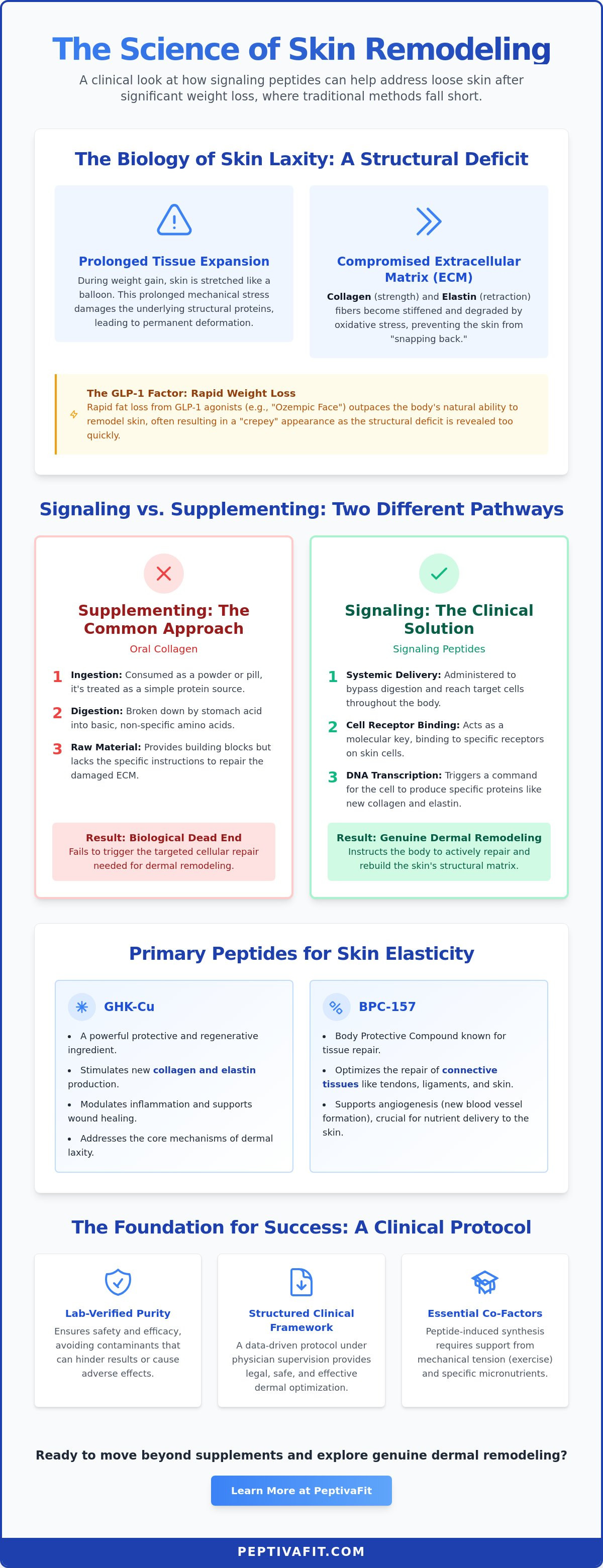
Skin laxity is not merely a cosmetic inconvenience; it is a physiological failure of the extracellular matrix (ECM). This complex network of proteins provides the structural scaffolding for your skin. When the body undergoes prolonged expansion during weight gain, a phenomenon known as the "balloon effect" occurs. This mechanical stretching compromises the structural integrity of dermal fibers, often leading to permanent deformation. Many individuals undergoing metabolic transformation ask: do peptides help with loose skin after weight loss? To answer this, one must understand that during a caloric deficit, the body operates under strict nutrient partitioning. It prioritizes the repair of internal organs and the maintenance of vital functions over the synthesis of new dermal proteins. The skin, while the largest organ, is not the most critical for immediate survival, so it often remains in a state of structural deficit.
Collagen vs. Elastin: The Scaffolding of the Dermis
The dermis relies on a sophisticated architecture of specific proteins. Collagen provides the necessary tensile strength and thickness to prevent tissue tearing, while elastin allows the skin to retract after movement or stretching. These short chains of amino acids are the essential building blocks for these larger, more complex proteins. During periods of significant weight gain, high levels of oxidative stress and glycation, the bonding of sugar molecules to proteins, create cross-links that stiffen collagen and degrade elastin. This damage is often irreversible through standard metabolic processes alone. It leaves the skin unable to "snap back" once the underlying adipose tissue is removed, resulting in the characteristic sagging associated with major weight changes.
The GLP-1 Factor: Rapid Loss and Crepey Skin
The rise of GLP-1 agonists has introduced a new variable in dermal health. Rapid pharmaceutical weight loss often results in a "crepey" appearance, frequently termed "Ozempic face" or body sagging. This occurs because the rate of fat loss significantly outpaces the body's natural capacity for skin remodeling. When fat is lost too quickly, the metabolic shift doesn't allow for the gradual contraction of the ECM. Consequently, the biological age of the skin may appear much older than the individual's chronological age. The question of do peptides help with loose skin after weight loss becomes a matter of whether we can accelerate cellular signaling to match this rapid fat loss. Without targeted intervention, the structural deficit remains. The body simply lacks the specific molecular instructions to prioritize skin tightening during a state of rapid depletion and metabolic stress.
Signaling vs. Supplementing: How Peptides Differ from Oral Collagen
Consumers often conflate oral collagen supplements with signaling peptides, but the biological distinction is absolute. Oral collagen "peptides" are essentially hydrolyzed proteins, intended to provide raw material for the body. However, these substances are digested into basic amino acids before they ever reach the bloodstream. They lack the specific molecular instructions required to reorganize a damaged extracellular matrix. When investigating whether do peptides help with loose skin after weight loss, one must look beyond dietary protein and toward bioactive signaling molecules that operate at a cellular level.
Signaling peptides act as molecular messengers that bind to specific cell receptors. This interaction triggers DNA transcription, instructing the cell to synthesize new proteins or repair existing structures. For instance, GHK-Cu is recognized as a powerful protective and regenerative ingredient that stimulates both collagen and elastin production while modulating inflammation. Unlike oral supplements, systemic administration ensures these messengers reach the deeper layers of the dermis and the underlying fascia where structural laxity originates. This systemic approach allows for a uniform signaling response across the entire body rather than localized, superficial attempts at repair.
The Role of Fibroblasts in Skin Remodeling
Fibroblasts are the primary "engine rooms" of the skin. They are responsible for the continuous production and maintenance of the collagen-elastin matrix. In cases of significant weight loss or aging, these cells often become dormant or senescent, failing to produce the necessary fibers to maintain skin tension. Signaling peptides effectively "wake up" these fibroblasts, restoring their youthful biosynthetic capacity. Maintaining a clinical-grade environment and utilizing lab tested peptides is essential to ensure molecular integrity. This precision prevents the introduction of impurities that could trigger a counterproductive inflammatory response, which would only further degrade the skin's structural proteins.
Bioavailability and Molecular Weight
The "500 Dalton Rule" dictates that molecules larger than 500 Daltons cannot penetrate the skin's basement membrane when applied topically. This fundamental limitation explains why most over-the-counter creams fail to address deep-seated laxity. While oral collagen is broken down into constituent parts during digestion, subcutaneous administration bypasses these barriers entirely. It delivers signaling molecules directly into systemic circulation for immediate cellular uptake. This method ensures maximum bioavailability and precise dosing. To truly understand if do peptides help with loose skin after weight loss, one must prioritize pharmaceutical-grade purity over consumer-grade marketing. High-purity compounds are necessary to prevent cellular stress and maximize the remodeling signal without the interference of inflammatory contaminants.
Primary Peptides for Skin Elasticity: GHK-Cu, BPC-157, and Secretagogues
The clinical efficacy of systemic peptides depends on a multi-layered approach that addresses both the dermis and the underlying connective tissue. While many individuals question, do peptides help with loose skin after weight loss, the answer is found in the synergistic application of specific signaling molecules. These compounds don't simply provide raw materials; they recalibrate the body's regenerative environment to prioritize structural integrity. By addressing the skin surface and the fascia simultaneously, a more robust remodeling response is achieved than through localized treatments alone.
GHK-Cu: The Remodeling Signal
GHK-Cu remains the premier choice for dermal remodeling. This tripeptide works by upregulating collagen, elastin, and glycosaminoglycans, the essential components of the skin's moisture barrier and structural matrix. According to a clinical review on GHK-Cu peptides, it's capable of tightening loose skin and improving overall firmness by stimulating DNA repair. It also modulates inflammatory cytokines, which promotes "clean" healing and prevents the formation of disorganized scar tissue. For a more technical breakdown of these mechanisms, consult our GHK-Cu clinical overview.
The Recovery Stack: BPC-157 and TB-500
Dermal health is inextricably linked to the health of the fascia and underlying connective tissue. BPC-157 and TB-500 comprise a recovery stack that focuses on angiogenesis and tissue healing. BPC-157 promotes the repair of tendons and ligaments, creating a stable foundation for the skin to adhere to. TB-500 facilitates cell migration and the formation of new blood vessels, ensuring that regenerative signals reach damaged areas efficiently. This combination is vital for those asking if do peptides help with loose skin after weight loss, as it addresses the deeper structural deficits. Detailed reconstitution protocols for these compounds are available in our BPC-157 reference guide.
Secretagogues and the GH-IGF-1 Axis
Increasing systemic growth hormone levels through secretagogues like Ipamorelin and CJC-1295 provides the metabolic background necessary for tissue synthesis. These peptides stimulate the pituitary gland to release natural growth hormone, which subsequently elevates IGF-1 levels. This axis is critical for increasing skin thickness and accelerating cellular turnover, which directly combats the "crepey" appearance of skin after rapid weight loss. Those focusing on the intersection of visceral fat reduction and skin health should review the Tesamorelin dosage guide for specialized metabolic optimization protocols. This systemic approach ensures that the body has the hormonal environment required to support the localized repair signals sent by GHK-Cu and BPC-157.
Optimizing the Remodeling Window: Implementation Strategies
Biological remodeling is a resource-intensive process that requires more than just molecular signaling. While the evidence suggests the answer to do peptides help with loose skin after weight loss is affirmative, their efficacy is contingent upon a supportive physiological environment. You must provide the mechanical and nutritional inputs necessary for the body to execute the instructions delivered by these signaling molecules. Without these foundations, the remodeling window is often missed, leading to suboptimal results. Success requires a disciplined, multi-factorial approach that spans several months of consistent application.
Combining Peptides with Resistance Training
Resistance training is a non-negotiable component of dermal recovery. Mechanical tension provides a direct signal to the fibroblasts to increase protein synthesis. Muscle hypertrophy serves to "fill the gap" created by subcutaneous fat loss, providing a firmer substrate for the skin to adhere to. There is a profound synergy between peptide-enhanced recovery and high-intensity interval training (HIIT). While the peptides facilitate faster tissue repair, the exercise provides the necessary stress to trigger that repair. For maximum efficacy, timing peptide administration around training windows can optimize the systemic growth environment. This ensures that the highest concentrations of signaling molecules are available when the body is in its peak state of repair and nutrient uptake.
Nutrient Density and Skin Synthesis
Peptides act as the messengers, but the body still requires the physical building blocks to construct new tissue. Specific amino acids, particularly Proline, Glycine, and Lysine, are essential for the formation of stable collagen triple helices. Vitamin C serves as a critical cofactor in this process, as it's required for the hydroxylation of these amino acids, which allows collagen fibers to cross-link and gain tensile strength. Zinc and copper also play vital roles in enzymatic reactions that maintain the extracellular matrix (ECM). Because every individual's metabolic starting point is unique, a personalized medical assessment is necessary to identify and correct any underlying nutrient deficiencies that could stall your progress.
Hydration and electrolyte balance are equally vital for maintaining the volume of the ECM. Hyaluronic acid within the dermis requires adequate water intake to maintain skin turgidity and "plumpness." Without proper hydration, the skin appears thinner and more prone to the crepey texture associated with rapid weight loss. Finally, you must manage your expectations regarding the biological timeline. Dermal remodeling is not an overnight occurrence. It typically requires a window of 3 to 6 months of consistent signaling and nutritional support to see significant changes in skin thickness and elasticity. This is a long-term physiological shift, not a temporary cosmetic fix.
The Peptiva Protocol: Integrating Systemic Peptides into Post-Loss Recovery
The Peptiva Protocol represents the clinical culmination of the research and strategies discussed throughout this guide. It's a rigorous framework designed for the individual who has achieved significant metabolic success but faces the residual challenge of dermal laxity. This protocol moves beyond the theoretical question of do peptides help with loose skin after weight loss and provides a disciplined path for systemic intervention. It marks the transition from a catabolic state of fat loss into an anabolic phase of tissue remodeling and structural repair. Success in this phase requires a high degree of personal responsibility and an uncompromising commitment to data-driven optimization.
A primary pillar of this framework is the absolute requirement for molecular integrity. The current landscape of "research use only" products often lacks the necessary regulatory oversight, posing significant risks to the user. Independent analysis has identified mislabeling or contamination in approximately 30% of peptide samples sourced from unregulated grey-market suppliers. Utilizing lab-tested peptides isn't merely a safety preference; it's a scientific necessity. Without verified purity, the signaling molecules may fail to trigger the desired biological response or, worse, induce systemic inflammation that further degrades the skin's extracellular matrix.
Selective Access and Clinical Oversight
The PeptivaFit philosophy prioritizes professional guidance over mass-market trends. We operate as a selective entity, providing an atmosphere of high-level expertise for those serious about their long-term performance. Our 1-on-1 coaching is essential for monitoring your physiological markers and adjusting protocols in real-time. This oversight is critical because individual responses to compounds like GHK-Cu or Ipamorelin vary based on age, metabolic history, and the specific extent of dermal damage. A personalized medical assessment ensures your protocol is tailored to your unique health profile, maximizing the efficacy of the signaling molecules while maintaining strict safety standards.
Next Steps for Dermal Optimization
Dermal remodeling is a methodical process that follows the laws of biology rather than the timelines of marketing. You must adopt a long-term view of skin health, recognizing that genuine structural changes take months of consistent signaling and support. Peptides provide the essential bridge between the completion of a weight loss journey and the achievement of a truly "finished" physique. By integrating these systemic messengers with disciplined nutritional and mechanical inputs, you can finally address the frustration of sagging skin. If you're ready to move beyond standard consumer advice and take control of your biological remodeling, the first step is to secure a personalized medical assessment. This evaluation provides the data necessary to determine exactly how do peptides help with loose skin after weight loss in your specific case, allowing for a sophisticated, non-invasive approach to your long-term dermal health.
Advancing Toward Structural Integration
Addressing dermal laxity requires a shift from the catabolic focus of fat loss to a targeted, anabolic remodeling strategy. Understanding that skin sagging is a breakdown of the extracellular matrix allows for more sophisticated interventions than standard oral supplements. By utilizing systemic signaling molecules, you can effectively "wake up" dormant fibroblasts and restore the skin's structural scaffolding. When evaluating if do peptides help with loose skin after weight loss, the outcome depends on the precision of the protocol and the quality of the compounds used.
Achieving a truly finished physique demands a disciplined approach that combines mechanical tension, nutrient density, and pharmaceutical-grade signaling. The Peptiva Protocol provides this framework through data-driven metabolic protocols and personalized medical oversight. We ensure the highest standards of safety by utilizing only lab-verified peptide purity, moving your recovery beyond mass-market guesswork. You have already completed the difficult work of weight loss; now is the time to optimize your dermal health through scientific investigation and expert guidance.
Access the Peptiva Protocol and Professional Peptide Guidance to begin your personalized assessment. Your commitment to a long-term, evidence-based strategy will yield the structural results your transformation deserves.
Clinical Inquiries and Dermal Optimization FAQ
Can peptides completely replace skin removal surgery?
Peptides cannot replace surgical excision in cases of extreme tissue redundancy or a large panniculus. They function as a biological intervention to improve skin thickness, quality, and moderate retraction. While they bridge the gap for many, they don't remove large volumes of excess skin that require mechanical removal. Surgery remains the only option for significant skin folds that have lost all elastic potential.
How long does it take to see skin tightening results from peptides?
Remodeling results typically manifest within a 3 to 6 month window of consistent signaling. Biological processes like collagen cross-linking and elastin synthesis are methodical and cannot be rushed. You must maintain a disciplined protocol during this time to allow the body to reorganize the extracellular matrix at a cellular level. Rapid changes are rare, as tissue remodeling is a long-term physiological shift.
What is the best peptide for loose skin after weight loss?
GHK-Cu is widely considered the gold standard for dermal remodeling due to its ability to upregulate collagen and elastin. When individuals ask, do peptides help with loose skin after weight loss, GHK-Cu is usually the primary compound recommended. It's often stacked with BPC-157 to support the underlying connective tissue and fascia, creating a more robust structural foundation for the skin.
Are there side effects to using peptides for skin remodeling?
Side effects are generally minimal when using lab-verified, high-purity compounds under clinical oversight. Some users report transient flushing or localized irritation at the injection site. Using unregulated grey-market products significantly increases the risk of inflammatory reactions due to potential contaminants. It's essential to utilize research-grade materials and follow professional guidance to ensure a safe and effective remodeling process.
Do I need to keep using peptides forever to maintain skin elasticity?
Permanent use is not required, as peptides are typically administered in structured cycles to trigger specific remodeling phases. Once you achieve the desired dermal density, maintenance is supported through mechanical tension and nutrient density. Periodic "booster" cycles may be utilized to sustain long-term skin elasticity as part of a broader wellness strategy. The goal is to restore the skin's natural regenerative capacity.
Is GHK-Cu better as a cream or an injection for loose skin?
Subcutaneous injection is superior to topical creams for systemic dermal remodeling. Topical applications are limited by the 500 Dalton rule, preventing them from reaching the deeper dermis where structural repair occurs. Injections ensure the signaling molecules reach the systemic circulation to answer the question: do peptides help with loose skin after weight loss from the inside out, affecting the entire body simultaneously.
Can I use peptides while still on a GLP-1 medication like Zepbound?
Peptides can be integrated into a protocol while using GLP-1 medications like Zepbound or Ozempic. This combination is often strategically beneficial to mitigate rapid volume loss and prevent the "crepey" skin texture associated with pharmaceutical weight loss. Supporting the skin's structural integrity during the loss phase is more efficient than attempting to repair damage after it has already occurred.
Does age affect how well peptides work for tightening skin?
Chronological age influences the baseline population of active fibroblasts and systemic growth hormone levels. While peptides are effective across various age groups, older individuals may require longer cycles or higher concentrations of secretagogues. This ensures the body has the hormonal background necessary to support peptide-triggered protein synthesis. A personalized assessment is vital to adjust the protocol based on your specific biological age.

![Shelf Life of Reconstituted Peptides: A Clinical Reference Guide [2026]](https://getautoseo.com/storage/hero_images/shelf-life-of-reconstituted-peptides-a-clinical-reference-guide-2026.jpg?v=b8ed5173acaa)
