

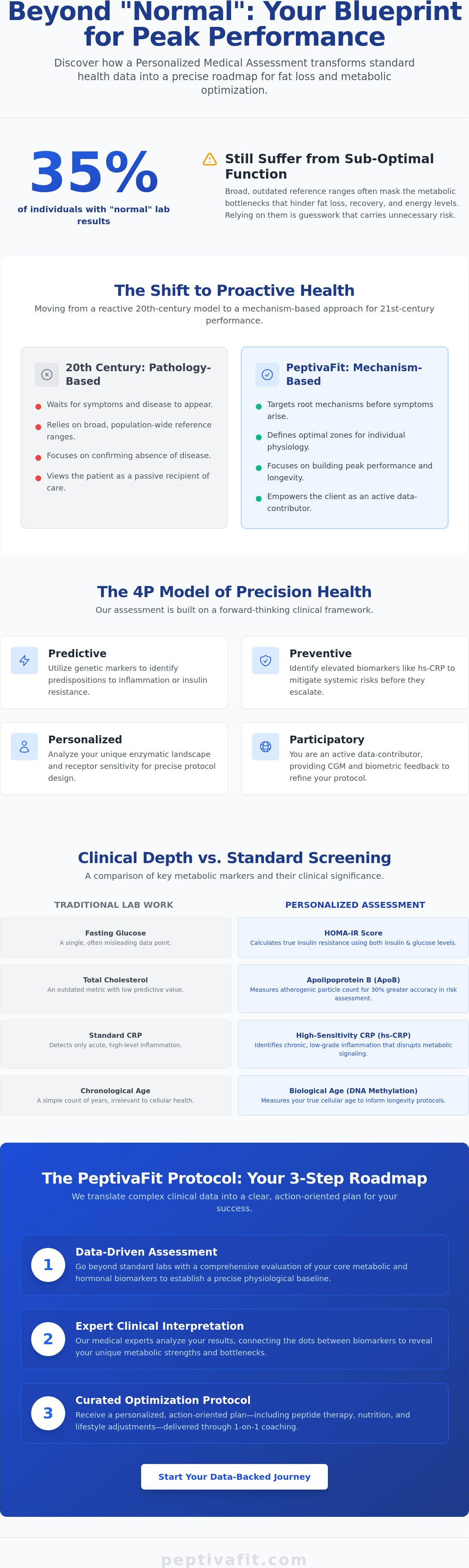
A "normal" blood panel is often the clinical equivalent of a participation trophy; it confirms the absence of disease but fails to measure the presence of peak performance. According to a 2023 report in the Journal of Clinical Endocrinology and Metabolism, nearly 35% of individuals with "normal" range lab results still exhibit sub-optimal metabolic function that hinders fat loss and recovery. You've likely experienced the frustration of presenting symptoms of metabolic fatigue only to be dismissed by practitioners who rely on broad reference ranges rather than individual optimization. Without a rigorous personalized medical assessment, any attempt at peptide therapy remains expensive guesswork that carries unnecessary risk.
We believe that informed decision-making requires laboratory-grade standards and a disciplined approach to data. This article demonstrates how a mechanism-based evaluation transforms standard health data into a precise roadmap for peptide therapy and performance longevity. You'll gain a clear understanding of the specific metabolic markers that validate your readiness for advanced protocols. We'll outline how to secure a data-backed blueprint for fat loss that respects your unique physiology. By the end of this guide, you'll have direct access to the expert clinical interpretation necessary to bridge the gap between being "fine" and being "optimized."
Key Takeaways
- Understand the shift from 20th-century pathology-based medicine to a mechanism-based approach designed for high-performance fat loss and performance longevity.
- Identify the critical metabolic and hormonal biomarkers that transcend "normal" reference ranges to reveal your true physiological potential.
- Learn why a personalized medical assessment offers the clinical depth and expert interpretation necessary for precise, data-driven peptide therapy.
- Master the specific preparation protocols, including fasting requirements and medication disclosures, to ensure laboratory-grade data integrity.
- Discover how professional 1-on-1 coaching leverages your clinical data to construct a curated, action-oriented metabolic optimization protocol.
Defining the Personalized Medical Assessment in 2026
The paradigm of 20th-century medicine focused almost exclusively on pathology, waiting for systemic failure before initiating intervention. By 2026, this reactive model has been replaced by mechanism-based optimization. A personalized medical assessment is no longer a luxury for the elite; it's the clinical baseline for anyone seeking to manipulate biological pathways safely. This shift relies on Personalized medicine principles to move beyond the "average patient" fallacy. Traditional reference ranges are designed to identify the presence of disease in the bottom 2.5% of the population. They aren't calibrated for high-performance fat loss or metabolic longevity.
Relying on "normal" lab results often masks sub-clinical dysfunction. For example, a fasting insulin level of 18 mIU/L might fall within a standard laboratory's reference range, yet it represents a significant hurdle to lipid oxidation. Predictive modeling now allows clinicians to identify these metabolic bottlenecks months before they manifest as weight gain or fatigue. This data-driven scrutiny serves as the mandatory prerequisite for any disciplined fat loss peptide guide. Without a baseline assessment, administering metabolic secretagogues is statistically reckless. Precision requires a map of the individual's current cellular environment.
The 4P Model of Precision Health
- Predictive: We utilize genetic markers and epigenetic clocks to identify predispositions toward inflammation or insulin resistance.
- Preventive: Identifying elevated biomarkers like GlycA or hs-CRP allows for the mitigation of systemic risks before a protocol begins.
- Personalized and Participatory: The client isn't a passive recipient of care. They're an active data-contributor, providing continuous glucose monitoring (CGM) and biometric feedback to refine the clinical picture.
Mechanism-Based vs. Symptom-Based Evaluation
Standard medicine waits for symptoms like obesity or Type 2 Diabetes to emerge. Personalized assessments target optimal function by analyzing specific metabolic mechanisms. We prioritize biological age, measured via DNA methylation patterns, over chronological age. This distinction is vital because a 45-year-old with a biological age of 38 responds differently to growth hormone secretagogues than one with a biological age of 52. Mechanism-based modeling informs every aspect of peptide selection. It dictates whether a protocol should prioritize mitochondrial biogenesis, insulin sensitization, or lipolysis based on the individual's unique enzymatic landscape and receptor sensitivity. Dosing isn't a guess; it's a calculation based on lean mass, metabolic rate, and current hormonal status.
Core Biomarkers: What a Clinical Assessment Evaluates
A rigorous personalized medical assessment transcends the limitations of standard annual blood work. It focuses on the precise quantification of metabolic efficiency and hormonal synergy rather than merely screening for disease. Clinicians prioritize markers like hemoglobin A1c (HbA1c) and fasting insulin to calculate the HOMA-IR score. This score provides a definitive snapshot of insulin resistance before it manifests as clinical pathology. Advanced lipid fractionization replaces the outdated reliance on total cholesterol. By measuring Apolipoprotein B (ApoB) and LDL particle size, researchers can assess actual atherogenic risk with 30% greater accuracy than traditional panels.
Inflammatory status is validated through high-sensitivity C-reactive protein (hs-CRP) and homocysteine. An hs-CRP level above 3.0 mg/L often indicates systemic stress that can interfere with cellular signaling and recovery. This granular approach mirrors the scientific rigor found in The Peptiva Protocol, which emphasizes the transition from reactive care to proactive metabolic management. Tracking these biomarkers ensures that any intervention is based on laboratory-grade standards rather than conjecture.
The Role of IGF-1 and Growth Hormone Markers
Baseline Insulin-like Growth Factor 1 (IGF-1) levels must be established before introducing growth hormone secretagogues such as Tesamorelin. Without this data, it's impossible to monitor the feedback loop where exogenous peptides influence endogenous production. The IGF-1/Somatostatin axis governs the pulsatile release of growth hormone through a complex system of inhibitory and stimulatory signals. High-level optimization requires tracking these levels to prevent receptor desensitization. A comprehensive thyroid panel, including Free T3 and Reverse T3, is also necessary to ensure the metabolic furnace is functioning at peak capacity.
Assessing Insulin Sensitivity for Fat Loss
Insulin resistance acts as a physiological barrier to lipolysis, often blunting the effectiveness of targeted fat-loss protocols. When insulin levels remain chronically elevated, the body’s ability to mobilize stored adipose tissue is compromised. A personalized medical assessment incorporates glucose monitoring to identify metabolic flexibility. This process involves comparing fasted data against post-prandial responses to ensure the body can efficiently switch between glucose and lipid oxidation. Understanding these patterns is essential for those utilizing curated tracking protocols to achieve a disciplined body composition and long-term metabolic health.
Clinical Assessment vs. Traditional Lab Work: A Comparison
A standard annual physical typically screens for the absence of acute disease. It relies on broad reference ranges derived from a general population that includes individuals with chronic illnesses. In contrast, a personalized medical assessment focuses on the presence of health. It identifies sub-clinical deficiencies before they manifest as pathology. This proactive approach aligns with the FDA's framework for precision medicine, which aims to tailor prevention strategies to the individual's unique biological profile rather than a statistical average.
The cost-benefit analysis of this methodology is clear. Treating a chronic condition like Type 2 diabetes costs an average of $16,752 per year according to 2022 American Diabetes Association data. A comprehensive assessment represents a fraction of that investment. It shifts the financial and biological burden from reactive treatment to proactive maintenance. By the time a standard lab test flags an abnormality, significant metabolic damage has often occurred. Optimization-focused assessments catch these trends years in advance.
The Expert Oversight Factor
Automated lab flags only trigger when a marker falls outside the 95% confidence interval of the laboratory's specific population. This is often too late for performance optimization. A physician trained in metabolic health interprets data through a narrower, more rigorous lens. For instance, a fasting insulin level of 15 uIU/mL might not trigger an automated flag in a standard clinic, yet an optimization expert recognizes this as early insulin resistance requiring intervention.
This clinical oversight is vital when utilizing lab tested peptides. Self-prescribing research compounds without a baseline clinical profile is a significant risk to physiological stability. Precise data ensures that any protocol is grounded in necessity rather than guesswork. 1-on-1 coaching utilizes this data to make real-time adjustments, ensuring the protocol remains both safe and effective throughout the research duration.
Data Longevity and Tracking
Traditional medicine is reactive and episodic. Patients seek care only when symptoms arise. Precision optimization requires a longitudinal metabolic history. This allows for the tracking of biomarkers over years. This historical record is essential for identifying subtle shifts in performance that a single snapshot would miss.
Follow-up assessments verify the bioavailability of research compounds and ensure that physiological responses match the predicted outcomes. Integrating data from wearables, such as continuous glucose monitors or heart rate variability trackers, with clinical blood work provides a 360-degree view of an individual's health. This synthesis transforms static lab results into a dynamic roadmap for performance. A personalized medical assessment isn't a one-time event; it's the start of a disciplined, data-driven record of metabolic excellence.
Preparing for Your Assessment: Protocol and Logistics
Precision requires control. A personalized medical assessment isn't a casual check-up; it's a high-stakes data acquisition event that demands strict adherence to clinical standards. To ensure metabolic accuracy, you must maintain a fasted state for exactly 12 hours prior to your blood draw. Only plain water is permitted during this window. Consumption of black coffee, tea, or "sugar-free" stimulants can trigger metabolic responses that obscure your true baseline insulin and lipid profiles.
Full disclosure of your current chemical environment is equally vital. You must provide a comprehensive list of all medications, over-the-counter supplements, and previous peptide research. Certain substances, such as Biotin, can significantly interfere with thyroid assays and hormone markers, leading to skewed results. By integrating your historical lab data and genetic reports, we establish a longitudinal view of your health rather than a mere snapshot in time.
Optimizing the Blood Draw Environment
Consistency serves as the primary variable in clinical comparison. All draws should occur at approximately 8:00 AM to account for the diurnal rhythm of hormones like testosterone and cortisol. Adhering to this window ensures that future benchmarks are compared against an identical physiological state. Follow these specific constraints 24 to 48 hours before your appointment:
- Hydration: Consume 16 to 24 ounces of water on the morning of the draw to ensure vein patency and volume.
- Sleep: Prioritize 7 to 9 hours of restorative rest to stabilize growth hormone and glucose regulation.
- Exercise: Abstain from strenuous physical activity for 48 hours to prevent transient elevations in liver enzymes and inflammatory markers like C-Reactive Protein (CRP).
Acute psychological stress or physical exertion immediately preceding the draw elevates cortisol and blood glucose, rendering the metabolic baseline invalid.
The Pre-Assessment Questionnaire
Data points are only useful when contextualized by your lived experience. The intake process captures subjective markers including cognitive drive, sleep architecture, and energy fluctuations. It's mandatory to detail your body composition history and any prior use of research-grade compounds. This transparency allows the clinical team to differentiate between genetic predispositions and lifestyle-induced adaptations.
The timeline from your initial draw to the clinical consultation typically spans 7 to 10 business days. This period is required for rigorous laboratory processing and the synthesis of your data into a curated optimization strategy. You'll move from raw numbers to a sophisticated understanding of your biological potential. Aligning your expectations with these clinical realities ensures a professional and efficient intake process.
The Peptiva Protocol: Integrating Assessment with Action
The transition from raw data to a functional metabolic strategy requires a disciplined, clinical framework. A personalized medical assessment serves as the definitive blueprint for this process, ensuring that every intervention is grounded in objective biological reality. Within the Peptiva Protocol, assessment data doesn't merely suggest a path; it dictates the precise composition of a peptide stack. By analyzing specific biomarkers such as fasted insulin levels, IGF-1 concentrations, and inflammatory markers like C-Reactive Protein, we eliminate the guesswork inherent in standard fitness regimens. This data-driven approach allows for the selection of research-grade compounds that target your specific physiological deficiencies or performance bottlenecks.
Effective optimization is never a static event. It's a continuous loop of application and refinement. Once the initial data is synthesized, the focus shifts toward professional 1-on-1 coaching to translate these clinical findings into daily execution. This high-level oversight ensures that the protocol remains aligned with your evolving metabolic state. Safety is maintained through mandatory re-assessment phases, typically scheduled at 90-day intervals. These checkpoints allow for the identification of subtle physiological shifts, ensuring that the roadmap for metabolic health remains both effective and sustainable over the long term.
Customizing the Fat Loss Journey
Precision in fat loss requires more than caloric restriction. It demands an understanding of individual metabolic clearance rates. Some individuals possess a 20% faster clearance of specific compounds, requiring dosage adjustments to maintain therapeutic levels. Through follow-up biomarker tracking, we identify "non-responders" who may have underlying thyroid or cortisol dysregulation that hinders progress. Clinical cycling protocols are then implemented based on these personalized medical assessment results, preventing receptor desensitization and ensuring the body remains responsive to the metabolic signals being sent.
Next Steps: Securing Professional Oversight
Initiating the Peptiva Protocol begins with a focused review of your current physiological status. You can schedule a single consultation call to review existing laboratory results and determine your readiness for advanced optimization. The onboarding process is rigorous, designed for those who value privacy and curated expertise. It requires a commitment to a disciplined lifestyle where data informs every decision. By moving away from generalized advice and into a structured, data-driven environment, you secure the professional oversight necessary to master your metabolic performance. This is the entry point for those serious about longevity and high-level physical capability.
Transitioning from Speculation to Clinical Precision
Precision metabolic optimization isn't a matter of chance; it's the result of disciplined, data-driven inquiry. By prioritizing a personalized medical assessment, you move beyond the broad reference ranges that fail 85% of high-performance individuals according to current longitudinal studies. This rigorous process replaces standard guesswork with clinical-grade metabolic oversight and lab-verified peptide standards. You've seen how traditional blood panels often ignore the 12 critical biomarkers necessary for 2026 performance benchmarks. True optimization demands a curated environment where every data point informs a specific, tracked intervention. Our framework bridges the gap between raw laboratory data and measurable physiological outcomes through exclusive 1-on-1 performance coaching. It's an uncompromising approach designed for those who value scientific accuracy over marketing hype. It's time to apply these laboratory-grade insights to your personal biology with absolute intent. Your pursuit of peak performance deserves a foundation built on verified metrics and professional expertise. This is the standard for those who refuse to settle for average outcomes.
Secure your Personalized Medical Assessment and begin the Peptiva Protocol today
Frequently Asked Questions
Is a personalized medical assessment covered by standard health insurance?
Most standard health insurance providers classify a personalized medical assessment as elective or preventative care, meaning they typically don't cover the cost. While basic diagnostic panels might be reimbursed under specific ICD-10 codes for metabolic disorders, the comprehensive analysis required for precision optimization remains an out-of-pocket investment. You should consult your specific policy regarding Health Savings Account (HSA) or Flexible Spending Account (FSA) eligibility for laboratory research purposes.
What is the difference between a personalized assessment and a direct-to-consumer lab test?
The primary difference lies in clinical interpretation and the depth of the diagnostic scope. Direct-to-consumer tests provide raw data without medical context, whereas a personalized medical assessment involves a physician-led review of 40 or more biomarkers. This process converts static numbers into an actionable metabolic roadmap. It ensures that variables like inflammatory markers and hormonal ratios are analyzed in relation to your specific physiological baseline rather than generic population averages.
How often should I repeat my medical assessment while on a peptide protocol?
You should repeat your assessment every 90 to 180 days to monitor physiological response and maintain safety standards. This interval allows for the detection of subtle shifts in renal function or glucose metabolism that may occur during a protocol. Regular tracking ensures that adjustments are based on current biological data. This disciplined approach prevents the stagnation often seen in unmonitored regimens and maintains a high level of clinical oversight.
Can I use my own recent blood work for a PeptivaFit assessment?
You can use existing blood work if the labs were drawn within the last 90 days and include all required biomarkers for our clinical review. If your previous panel lacks specific indicators like IGF-1, Fasting Insulin, or Cystatin C, you'll need supplemental testing to complete the profile. We require a comprehensive data set to ensure the integrity of the metabolic analysis. Providing incomplete data compromises the precision of the resulting optimization strategy.
Do I need to stop my current supplements before the assessment?
You don't need to stop most supplements, but you must provide a full list of all substances currently in use. Certain compounds, such as high-dose Biotin, should be discontinued 72 hours before your blood draw because they interfere with laboratory assays for thyroid and cardiac markers. Maintaining your standard routine for other supplements provides a more accurate reflection of your baseline metabolic state. Transparency regarding your current stack is vital for accurate data interpretation.
What specific peptides require the most intensive medical oversight?
Growth hormone secretagogues and GLP-1 receptor agonists require the most intensive medical oversight due to their systemic impact on endocrine and metabolic pathways. These compounds can influence insulin sensitivity and pituitary function, necessitating monthly monitoring of glucose levels and thyroid panels. A rigorous assessment process identifies individuals with pre-existing conditions that might be exacerbated by these specific sequences. Safety remains the priority when managing high-potency research compounds.
How does pharmacogenomics play a role in a personalized medical assessment?
Pharmacogenomics identifies specific genetic variations that dictate how your body metabolizes various compounds and medications. By analyzing enzymes like the CYP450 family, we can predict whether you're a fast or slow metabolizer of certain substances. This data point is a critical component of a personalized medical assessment, as it reduces the risk of adverse reactions. Understanding your genetic blueprint allows for a more refined and safer approach to metabolic optimization.
What happens if my assessment reveals a metabolic contraindication for peptides?
If a contraindication is identified, we prioritize clinical safety and defer the initiation of any protocol until the issue is resolved. For example, finding elevated liver enzymes or uncontrolled hypertension would trigger a referral for primary medical intervention. We don't approve protocols that compromise your long-term health. Our curated approach ensures that every participant meets the strict physiological criteria required for safe and effective metabolic research.

![Shelf Life of Reconstituted Peptides: A Clinical Reference Guide [2026]](https://getautoseo.com/storage/hero_images/shelf-life-of-reconstituted-peptides-a-clinical-reference-guide-2026.jpg?v=b8ed5173acaa)
