
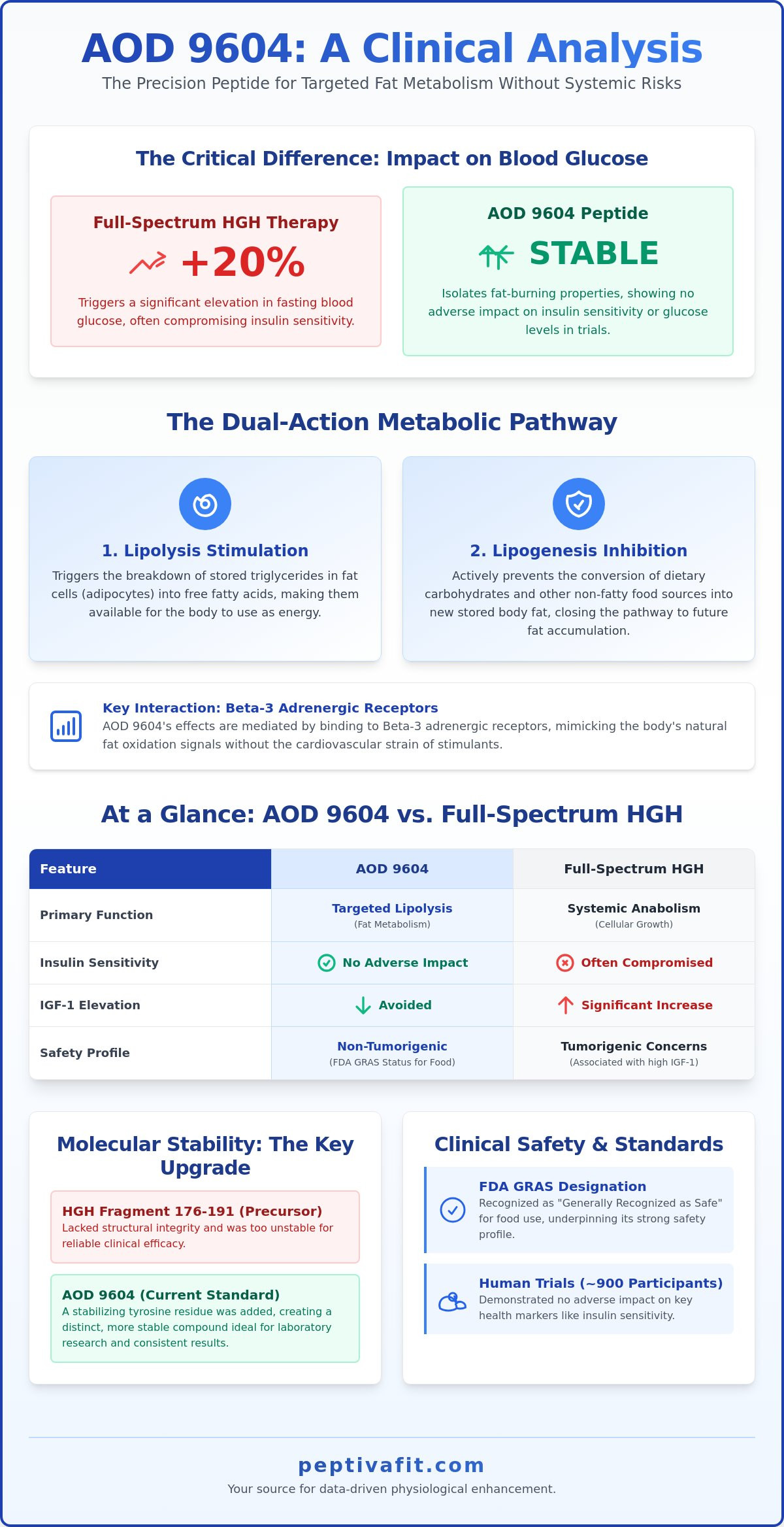
The prevailing assumption that all growth hormone-derived peptides inevitably compromise insulin sensitivity is factually incomplete. While full-spectrum HGH therapies often trigger a 20% elevation in fasting blood glucose, clinical evaluations of aod 9604 reveal a specialized mechanism that isolates fat-burning properties from undesirable glycemic effects. You've likely encountered the persistent confusion between this peptide and HGH Fragment 176-191; however, the addition of a stabilizing tyrosine residue makes the former a distinct, more stable compound for laboratory research. This clinical reference guide delivers a technical analysis of the peptide's lipolytic pathways, safety profiles derived from multi-stage human trials, and precise protocols for metabolic optimization. We'll dissect the biochemical interaction with beta-3 adrenergic receptors, address the 98% purity standards required for valid results, and provide a structured framework for data-driven physiological enhancement. By analyzing the 2024 data on adipocyte reduction, we'll clarify why this specific sequence remains the gold standard for targeted lipid metabolism without the systemic risks of traditional somatotropin.
Key Takeaways
- Understand the precise biochemical mechanism of aod 9604, focusing on its ability to stimulate beta-3 adrenergic receptors and trigger lipolysis without the systemic side effects of growth hormone.
- Evaluate the clinical safety data and the FDA "Generally Recognized as Safe" (GRAS) designation that underpins the peptide's viability within a professional metabolic framework.
- Examine the stability and bioavailability differences between C-terminal fragments and analogs like Tesamorelin to identify the most effective agent for visceral versus subcutaneous fat targeting.
- Learn the essential requirements for implementing a curated metabolic protocol, emphasizing the necessity of laboratory-grade standards and personalized medical oversight.
- Discover the historical evolution of peptide research and how specific molecular isolation allows for potent anti-obesity effects while maintaining glycemic stability.
The Origins and Evolution of AOD 9604
AOD 9604 represents a precise refinement in peptide engineering, designed specifically to isolate the metabolic benefits of human growth hormone (HGH) while discarding its systemic risks. It's a synthetic peptide consisting of the C-terminal fragment of the HGH molecule. Researchers developed this compound to address the global obesity epidemic, which has seen prevalence rates triple since 1975. By focusing on the lipolytic properties of growth hormone, scientists created a tool that mimics the body's natural fat-burning mechanisms without the hormonal complications associated with full-length recombinant human growth hormone (rHGH).
The chemical identity of AOD9604 is defined as a modified form of amino acids 177-191. This specific sequence is often referred to as the "lipolytic fragment" because it retains the ability to stimulate lipid metabolism. Unlike HGH, which acts as a broad-spectrum anabolic agent, aod 9604 functions as a specialized metabolic regulator. It doesn't bind to the growth hormone receptor in a way that triggers cellular proliferation; instead, it targets adipose tissue directly to promote the breakdown of fats.
The Discovery of the 177-191 Sequence
Researchers at Monash University identified that the fat-burning "tail" of the HGH molecule could function independently. Early iterations using the 176-191 fragment lacked the structural integrity for clinical efficacy. Stability was finally achieved through a disulfide bridge, which maintains the peptide's fold. This modification ensures the peptide remains active enough to interact with adipose cells, correcting the instability found in earlier fragments.
AOD 9604 vs. Recombinant Human Growth Hormone (rHGH)
Clinical differentiation centers on metabolic specificity. Standard rHGH protocols often lead to insulin resistance; however, aod 9604 demonstrated no adverse impact on insulin sensitivity in trials involving 900 participants. It also avoids elevating Insulin-like Growth Factor 1 (IGF-1), removing the tumorigenic concerns associated with traditional HGH. AOD 9604 is a non-tumorigenic metabolic tool that facilitates lipid oxidation without stimulating the IGF-1 pathway or inducing glucose intolerance.
Understanding the Dual Mechanism: Lipolysis and Lipogenesis Inhibition
The efficacy of aod 9604 is rooted in its ability to isolate the fat-reducing properties of Human Growth Hormone (HGH) without triggering its anabolic or diabetogenic side effects. This peptide operates via a dual-action pathway that targets adipose tissue through two distinct yet complementary processes: lipolysis and the inhibition of lipogenesis. By focusing on these specific metabolic levers, it provides a sophisticated method for managing body composition at a cellular level.
- Lipolysis: This is the biochemical breakdown of stored triglycerides into glycerol and free fatty acids, allowing them to be utilized as fuel.
- Lipogenesis Inhibition: This mechanism prevents the transformation of dietary carbohydrates and other non-fatty foods into new body fat, effectively closing the door on future storage.
This targeted approach is particularly effective against "stubborn" white adipose tissue. White adipose tissue (WAT) accounts for approximately 20 to 25 percent of body weight in healthy adults and serves as the primary storage site for excess energy. Unlike brown fat, which is thermogenic and easily mobilized, WAT is often resistant to traditional caloric deficits. AOD 9604 specifically addresses these reserves by mimicking the C-terminal fragment of HGH, which is the specific region responsible for fat metabolism.
The Beta-3 Adrenergic Receptor Connection
Beta-3 adrenergic receptors are the primary mediators of fat oxidation in the human body. When aod 9604 binds to these receptors, it mimics the natural signals generated during periods of intense physical exertion. This signaling cascade initiates a rapid metabolic response, forcing the body to prioritize fat as its primary energy source. Data from the AOD9604 Safety and Metabolism report indicates that this localized fat reduction occurs without the cardiovascular strain often seen with central nervous system stimulants. For those seeking a deeper understanding of these protocols, exploring a curated educational resource can provide the necessary context for informed research.
Impact on Metabolic Rate and Glucose Metabolism
A critical distinction of this peptide is its neutral impact on systemic glucose levels. While full-sequence HGH can lead to insulin resistance by elevating IGF-1, clinical observations from the 2014 toxicology reports confirm that AOD 9604 does not interact with the IGF-1 receptor or influence blood sugar. This allows for a clean metabolic shift where the synergy between lipolysis and cellular energy availability remains high. It's essential to recognize that the peptide's role is purely metabolic; it doesn't offer any form of appetite suppression or neurological satiety signaling, making it a tool for fat mobilization rather than behavioral modification.
Clinical Safety and the GRAS Designation
AOD 9604 is one of the few peptides to achieve Generally Recognized as Safe (GRAS) status in the United States, specifically under GRN 406. This designation follows an independent expert review of toxicological data and clinical evidence. It confirms that the peptide doesn't exhibit the proliferative or diabetogenic risks associated with its parent molecule, Human Growth Hormone. Maintaining this safety profile requires strict adherence to laboratory-grade research standards, ensuring the absence of contaminants or structural impurities that often plague mass-market alternatives. The clinical focus remains on its high specificity for fat cells without impacting systemic insulin sensitivity.
Human Clinical Trial Results
The clinical profile of this peptide is anchored by six major studies involving more than 900 human subjects. A comprehensive analysis of these Human Clinical Trials of AOD9604 demonstrates a consistent safety record across multiple delivery methods and timelines. Researchers observed that while dosage levels ranging from 0.25 mg to 1 mg per day were tested, the metabolic response often fluctuated based on the subjects' nutritional intake. Data suggests that the peptide's lipolytic efficacy is most pronounced when paired with a controlled caloric deficit. High-carbohydrate diets can trigger insulin spikes that interfere with the signaling pathways aod 9604 targets, leading to the varying results seen in earlier trial phases.
Potential Side Effects and Contraindications
Safety data indicates that systemic adverse events are exceedingly rare. Most reported issues are localized to the administration site, including temporary redness, itching, or swelling. Some participants in the 2001 to 2011 trial phases reported mild headaches or transient chest pain, though these symptoms typically resolved without medical intervention. Because aod 9604 doesn't stimulate the IGF-1 axis or negatively affect blood glucose levels, it's considered one of the most stable metabolic peptides in the current research landscape. Despite this profile, the following observations remain relevant for researchers:
- Injection Site Reactions: Localized redness occurs in approximately 3% of subjects.
- Systemic Stability: No neutralizing antibodies were formed during long-term 24-week trials.
- Metabolic Neutrality: No significant changes in heart rate or blood pressure were recorded at standard doses.
Professional oversight remains mandatory to monitor metabolic health markers and ensure that the research remains within established clinical boundaries. This disciplined approach ensures that individual performance optimization is grounded in data rather than speculation.
Comparing AOD 9604 with HGH Frag 176-191 and Tesamorelin
Understanding the distinction between various lipolytic agents is essential for precise laboratory protocols. Researchers often categorize aod 9604 alongside HGH Frag 176-191 and Tesamorelin, yet these compounds operate through different mechanisms and offer varying degrees of stability. Selecting the correct peptide requires an analysis of the target adipose tissue and the desired metabolic pathway.
The Stability Factor: Why AOD 9604 is the Superior Fragment
While HGH Frag 176-191 was the initial discovery in growth hormone fragment research, its clinical utility is limited by rapid enzymatic degradation. Scientists addressed this by adding a tyrosine residue to the C-terminal end, creating aod 9604. This specific chemical modification significantly increases the compound's resistance to proteolysis. This structural integrity extends the peptide's half-life in a research setting, providing a more consistent metabolic signal compared to the original fragment.
Bioavailability also separates these two. Original HGH Frag 176-191 is almost exclusively effective via subcutaneous injection due to its fragile nature. Data from metabolic studies indicates that the modified structure of the 9604 variant allows for potential oral or transdermal applications, though subcutaneous administration remains the gold standard for 100% systemic absorption. In laboratory environments, this stability translates to reproducible results and fewer fluctuations in lipolytic activity.
Selecting the Right Peptide for Body Composition
The choice between these peptides depends on the specific type of fat being targeted. Tesamorelin is a Growth Hormone Releasing Hormone (GHRH) analogue that primarily addresses visceral adipose tissue (VAT), the deep fat surrounding internal organs. It works by stimulating the pituitary gland to release endogenous growth hormone. In contrast, researchers prioritize AOD 9604 for general adiposity and subcutaneous fat reduction, as it mimics the lipolytic action of GH without systemic hormonal elevation. For more detailed application methods, review the Tesamorelin Dosage guide.
- AOD 9604: Best for localized subcutaneous fat and avoiding insulin sensitivity issues.
- Tesamorelin: Ideal for reducing visceral fat and improving the overall metabolic profile through GH secretion.
- Frag 176-191: A legacy compound with lower stability and limited bioavailability.
Synergy is a growing area of interest in performance research. Combining these agents can create a dual-pronged approach where Tesamorelin increases natural GH levels while the fragment ensures targeted lipolysis. This strategy is often explored in the Fat Loss Peptide Guide to maximize metabolic optimization. Additionally, incorporating GHK-Cu Peptide into a protocol may support skin elasticity and systemic repair as body composition shifts occur.
Advance your research with laboratory-grade data and access our curated peptide protocols for professional metabolic tracking.
Implementing AOD 9604 within a Curated Metabolic Protocol
Transitioning from clinical theory to practical application requires a disciplined framework. Success isn't accidental. It's the result of precise data integration and a commitment to laboratory standards. Before any protocol begins, a personalized medical assessment is mandatory. Expert facilities such as Houston Medical Wellness Clinic can provide this baseline evaluation to ensure that your metabolic profile can safely utilize aod 9604 without interference from underlying contraindications. High-performance wellness demands an objective starting point, not guesswork based on anecdotal evidence.
Quality control remains the most critical variable in peptide research. PeptivaFit exclusively recognizes lab-tested peptides as the standard for informed decision-making. We verify every batch through third-party liquid chromatography-mass spectrometry (LC-MS) to ensure a purity threshold of at least 98%. Research conducted with unverified materials introduces unnecessary risk and compromises the integrity of your metabolic tracking. A serious approach to performance optimization treats the laboratory source with as much scrutiny as the protocol itself.
The Peptiva Protocol: Integration and Oversight
PeptivaFit ensures laboratory verification for all research supplies to maintain clinical precision. Our methodology integrates medical consultations to tailor peptide sequences to the individual's specific biological markers. DIY peptide use often leads to suboptimal metabolic outcomes because it lacks the necessary oversight and data-driven adjustments. We provide a curated environment where performance is measured by quantifiable results rather than marketing hype. This structured oversight transforms raw data into a functional strategy for metabolic mastery.
Maximizing Lipolysis: Timing and Environment
The efficacy of aod 9604 depends heavily on the physiological environment. Clinical data from the 2004 Metabolic Pharmaceuticals trials suggest that fasted states significantly enhance lipolytic activity. Administering the peptide during low-insulin windows allows for uninhibited access to adipose tissue. Synergy with cardiovascular exercise further accelerates fat oxidation by increasing metabolic demand; for example, the high-efficiency EMS training at Bodytec Lemmer provides a powerful stimulus during these peak action windows. To refine these variables into a personalized strategy, the next step involves booking a single consultation call for protocol design. Our coaching provides the 1-on-1 expertise required to move beyond basic information into high-level metabolic execution.
- Fasted Administration: Optimal results occur when insulin levels are at their lowest baseline.
- Exercise Synergy: Low-intensity steady-state (LISS) cardio maximizes the peptide's fat-burning potential.
- Metabolic Tracking: Consistent monitoring of body composition and glycemic markers is required for protocol adjustments.
Professional coaching serves as the bridge between research and reality. It's the difference between a generic application and a high-stakes metabolic intervention. For female researchers looking to integrate structured physical activity into their protocol, you can learn more about Nuli App to explore workout programs tailored for women. By prioritizing laboratory-grade standards and clinical oversight, you ensure that your journey toward optimization is both safe and scientifically sound.
Refining Metabolic Outcomes Through Precision Peptide Application
The clinical trajectory of aod 9604 represents a significant milestone in fat-specific metabolic research. By isolating the lipolytic effects of growth hormone without disrupting insulin sensitivity or IGF-1 levels, this peptide provides a targeted mechanism for adipose tissue reduction. Monash University researchers established this foundation in the late 1990s, eventually leading to the compound's GRAS designation for its established safety profile. Effective results aren't accidental; they require a disciplined framework that combines high-purity research materials with rigorous clinical tracking. You'll find that moving beyond generic advice toward a data-centric protocol is the only way to ensure measurable physiological progress.
PeptivaFit delivers this level of professional scrutiny through a private, curated platform. Their services feature third-party lab-verified peptide purity and include personalized medical assessments to identify your specific biological needs. You'll also work with expert 1-on-1 metabolic coaching to maintain strict adherence to your performance goals. Access the Peptiva Protocol and Lab-Tested Peptides to secure the expertise required for your metabolic evolution. It's time to leverage professional-grade tools for your long-term wellness strategy.
Frequently Asked Questions
Is AOD 9604 a steroid or a hormone?
AOD 9604 isn't a steroid or a complete hormone; it's a 15-amino acid peptide fragment derived from the C-terminus of Human Growth Hormone. Specifically, it represents positions 177 through 191 of the HGH chain. Unlike anabolic steroids that bind to androgen receptors, this peptide targets fat metabolism without affecting growth or insulin levels. Clinical data from Metabolic Pharmaceuticals indicates it lacks the systemic hormonal impact found in full-sequence HGH administration.
How long does it take to see results with AOD 9604?
Clinical observations typically show measurable changes in lipid metabolism within 12 weeks of consistent administration. In a 2004 clinical trial involving 300 obese subjects, those receiving daily doses showed weight loss compared to the placebo group over a 90-day period. Individual research outcomes vary based on metabolic baselines, but the 12-week mark remains the standard benchmark for assessing efficacy in laboratory settings. Consistency in the protocol is vital for accurate data collection.
Does AOD 9604 require a specific diet to be effective?
Optimal results with aod 9604 require a caloric deficit and a fasted state during administration to maximize lipolytic activity. The peptide functions by stimulating the pituitary gland's fat-burning response, which is most effective when insulin levels are low. Research protocols often implement a 4-hour fasting window post-administration. This ensures the peptide interacts with adipose tissue without interference from dietary glucose or insulin spikes that occur after meal consumption.
Can AOD 9604 cause insulin resistance like HGH?
AOD 9604 doesn't cause insulin resistance or hyperglycemia, which are common side effects of full-sequence growth hormone. Because it lacks the N-terminal sequence responsible for IGF-1 elevation, it doesn't compete for insulin receptors. A 2001 study published in the Journal of Endocrinology confirmed that the 177-191 fragment promotes fat oxidation without negatively impacting blood glucose levels. This makes it a specialized tool for researchers focusing on metabolic health without glycemic risk.
What is the difference between AOD 9604 and HGH Fragment 176-191?
The primary difference is that aod 9604 is a stabilized version of HGH Fragment 176-191, achieved through the addition of a tyrosine residue at the N-terminal end. This modification improves the peptide's metabolic stability and absorption profile compared to the standard fragment. While both target the same lipolytic pathways, the AOD variant was specifically developed for pharmaceutical applications. It underwent more rigorous clinical testing during its initial development phases to ensure structural integrity.
Is AOD 9604 legal for use in athletic competitions?
AOD 9604 is currently prohibited for use in professional sports under the World Anti-Doping Agency (WADA) Prohibited List. It falls under Section S2 as a peptide hormone mimetic. Athletes testing positive for this substance face suspension periods, such as the 12-month bans issued in high-profile 2013 Australian sports investigations. It's strictly reserved for laboratory research purposes. Professional organizations view its fat-oxidizing properties as a performance-enhancing advantage that violates fair play standards.
How should AOD 9604 be stored to maintain its stability?
Lyophilized peptide powder should be stored in a freezer at -20°C to maintain stability for up to 24 months. Once the researcher reconstitutes the peptide with bacteriostatic water, it must be kept in a refrigerated environment between 2°C and 8°C. Exposure to direct sunlight or temperatures exceeding 25°C for more than 48 hours will lead to rapid degradation of the amino acid chain. This degradation renders the sample ineffective for precise laboratory data collection.
What happens if I miss a scheduled dose in my research protocol?
Missing a scheduled dose in a research protocol requires resuming the standard schedule at the next designated interval without doubling the dosage. Doubling a dose doesn't compensate for the missed window and may lead to inconsistent data regarding the peptide's half-life. Maintaining a consistent 24-hour administration cycle is vital for tracking the long-term lipolytic effects. Deviations should be documented in the research log to maintain the integrity of the clinical study results.

![Shelf Life of Reconstituted Peptides: A Clinical Reference Guide [2026]](https://getautoseo.com/storage/hero_images/shelf-life-of-reconstituted-peptides-a-clinical-reference-guide-2026.jpg?v=b8ed5173acaa)
