

Peptide efficacy is a function of both molecular integrity and physiological timing; a technical error in either renders the compound inert. You've likely invested significant resources into your optimization protocol, yet even a minor deviation in reconstitution or depth can compromise your biological data. Many individuals struggle with common mistakes with peptide injections that lead to unnecessary site reactions or degraded bioactivity. Identifying these technical failures is essential for anyone serious about high-level performance and wellness.
It's understandable to feel anxious about wasting expensive compounds or experiencing local irritation from improper technique. You deserve a protocol that yields predictable, scientific-grade results without the guesswork. This clinical guide identifies the procedural errors that sabotage your progress and provides the exact standards needed for flawless administration. We'll examine the nuances of reconstitution ratios and the critical importance of sourcing from regulated compounding pharmacies as the FDA continues its July 2026 review of peptide substances. By mastering these technical requirements, you ensure your investment translates into maximized bioavailability and superior physiological outcomes.
Key Takeaways
- Learn why direct solvent contact during reconstitution can degrade fragile peptide chains and how to preserve molecular stability through precise handling.
- Master the specific needle angles and site rotation strategies required to prevent lipohypertrophy and ensure consistent subcutaneous absorption.
- Identify the most common mistakes with peptide injections, including the technical failures in metabolic timing that can render your protocol ineffective.
- Understand the physiological conflict between insulin and growth hormone secretagogues to optimize your administration schedule for maximum metabolic receptivity.
- Discover how lab-verified purity and professional 1-on-1 coaching provide the necessary oversight to troubleshoot individual administration hurdles.
The Clinical Margin of Error in Peptide Administration
The distinction between pharmaceutical-grade administration and casual research is often the difference between physiological transformation and total protocol failure. In the pursuit of metabolic optimization, the margin of error is remarkably slim. Unlike traditional vitamins or stable hormones, peptides require a disciplined environment to maintain their bioactivity. When an individual approaches these compounds with a casual mindset, they risk more than just financial loss; they risk systemic inefficiency and the administration of inert substances.
Protocol compliance defines the boundary between those who achieve documented results and those who remain stagnant. Many common mistakes with peptide injections occur before the needle even touches the skin. These errors are cumulative. A single instance of improper storage or a slight deviation in reconstitution might seem negligible, but over a twelve-week cycle, these minor failures compromise long-term fat loss and recovery goals. True optimization demands a transition from "dosage guessing" to a rigorous, data-driven clinical standard.
Understanding Peptide Fragility
Molecular integrity is the cornerstone of efficacy. Peptides are short chains of amino acids held together by peptide bonds that are susceptible to extreme mechanical stress. While a vial of testosterone or a B12 solution can withstand significant movement, peptides are notoriously delicate. Rough handling, such as shaking a vial or exposing the lyophilized powder to rapid temperature shifts, can cause these bonds to shear. This leads to immediate molecular degradation, rendering the compound biologically useless. The economic and physiological cost of administering an inert compound is high, as it stalls progress and introduces unnecessary variables into your metabolic data.
The Role of Precision in Bio-Optimization
Achieving flawless results requires moving beyond the "gray market" mentality and embracing clinical precision. Establishing a sterile, disciplined environment for your research is a non-negotiable prerequisite. This starts with a personalized medical assessment to determine baseline biomarkers and individual receptivity. Without this data, you're essentially operating in the dark. Common mistakes with peptide injections often involve using generic protocols that don't account for individual metabolic nuances. By prioritizing lab-tested peptides and professional oversight, you eliminate the technical hurdles that lead to site reactions and sub-optimal bioavailability. Precision isn't just about the injection itself; it's about the entire procedural lifecycle from the pharmacy to the cellular receptor.
Molecular Integrity: Errors in Reconstitution and Handling
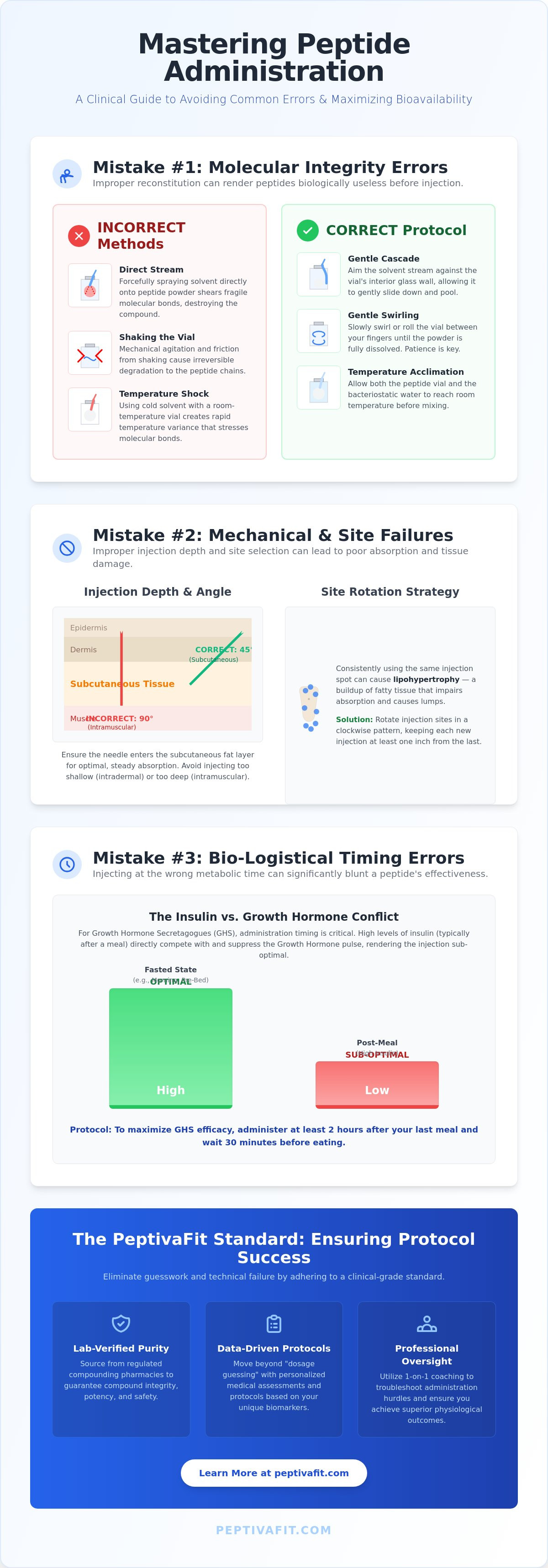
Reconstitution is the most volatile stage of peptide administration. It's a delicate chemical transition where the compound is most vulnerable to external stressors. One of the most frequent common mistakes with peptide injections involves the "Direct Stream" error. When introducing bacteriostatic water, the vacuum seal within the vial often pulls the solvent in with significant force. If this stream hits the lyophilized powder directly, the mechanical impact can shear the fragile amino acid chains, rendering the batch biologically inert. Instead, you must aim the solvent at the interior glass wall, allowing it to cascade gently onto the powder.
Temperature shock is another overlooked procedural failure. Many individuals use refrigerated bacteriostatic water to reconstitute peptides that have been sitting at room temperature. This rapid thermal variance can stress the molecular bonds. Always ensure your solvent and the peptide vial have reached a similar temperature before beginning the process. Additionally, the volume of solvent used is not arbitrary. Using too little water makes precise dosing difficult, while too much can over-dilute the compound, potentially affecting its stability over time. Precision in measurement is the only way to maintain a scientific-grade protocol.
The Science of Solubilization
Proper solubilization requires patience and a controlled environment. You should allow the solvent to enter the vial slowly by maintaining control over the syringe plunger against the vacuum's pull. Once the liquid is inside, never shake the vial. Mechanical agitation is a primary cause of degradation. Use a gentle swirling motion until the solution is completely clear. Injecting a cloudy solution or one with visible undissolved particles is a major error that compromises bioavailability. For a more detailed breakdown of these technical steps, refer to our guide on how to reconstitute peptides.
Storage Failures Post-Reconstitution
The lifecycle of a peptide doesn't end with successful reconstitution. Post-mixing stability is highly dependent on environmental factors like UV exposure and thermal consistency. Storing vials in the door of a refrigerator exposes them to constant temperature fluctuations and light. High-end protocols require storage in the main body of the fridge, ideally in a light-shielded container. Another frequent error among common mistakes with peptide injections is pre-loading syringes days in advance. The plastic and rubber components of a syringe aren't designed for long-term storage and can leach into the solution or cause the peptide to "crash" out of the liquid. Understanding the risks and side effects associated with degraded compounds is essential for maintaining safety. If you're unsure about your current technique, seeking professional oversight can help rectify these procedural gaps before they impact your results.
Mechanical Failures: Depth, Angle, and Site Selection
Mechanical failures represent the final barrier between a potent compound and its intended biological target. While molecular integrity is paramount, the physical delivery determines the rate of absorption and the presence of adverse site reactions. One of the most frequent common mistakes with peptide injections is the "dull needle" error. Using the same needle to draw from the vial and then inject into the tissue is a procedural failure. The rubber stopper on the vial is designed for a single pass; it immediately blunts the microscopic bevel of the needle. This causes unnecessary tissue trauma, increased pain, and localized inflammation. Professional protocols always mandate a fresh needle for the final administration.
Angle selection is equally critical, especially for lean individuals. While a 90-degree insertion is standard for many, those with lower body fat percentages risk penetrating the muscle layer prematurely. A 45-degree angle ensures the compound remains in the subcutaneous adipose tissue where it can be absorbed at the intended rate. Beyond the angle, site exhaustion is a cumulative problem. Failing to maintain a strict rotation map leads to lipohypertrophy, a condition where localized fat cells harden or scar tissue forms. This creates a physiological barrier that prevents the peptide from reaching systemic circulation, effectively wasting the compound.
Subcutaneous vs. Intramuscular Precision
Precision requires identifying the specific tissue layer required for the protocol. Peptides like AOD-9604 or Frag 176-191 are specifically designed to interact with adipose tissue. Deep intramuscular (IM) injections for these compounds are counterproductive; they bypass the intended metabolic environment and can lead to rapid clearance before the peptide can exert its effect. Additionally, staying within the subcutaneous layer reduces the risk of hitting "hot spots" like nerves or blood vessels. If you're struggling to identify the correct depth for your body composition, a single consultation call can provide the technical clarity needed to refine your technique.
Post-Injection Discipline
The protocol doesn't end when the needle is withdrawn. Many people make the mistake of massaging the injection site, believing it aids distribution. In reality, this mechanical pressure can disrupt the intended absorption rate and cause localized bruising or irritation. Minor site reactions, such as redness or slight itching, are common but should be monitored without disrupting the protocol. Aspiration remains a debated step in research circles. While modern subcutaneous needles are short enough that the risk of vascular entry is low, maintaining high research standards often involves a brief pause to ensure no blood return. This discipline separates casual users from those committed to scientific-grade optimization and helps avoid common mistakes with peptide injections that compromise safety.
The Bio-Logistics of Timing and Metabolic Receptivity
Achieving pharmacological precision requires more than mechanical accuracy; it demands an understanding of metabolic receptivity. One of the most significant common mistakes with peptide injections is ignoring the insulin-antagonist relationship. Growth hormone (GH) secretagogues, for instance, are highly sensitive to blood glucose levels. When you inject these compounds shortly after consuming carbohydrates, the resulting insulin spike blunts the pituitary response. This renders the administration significantly less effective as the exogenous signal is overridden by the body's nutrient-processing state. This systemic failure often stems from a lack of understanding regarding nutrient-hormone interactions.
Biological half-lives are strictly defined and unforgiving. Irregular dosing schedules create volatile serum levels, which prevents the body from maintaining a steady-state environment for metabolic optimization. Circadian rhythms also dictate receptivity. Administering a peptide at a sub-optimal time of day ignores the natural pulsatile nature of endocrine function. Growth hormone secretagogues are most effective when they align with the body's natural nocturnal pulses. Systemic dehydration further complicates this by increasing the viscosity of the interstitial fluid, which slows the diffusion of the peptide from the injection site to the bloodstream and impairs overall transport.
Fasted State Requirements
The physiological rationale for a strict two-hour pre and post-injection fast is rooted in hormonal signaling. Elevated blood glucose acts as a primary inhibitor for several metabolic pathways. For example, the Tesamorelin dosage guide highlights how timing is critical for visceral fat reduction. If the metabolic environment is crowded with nutrients, the peptide's signal is lost in the noise and the intended pituitary response is blunted.
Synergistic Lifestyle Integration
Peptides function as biological signals, but those signals require a receptive host. Using these compounds as a crutch for poor sleep hygiene is a significant tactical error. Deep sleep is the primary window for natural recovery; peptides should enhance this process rather than compensate for its absence. Training intensity must also mirror the metabolic signal provided. Regular monitoring through a personalized medical assessment allows for the fine-tuning of these bio-logistics to ensure your protocol remains optimized for your specific biomarkers and avoids common mistakes with peptide injections.
The PeptivaFit Standard: Ensuring Protocol Success
The transition from a casual user to a disciplined metabolic researcher requires a fundamental shift in procedural philosophy. While previous sections detailed technical failures that compromise results, achieving excellence involves an integrated approach where molecular integrity and professional oversight converge. By adopting the PeptivaFit standard, you bypass the common mistakes with peptide injections that frequently plague unregulated research environments. Success isn't found in a single dose; it's the result of a precise, repeatable lifecycle of administration.
Lab-verified purity is the non-negotiable foundation of this standard. Administering compounds without documented third-party analysis is a primary cause of protocol failure. PeptivaFit ensures that every compound meets strict purity thresholds, eliminating the risk of contaminants or sub-potent batches that stall metabolic progress. This level of transparency allows you to focus on optimization rather than questioning the integrity of your supplies. When you move away from gray-market uncertainty, you gain the control necessary for high-level performance enhancement within the PeptivaFit framework.
Leveraging Professional Oversight
Technical precision often requires a second set of expert eyes to identify subtle errors in form or timing. 1-on-1 coaching serves as a critical diagnostic tool to troubleshoot individual injection hurdles, such as persistent site reactions or confusion regarding reconstitution math. A single consultation call can provide the definitive clarity needed to verify your technique before you commit to a full cycle. This professional guidance allows you to customize the fat loss peptide guide to your specific biology, ensuring that your protocol aligns with your unique biomarkers and metabolic goals through high-purity PeptivaFit supplies.
Final Protocol Checklist
Clinical discipline is maintained through a structured pre-injection routine. Before every administration, perform a 30-second mental rehearsal to confirm your environment is sterile, your solvent is at the correct temperature, and your fasted state is verified. Documentation is the final pillar of a successful protocol. You must record every dose, the specific injection site, and any localized reactions to create a data-driven map of your progress. This level of detail transforms a simple injection into a sophisticated scientific investigation. To begin your journey with the highest level of clinical precision, Secure your Personalized Medical Assessment today. This assessment provides the data-driven foundation required to avoid common mistakes with peptide injections and achieve the flawless execution your protocol demands.
Mastering the Precision of Peptide Administration
Transitioning from a casual approach to a disciplined clinical standard is the only way to ensure your metabolic signals aren't lost to technical error. We've established that molecular integrity depends on precise reconstitution and that metabolic receptivity is governed by the strict timing of your fasted state. Avoiding common mistakes with peptide injections requires a commitment to data-driven optimization and a rejection of the guesswork that often leads to sub-optimal results. By prioritizing mechanical accuracy and biological timing, you protect both your investment and your physiological progress.
True optimization demands more than just a vial and a syringe; it requires a structured ecosystem of purity and expertise. You can Optimize Your Protocol with the Peptiva Protocol Fat Loss Guide to access lab-verified peptide purity standards and expert 1-on-1 clinical coaching. This science-backed metabolic optimization framework eliminates the variables that compromise efficacy, providing you with a clear path toward your performance goals. With the right data and a refined technique, you're now equipped to execute your protocol with absolute confidence and clinical precision.
Frequently Asked Questions
What should I do if I see a small bubble in the syringe before injecting?
You should expel the air bubble by gently tapping the syringe and depressing the plunger until a tiny drop of solution appears at the needle tip. While small amounts of air in subcutaneous tissue aren't clinically life-threatening, they displace the active compound and compromise dosage accuracy. Precision is the standard of any high-level protocol. Don't allow minor mechanical errors to introduce variables into your metabolic data.
Can I mix two different peptides in the same syringe to save time?
Mixing two different peptides in a single syringe is generally discouraged unless they're part of a pre-formulated blend. Different compounds have varying pH levels and stability requirements; combining them can cause immediate molecular degradation or precipitation. To maintain the integrity of your research, administer each compound separately. This ensures localized absorption isn't compromised by chemical interference or unforeseen molecular reactions between the two substances.
Is it normal to have a small red bump at the injection site after a subcutaneous shot?
A small red bump or localized irritation is a common physiological response to the injection process or the bacteriostatic water's preservative. This typically resolves within 24 to 48 hours. Persistent or spreading redness can indicate one of the common mistakes with peptide injections related to poor sterilization or using a dull needle. You should monitor the site for any signs of systemic inflammation or infection to ensure your protocol remains safe.
What happens if I accidentally shake the peptide vial after reconstitution?
Shaking the vial after reconstitution can lead to mechanical degradation of the fragile peptide bonds. These amino acid chains are susceptible to shearing forces that render the compound biologically inert. If you've accidentally agitated the solution, inspect it for cloudiness or particulates. While the batch might not be dangerous, its efficacy is likely compromised. This leads to sub-optimal results and a waste of high-purity research materials.
How long can a reconstituted peptide stay out of the refrigerator before it degrades?
A reconstituted peptide should remain out of the refrigerator for no more than 15 to 30 minutes during administration. Thermal degradation begins as the solution reaches room temperature, which accelerates the breakdown of the molecular structure. Maintaining a strict cold chain is essential for preserving the bioactivity of the compound over its intended lifecycle. Don't compromise your protocol's success by allowing thermal variance to destabilize your reconstituted vials.
Why is it recommended to inject peptides on an empty stomach?
Injecting on an empty stomach is necessary to avoid the insulin conflict that blunts growth hormone secretagogue effectiveness. Elevated blood glucose levels from carbohydrate or fat consumption act as a physiological inhibitor to the pituitary response. By maintaining a fasted state for at least two hours before and after administration, you ensure the metabolic signal isn't overridden by nutrient processing. This discipline is required to maximize the bioavailability of your optimization protocol.
Does the needle gauge affect the absorption rate of the peptide?
The needle gauge doesn't significantly alter the systemic absorption rate, but it does impact localized tissue trauma. Thinner gauges, such as 31G, are preferred for subcutaneous administration to minimize scarring and inflammation. Using an inappropriately thick needle is one of the common mistakes with peptide injections that can lead to site exhaustion and lipohypertrophy over time. Discipline in tool selection is a prerequisite for maintaining long-term site health.
What are the signs that my peptides have been contaminated or have lost their potency?
Signs of contamination include visible cloudiness, particulates, or a change in the solution's color. Loss of potency is more difficult to detect visually but is often identified by a sudden lack of expected physiological response or biomarker changes. If the solution appears "crashed" or shows any precipitate, the molecular integrity is lost. You should discard the vial immediately to maintain the clinical standards of your metabolic research.

![Shelf Life of Reconstituted Peptides: A Clinical Reference Guide [2026]](https://getautoseo.com/storage/hero_images/shelf-life-of-reconstituted-peptides-a-clinical-reference-guide-2026.jpg?v=b8ed5173acaa)
