

What if the primary risk of peptide therapy isn't the molecular sequence itself, but the absence of a disciplined, clinical-grade monitoring protocol? While these signaling molecules offer profound benefits, the long term side effects of peptides remain a significant concern for individuals who prioritize sustained health over temporary performance gains. You're likely aware of the potential for optimization, yet you're rightfully cautious about permanent hormonal downregulation or the risks inherent in the unregulated research chemical market.
This article provides a professional framework to understand how chronic administration impacts receptor sensitivity and organ health. Since the FDA began enforcing stricter compounding rules in January 2025 and reclassified 12 key peptides in April 2026, the landscape of safety has shifted toward rigorous data monitoring. At PeptivaFit, we emphasize identifying high-purity materials and implementing protocols designed to mitigate risks like immunogenicity. You'll gain a clear understanding of receptor desensitization and the criteria necessary for a safe, sophisticated approach to long-term wellness.
Key Takeaways
- Contrast acute localized reactions with the systemic adaptations that characterize the long term side effects of peptides.
- Analyze how chronic secretagogue administration impacts the pituitary-adrenal axis and identify the risks of suppressed endogenous hormone production.
- Recognize the cumulative toxicity risks associated with residual solvents and heavy metals frequently found in unverified research-grade materials.
- Implement clinical "washout" periods and a strategic cycling philosophy to maintain receptor sensitivity and ensure metabolic longevity.
- Establish a professional safety framework by integrating a personalized medical assessment to monitor your physiological markers over time.
Understanding the Long-Term Physiological Profile of Peptide Therapy
Peptides are short chains of amino acids that act as specialized signaling molecules, instructing the body to perform specific biological functions. While the human body naturally metabolizes these chains, the introduction of exogenous analogs over extended durations creates a complex physiological environment. Clinical oversight is essential to distinguish between the body's immediate response and the systemic adaptations that may emerge over years of use. Understanding the long term side effects of peptides requires a shift in focus from immediate performance outcomes to the preservation of endogenous signaling pathways.
The landscape of Peptide therapeutics has evolved rapidly, particularly following the April 15, 2026, reclassification of 12 substances like BPC-157 and TB-500. There is a critical distinction between FDA-approved peptides, which have undergone rigorous longitudinal human trials, and research analogs that lack extensive multi-year data. Without professional monitoring, an individual may ignore subtle markers of systemic fatigue. They often assume that the absence of acute discomfort equates to long-term safety, which is a dangerous oversight in a sophisticated wellness protocol.
Acute vs. Chronic Side Effects: The Temporal Distinction
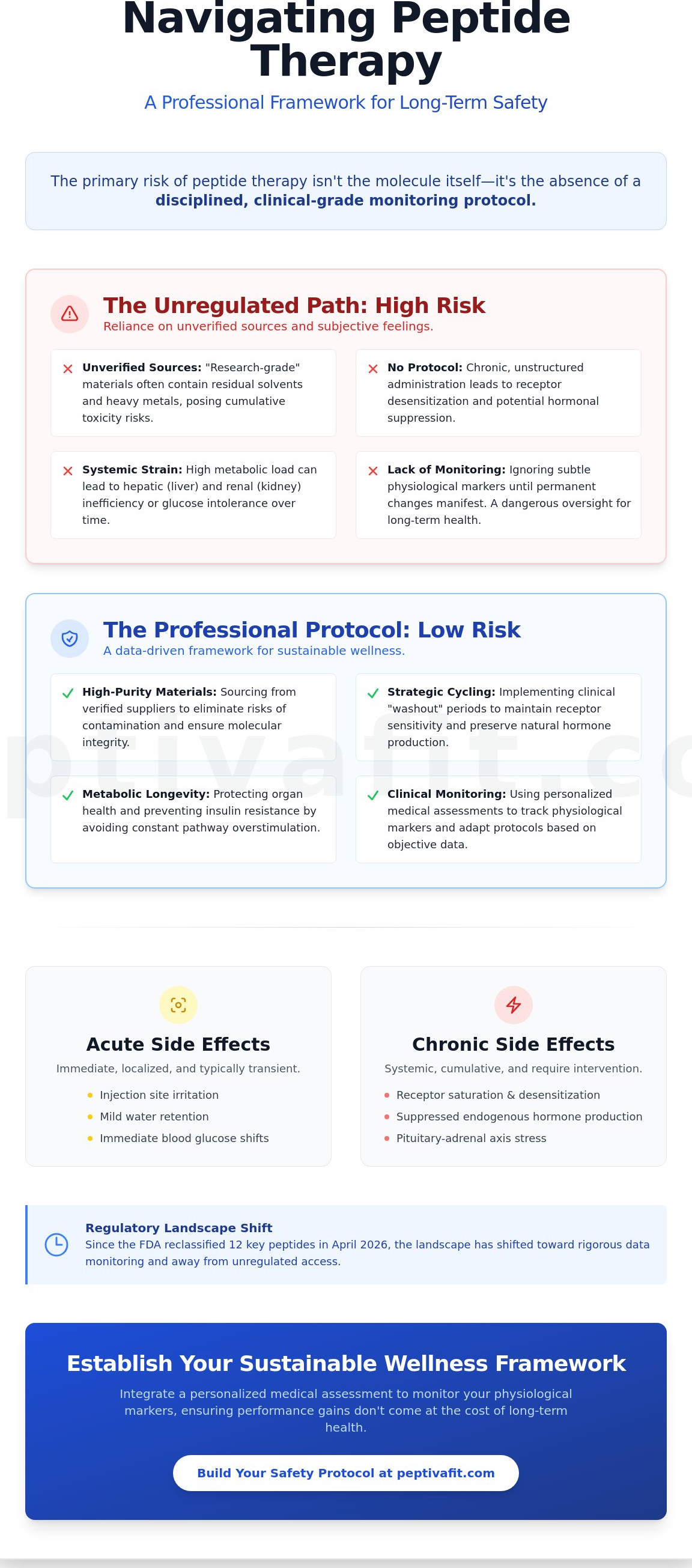
Acute side effects are typically localized and transient. These include injection site irritation, mild water retention, or immediate fluctuations in blood glucose levels. These reactions are often manageable; they usually subside as the body adjusts to the initial administration. Chronic effects involve deeper systemic shifts. Prolonged use can lead to receptor saturation, where the body’s natural receptors become less responsive to both exogenous and endogenous signals. This desensitization may eventually cause a decline in natural hormone production as the body relies on external cues. Short-term safety data cannot be directly extrapolated to multi-year protocols because biological feedback loops operate on much longer cycles.
The Current State of Longitudinal Research in 2026
While established peptides like insulin have decades of longitudinal data, newer synthetic sequences often lack comprehensive 10-year human studies. The primary challenge in monitoring these substances lies in their high binding affinity, which can lead to prolonged receptor occupancy. This sustained activation may contribute to the long term side effects of peptides when they are used without structured intervals. In 2026, the scientific community recognizes that individual metabolic variance is a significant factor in safety. What remains stable for one person may cause pituitary-adrenal axis stress in another. Data-driven monitoring is the only reliable method to identify these variances before they manifest as permanent physiological changes.
Potential Systemic Impacts of Prolonged Peptide Administration
Prolonged peptide administration necessitates a sophisticated understanding of systemic feedback mechanisms. While acute effects are often transient, the chronic introduction of exogenous signaling molecules can impose a significant metabolic load on the liver and kidneys. These organs are responsible for processing and clearing these amino acid sequences; excessive frequency or dosage may lead to hepatic strain or renal inefficiency over time. Additionally, specific growth-hormone mimetics carry a documented risk of inducing glucose intolerance. When these pathways are stimulated without reprieve, the body may develop compensatory insulin resistance, highlighting the long term side effects of peptides when used outside a controlled clinical framework.
Clinical researchers often discuss potential long-term safety concerns of peptides in the context of growth pathway overstimulation. Constant activation of these pathways requires diligent monitoring of glycemic markers to prevent metabolic dysfunction. Maintaining a balanced internal environment is easier when you utilize a personalized medical assessment to establish baseline metrics and track physiological shifts. This disciplined approach ensures that performance gains don't come at the expense of metabolic health.
Receptor Desensitization and Downregulation Mechanisms
The biochemical process of receptor internalization serves as a protective adaptation against chronic overstimulation. When receptors are constantly bombarded by synthetic ligands, the cell physically pulls these receptors inward, reducing the surface area available for binding. This mechanism explains why high-frequency dosing schedules often result in diminished returns and physiological resistance. Receptor downregulation is the cellular defense against chronic exogenous signaling. Without structured breaks, the effectiveness of the protocol decreases while the potential for systemic imbalance increases. Chronic exposure without recovery intervals effectively trains the body to ignore the very signals you're trying to enhance.
Hormonal Feedback Loops and Endogenous Interference
A common concern is the total "shutdown" of natural hormone production. While complete cessation is rare compared to traditional anabolic steroids, the reality involves a significant blunting of natural pulses. In the GHRH and GHS pathways, long-term feedback inhibition can lead to "lazy" endogenous production. The pituitary gland may reduce its natural output because it perceives a constant surplus of signaling molecules. This creates a state of dependency where natural production cannot meet physiological needs without external aid. Strategies for maintaining a natural baseline include implementing strategic washout periods and using the lowest effective dose. These measures ensure that the body's natural endocrine rhythm remains intact during and after the protocol. Monitoring the long term side effects of peptides involves tracking these hormonal baselines to ensure the pituitary-adrenal axis remains responsive to internal stimuli.
The Invisible Risk: Chronic Impurity Exposure from Unverified Sources
The gray market for research chemicals operates with a lack of regulatory oversight that introduces severe systemic toxicity risks. Recent industry shifts, including the voluntary shutdown of prominent U.S. vendors on March 6, 2026, underscore the volatile and often compromised nature of these unverified sources. While earlier sections addressed physiological adaptations to the molecules themselves, the long term side effects of peptides are often exacerbated by industrial contaminants that the body cannot naturally recycle. You aren't just administering a signaling molecule; you're potentially introducing micro-doses of heavy metals and solvents that accumulate in your tissues over years of use.
Chronic exposure to residual solvents like Trifluoroacetic acid (TFA) presents a persistent metabolic challenge. These solvents are necessary for peptide synthesis but must be rigorously removed during the final purification stages. When you bypass clinical-grade sourcing, you risk the ingestion of these chemical byproducts. High-purity standards require batch-specific verification to ensure these cumulative toxins don't compromise your long-term renal or hepatic health. Professional-grade protocols demand a level of transparency that the research chemical market simply isn't designed to provide.
Heavy Metal Accumulation and Systemic Toxicity
Low-tier manufacturing facilities often prioritize volume over purity, resulting in the presence of lead, arsenic, or mercury in the final product. These elements are neurotoxic and nephrotoxic. They don't exit the system through standard metabolic pathways. Over a multi-year protocol, even trace amounts can lead to cognitive decline or decreased kidney function. Marketing claims of "99% purity" are meaningless without verified laboratory documentation. True safety requires a commitment to materials that have been screened for these systemic threats through HPLC and Mass Spectrometry testing.
Immunogenic Responses to Molecular Impurities
Incorrectly folded or truncated peptide sequences pose a unique hazard to your immune system. When the body encounters a sequence that mimics a human hormone but contains structural errors, it may trigger an autoimmune-like reaction. This leads to the development of neutralizing antibodies that target both the exogenous peptide and your natural production. Chronic low-grade inflammation from impure materials is a primary driver of long-term physiological decline. Utilizing lab tested peptides from PeptivaFit ensures that the molecular structure is precise enough to avoid these dangerous immunogenic triggers and protect your internal ecosystem.
Mitigating Long-Term Risks through Clinical Monitoring and Protocols
Proactive management is the only defense against the physiological adaptations associated with chronic use. While previous sections detailed the mechanisms of receptor downregulation and impurity risks, mitigation relies on a disciplined framework of objective data and strategic recovery. To minimize the long term side effects of peptides, a user must move beyond subjective feeling and rely on precise blood chemistry. This high-level oversight ensures that signaling pathways remain responsive and that metabolic health is preserved through every phase of the protocol. You can't rely on guesswork when your endocrine health is at stake.
Protocol adjustments aren't based on intuition; they require regular laboratory verification. For instance, optimizing a tesamorelin dosage involves tracking visceral adipose tissue reduction alongside glycemic markers. If fasting glucose levels begin to trend upward, the protocol must be adjusted or paused to prevent insulin resistance. This data-driven approach allows for sophisticated control over your physiological trajectory. If you're ready to implement a professional-grade safety strategy, you can schedule a single consultation call to review your current markers and refine your approach.
The Role of Strategic Cycling and Recovery
A "Cycle-On, Cycle-Off" philosophy is fundamental to maintaining metabolic longevity. A standard duration often involves 12 weeks of active administration followed by a mandatory 4-week washout period. This interval allows the body to return to homeostatic baselines and restores receptor sensitivity. Without these breaks, the risk of developing blunted natural pulses increases significantly. Immediate cessation is necessary if you experience persistent edema, significant joint discomfort, or unexplained lethargy. These symptoms often serve as early indicators that the system is overtaxed and requires a recovery phase to prevent the long term side effects of peptides from becoming permanent. It's a long-term process, not a quick fix.
Essential Biomarkers for Long-Term Safety
Monitoring blood chemistry every 90 to 180 days provides a clear record of systemic health. Key biomarkers include:
- HbA1c and Fasting Insulin: These detect early metabolic shifts and potential insulin resistance caused by growth-hormone mimetics.
- IGF-1 and IGFBP-3 Ratios: These markers provide a window into the health of the growth hormone axis and ensure signaling remains within physiological limits.
- Liver Enzymes (AST/ALT): Essential for monitoring the hepatic processing of exogenous loads.
- Kidney Function (eGFR): Regular checks ensure that renal clearance remains efficient over multi-year durations.
Maintaining these values within optimal ranges is the hallmark of a disciplined, clinical-grade protocol. This methodical nature of monitoring ensures that any deviations are caught before they manifest as chronic health issues.
Establishing a Sustainable Framework with the Peptiva Protocol
Managing the long term side effects of peptides requires more than just theoretical awareness; it requires a structured clinical environment where data dictates every intervention. PeptivaFit provides this necessary structure through a personalized medical assessment that establishes your unique metabolic baseline. This data-driven entry point ensures that every signaling molecule introduced is compatible with your current physiological state, significantly reducing the risk of systemic overload or endocrine stress. By anchoring your protocol in objective blood chemistry from the start, we move beyond the generic advice found in mass-market resources.
Many individuals struggle when transitioning from an aggressive fat loss phase to sustainable metabolic maintenance. This shift is a high-risk period where receptor sensitivity and natural hormonal pulses must be monitored with extreme precision to prevent a rebound or permanent downregulation. Through 1-on-1 coaching, PeptivaFit provides the real-time adjustments necessary to taper protocols effectively. This expert oversight creates a feedback loop that ensures your natural production remains robust as you shift focus from rapid optimization to long-term health preservation. It's a methodical process that prioritizes stability over temporary results.
The Necessity of Lab-Verified Molecular Integrity
Purity is the most critical variable in any multi-year protocol. PeptivaFit maintains an uncompromising stance on molecular integrity, utilizing batch-specific testing to eliminate the chronic impurity exposure that compromises long-term health. Even the highest purity peptide can be compromised by improper preparation. Understanding how to reconstitute peptides correctly is essential to preventing molecular degradation and a subsequent loss of signaling efficacy. This commitment to pharmaceutical-grade research materials ensures your system only interacts with precise, stable sequences, protecting your internal ecosystem from the cumulative damage caused by low-tier manufacturing.
Personalized Risk Stratification
Your individual health history and current metabolic status determine your long-term tolerance for peptide therapy. A single consultation call serves as a comprehensive audit of your current protocol and safety markers. We use this time to stratify your risk based on clinical-grade data, empowering you to make informed decisions about your wellness trajectory. This level of personalized attention allows for a more sophisticated control over your biology than a standard consumer approach. PeptivaFit operates as a serious guide for a mature demographic, offering the education and monitoring necessary to navigate the complexities of performance optimization with absolute confidence.
Securing Your Physiological Future Through Clinical Discipline
Professional peptide administration is a long-term commitment to data-driven health. You've seen that managing the long term side effects of peptides requires more than just avoiding unregulated contaminants; it demands a sophisticated understanding of receptor sensitivity and systemic feedback loops. By implementing strategic washout periods and monitoring specific biomarkers, you ensure that your optimization efforts remain sustainable over many years. Success in this field belongs to those who prioritize clinical-grade materials and expert oversight rather than following unverified trends.
We provide batch-specific HPLC and Mass Spec verification alongside personalized medical assessments to ensure your protocol remains within safe physiological boundaries. You don't have to navigate these complexities alone. It's time to transition from experimental guesswork to a disciplined, scientific framework that protects your endocrine health. Access the Peptiva Protocol for Lab-Verified Safety and take command of your metabolic trajectory. Your commitment to rigorous standards today secures your performance and wellness for the future.
Frequently Asked Questions
Do peptides cause permanent damage to natural hormone production?
Permanent cessation of natural hormone production is rare, but chronic administration can lead to a blunting of endogenous pulses. Unlike traditional anabolic steroids that often cause total shutdown, peptides typically modulate existing pathways. However, without structured washout periods, the pituitary gland may become less responsive to internal signals, leading to a state of endocrine "laziness" that requires clinical intervention to reverse.
How long can I safely stay on a fat loss peptide protocol?
A standard safe duration for most fat loss protocols is 12 weeks of active administration followed by a mandatory 4-week recovery phase. This window allows the body to restore receptor sensitivity and prevents the metabolic adaptations that often occur with continuous use. Extending a cycle beyond this timeframe without objective data from a personalized medical assessment increases the risk of diminished returns and systemic fatigue.
What are the signs of receptor desensitization during peptide therapy?
The primary indicators of receptor desensitization are a noticeable plateau in fat loss or recovery and the disappearance of initial acute responses, such as mild flushing. You may also experience increased systemic lethargy as the body’s cellular defense mechanisms internalize receptors to protect against constant overstimulation. When these signs emerge, it's a clear physiological signal that the protocol requires an immediate pause to reset homeostatic baselines.
Can long-term peptide use increase the risk of cancer or tumor growth?
Peptides that stimulate growth pathways, specifically those increasing IGF-1 levels, can potentially accelerate the proliferation of existing, undiagnosed neoplasms. While these molecules aren't known to cause cancer directly, their role in cellular signaling means they don't distinguish between healthy and malignant tissue. Rigorous screening and regular monitoring of growth markers are essential for any individual utilizing these sequences over several years.
Is it necessary to take breaks (cycling) when using peptides for longevity?
Strategic cycling is mandatory to maintain the efficiency of longevity protocols and prevent feedback inhibition. Continuous exogenous signaling can override the body's natural rhythmic pulses, eventually leading to a reduced endogenous output. Periodic breaks ensure that the cellular machinery remains responsive to both synthetic and natural signals, which is a cornerstone of maintaining metabolic longevity and preventing long term side effects of peptides.
How do impurities in unverified peptides affect my health over time?
Industrial contaminants like lead, arsenic, and residual solvents accumulate in your tissues, leading to chronic organ stress and potential neurotoxicity. The body lacks a natural mechanism to recycle these heavy metals, meaning they remain in your system for years. This toxic accumulation is a primary driver of long term side effects of peptides when they are sourced from the gray market rather than lab-verified facilities.
What blood tests should I get to monitor my health while on peptides?
You should prioritize testing for HbA1c, fasting insulin, IGF-1, and a comprehensive metabolic panel that includes eGFR and liver enzymes (AST/ALT) every 90 to 180 days. These markers provide a transparent view of your glycemic health and organ efficiency. Monitoring these specific values allows you to detect subtle physiological shifts and adjust your protocol before they manifest as permanent health complications.
Can peptides affect my kidney or liver function if used for years?
Chronic use can impose a significant clearance load on the kidneys and liver, particularly if the peptides contain manufacturing impurities or if dosages are excessive. While the amino acids themselves are generally processed efficiently, the cumulative effect of metabolizing synthetic analogs over years can lead to decreased renal filtration rates or hepatic strain. Maintaining a disciplined protocol with lab-tested materials is the only way to ensure these vital organs remain protected during long-term therapy.

![Shelf Life of Reconstituted Peptides: A Clinical Reference Guide [2026]](https://getautoseo.com/storage/hero_images/shelf-life-of-reconstituted-peptides-a-clinical-reference-guide-2026.jpg?v=b8ed5173acaa)
