

Purchasing a research-grade vial from an unregulated vendor might feel like a shortcut to performance, but it's actually a gamble with your metabolic integrity. True optimization requires more than a digital checkout; it demands a rigorous online medical assessment for peptide therapy to bridge the gap between biological potential and clinical safety. You likely recognize that the "gray market" of unverified powders and conflicting forum advice creates more anxiety than results. It's frustrating to invest in low-purity products only to wonder if your dosage is effective or even safe.
Following the 2026 FDA reclassification of compounds like BPC-157 and CJC-1295, the path to legitimate, compounded peptides has become clearer for those who prioritize medical oversight. This guide defines the clinical standards required for a professional assessment to ensure your metabolic optimization is data-driven. You'll discover how a personalized protocol based on your specific blood work and lab-verified peptides provides the sophisticated control you need to achieve your goals. We'll examine the necessity of professional oversight and how it transforms an experimental hobby into a precise, medically sound strategy.
Key Takeaways
- Understand why a professional online medical assessment for peptide therapy is the essential gatekeeper for metabolic safety and effective dosing.
- Identify the specific metabolic and hormonal biomarkers, including IGF-1 and fasting insulin, required to establish a baseline for precise physiological optimization.
- Learn how modern telehealth integration allows for centralized clinical review of local laboratory data to ensure high-level oversight across the United States.
- Prepare for your clinical consultation by consolidating your medical history and defining performance objectives to streamline the diagnostic process.
- Discover how the Peptiva Protocol bridges the gap between diagnostic data and lab-verified purity to ensure your intervention remains targeted and secure.
The Necessity of Clinical Oversight in Modern Peptide Therapy
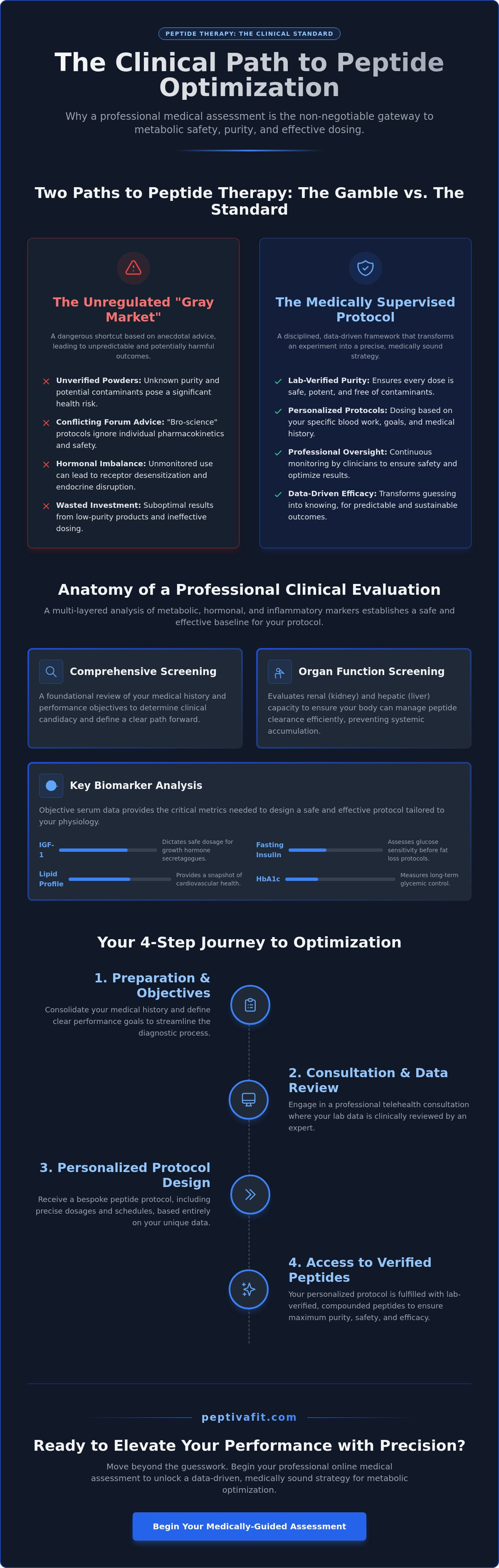
An online medical assessment for peptide therapy serves as the primary diagnostic gatekeeper for individuals seeking high-level metabolic optimization. It is not a perfunctory step. Rather, it's a comprehensive screening designed to determine clinical candidacy through the lens of rigorous biological data. This evaluation ensures that any proposed protocol aligns with the patient's unique physiological requirements and safety profile. Bypassing this stage transforms a sophisticated medical intervention into an unmonitored experiment. True optimization requires a disciplined approach where data dictates the strategy.
Clinical oversight is necessary to address the requirement for metabolic priming. Peptides don't function in isolation. Their effectiveness depends on the body's current state of bioavailability. If systemic inflammation is high or if essential co-factors are depleted, the therapeutic response will be suboptimal. A professional assessment identifies these variables; it allows for the priming of the internal environment before any peptide administration occurs. This methodical approach prioritizes long-term health outcomes over the quick fix mentality prevalent in mass-market wellness circles. It's about building a sustainable foundation for performance.
Understanding Peptide Signaling and Biological Feedback
Precision is the hallmark of modern Peptide therapeutics. These targeted amino acid chains function as signaling molecules that interact with specific cellular receptors. This interaction triggers internal cascades that influence everything from tissue repair to metabolic rate. However, the endocrine system is governed by complex feedback loops. Without a baseline online medical assessment for peptide therapy, it's impossible to monitor how exogenous administration affects natural production. Continuous, unmonitored use can lead to receptor desensitization. This happens when the body's receptors become less responsive to the peptide signaling, potentially causing hormonal imbalances that are difficult to reverse.
The Limitations of Self-Directed Protocols
The research only loophole provides a dangerous entry point for the uninformed. Unregulated online communities often circulate bro-science that lacks a foundation in actual pharmacokinetics. These self-directed protocols frequently ignore the nuances of half-life, peak concentration, and individual clearance rates. There's a stark difference between anecdotal forum posts and clinical-grade data monitoring. Relying on unverified information increases the risk of wasted investment and significant side effects. True performance optimization requires a disciplined, data-driven framework that only professional oversight can provide. It's the difference between guessing and knowing.
Key Components of a Comprehensive Peptide Clinical Evaluation
A professional online medical assessment for peptide therapy prioritizes objective serum data over subjective questionnaires. Clinical precision requires a multi-layered analysis of metabolic, hormonal, and inflammatory markers to establish a safe and effective baseline. This data-driven approach ensures that any proposed intervention aligns with your unique physiological state. Without these metrics, administration remains speculative and potentially hazardous to your long-term health.
Organ function screening is a non-negotiable component of this framework. We specifically evaluate renal and hepatic capacity to ensure your body can manage peptide clearance efficiently. If these pathways are compromised, the risk of systemic accumulation increases. Simultaneously, a lipid profile and HbA1c analysis provide a necessary snapshot of your cardiovascular and glycemic health. This information determines whether an individual is a suitable candidate for metabolic secretagogues or if preliminary corrective measures are required first.
Biomarkers for Metabolic Optimization
IGF-1 (Insulin-like Growth Factor 1) serves as the primary metric for evaluating the Growth Hormone axis. Baseline IGF-1 levels directly dictate the safe and effective dosage of secretagogues such as Ipamorelin. If levels reside near the upper physiological limit, further stimulation may be clinically contraindicated to avoid side effects. Additionally, evaluating fasting insulin and glucose sensitivity is mandatory before initiating fat loss protocols. This screening identifies silent contraindications, such as undiagnosed insulin resistance, which must be addressed to ensure the peptide's efficacy. A personalized medical assessment provides the sophisticated control necessary to navigate these biological variables.
Screening for Contraindications and Pre-existing Conditions
Safety protocols must account for both personal and family medical histories. A critical component of a professional evaluation is the review of recent oncology screenings. Because certain peptides influence growth signaling, active or recent malignancies represent a strict contraindication for specific therapies. Inflammatory indicators, such as hs-CRP and ESR, also play a vital role in determining appropriate peptide stacks. High systemic inflammation may require a shift in strategy to prioritize cellular repair before metabolic acceleration. Finally, cardiovascular health must be verified. Peptides that influence heart rate or blood pressure require a stable baseline to prevent adverse events during the protocol. This methodical screening process ensures that your optimization journey is built upon a foundation of clinical integrity.
Online Assessment vs. Traditional In-Person Evaluation
Telehealth technology has transitioned from a convenience to a clinical necessity for those seeking specialized performance optimization. Unlike traditional in-person models that are often bogged down by administrative delays and multi-week wait times, an online medical assessment for peptide therapy provides a streamlined, high-level oversight framework. This model allows for the deployment of expert medical review across the United States without geographic limitations. It replaces the general practitioner approach with a centralized hub of expertise specifically focused on molecular integrity and peptide signaling. You don't need to visit a physical office to receive elite-level care.
The efficiency of virtual consultations doesn't imply a reduction in clinical rigor. In fact, digital platforms often facilitate more frequent data monitoring and more precise adjustments than traditional office visits. By utilizing secure, HIPAA-compliant platforms, patients receive a level of privacy and exclusivity that's rarely achievable in a public clinic setting. This environment fosters a professional dialogue where sophisticated control and informed decision-making remain the primary objectives. It's a disciplined alternative to the crowded, mass-market healthcare experience.
The Role of Decentralized Diagnostics
The integration of national laboratory partnerships makes the decentralized model effective. Patients access professional-grade blood work at local facilities, while the raw diagnostic data is securely transmitted to a centralized medical review team. This process ensures data integrity through encrypted patient portals. Once the biomarkers are analyzed, the medical team transitions the raw data into a personalized peptide protocol. This method guarantees that every intervention is grounded in objective serum metrics rather than subjective observation. It's a methodical transition from raw biological data to a precise, actionable strategy.
Exclusivity and Privacy in Telehealth
Selective health platforms prioritize individual attention over mass-market volume. This is particularly evident in the 1-on-1 coaching models provided in a private, virtual environment. Such exclusivity ensures that your progress is monitored with a high degree of personal responsibility. For those who require immediate expert insight without a long-term commitment, single consultation calls offer direct access to specialized knowledge. This focused interaction allows for the refinement of existing strategies or the clarification of complex pharmacokinetic data, ensuring your protocol remains both safe and effective. You gain the benefits of a private medical guide with the efficiency of modern technology.
Preparing for Your Clinical Consultation: A Professional Checklist
A disciplined approach to performance optimization begins long before the initial consultation. To extract maximum value from an online medical assessment for peptide therapy, you must present a consolidated clinical profile. This starts with a comprehensive log of current pharmaceutical interventions and nutritional supplements. Precise data is the only foundation for a safe protocol. You must also ensure that recent laboratory work, conducted within the last 90 days, is available for medical review. Data older than this window fails to reflect your current physiological state and cannot be used for clinical decision-making.
Beyond baseline data, preparation involves technical readiness. You should formulate specific questions regarding the practical aspects of your protocol, such as peptide reconstitution and subcutaneous administration. Understanding the molecular stability of these compounds is vital for maintaining efficacy. This level of preparation signals a commitment to the process and allows the medical team to focus on sophisticated strategy rather than basic instruction. It's the difference between a passive patient and a serious individual taking control of their biological trajectory.
Defining Your Metabolic Objectives
Specificity is required when defining your performance goals. You must distinguish between objectives like systemic fat loss, muscle preservation during caloric deficits, or cognitive optimization. These distinctions influence compound selection significantly. For instance, the clinical requirements for Tesamorelin differ from those of other growth hormone secretagogues based on its specific affinity for visceral adipose tissue. Establishing realistic timelines is equally important. Peptide therapy is a methodical process of cellular signaling, not a rapid-onset stimulant. Professional protocols prioritize sustainable metabolic shifts over temporary fluctuations.
The Importance of Transparency
Absolute transparency regarding previous use of research chemicals or performance-enhancing substances is non-negotiable. These substances can alter receptor sensitivity and endocrine feedback loops, which the medical team must account for during protocol design. Honest reporting of lifestyle variables, including sleep architecture, chronic stress levels, and dietary adherence, is also critical. These factors directly impact the bioavailability and effectiveness of the therapy. Utilizing 1-on-1 coaching provides a framework for maintaining this transparency throughout your journey, ensuring that your protocol is adjusted based on real-world feedback rather than static assumptions.
If you're ready to transition from speculative use to a data-driven clinical framework, the first step is a professional evaluation. You can initiate your journey by securing a personalized medical assessment to establish your biological baseline.
The Peptiva Protocol: Bridging Assessment and Lab-Verified Purity
The transition from diagnostic screening to therapeutic implementation represents a critical juncture in metabolic optimization. An online medical assessment for peptide therapy is only as effective as the compounds it directs. Within the Peptiva Protocol, your specific biological data is used to customize the fat loss peptide guide, ensuring that the selected molecules align with your metabolic baseline. This integration eliminates the guesswork associated with generic protocols. It transforms raw laboratory values into a precise, actionable strategy for body composition and performance.
Molecular integrity serves as the final step in the safety chain. While many providers mention accreditation, the Peptiva Protocol emphasizes the critical link between clinical evaluation and lab-tested peptides. A professional assessment defines the required dosage and frequency, but the purity of the compound determines the actual biological response. This disciplined approach ensures that your investment in performance is backed by scientific-grade standards. From the moment your assessment is finalized, the focus shifts to the precise administration of verified substances.
Ensuring Molecular Integrity and Purity
Verification of peptide quality requires more than a simple guarantee. We mandate the use of third-party Certificates of Analysis (COAs) to confirm the identity and purity of every recommended supply. This level of scrutiny is necessary to avoid the pitfalls of generic dosing found in unregulated markets. High-purity peptides ensure that the signaling pathways identified during your online medical assessment for peptide therapy are accurately stimulated. PeptivaFit maintains a selective standard for recommended sources, prioritizing long-term safety over market convenience. This rigorous oversight protects your endocrine system from the contaminants and under-dosed vials common in mass-market alternatives.
Continuous Monitoring and Protocol Adjustment
Optimization is not a static event; it is a long-term process that requires ongoing data monitoring. Follow-up assessments are necessary to track how your biomarkers evolve in response to the therapy. These reviews allow the medical team to adjust dosages based on real-world physiological feedback, maintaining the balance between efficacy and safety. As you achieve your initial body composition goals, the protocol shifts toward maintenance phases. Utilizing specific peptides for metabolism allows for a controlled transition that preserves muscle mass and metabolic rate. This methodical progression ensures that your results are sustainable and your biological integrity remains uncompromised throughout every phase of the protocol.
Establishing Your Clinical Foundation for Optimization
The path to advanced performance is paved with data rather than assumptions. By prioritizing a rigorous online medical assessment for peptide therapy, you ensure that your physiological signals are interpreted with clinical precision. We've established that metabolic priming and hormonal baselines are non-negotiable for anyone serious about molecular integrity. This methodical approach separates elite-level optimization from the risks of unregulated experimentation.
True sophisticated control requires more than just a prescription. It demands a synergy between professional clinical oversight, comprehensive metabolic optimization guides, and the absolute assurance of lab-verified peptide purity. You've prepared your medical history and defined your objectives; now it's time to execute the final step of the diagnostic framework. Transitioning from speculation to science is the only way to achieve sustainable results while protecting your long-term health.
Secure your personalized medical assessment and start the Peptiva Protocol today. Taking charge of your biological trajectory is a significant responsibility. We expect the same level of commitment from you as we provide in our oversight. Your journey toward data-driven excellence begins with a single, disciplined decision.
Frequently Asked Questions
What biomarkers are most important for a peptide therapy assessment?
Biomarkers such as IGF-1, HbA1c, and fasting insulin are the most critical metrics for establishing a baseline. These indicators allow the medical team to evaluate the state of your Growth Hormone axis and glycemic control before any intervention begins. Additionally, hs-CRP and ESR identify systemic inflammation levels, while creatinine and hepatic enzymes verify your body's capacity for peptide clearance.
How long does the online medical assessment process take?
The timeline for a clinical evaluation depends primarily on the speed of laboratory processing and the depth of the medical review. Once you complete your blood work at a local facility, the data is transmitted for a centralized review. This methodical approach ensures that your final protocol is grounded in objective biological evidence rather than a rushed, superficial summary.
Can I use my existing blood work for the peptide evaluation?
You may utilize existing laboratory results if the blood work was conducted within the last 90 days. Data exceeding this timeframe is considered clinically stagnant and fails to reflect your current physiological state accurately. It's mandatory that an online medical assessment for peptide therapy relies on recent, high-fidelity data to ensure both safety and therapeutic efficacy.
Is a medical assessment required for all peptides in the Peptiva Protocol?
Yes, a personalized medical assessment is a non-negotiable prerequisite for every intervention we recommend. We don't offer generic protocols or unmonitored access to compounds. Clinical oversight serves as the essential gatekeeper to ensure that exogenous signaling doesn't lead to receptor desensitization or the disruption of your natural endocrine feedback loops.
What happens if my assessment reveals a contraindication?
If the clinical review identifies a contraindication, the medical team will either modify the proposed protocol or recommend deferring therapy entirely. Safety is the fundamental objective of the diagnostic process. Identifying these biological red flags early prevents adverse events and ensures that your path to optimization doesn't compromise your long-term metabolic health.
How often should I repeat the medical assessment while on therapy?
Follow-up assessments are typically required every three to six months to monitor your physiological response to the therapy. These regular screenings allow for precise adjustments to your dosage and frequency based on shifting biomarkers. This continuous data loop ensures your protocol remains optimized and safe as your body achieves its initial performance milestones.
What is the difference between a research-grade and clinical-grade assessment?
A clinical-grade assessment utilizes objective serum data and professional medical oversight to determine candidacy. In contrast, research-grade assessments often found in unregulated forums rely on anecdotal evidence and subjective reporting. A legitimate online medical assessment for peptide therapy provides the technical rigor and legal compliance necessary for high-level performance optimization.
Can an online assessment provide a protocol for peptide reconstitution?
Yes, the assessment process includes comprehensive education regarding peptide reconstitution and subcutaneous administration. Understanding the molecular stability of these compounds is vital for maintaining their efficacy throughout the protocol. We provide the technical guidance necessary to ensure you handle the compounds with the same precision used during the clinical evaluation phase.

![Shelf Life of Reconstituted Peptides: A Clinical Reference Guide [2026]](https://getautoseo.com/storage/hero_images/shelf-life-of-reconstituted-peptides-a-clinical-reference-guide-2026.jpg?v=b8ed5173acaa)
