

What if the 20.2% weight reduction observed in the SURMOUNT-5 trial represents the floor of metabolic optimization rather than the ceiling? For many individuals dedicated to high-level performance, the transition from semaglutide to dual-agonist therapy is a logical step, yet it often comes with confusion regarding receptor synergy and the risk of lean tissue depletion. You likely recognize that weight loss is a poor metric if it sacrifices the metabolic engine of skeletal muscle. This clinical review provides a sophisticated analysis of peptides similar to tirzepatide, focusing on the transition from dual-agonist to triple-agonist protocols.
We'll examine the evidence-based integration of compounds like retatrutide, which demonstrated up to 30% weight loss in the TRIUMPH-1 trial, while addressing the critical need for muscle preservation. By the end of this analysis, you'll understand how to utilize the Peptiva Protocol to navigate the complexities of GIP, GLP-1, and Glucagon agonism. This is a technical exploration of how to move beyond standard consumer options into a framework of disciplined, data-driven metabolic control. We'll prioritize scientific-grade standards to ensure your protocol remains as effective as it is safe.
Key Takeaways
- Understand why multi-receptor agonism, such as the GIP/GLP-1 synergy found in tirzepatide, represents a significant advancement over first-generation, single-receptor medications.
- Evaluate the clinical efficacy and synergistic potential of peptides similar to tirzepatide, including next-generation triple-agonists and amylin analogues like Cagrilintide.
- Discover how integrating mitochondrial-derived peptides like MOTS-C can enhance metabolic flexibility and energy regulation within a professional optimization protocol.
- Learn specific strategies for lean tissue preservation to mitigate the risk of sarcopenic obesity during rapid fat loss phases.
- Identify the essential criteria for verifying molecular integrity through Certificate of Analysis (COA) data to ensure safety and protocol efficacy.
The Evolution of Incretin Mimetics: Beyond Single-Receptor Agonism
The pharmacological landscape for metabolic optimization is undergoing a fundamental shift. We've moved past the era of single-hormone mimics. First-generation GLP-1 receptor agonists proved effective for weight reduction, but they often reached a ceiling of efficacy. This saturation led researchers to explore multi-pathway strategies that mirror the complex nature of human metabolism. In 2026, we've entered the era of metabolic reconfiguration. This approach focuses on systemic hormonal balance rather than simple appetite suppression. The objective is no longer just "weight loss" in the aggregate sense. Instead, clinical focus has shifted toward high-quality fat loss, where adipose tissue is reduced while skeletal muscle and metabolic rate are preserved.
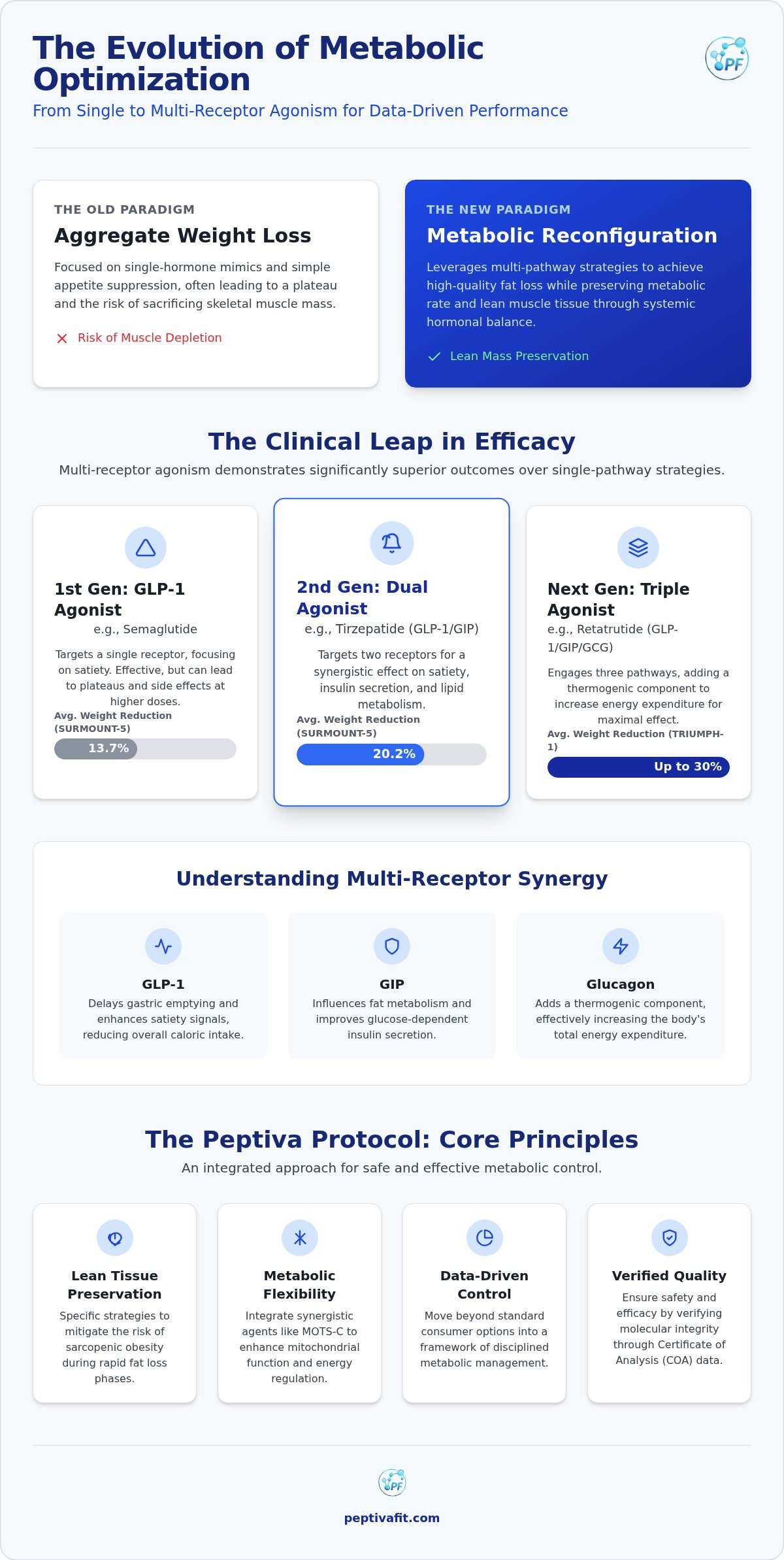
Tirzepatide represents the first successful clinical implementation of this dual-agonist philosophy. By targeting both the Glucagon-like peptide-1 (GLP-1) and Glucose-dependent insulinotropic polypeptide (GIP) receptors, it achieved a 20.2% reduction in body weight in the SURMOUNT-5 trial. This success has catalyzed interest in peptides similar to tirzepatide that leverage multiple pathways to achieve superior outcomes. Understanding this evolution is essential for anyone seeking to move beyond standard consumer-grade solutions into a framework of disciplined, data-driven metabolic control.
The Limitations of GLP-1 Monotherapy
Single-receptor protocols often lead to receptor saturation. At high doses, the gastrointestinal side effects frequently outweigh the marginal gains in fat loss. This creates a plateau where progress stalls despite increasing the dosage. Many individuals find that the side effect profile of high-dose semaglutide becomes a barrier to long-term compliance. Multi-agonist peptides are now the preferred standard for metabolic health because they engage complementary pathways. This allows for lower effective doses at each individual receptor site, reducing the total burden on the system while enhancing the overall metabolic signal. Identifying peptides similar to tirzepatide involves analyzing how these agents distribute the workload across different hormonal receptors to maintain efficacy without excessive toxicity.
Defining Dual and Triple-Receptor Agonism
While GLP-1 focuses on delayed gastric emptying and satiety, GIP influences lipid metabolism and insulin secretion. The introduction of Glucagon receptor agonism in emerging triple-agonists adds a thermogenic component, effectively increasing energy expenditure. The Incretin Effect is defined as the physiological phenomenon where oral glucose intake triggers a significantly larger insulin response than intravenous glucose due to the release of specialized gut hormones. This synergy is why multi-target protocols are more effective than isolated GLP-1 use. By engaging these multiple fronts, we can achieve a more sophisticated level of control over glucose disposal and fat oxidation.
Peptides Similar to Tirzepatide: A Comparative Clinical Review
Selecting an appropriate metabolic protocol requires a granular understanding of how different agents interact with human physiology. While tirzepatide set a new benchmark, the emergence of peptides similar to tirzepatide offers a broader spectrum of intervention. The SURMOUNT-5 trial, published in May 2025, provided a definitive head-to-head comparison. It demonstrated that tirzepatide achieved a 20.2% reduction in body weight at 72 weeks, significantly outperforming semaglutide's 13.7% reduction. This data highlights the clear advantage of dual-receptor agonism over single-pathway strategies. For a deeper dive into these mechanisms, the Tirzepatide Clinical Review provides the necessary pharmacological foundation.
Beyond the established dual-agonists, agents like Mazdutide are gaining attention for their specific focus on GLP-1 and glucagon receptors. This combination aims to balance appetite suppression with increased energy expenditure. Similarly, Cagrilintide, an amylin analogue, is being studied for its synergistic potential when paired with semaglutide. This combination, often referred to as CagriSema, targets different satiety signals to prevent the metabolic adaptation often seen in long-term protocols. If you're looking for a structured way to integrate these findings, a personalized medical assessment can help determine which receptor profile aligns with your specific metabolic markers.
Semaglutide vs. Tirzepatide: Potency and Tolerance
The STEP and SURMOUNT clinical programs reveal distinct differences in fat oxidation and patient tolerance. While tirzepatide offers superior weight loss, it requires a more disciplined titration schedule to manage its potent GIP activity. Gastrointestinal distress remains the primary hurdle for both, though some users report a smoother experience with the dual-agonist due to its balanced hormonal signal. A single-agonist approach like semaglutide remains clinically appropriate for individuals who are highly sensitive to GIP or those who have successfully reached their maintenance phase without significant muscle loss. You can explore more about these distinctions in our Peptides for Metabolism and Fat Loss: A Clinical Overview [2026].
Retatrutide: The Triple-Agonist Advancement
Retatrutide represents the current frontier of metabolic research. By engaging GIP, GLP-1, and Glucagon receptors simultaneously, it addresses weight loss from three distinct angles. Data from the TRIUMPH-1 trial, announced in May 2026, showed that participants on the highest dose lost up to 30% of their body weight over two years. The addition of glucagon receptor agonism is particularly significant. It accelerates metabolic rate and has shown remarkable results in reducing liver fat, making it arguably the most potent peptide similar to tirzepatide available in a clinical research context. This triple-agonist approach doesn't just suppress appetite; it aggressively reconfigures how the body processes and stores energy.
Synergistic Peptides for Metabolic Flexibility
Metabolic flexibility is the physiological capacity to adapt fuel oxidation to fuel availability. While the dual-agonist mechanism of tirzepatide effectively manages appetite and insulin sensitivity, it does not directly address the efficiency of the cellular machinery responsible for burning that fuel. To achieve a truly optimized state, you must consider synergistic peptides similar to tirzepatide that target complementary physiological pathways. For instance, Tesamorelin is a growth hormone-releasing hormone (GHRH) analogue specifically indicated for the reduction of excess visceral adipose tissue. By integrating such compounds, a protocol moves from simple weight reduction to targeted body composition refinement.
Mitochondrial integrity serves as the foundation for sustaining these results. Without healthy mitochondria, the body struggles to maintain metabolic independence once the primary peptide stimulus is removed. This is where MOTS-C Peptide becomes invaluable. It functions as a mitochondrial-derived transcript that regulates insulin sensitivity and metabolic homeostasis at the cellular level. Addressing mitochondrial health ensures that the fat oxidation triggered by multi-agonist therapy is supported by efficient cellular respiration.
Growth Hormone Secretagogues and Fat Oxidation
Combining growth hormone secretagogues (GHS) like Ipamorelin and CJC-1295 with tirzepatide-class peptides can mitigate some of the common challenges of caloric restriction. These secretagogues stimulate the endogenous release of growth hormone, which plays a critical role in lipid mobilization and the preservation of lean mass. Furthermore, the impact of GH signaling on sleep quality and systemic recovery is vital when the body is in a significant energy deficit. Improved sleep hygiene and enhanced recovery allow for higher intensity during resistance training, which is the primary defense against muscle loss. This multi-layered approach ensures that the weight lost is primarily adipose tissue rather than functional muscle.
Mitochondrial Mimetics and Exercise Efficiency
Using MOTS-c helps the body overcome 'metabolic adaptation,' a state where the resting metabolic rate slows down in response to prolonged weight loss. It enhances glucose uptake in skeletal muscle through the activation of the AMPK pathway, achieving this without the need for insulin spikes. This is particularly useful for maintaining exercise performance while on a dual-agonist protocol. Mitochondrial peptides provide the necessary cellular energy to ensure the metabolic pathways activated by GLP-1 agonists operate at peak efficiency. By optimizing the 'work' done by these agonists, you create a more resilient metabolic environment that is less prone to the weight-loss plateaus common in single-agent protocols.
The Peptiva Protocol: Lean Mass Preservation Strategies
Rapid weight reduction often masks a clinical danger: the disproportionate loss of skeletal muscle. This phenomenon, known as sarcopenic obesity, occurs when the body's metabolic rate collapses due to insufficient protein intake and a lack of mechanical tension during fat loss. When utilizing peptides similar to tirzepatide, the suppression of appetite can be so profound that patients inadvertently enter a state of severe catabolism. Our framework mandates that fat oxidation never comes at the expense of functional tissue. We prioritize the preservation of the metabolic engine over the number on a digital scale.
Resistance training is a non-negotiable component of any disciplined metabolic strategy. High-protein intake, specifically targeting 1.6 to 2.2 grams per kilogram of body weight, provides the necessary substrate for nitrogen balance. To sustain the required training volume, we often integrate BPC-157 Peptide to accelerate connective tissue repair and manage systemic inflammation. This ensures that the individual remains capable of high-intensity stimulus, which is the primary driver for muscle retention. Integrating peptides similar to tirzepatide requires this vigilant, dual-focus approach to maintain a favorable body composition.
Nutritional Foundations for Peptide Therapy
Macro-nutrient ratios must be precisely managed to support muscle protein synthesis. Essential amino acids (EAAs) are often required to supplement whole food sources, particularly when gastric emptying is delayed by GLP-1 agonism. Hydration and electrolyte management are equally critical. Dual-agonist protocols can alter fluid dynamics, making consistent intake of sodium, potassium, and magnesium essential for maintaining muscle contractility and cognitive clarity. It's not just about eating less; it's about eating with surgical precision to protect your lean mass.
Biomarker Tracking and Titration
Successful optimization requires data over intuition. Scale weight is a deceptive metric. We prioritize body composition analysis via DEXA scans to ensure the fat-to-lean mass loss ratio remains favorable. Before initiating any protocol, a Personalized Medical Assessment is necessary to establish baseline biomarkers. We track HbA1c and fasting insulin to monitor improvements in metabolic health while adjusting peptide dosages based on objective data. For a deeper technical framework, consult our Comprehensive Fat Loss Peptide Guide [2026]. To secure a strategy tailored to your specific physiological data, book your personalized medical assessment today.
Implementation and Lab-Verified Quality Standards
Molecular integrity isn't just a preference; it's the foundation of clinical safety and protocol efficacy. When you're investigating peptides similar to tirzepatide, the complexity of the amino acid sequence increases the risk of manufacturing errors. Substandard synthesis can lead to truncated sequences or residual solvents that don't belong in a high-level metabolic protocol. These impurities don't just reduce the effectiveness of the peptide. They can trigger immunogenicity, where the body's immune system identifies the peptide as a foreign invader and develops antibodies against it. This reaction can neutralize the therapeutic effect and potentially cross-react with endogenous hormones, leading to long-term metabolic dysfunction.
The market for peptides similar to tirzepatide is often saturated with low-grade options that lack the necessary clinical transparency. Professional oversight is the primary differentiator between simple weight loss and true health optimization. Without a disciplined framework for sourcing and administration, you're essentially guessing with your hormonal health. We prioritize data-driven standards to ensure every compound used in a protocol meets the rigorous demands of sophisticated performance optimization.
Identifying Lab-Verified Peptides
High-Performance Liquid Chromatography (HPLC) and Mass Spectrometry (MS) are the essential standards for verifying research accuracy. HPLC confirms the purity level of the batch, while MS verifies the molecular mass to ensure the identity of the peptide is correct. You should never accept a simple "purity report" without a corresponding, batch-specific chromatogram from a third-party laboratory. A purity level of 99% or higher is the clinical gold standard for peptide research because it minimizes the risk of immunogenic reactions and ensures consistent receptor binding. Avoiding gray market suppliers who refuse to provide transparent, verifiable testing is a prerequisite for any serious investigator.
The Value of Clinical Coaching
The transition from active fat loss to metabolic maintenance is the most vulnerable phase of any protocol. Satiety signals and "food noise" often return with increased intensity once the primary peptide stimulus is reduced. This is where a clinical coaching framework becomes indispensable. It's not enough to simply stop the protocol once a target weight is reached. You need a structured exit strategy that addresses the psychological management of hunger while slowly recalibrating the body's metabolic set point through precise nutritional adjustments.
Effective optimization requires a long-term perspective rather than a quick-fix mentality. By focusing on data, molecular purity, and expert guidance, you can maintain your results without falling back into old metabolic patterns. Optimize your metabolic health with the Peptiva Protocol today.
Mastering the Multi-Agonist Framework
The transition from basic weight loss to sophisticated metabolic reconfiguration requires a shift in perspective. We've established that the future of fat oxidation lies in the synergy of multi-agonist pathways, moving beyond the limitations of single-receptor saturation. Utilizing peptides similar to tirzepatide allows for a more balanced hormonal signal; however, this potency must be managed through disciplined biomarker tracking and aggressive lean mass preservation strategies. High-quality results are defined by the retention of the metabolic engine, not just the reduction of adipose tissue.
Achieving this level of precision requires a commitment to scientific-grade standards and professional oversight. Through our framework, you gain access to the data and education necessary to navigate these complex protocols with confidence. Access the Peptiva Protocol and Secure Lab-Verified Peptides to benefit from lab-verified molecular integrity, personalized clinical assessments, and professional 1-on-1 metabolic coaching. You now possess the specialized knowledge required to take absolute control of your performance and wellness journey.
Frequently Asked Questions
Are there peptides more effective than tirzepatide for weight loss?
Retatrutide has demonstrated superior efficacy compared to tirzepatide in recent clinical investigations. Data from the TRIUMPH-1 trial, released in May 2026, indicated that participants on the highest dose of retatrutide achieved up to 30% weight reduction over two years. This surpasses the 20.2% reduction observed with tirzepatide in the SURMOUNT-5 trial, positioning retatrutide as the most potent option among peptides similar to tirzepatide currently under research.
What is the difference between a dual-agonist and a triple-agonist peptide?
The distinction lies in the number of hormonal pathways activated to regulate metabolism. A dual-agonist like tirzepatide targets the GLP-1 and GIP receptors to manage satiety and insulin secretion. A triple-agonist, such as retatrutide, adds glucagon receptor agonism to this profile. This third pathway increases energy expenditure and thermogenesis, offering a more aggressive approach to fat oxidation than dual-receptor agents.
Can I use BPC-157 alongside tirzepatide for recovery?
BPC-157 is frequently integrated into metabolic protocols to manage training volume and connective tissue repair. While tirzepatide focuses on hormonal metabolic control, BPC-157 provides systemic support for injury recovery and gut health. Combining these agents requires professional oversight to ensure that the healing properties of BPC-157 complement the fat loss objectives without interfering with the primary metabolic signal.
How do I prevent muscle loss while taking peptides similar to tirzepatide?
Muscle preservation requires a disciplined combination of mechanical tension and nutritional precision. You must prioritize resistance training and maintain a high protein intake, specifically between 1.6 and 2.2 grams per kilogram of body weight. The Peptiva Protocol often incorporates growth hormone secretagogues like Ipamorelin to further support nitrogen balance and protect lean tissue during rapid adipose reduction.
Is retatrutide available for human use in 2026?
Retatrutide remains an investigational medication as of August 2026 and hasn't received FDA approval. Eli Lilly has indicated plans to seek US approval in the first quarter of 2027. While clinical trial data is promising, the compound is currently restricted to research environments. Availability for general clinical use is not expected until late 2027 or early 2028 depending on regulatory timelines.
What are the most common side effects of dual-agonist peptides?
Gastrointestinal distress is the most frequently reported side effect for dual-agonist protocols. This includes nausea, diarrhea, and constipation, which are often related to the slowing of gastric emptying. These symptoms are typically dose-dependent and can be mitigated through a structured titration schedule. Monitoring your body's response during the initial phases of the protocol is essential for long-term tolerance and safety.
How do I know if my peptides are lab-verified and safe?
Verification requires a third-party Certificate of Analysis (COA) that includes HPLC and Mass Spectrometry data. These tests confirm both the purity level and the exact molecular identity of the compound. You should only utilize supplies that demonstrate a purity level of 99% or higher. This scientific-grade standard ensures that the peptide is free from truncated sequences or residual manufacturing solvents that could cause immunogenic reactions.
Is a medical assessment necessary before starting a peptide protocol?
A personalized medical assessment is a non-negotiable requirement for any disciplined metabolic intervention. Establishing baseline biomarkers for HbA1c, fasting insulin, and kidney function is critical for safety and tracking progress. This initial data allows for a customized titration strategy and ensures that the chosen protocol is appropriate for your specific physiological profile. Operating without this clinical foundation introduces unnecessary risk to your long-term health.

![Shelf Life of Reconstituted Peptides: A Clinical Reference Guide [2026]](https://getautoseo.com/storage/hero_images/shelf-life-of-reconstituted-peptides-a-clinical-reference-guide-2026.jpg?v=b8ed5173acaa)
