

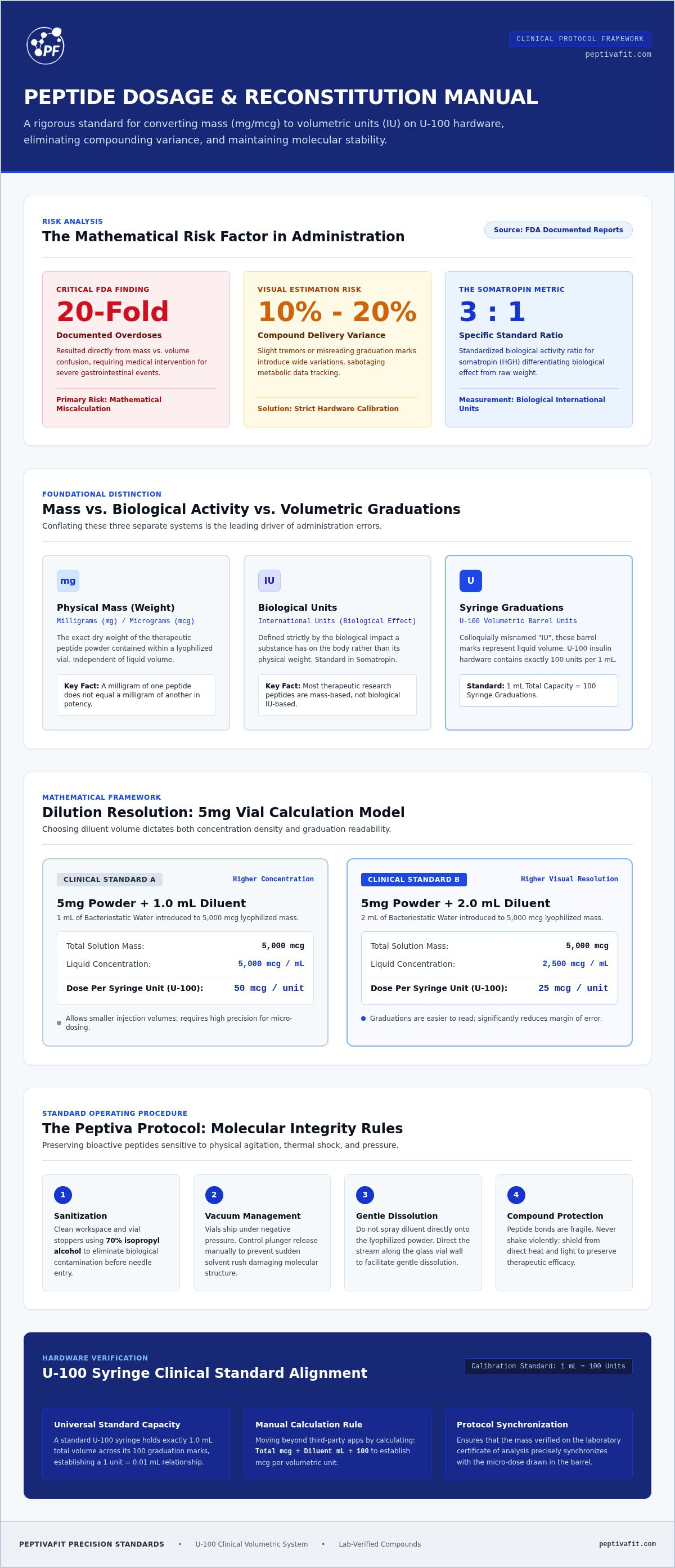
The FDA recently documented cases where confusion between mass and volume led to 20-fold overdoses, requiring medical intervention for severe gastrointestinal events. This data underscores a critical reality in performance optimization; mathematical errors are the primary risk factor in peptide administration. Mastering how to measure peptide dosage in iu isn't merely a convenience; it's a foundational requirement for anyone operating at a professional or clinical standard. When you're handling lab-verified compounds, your protocol must be as precise as the synthesis itself.
It's understandable if the conversion between milligrams, micrograms, and international units feels daunting. This complexity often creates a barrier for those who prioritize safety and data-driven results. This guide promises to eliminate that anxiety by providing a rigorous, manual framework for reconstitution and dosing. You'll gain total confidence in your calculations, moving beyond the limitations of third-party apps. We'll examine the specific 3:1 ratio for somatropin, the volumetric capacity of U-100 hardware, and the exact "mcg per unit" formulas required to maintain professional-grade standards in every application.
Key Takeaways
- Differentiate between biological International Units and volumetric syringe graduations to eliminate the primary cause of administration errors.
- Master the core mathematical formula for how to measure peptide dosage in iu to establish a precise concentration ratio for any vial mass.
- Determine the optimal volume of bacteriostatic water required for reconstitution to maintain the stability and accuracy of your specific protocol.
- Verify syringe hardware specifications to ensure that your volumetric measurements align with the U-100 clinical standard.
- Apply the Peptiva Protocol framework to synchronize manual calculations with lab-verified data for consistent and safe performance optimization.
Understanding International Units (IU) in Peptide Therapy
Precision in metabolic optimization isn't a suggestion; it's a requirement. For those seeking peak performance, the ability to translate a laboratory mass into a tangible administration volume is the difference between success and a total loss of research integrity. Learning how to measure peptide dosage in iu requires a shift in perspective. You aren't just looking at numbers on a plastic barrel; you're managing the pharmacokinetics of highly potent compounds. When dealing with lab-verified substances, the math must be as disciplined as the training regimen.
Biological IU vs. Volumetric Units
In pharmacology, International Units (IU) are defined by the biological effect a substance has on the body rather than its physical weight. This creates a point of frequent confusion. While hormones like Somatropin (HGH) are standardized by biological activity, the vast majority of therapeutic peptides are measured in mass, specifically milligrams (mg) or micrograms (mcg). The distinction is vital because a milligram of one peptide does not equal a milligram of another in terms of potency.
The term "IU" has become colloquially synonymous with the graduation marks on an insulin syringe, but this is technically inaccurate. When a researcher asks how to measure peptide dosage in iu, they're usually referring to the volumetric "units" marked on a U-100 syringe. These markings represent volume, not biological activity. Confusing a unit of volume with a unit of activity is a primary driver of dosing errors in unregulated environments, often leading to significant overdoses.
The Role of Precision in Metabolic Optimization
High-level performance optimization often involves micro-dosing, where the margin for error is razor-thin. Eyeballing a dose or relying on visual estimation is unacceptable in a professional protocol. A slight tremor or a misread graduation mark can lead to a 10% or 20% variance in the active compound delivered. This inconsistency sabotages data tracking and makes it impossible to identify which metabolic adjustments are actually driving results.
Standardization is the only safeguard against these inconsistencies. The U-100 syringe standard is defined as exactly 1mL of total liquid volume. Because this standard is universal, it allows for the creation of precise mathematical ratios. By using lab-tested peptides and following a structured framework like the Peptiva Protocol, you ensure that the mass on the label matches the concentration in the syringe. This disciplined approach transforms guesswork into a repeatable, scientific process, protecting the integrity of your metabolic data.
The Reconstitution Foundation: Preparing the Solution
Reconstitution represents the foundational phase of any peptide protocol. It's the point where a lyophilized powder is converted into a bioactive liquid. If you fail to grasp how to measure peptide dosage in iu at this stage, every subsequent step is compromised. Precision requires more than just adding water; it demands a calculated approach to solvent volume and molecular stability. A disciplined researcher understands that the volume of bacteriostatic water added isn't arbitrary. It's a variable that defines the resolution of your dosing.
Calculating Solvent Volume
Choosing your diluent volume is a strategic decision. While 1mL and 2mL are the clinical standards, your choice dictates the final concentration and the ease of manual calculation. Standardizing your ratio is the first step in learning how to measure peptide dosage in iu without constant reliance on external tools. For instance, a 5mg vial reconstituted with 1mL yields 5,000mcg per mL. Using 2mL dilutes this to 2,500mcg per mL. For those beginning their research, utilizing a peptide reconstitution calculator ensures the initial setup is mathematically sound. High concentrations allow for smaller injection volumes, which some prefer for comfort. However, higher solvent volumes make the graduations on calibrated U-100 syringes much easier to read, reducing the margin of error for micro-doses.
Step-by-Step Reconstitution Protocol
Molecular integrity is fragile. Peptides are sensitive to heat, light, and physical agitation. You must sanitize your workspace and vial stoppers with 70% isopropyl alcohol before proceeding. When introducing bacteriostatic water, manage the vacuum effect with extreme care. Vials are often shipped under vacuum pressure. If you allow the solvent to spray directly onto the lyophilized powder, the resulting kinetic energy can shear the delicate peptide chains. Aim the needle at the glass wall, allowing the liquid to trickle down slowly. Once the solvent is added, gently swirl the vial until the solution is clear; never shake it. Professional frameworks like the Peptiva Protocol emphasize these sterile techniques to maintain the potency of lab-verified compounds. Proper storage is equally vital. Most reconstituted peptides require refrigeration between 2°C and 8°C. Don't freeze them, as ice crystallization can disrupt the tertiary protein structures. Following these steps ensures your data remains accurate and your compounds remain effective.
The Mathematics of Peptide Dosage: mg to IU Conversion
Digital calculators offer a convenient shortcut, but true clinical proficiency requires the ability to audit these results manually. Relying on third-party tools creates a vulnerability in your protocol; if the tool fails or uses a different syringe standard, your research integrity is compromised. Understanding the fundamental ratio between mass and volume is the only way to ensure absolute accuracy. When you master how to measure peptide dosage in iu, you transition from a passive user to a disciplined researcher who controls every variable of the metabolic environment.
The standard U-100 insulin syringe is the baseline for these calculations. On this hardware, 100 graduation marks, or "units," represent exactly 1.0mL of liquid volume. This equates to 1,000 microliters. Therefore, each single unit on a U-100 syringe represents 0.01mL. This volumetric constant is the foundation upon which all peptide concentrations are built. Whether you're administering 200mcg or 500mcg, your success depends on calculating how much mass is contained within each of those 0.01mL increments.
The Mastery Formula for Manual Calculation
The process of determining your dose follows a logical, three-step framework. First, you must convert the total mass in the vial from milligrams (mg) to micrograms (mcg). Since 1mg equals 1,000mcg, a 5mg vial contains 5,000mcg of the active compound. Next, identify the total number of units of bacteriostatic water you added during reconstitution. If you used 2mL of solvent, you have 200 units of liquid volume.
Finally, divide the total micrograms by the total units to find the concentration per "tick" on the syringe. In our 5mg example reconstituted with 2mL, the math is 5,000mcg divided by 200 units, resulting in 25mcg per unit. If your target dose is 250mcg, you simply draw to the 10-unit mark. This manual mastery ensures you never have to guess how to measure peptide dosage in iu, regardless of the vial size or solvent volume you choose.
Common Concentration Reference Table
Establishing a standardized reconstitution ratio simplifies your mental math and reduces the risk of calculation fatigue. Use the following reference points to verify your manual math for common vial sizes:
- 5mg Vial with 2mL Water: 25mcg per syringe unit. A 250mcg dose requires 10 units.
- 2mg Vial with 1mL Water: 20mcg per syringe unit. A 100mcg dose requires 5 units.
- 10mg Vial with 2mL Water: 50mcg per syringe unit. A 500mcg dose requires 10 units.
By maintaining these consistent ratios, you create a repeatable environment for your research. This discipline allows you to focus on tracking metabolic data and performance outcomes rather than struggling with basic arithmetic before every administration.
Syringe Calibration and Hardware Selection
Mathematical accuracy is futile if the physical delivery mechanism is flawed. Selecting the correct hardware is the final step in mastering how to measure peptide dosage in iu. In a clinical environment, the assumption that all syringes are interchangeable is a dangerous fallacy. Suboptimal hardware choice leads to volumetric inaccuracies and compound waste, both of which undermine the integrity of a professional protocol. Precision is paramount.
U-100 vs. U-40: The Critical Distinction
The distinction between U-100 and U-40 syringes is the most significant hardware variable. U-100 syringes are the clinical standard, calibrated so that 100 units equal exactly 1.0mL. Conversely, U-40 syringes are often utilized in veterinary medicine and are calibrated for 40 units per 1.0mL. Accidentally using U-40 hardware with a U-100 calculation introduces a 2.5-fold dosing error. This magnitude of error is often enough to trigger adverse events or complete protocol failure.
For micro-dosing, barrel volume is equally important. A 0.3mL or 0.5mL syringe offers greater graduation clarity than a 1.0mL barrel. When your dose is only 10 units, the visual resolution on a smaller barrel reduces reading errors significantly. Fixed-needle syringes are mandatory for precision. Detachable needles create "dead space" in the hub where expensive peptides are trapped and wasted. In a high-end protocol, every microgram must be accounted for to maintain data integrity.
Needle Gauge and Injection Logistics
Comfort and molecular preservation depend on needle gauge. A 31G needle is thinner than a 29G, providing a more comfortable experience for subcutaneous administration. Most researchers prefer a needle length of 5/16-inch (8mm) to ensure the compound reaches the adipose tissue without entering the muscle layer. This depth is critical for the intended pharmacokinetic release of the peptide. Shorter needles may fail to reach the subcutaneous layer, while longer needles increase the risk of intramuscular injection.
Safety protocols demand that hardware is strictly single-use. Reusing needles dulls the tip, causing unnecessary tissue trauma and increasing the risk of contamination. Dispose of all used syringes in a puncture-proof sharps container to maintain a sterile and professional research environment. If you require expert guidance on hardware selection or protocol integration, book a personalized medical assessment to ensure your setup meets clinical standards.
Clinical Best Practices and Protocol Integration
Precision in administration is the final barrier between theoretical research and tangible metabolic results. Once you've mastered the mathematics of how to measure peptide dosage in iu, you must integrate that knowledge into a broader clinical framework. A successful protocol isn't static; it requires constant calibration based on compound purity and individual bio-feedback. In high-level performance optimization, the margin for error is minimized through rigorous standardization and professional oversight. Guesswork has no place in a data-driven metabolic strategy.
Ensuring Peptide Purity and Mass Accuracy
A label stating "5mg" is merely a claim until it's validated by third-party laboratory testing. If the actual mass in the vial deviates from the label, your volumetric calculations will be fundamentally flawed from the start. Impurities or residual fillers can skew the weight, meaning your 10-unit draw might deliver significantly less active compound than intended. This is why the Peptiva Protocol mandates the use of lab-verified supplies to ensure the mass used in your concentration formula is accurate. For those pursuing targeted lipolysis, following a specific Tesamorelin dosage guide provides the necessary guardrails for safe and effective application, ensuring your math aligns with clinical-grade standards.
Advanced Monitoring and Coaching
Determining a starting dose is a complex process that should ideally begin with personalized medical assessments. These evaluations allow for the adjustment of your "unit" count based on objective data like blood work and metabolic response. A disciplined researcher monitors for side effects and adjusts the concentration or volume accordingly under professional guidance. Beyond the math, physical errors like the "air-bubble factor" can displace up to 2 units of volume, leading to consistent under-dosing. Purging the syringe and verifying the meniscus level are small but vital steps in maintaining protocol integrity. Precision is a habit, not just a calculation.
To ensure a precise research session, follow this final clinical checklist:
- Verify Mass: Confirm the vial's total milligrams against a recent third-party Certificate of Analysis (COA).
- Audit Calculations: Re-run your "mcg per unit" math manually to ensure no decimal point errors occurred during the conversion.
- Inspect Volume: Check for air bubbles that could displace the active solution in the syringe barrel, especially when using 0.3mL syringes.
- Document Response: Log every administration and subsequent bio-feedback to refine your long-term metabolic strategy.
Mastering how to measure peptide dosage in iu is a skill that empowers you to take total control of your metabolic health. By combining mathematical precision with high-quality, lab-tested compounds and professional coaching, you move beyond the guesswork of the mass market. This disciplined approach ensures that your research is safe, repeatable, and driven by accurate data.
Precision as a Standard for Metabolic Success
Achieving clinical-grade precision is a fundamental requirement for anyone serious about performance. Mastering how to measure peptide dosage in iu transforms a complex variable into a controlled constant. By applying the mathematical frameworks and hardware standards discussed, you ensure that your research is defined by accuracy rather than approximation. This discipline is what separates elite protocols from standard consumer advice. It's the difference between hoping for results and engineering them through rigorous data.
Success in metabolic optimization depends on the quality of your data and your compounds. We provide the tools necessary for this high-level work, including access to lab-verified peptide supplies and expert 1-on-1 coaching tailored to your specific objectives. Every protocol is strengthened by clinical oversight via personalized medical assessments, ensuring your path is as safe as it is effective. Optimize your metabolic journey with the Peptiva Protocol and take control of your performance with the confidence that only precision can provide. Your commitment to scientific accuracy is the catalyst for your long-term success.
Frequently Asked Questions
Is 1 IU the same as 1 unit on an insulin syringe?
No, 1 IU is not physically identical to 1 unit on a syringe. A biological International Unit measures the potency of a substance, whereas a syringe unit measures a specific volume of liquid. On a standard U-100 syringe, 1 unit equals exactly 0.01mL of volume. Confusing these two definitions is a primary source of dosing errors in clinical research. Always calculate your dose based on the mass-to-volume ratio rather than assuming 1:1 parity.
How many mcg are in 10 units of a 5mg reconstituted peptide?
In a 5mg vial reconstituted with 2mL of bacteriostatic water, 10 units contain 250mcg of the active peptide. Understanding how to measure peptide dosage in iu requires converting the 5mg mass into 5,000mcg and dividing by the 200 units of volume present in 2mL. This results in a concentration of 25mcg per unit. Precision in this calculation is vital for maintaining the integrity of your protocol and ensuring consistent metabolic data.
What happens if I use too much bacteriostatic water?
Using an excessive volume of bacteriostatic water decreases the concentration of the peptide solution. This doesn't change the total mass of the compound in the vial, but it does mean you'll need to draw a larger volume of liquid to achieve your target dose. While higher dilution can make micro-dosing easier to see on the syringe barrel, it also increases the amount of fluid administered. This may impact the comfort of subcutaneous injections.
Can I measure peptide dosage with a standard oral dropper?
No, oral droppers are entirely inappropriate for measuring peptide dosages. Droppers lack the clinical calibration required for precise micro-dosing and often deliver inconsistent volumes based on the viscosity of the solution. Peptides require the high resolution provided by U-100 insulin syringes, which allow for measurements in 0.01mL increments. Relying on non-clinical hardware introduces unacceptable levels of variance into your research, sabotaging the accuracy of your results and your safety.
Why is my syringe showing 100 units if I only put in 1mL of water?
Your syringe shows 100 units because it follows the U-100 clinical standard, where 100 graduation marks equal 1.0mL. This universal calibration ensures that liquid volume is standardized across all medical hardware. If you've introduced 1.0mL of bacteriostatic water into a vial, you've added 100 units of volume. This standardization allows for the precise calculation of concentration, provided you know the exact mass of the lyophilized peptide before reconstitution began.
How do I calculate the dosage for a 'blend' or 'stack' in one vial?
To calculate the dosage for a blend, you must determine the concentration of each individual peptide based on its specific mass in the vial. When managing complex blends, knowing how to measure peptide dosage in iu ensures that each compound is administered at its intended concentration. If a vial contains two peptides at different weights, their ratio remains constant throughout the solution. You simply calculate the mcg per unit for each compound independently.
Does the thickness of the peptide solution affect the IU measurement?
The thickness or viscosity of a peptide solution doesn't change the volumetric measurement on the syringe. While highly concentrated solutions may be more resistant to the draw, 10 units on a U-100 syringe will always represent 0.10mL of volume. If a solution is significantly viscous, it's often a sign that more solvent is needed to ensure proper molecular dispersion. Always swirl the vial gently to ensure the lyophilized powder has completely dissolved into the diluent.
Should I include the air bubble volume in my IU calculation?
You should never include air bubble volume in your calculations. Air bubbles displace the active peptide solution, meaning a 10-unit draw with a 2-unit bubble only delivers 8 units of the compound. This creates a significant under-dosing error that compromises your protocol's consistency. You must purge all air from the syringe barrel before verifying your final draw. Precision requires that the volume measured consists entirely of the reconstituted liquid solution.
![Shelf Life of Reconstituted Peptides: A Clinical Reference Guide [2026]](https://getautoseo.com/storage/hero_images/shelf-life-of-reconstituted-peptides-a-clinical-reference-guide-2026.jpg?v=b8ed5173acaa)

