

Administering metabolic peptides without respect for your body's endocrine clock is a clinical exercise in futility. You've likely invested in high-grade compounds only to see marginal shifts in body composition, leading to the frustrating realization that biological signaling isn't a constant state. Most individuals understand that growth hormone secretagogues and mitochondrial modulators possess immense potential, yet they struggle with the specific nuances of insulin interference and nocturnal pulses. Determining the best time to inject peptides for fat loss isn't merely a matter of convenience; it's a physiological requirement to bypass metabolic inhibitors and amplify the somatotropic axis.
This guide provides the precise data required to synchronize your administration protocol with your natural circadian rhythms. You'll master the timing of fasting windows to ensure insulin levels remain low enough for lipolysis to occur without interruption. We'll examine a structured daily schedule that optimizes the efficacy of the Peptiva Protocol, ensuring every milligram of your supply works in harmony with your biology. From morning mitochondrial activation to evening growth hormone support, you're about to gain the sophisticated control necessary for maximum metabolic efficiency.
Key Takeaways
- Synchronize administration with endogenous growth hormone pulses and circadian rhythms to optimize lipolytic signaling.
- Maintain precise fasting windows to prevent insulin from neutralizing the fat-mobilization effects of specific metabolic compounds.
- Identify the best time to inject peptides for fat loss by categorizing agents as either morning mitochondrial stimulants or nocturnal secretagogues.
- Sequence metabolic and recovery peptides within the Peptiva Protocol to ensure that disparate physiological pathways do not compete for efficacy.
- Utilize lab-verified peptides to ensure consistent half-lives, as predictable pharmacokinetics are necessary for maintaining a disciplined timing schedule.
The Physiology of Peptide Timing: Why Synchronicity Matters
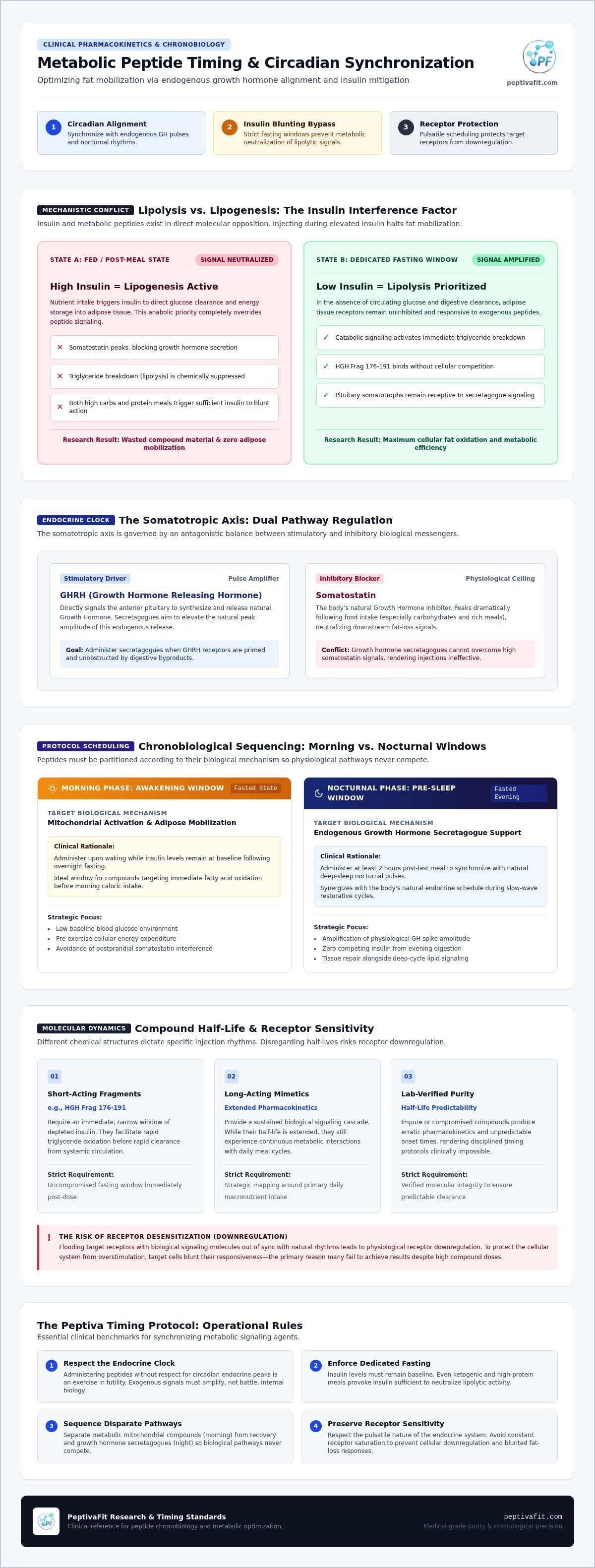
Peptides function as biological signaling molecules rather than traditional pharmacological agents. Their efficacy depends entirely on the existing hormonal environment at the moment of administration. To achieve significant metabolic shifts, you've got to understand that the body operates on a strict schedule of endogenous pulses and inhibitory phases. Identifying the best time to inject peptides for fat loss involves more than convenience; it requires an understanding of circadian synchronicity. When exogenous signals are introduced out of sync with these natural rhythms, the message to mobilize adipose tissue is often blunted or entirely ignored by the target receptors.
Understanding the Somatotropic Axis
The somatotropic axis is the primary driver of peptide-induced fat loss. This complex system relies on the delicate balance between Growth Hormone Releasing Hormone (GHRH) and Somatostatin, the body's natural growth hormone inhibitor. When you're utilizing growth hormone secretagogues, the objective is to amplify the amplitude of natural GH pulses. If administration occurs during a Somatostatin peak, such as immediately following a high-carbohydrate meal, the secretagogue can't overcome the inhibitory signal. This metabolic interference results in wasted research material and diminished lipolytic results. Precision timing ensures that the exogenous signal hits the pituitary when it's most receptive to stimulation.
Half-Life and Bioavailability Considerations
Molecular integrity is the baseline for predictable half-life behavior. Different compounds require distinct timing strategies based on their chemical structure and duration of action. Subcutaneous administration dictates the onset of action, but several factors influence how long a peptide remains active:
- Short-acting fragments: These require a narrow window of low insulin to facilitate fat oxidation before they're cleared from the system.
- Long-acting mimetics: These provide a sustained signal but still interact with daily metabolic fluctuations.
- Purity levels: Impure compounds lead to erratic pharmacokinetics, making it impossible to establish a disciplined schedule.
Understanding these variables is essential for anyone following the Peptiva Protocol. Without lab-verified purity, the onset and peak of the peptide become unpredictable. It's a disciplined approach. You can't rely on guesswork when the goal is cellular-level optimization.
Chronic mismanagement of timing often leads to receptor desensitization. When the body's flooded with signaling molecules at inappropriate intervals, the receptors "downregulate" to protect the system from overstimulation. This blunted response is a common reason why many fail to see results despite using potent compounds. By respecting the natural pulsatile nature of the human endocrine system, you maintain receptor sensitivity and ensure that each dose contributes to maximum fat loss efficiency. Determining the best time to inject peptides for fat loss is therefore a prerequisite for long-term physiological success.
The Insulin Factor: Why Fasting is Non-Negotiable
Insulin is the primary metabolic antagonist to lipolytic signaling. While some generic advice suggests flexibility in administration, clinical reality dictates that the "insulin blunting" effect can effectively halt fat mobilization. To identify the best time to inject peptides for fat loss, you must first map your blood glucose fluctuations. High insulin levels signal the body to enter an anabolic, storage-heavy state, which diametrically opposes the catabolic signals sent by fat-loss fragments. Without a low-insulin environment, the peptide's message to the adipose tissue is essentially neutralized before it can take effect.
The Molecular Conflict: Lipolysis vs. Lipogenesis
Insulin and lipolytic peptides exist in a state of molecular opposition. While insulin signals the body to store energy via lipogenesis, peptides like HGH Frag 176-191 trigger the breakdown of triglycerides. Injecting after a meal effectively wastes the peptide dose because the body cannot prioritize fat mobilization while insulin is actively clearing glucose from the bloodstream. This blunting effect is absolute. Even if you're following a ketogenic or low-carb diet, a protein-heavy meal can still trigger enough insulin to interfere with signaling. You've got to treat the injection window as a dedicated metabolic event rather than a secondary task.
Optimizing the Fasting Window
A rigorous protocol requires a three-hour fast prior to injection and at least a one-hour fast afterward. This timeframe ensures that blood glucose has stabilized and the peptide can initiate the mobilization of fatty acids without metabolic competition. Fat loss peptides require a 'metabolic vacuum' to function at peak efficiency. Individuals practicing intermittent fasting often find the tail end of their fast to be the best time to inject peptides for fat loss, as this is when endogenous insulin is at its nadir. You can further refine these windows by utilizing the comprehensive frameworks in the Peptiva Protocol.
The dawn phenomenon presents a specific challenge for early-morning administration. This physiological event involves a surge in cortisol and a subsequent rise in blood glucose levels as the body prepares for wakefulness. Injecting during this spike can lead to suboptimal results because the elevated glucose may trigger a corresponding insulin response. Monitoring your waking glucose levels provides the data necessary to decide if you should inject immediately upon waking or wait sixty to ninety minutes for your baseline to return to a true fasted state. Precision is the hallmark of high-level optimization; adjusting for these individual variances is what separates elite results from median outcomes.
Morning vs. Night: Categorizing Peptides by Mechanism
Categorizing peptides by their primary biochemical mechanism is the first step in establishing a disciplined administration schedule. While some compounds are designed to amplify the body's natural pulsatile release of hormones, others act directly on mitochondrial efficiency or adipocyte mobilization. Determining the best time to inject peptides for fat loss depends entirely on whether the goal is to enhance nocturnal recovery or to fuel active lipid oxidation during the day. A misaligned schedule doesn't just reduce efficiency; it can actively interfere with the body's circadian signaling.
Evening Peptides: CJC-1295 and Ipamorelin
The nocturnal growth hormone surge represents the body's most significant natural lipolytic event. Administering a combination of CJC-1295 and Ipamorelin approximately thirty to sixty minutes before sleep leverages this physiological window. This synergy enhances deep sleep quality, which is a prerequisite for effective fat metabolism and cellular repair. The 'no-food' rule discussed in previous sections is most critical here. Any elevation in insulin before bed will blunt the secretagogue's ability to trigger the pituitary. For individuals seeking more advanced nocturnal protocols, our Tesamorelin Dosage guide provides a clinical framework for metabolic optimization.
Morning Peptides: Frag 176-191 and MOTS-C
Morning protocols focus on the immediate mobilization and oxidation of stored fat. Injecting MOTS-C peptide before fasted exercise enhances mitochondrial derived metabolic regulation, significantly increasing energy expenditure during the workout. Similarly, AOD-9604 and HGH Frag 176-191 are most effective when administered in a fasted state before performing high-intensity steady-state (HISS) cardio. These compounds target localized adipocytes, breaking down triglycerides into free fatty acids that the body can then burn for fuel. Without the morning exercise component, these mobilized fats may simply be re-esterified and stored again. This makes the pre-cardio window the best time to inject peptides for fat loss when using direct lipolytic agents.
Some protocols require split doses to maintain a constant signaling environment. For example, individuals with high metabolic demands might administer a fat-loss fragment in the morning for exercise support and a secretagogue at night for hormonal optimization. This dual-window approach ensures that the body remains in a fat-burning state for the maximum number of hours per day. It requires a high level of personal responsibility and strict adherence to fasting requirements to manage multiple injection windows successfully. Consistency is the only way to ensure that these exogenous signals translate into measurable changes in body composition.
Advanced Stacking: The Peptiva Protocol Timing Framework
Sophisticated metabolic optimization often requires the simultaneous use of disparate peptide classes. Managing a stack that includes both lipolytic agents and recovery compounds, such as the 'Wolverine Stack', requires a high level of sequencing discipline. The best time to inject peptides for fat loss changes when you're also accounting for systemic repair. You've got to ensure that the signaling pathways for tissue recovery do not overlap with the acute fasting windows required for fat mobilization. Pharmacokinetic interference can occur if too many signals are introduced to the system simultaneously, leading to a blunted response across all objectives.
Coordinating Fat Loss and Recovery
Timing BPC-157 peptide is generally more flexible than timing secretagogues because its primary mechanism involves angiogenesis and cellular modulation rather than insulin-sensitive lipolysis. However, for maximum efficiency, recovery peptides should be administered at least two hours away from lipolytic fragments. This separation allows the body to prioritize one physiological signal at a time. While recovery agents don't require the same strict fasting as fat-loss peptides, many clients find that mid-day administration provides a stable window that doesn't conflict with morning cardio or evening growth hormone pulses.
Localized tissue health is a frequently overlooked aspect of advanced stacking. Repeated injections in the same subcutaneous area can lead to lipohypertrophy or localized inflammation, which may impede the absorption rate and disrupt your timing. You should rotate between at least four distinct sites on the abdomen or thighs. Maintaining the molecular integrity of the injection site is as important as the timing of the dose itself. A disciplined 24-hour protocol for a PeptivaFit client might follow this structured schedule:
- 05:30: Fasted administration of HGH Frag 176-191.
- 06:00: Fasted cardio or mitochondrial activation.
- 14:00: Mid-day administration of BPC-157 and TB-500 for recovery.
- 20:00: Final caloric intake (commence three-hour fast).
- 23:00: Bedtime administration of CJC-1295 and Ipamorelin.
The Role of Professional Oversight
Generic schedules provide a functional baseline, but individual variability in metabolic rate and sleep architecture necessitates professional oversight. Our 1-on-1 coaching analyzes your specific 'metabolic fingerprint' to fine-tune these windows based on real-time data. Transitioning from the initial Peptiva Protocol to a long-term maintenance phase requires data-driven adjustments to dosage frequency and timing. You can secure a personalized medical assessment to ensure your timing strategy is optimized for your unique physiology and goals.
Adherence to this level of detail is what separates high-performance individuals from the general population. It's not just about the compounds you select; it's about the precision with which you deploy them. When you treat your administration schedule with clinical seriousness, you bypass the common pitfalls of receptor desensitization and metabolic interference. This methodical approach ensures that you aren't just taking peptides, but rather orchestrating a complete biological shift toward fat loss and recovery. Determining the best time to inject peptides for fat loss is the foundation upon which this entire framework is built.
Clinical Precision: The Link Between Purity and Timing
Identifying the best time to inject peptides for fat loss is a wasted effort if the compound's molecular structure is compromised. Purity isn't just a safety concern; it's a pharmacokinetic requirement for predictable results. When a peptide contains unverified fillers or manufacturing byproducts, its half-life becomes erratic. This instability makes it impossible to synchronize administration with your body's natural hormonal pulses. A compound that should peak in thirty minutes might take ninety if its molecular integrity is degraded, causing the signal to collide with an insulin spike or a somatostatin surge that neutralizes its effect.
The Peptiva Protocol mandates the use of lab-tested peptides to eliminate these variables. A Certificate of Analysis (COA) is the only objective proof of a compound's quality. You must look for High-Performance Liquid Chromatography (HPLC) results that confirm purity levels above 98%. Anything less suggests the presence of truncated sequences or residual solvents. These impurities don't just blunt metabolic signaling; they can trigger an immune response that leads to systemic inflammation, further hindering your fat loss progress.
Molecular Integrity and Dosing Accuracy
Degradation is the primary enemy of signaling speed. Even a high-purity peptide can lose its efficacy through improper handling after it arrives. Mastering reconstitution techniques is as important as the injection timing itself. Forceful agitation or exposure to UV light can cleave the delicate peptide bonds, rendering the dose biologically inert. Storage protocols are equally vital. Maintaining a consistent temperature between 2°C and 8°C (36°F to 46°F) after reconstitution ensures the chemical stability required for precise timing. Without this discipline, you're essentially injecting an unpredictable variable into a complex biological system.
Next Steps for Metabolic Optimization
Achieving elite body composition requires more than just access to compounds; it requires a disciplined execution of the entire timing framework. If you're unsure about your current schedule, booking a single consultation call allows us to review your timing and dosage frequency against your specific metabolic data. This professional oversight ensures your efforts aren't compromised by avoidable errors in administration. Determining the best time to inject peptides for fat loss is a data-driven process that leaves no room for guesswork.
Before you proceed with your next administration, ensure you can verify the following checklist for peak efficiency:
- Verify purity via a current COA before the first dose.
- Adhere strictly to the three-hour pre-injection fasting rule.
- Synchronize morning modulators with fasted cardio for active oxidation.
- Maintain absolute consistency in your daily injection windows to prevent receptor downregulation.
- Utilize lab-verified peptides to ensure consistent half-lives and signaling speed.
Metabolic optimization is a long-term process that demands maturity and compliance. By focusing on clinical purity and physiological timing, you bypass the common pitfalls that lead to stagnant results. You're not just following a trend; you're managing a sophisticated biological protocol with the intent of permanent physiological change.
Mastering Your Metabolic Architecture
Achieving significant body composition changes requires a disciplined transition from casual administration to clinical precision. You've learned that timing isn't a suggestion; it's a physiological requirement to bypass insulin interference and amplify your body's natural somatotropic pulses. Identifying the best time to inject peptides for fat loss is the foundational step toward reclaiming metabolic control. Without this synchronicity, even high-grade compounds will fail to yield elite results.
Success in 2026 demands more than just a schedule. It requires lab-verified peptide purity to ensure predictable half-lives and clinical medical assessments to map your unique endocrine landscape. For those seeking a higher level of oversight, expert 1-on-1 coaching is available to fine-tune your protocol based on real-time data. You don't have to navigate these complexities alone. Optimize your timing with the Peptiva Protocol Fat Loss Guide and begin orchestrating a more efficient version of your biology. Your commitment to precision is the only variable that guarantees success.
Frequently Asked Questions
Can I eat immediately after injecting fat loss peptides?
No. You must wait at least 30 to 60 minutes after administration before consuming any calories. Fat-mobilizing peptides require a low-insulin environment to trigger lipolysis effectively. Eating immediately triggers an insulin response that blunts the peptide's signaling, rendering the dose largely ineffective for fat oxidation. This waiting period ensures the compound has initiated the intended metabolic pathway without interference from glucose spikes. Adhering to this window is a non-negotiable requirement for metabolic optimization.
What happens if I inject my peptides at the wrong time?
Injecting at the wrong time typically results in diminished efficacy due to metabolic interference. If you administer a lipolytic peptide shortly after a meal, the elevated insulin will block the breakdown of stored fats. Additionally, misaligned timing with your natural circadian rhythms can lead to receptor desensitization or disrupted sleep patterns. While not usually dangerous, poor timing represents a significant waste of high-quality research materials and stalls your progress toward body composition goals. Precision is essential for results.
Do I need to fast before injecting BPC-157 for recovery?
No, fasting isn't required for BPC-157 administration. Unlike growth hormone secretagogues or fat-loss fragments, BPC-157 operates through angiogenesis and cellular modulation pathways that aren't sensitive to insulin fluctuations. You can inject this recovery peptide at any time of day, though many disciplined users prefer a mid-day window to avoid any potential signaling overlap with their morning or evening fat-loss protocols. Consistency in daily administration is more critical than fasting for this specific compound's systemic repair functions.
Is it better to inject peptides in the morning or at night for weight loss?
The best time to inject peptides for fat loss depends on the specific mechanism of the compound you're using. Morning administration is ideal for direct lipolytic agents like Frag 176-191, especially when paired with fasted cardio. Conversely, nighttime administration is superior for secretagogues like Ipamorelin, as it amplifies the body's natural nocturnal growth hormone surge. Most advanced protocols utilize both windows to provide a continuous metabolic signal throughout a 24-hour cycle while respecting endogenous hormonal rhythms.
How long should I wait to exercise after a morning peptide injection?
You should wait approximately 20 to 30 minutes after a subcutaneous injection before beginning your exercise session. This window allows the peptide to enter systemic circulation and begin the process of mobilizing free fatty acids from adipose tissue. Performing fasted cardio shortly after administration ensures that these mobilized fats are oxidized for fuel rather than being re-stored. This synergy between timing and activity is a core component of the Peptiva Protocol for achieving maximum fat loss efficiency.
Can I take all my peptides at once in a single stack?
While you can administer multiple peptides in a single session, you shouldn't mix different compounds in the same syringe unless they're specifically manufactured as a blend. More importantly, you've got to ensure the timing of the stack respects the metabolic requirements of each agent. For example, recovery peptides can be taken together, but they should be separated from fat-loss agents to prevent pathway competition. A structured 24-hour schedule is always superior to a single, uncoordinated administration window.
Will caffeine or coffee interfere with my peptide timing?
Black coffee or plain caffeine won't interfere with your peptide timing because they don't trigger an insulin response. However, adding cream, sugar, or MCT oil to your coffee will break your fast and neutralize the effectiveness of fat-loss peptides. If you're using morning modulators like MOTS-C, caffeine can actually act synergistically by increasing metabolic rate and fatty acid oxidation. Just ensure your beverage is strictly non-caloric to maintain the necessary metabolic vacuum required for the best time to inject peptides for fat loss.
How do I adjust my peptide timing if I work night shifts?
You must adjust your administration schedule to match your personal circadian rhythm rather than the clock. If you work nights, your "morning" injection should occur immediately upon waking, and your "nocturnal" secretagogue dose should be taken before your primary sleep period. The goal is to maintain the same relationship with your sleep-wake cycle and fasting windows. Personalized medical assessments can help you map these adjustments with clinical precision to ensure your protocol remains effective despite an unconventional schedule.

![Shelf Life of Reconstituted Peptides: A Clinical Reference Guide [2026]](https://getautoseo.com/storage/hero_images/shelf-life-of-reconstituted-peptides-a-clinical-reference-guide-2026.jpg?v=b8ed5173acaa)
