
![Shelf Life of Reconstituted Peptides: A Clinical Reference Guide [2026]](https://getautoseo.com/storage/hero_images/shelf-life-of-reconstituted-peptides-a-clinical-reference-guide-2026.jpg?v=b8ed5173acaa)
The moment bacteriostatic water hits a lyophilized powder, a kinetic countdown begins that most researchers fundamentally misunderstand. It's frustrating to invest in premium, lab-tested compounds only to question their efficacy after a few weeks of storage. You've likely faced conflicting data regarding refrigeration versus freezing, which creates unnecessary risk for your experimental outcomes. Mastering the shelf life of reconstituted peptides is not about adhering to a generic calendar date; it's about understanding the specific molecular fragility of the sequences in your care.
This reference guide, aligned with the disciplined standards of The Peptiva Protocol, provides the protocols required to maintain the integrity of your research materials. We'll establish a clear timeline for stability based on 2026 data for complex sequences like MOTS-c, define standardized storage environments, and identify the subtle visible markers of chemical degradation. By the end of this analysis, you'll possess the technical knowledge to protect your research and ensure the precision of your metabolic optimization protocols.
Key Takeaways
- Understand the chemical transition from lyophilized stability to liquid volatility and how hydrolysis initiates the degradation of peptide bonds.
- Master the environmental controls required to maintain the shelf life of reconstituted peptides, specifically the 2°C to 8°C thermal threshold.
- Differentiate between the four-week stability window for Growth Hormone Secretagogues and the extended eight-week durability of healing sequences.
- Implement standardized clinical storage protocols, such as using amber vials and dedicated medical refrigeration, to protect your research materials.
- See how The Peptiva Protocol utilizes lab-verified purity standards to provide a foundation for maximum molecular longevity and research accuracy.
Molecular Stability: What Occurs During Peptide Reconstitution?
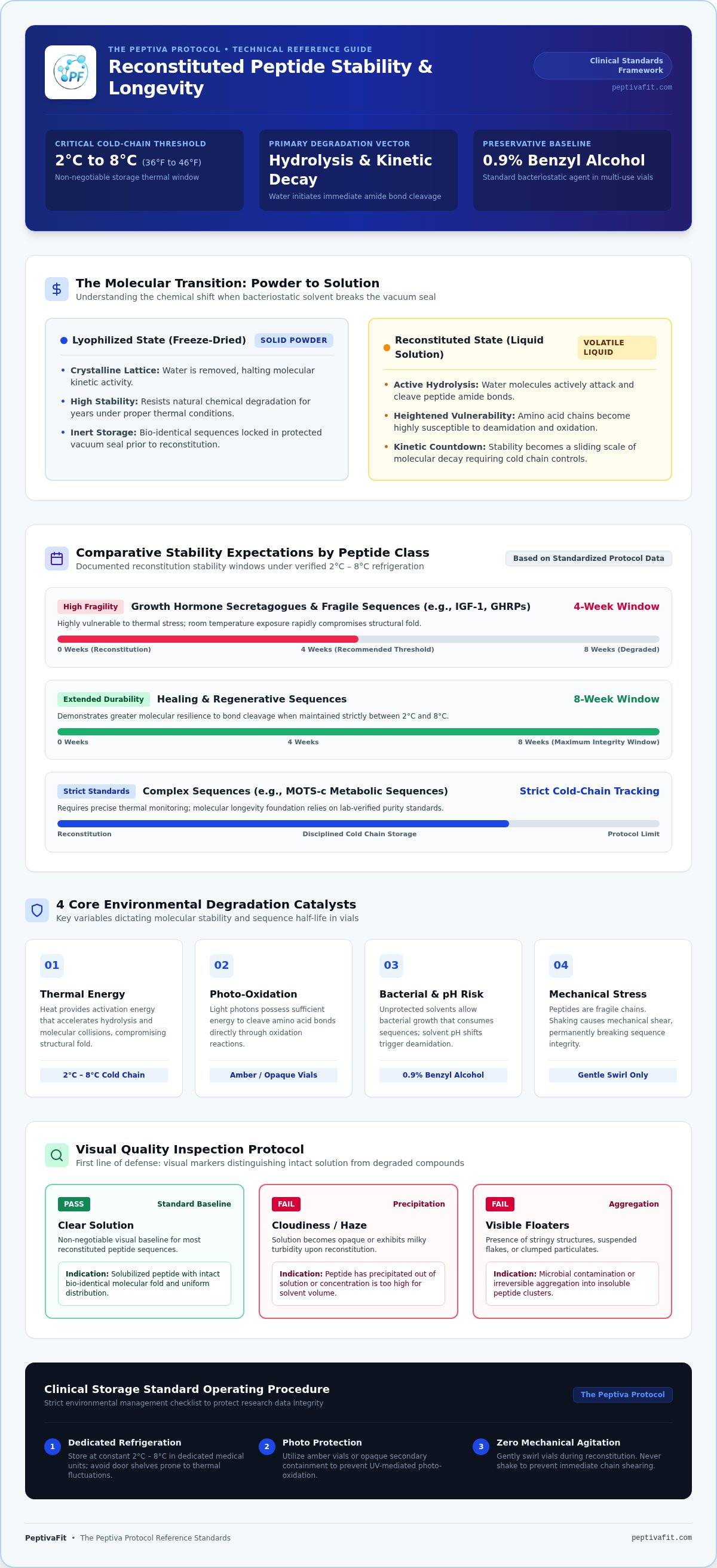
Lyophilization, or freeze-drying, remains the industry standard for long-term storage because it effectively halts kinetic activity by removing water. In this state, molecules are locked in a stable crystalline structure that resists degradation for years if kept under proper thermal conditions. However, research requires these compounds to be functional and bio-available. Peptide reconstitution is the process of restoring a lyophilized solid to a liquid state for research application. This transition marks the shift from a protected, inert state to a volatile liquid environment where the shelf life of reconstituted peptides becomes the primary variable in experimental success.
Once a solvent like bacteriostatic water is introduced, a process known as hydrolysis begins. This chemical reaction involves water molecules actively attacking and breaking the amide bonds that define the peptide chemistry and molecular structure. The primary goal of the researcher is to maintain the bio-identical structure of the sequence for as long as possible to ensure experimental accuracy. Any deviation in the molecular fold or sequence integrity renders the resulting research data void, as the peptide no longer interacts with receptors as intended.
The Chemical Transition Process
The introduction of a solvent initiates molecular vibration. While a peptide's "half-life" usually refers to its duration of activity within a biological system, its shelf life in a vial is dictated by its stability against environmental stressors. In a liquid state, amino acid chains are highly susceptible to deamidation and oxidation. These processes accelerate based on the pH of the solvent and the presence of thermal energy, which provides the activation energy necessary for bond cleavage. Stability isn't a fixed date but a sliding scale of molecular decay that begins the second the vacuum seal is broken.
Signs of Immediate Molecular Instability
Immediate visual inspection serves as the first line of defense in maintaining research integrity. Clear solutions are the non-negotiable baseline for most sequences. If a solution appears compromised, the researcher must assume the molecular integrity is lost. Common indicators of instability include:
- Cloudiness: This often indicates that the peptide has precipitated out of the solution or that the concentration is too high for the solvent volume.
- Floaters: Visible particulates or "stringy" structures suggest contamination or that the peptide has aggregated into insoluble clumps.
- Mechanical Stress: Peptides are delicate. Aggressive shaking instead of gentle swirling can shear peptide chains, causing irreversible structural damage before the protocol even begins.
Maintaining a disciplined approach to these initial steps is vital. A failure to recognize early signs of instability leads to the use of degraded material, which compromises the validity of the entire research project.
Primary Environmental Factors Influencing Peptide Longevity
External variables act as the primary catalysts for molecular decay once a compound is in solution. Maintaining a strict temperature range between 2°C and 8°C (36°F to 46°F) is non-negotiable for preserving the shelf life of reconstituted peptides. Deviating from this thermal window introduces kinetic energy that accelerates hydrolysis. Similarly, light exposure represents a significant risk. Photons possess enough energy to break amino acid bonds through photo-oxidation, which is why amber vials or opaque secondary packaging are standard requirements in high-level research.
The chemical environment within the vial is equally critical. The acidity or alkalinity of the solvent must remain within a narrow range to prevent deamidation. Clinically, 0.9% benzyl alcohol serves as the preservative standard in multi-use vials. This bacteriostatic agent prevents microbial colonies from establishing themselves. Without it, bacterial growth would not only contaminate the sample but also actively consume the peptide sequences, destroying the vial's integrity within days.
Thermal Stress and Kinetic Energy
Heat increases the frequency and intensity of molecular collisions. Sensitive sequences, such as IGF-1 or certain GHRPs, are particularly vulnerable to thermal stress. Even short periods of room temperature exposure can compromise the structural fold of these molecules. Researchers must utilize insulated transport systems to maintain the cold chain from the moment of reconstitution. If the thermal threshold is breached, the efficacy of the sequence becomes unpredictable, regardless of the remaining volume in the vial.
Solvent Quality and Contamination
Precision in solvent choice is a hallmark of disciplined research. There is a fundamental functional difference between sterile water and bacteriostatic water for peptides. Sterile water is intended for single-use applications as it lacks the antimicrobial properties needed for multi-puncture protocols. To ensure accuracy and prevent degradation, using a peptide reconstitution calculator is essential for determining the exact volume of solvent required. This level of detail protects the shelf life of reconstituted peptides by maintaining the correct concentration and pH balance. For those serious about metabolic optimization, professional coaching can provide the oversight necessary to eliminate these common environmental errors.
Comparative Stability: Shelf Life Expectations by Peptide Class
The common laboratory assumption that all sequences expire exactly 30 days after mixing is a clinical fallacy that compromises research precision. Stability is a function of molecular complexity, sequence length, and the specific amino acids involved. The shelf life of reconstituted peptides varies significantly between classes, ranging from a few days to several months. Understanding these specific windows is essential for maintaining the molecular integrity of your research protocols and avoiding the use of degraded, inert compounds.
Research materials generally fall into four stability categories when stored at the non-negotiable 2°C to 8°C range:
- Metabolic and Mitochondrial (MOTS-c, Tesamorelin): These are highly volatile. 2026 stability data suggests these sequences are best used within 7 to 14 days post-reconstitution.
- Growth Hormone Secretagogues (Ipamorelin, CJC-1295): These exhibit medium stability, typically remaining viable for approximately 4 weeks.
- Repair and Healing Peptides (BPC-157, TB-500): These are notably resilient, often maintaining integrity for up to 8 weeks if refrigeration is strictly maintained.
- Nootropic Peptides (Semax, Selank): Stability is variable. Injectable formats follow the 4-week rule, while nasal sprays may degrade faster due to frequent room temperature exposure during administration.
The Fragility of Growth Hormone Analogues
The molecular weight of a compound often correlates with its degradation speed. Larger, more complex chains are more susceptible to folding errors and bond cleavage once in solution. This is why tesamorelin dosage protocols require strict adherence to fresh reconstitution; the molecule is too fragile for long-term liquid storage. Conversely, the addition of a Drug Affinity Complex (DAC) to CJC-1295 significantly extends its half-life in vivo, but it does not proportionally increase its shelf life of reconstituted peptides in the vial. Researchers must still prioritize use within the standard 28-day window to ensure full potency.
Resilient Sequences: BPC-157 and TB-500
Certain sequences possess a more robust structural integrity. The BPC-157 peptide, a gastric pentadecapeptide, is uniquely stable compared to larger growth factors. Its sequence is less prone to the rapid hydrolysis that plagues mitochondrial peptides. While TB-500 also shows high durability, research timelines should still cap use at 8 weeks. Beyond this point, even if the solution remains clear, the gradual accumulation of deamidated byproducts can alter the experimental results. Discarding vials according to these class-specific timelines is a hallmark of disciplined, high-level research.
Clinical Storage Protocols for Maximizing Research Integrity
Precision in storage is the final barrier between valid research and wasted resources. To maximize the shelf life of reconstituted peptides, researchers must move beyond casual storage habits and adopt a clinical framework. This protocol ensures that the molecular structure remains intact from the first draw to the final milligram. Adhering to these five steps is mandatory for any serious metabolic optimization project conducted under The Peptiva Protocol.
- Step 1: Immediate Refrigeration. Vials must be placed in a dedicated medical refrigerator immediately after reconstitution to prevent thermal degradation.
- Step 2: Light Protection. Utilize amber vials or opaque storage containers to shield the solution from UV-induced photo-oxidation.
- Step 3: Minimal Agitation. Never shake a vial. Swirl it gently to dissolve the lyophilized powder, as aggressive mechanical stress can shear delicate peptide chains.
- Step 4: Digital Monitoring. Use a calibrated digital thermometer to track internal fridge temperatures, ensuring they remain within the 2°C to 8°C range without fluctuation.
- Step 5: Strict Use-By Dates. Assign a terminal date to each vial based on its molecular class as defined in our research standards, ensuring no compound is used past its stability window.
Refrigeration vs. Freezing Post-Reconstitution
A common misconception is that freezing reconstituted peptides will extend their longevity. This is false. The "never freeze" rule is absolute once a peptide is in solution. The formation of ice crystals creates jagged physical structures that destroy molecular chains and cause irreversible denaturation. Additionally, the refrigerator door is the least stable environment due to constant temperature swings. Vials should be stored in the center of the unit, away from the cooling element, to maintain a consistent cold chain throughout the research duration.
Identifying Peptide Degradation
Vigilance during each research session is required to detect early signs of chemical breakdown. Visual indicators include precipitation, noticeable discoloration, or an increase in the liquid's viscosity. Functional cues are more subtle, often manifesting as a loss of the expected physiological response in research subjects despite accurate dosing. Any change in the clarity of a reconstituted peptide solution is a definitive sign of molecular degradation. If you're concerned about the integrity of your current research materials, securing lab tested peptides is the only way to guarantee baseline purity before storage begins.
Ensuring Efficacy through The Peptiva Protocol and Professional Oversight
The integrity of your research doesn't begin with the solvent; it starts with the molecular purity of the lyophilized powder. While environmental controls are essential, the shelf life of reconstituted peptides is fundamentally limited by the presence of synthesis byproducts. The Peptiva Protocol prioritizes lab-verified purity standards because even a 1% margin of impurity can act as a chemical catalyst, accelerating the breakdown of the primary sequence. High-purity compounds exhibit a more predictable degradation curve, allowing for more precise data collection and better long-term outcomes.
Personalized medical assessments provide the necessary context for these timelines. A standardized 30-day rule fails to account for individual research goals or the specific molecular fragility of the sequences being utilized. By integrating professional oversight, researchers can move beyond guesswork and establish storage and usage protocols that reflect the actual kinetic data of their specific batch. This disciplined approach ensures that the bio-identical structure of the peptide remains functional throughout the entire duration of the protocol.
Quality Assurance in Peptide Research
Many suppliers label their products as "research grade" to bypass rigorous quality controls, leaving the researcher with unverified compounds. These impurities aren't just inert filler; they often consist of truncated sequences or residual solvents that trigger faster oxidation and hydrolysis. When integrating peptides for metabolism and fat loss, the margin for error is non-existent. A disciplined lifestyle requires disciplined materials. Utilizing lab-tested peptides is the only way to ensure that the shelf life of reconstituted peptides isn't compromised before the vial is even opened.
Next Steps: Consultation and Strategy
Transitioning from theoretical knowledge to practical application requires a level of precision that generic resources cannot provide. Professional 1-on-1 coaching serves as a critical resource for troubleshooting complex reconstitution and storage issues that arise during extended research projects. It's about maintaining sophisticated control over every variable, from the initial vacuum seal to the final administration. If you're ready to audit your current research framework and ensure you're utilizing the highest clinical standards, you can book a single consultation call to refine your strategy. This professional medical assessment ensures your research is conducted with the oversight required for handling complex molecular sequences.
Advancing Research Precision through Disciplined Molecular Management
Precision in metabolic optimization requires more than just high-quality sequences; it demands a rigorous commitment to environmental and chemical stability. We've established that the shelf life of reconstituted peptides is a variable dictated by molecular weight, sequence complexity, and the strict maintenance of the cold chain. Relying on generic storage timelines compromises the integrity of your data and the efficacy of your protocols. By identifying visual markers of degradation and adhering to class-specific use-by dates, you protect the viability of your research materials.
True optimization occurs when clinical knowledge meets professional oversight. The Peptiva Protocol provides the necessary framework for this high-level management, combining lab-verified peptide purity with comprehensive fat loss guides. To move beyond theoretical study and implement these standards with precision, you can access the full Peptiva Protocol for expert-led metabolic optimization. Our professional 1-on-1 medical coaching ensures your research is conducted with the sophisticated control required for elite performance. You have the data; now implement the discipline required to master your results.
Frequently Asked Questions
How long do peptides last in the fridge after being mixed?
Reconstituted peptides generally maintain stability for 4 to 8 weeks when stored at 2°C to 8°C. However, the shelf life of reconstituted peptides depends heavily on the specific sequence. Growth hormone secretagogues typically reach their limit at the 30-day mark, whereas more resilient sequences like BPC-157 may remain viable for up to 60 days. Always verify the specific molecular window for your research material to prevent using degraded compounds.
Can I freeze peptides after they have been reconstituted?
You must never freeze peptides once they've been reconstituted with a solvent. The formation of ice crystals creates physical stress that shears the delicate amino acid chains, leading to irreversible molecular denaturation. While lyophilized powder is often stored in the freezer for long-term stability, the liquid state is too fragile for sub-zero temperatures. Freezing a mixed vial effectively renders the research material inert and causes aggregation that compromises experimental data.
What happens if I leave my reconstituted peptides at room temperature overnight?
Leaving reconstituted peptides at room temperature overnight initiates rapid molecular degradation through accelerated hydrolysis. Thermal energy increases the frequency of molecular collisions, which breaks the amide bonds holding the sequence together. For highly volatile peptides like MOTS-c or Tesamorelin, even a single night of exposure can result in a significant loss of potency. If a vial is accidentally left out, visual inspection for cloudiness is necessary, though internal molecular damage often remains invisible.
Is it safe to use peptides if the liquid has turned cloudy?
Cloudiness is a definitive clinical indicator that the solution is no longer safe for research application. This visual change suggests that the peptide has precipitated out of the solvent or that microbial contamination has occurred. In some cases, it indicates that the peptide has aggregated into insoluble clumps, which fundamentally alters its biological activity. Any deviation from a completely clear solution means the molecular integrity is compromised and the vial should be discarded immediately.
Does the type of water used for reconstitution affect the shelf life?
The choice of solvent is a primary factor in determining the shelf life of reconstituted peptides. Bacteriostatic water, which contains 0.9% benzyl alcohol, is the clinical standard for multi-use vials because it inhibits bacterial growth. Using sterile water without a preservative limits the vial's viability to a single use, as bacteria introduced during the first puncture will quickly degrade the peptide. Proper solvent selection ensures the chemical environment remains stable for the duration of the protocol.
How can I tell if my peptides have lost their potency?
Potency loss is often identified through a combination of visual markers and a diminished physiological response in research subjects. If the solution shows discoloration, particulates, or increased viscosity, the compound has likely degraded. In a clinical setting, if a previously effective protocol no longer produces the expected metabolic or recovery markers, it's a strong indicator that the peptide bonds have broken down. Utilizing lab-verified purity standards from the start helps establish a more predictable efficacy window.
Do all peptides have the same shelf life once mixed?
Stability varies significantly across different peptide classes based on their molecular structure. Mitochondrial sequences like MOTS-c are highly volatile and should be utilized within 7 to 14 days of mixing. Conversely, healing peptides like BPC-157 exhibit much higher resilience, often maintaining integrity for up to 8 weeks. Understanding these specific windows is a core component of The Peptiva Protocol, ensuring that researchers don't apply a generic 30-day rule to every compound in their inventory.
Should I store my peptides in the original vial or transfer them?
You should always maintain storage within the original manufacturer's vial to preserve the sterile environment. Transferring the liquid to a new container introduces significant risks of bacterial contamination and exposure to atmospheric oxygen, both of which accelerate degradation. Most professional-grade vials are designed to shield the contents from light and maintain a consistent pH. Moving the solution to a secondary container unnecessarily complicates the protocol and risks compromising the molecular stability of the research material.


