

Achieving the systemic benefits of a high-intensity endurance session through a targeted chemical signaling pathway isn't just a theoretical concept; it's the specific promise of the novel ERR agonist known as slu-pp-332. While most metabolic aids rely on CNS stimulation, this compound functions as a metabolic re-programmer that mirrors the genetic response to physical exertion. You're likely aware that the bridge between promising 2023 findings from Saint Louis University and practical human application is often obscured by low-purity research data and unverified claims.
It's understandable to feel cautious when addressing the gap between rodent-based metabolic theory and actual performance optimization. This article provides an objective, research-driven analysis of slu-pp-332 and its unique mechanism within the Estrogen-Related Receptor framework. You'll gain a technical understanding of its role in mitochondrial biogenesis. We'll also compare its efficacy to mitochondrial-derived peptides like MOTS-C. Finally, we'll evaluate the current state of clinical research to determine if this compound meets the laboratory-grade standards required for sophisticated metabolic tracking.
Key Takeaways
- Understand how slu-pp-332 functions as a metabolic re-programmer by targeting Estrogen-Related Receptors to trigger mitochondrial biogenesis.
- Evaluate the 2024 research findings that demonstrated a 12% reduction in body fat and enhanced endurance through non-stimulant pathways.
- Distinguish the unique pharmacokinetic profile of this small molecule against established research peptides like MOTS-C and PPARδ agonists.
- Identify the current clinical trajectory and regulatory status within an analytical framework designed for informed, laboratory-grade decision-making.
What is SLU-PP-332? Defining the Next Generation of Exercise Mimetics
The pursuit of metabolic optimization has shifted from simple caloric restriction to the sophisticated modulation of genetic pathways. At the center of this evolution is slu-pp-332, a synthetic small-molecule that functions as an agonist for Estrogen-Related Receptors (ERRs). Developed by researchers at Saint Louis University, this compound represents a significant departure from traditional weight loss agents. It doesn't rely on the central nervous system to accelerate heart rate or suppress appetite. Instead, it acts as an "exercise mimetic," a class of molecules designed to replicate the cellular signaling and physiological adaptations typically induced by physical activity.
Exercise mimetics serve a critical role in contemporary metabolic research. They provide a mechanism to activate energy-demanding processes directly at the source. This includes mitochondrial biogenesis and fatty acid oxidation. While metabolic stimulants create a temporary state of heightened activity, genetic pathway activators like SLU-PP-332 induce structural changes in how cells process fuel. This distinction is vital. It allows researchers to address systemic conditions like metabolic syndrome or muscle wasting without the cardiovascular strain associated with sympathomimetic drugs.
The Discovery of the 4-Hydroxybenzamide Derivative
The development of this molecule began as a targeted effort to solve the inherent instability of earlier ERR agonists. In 2023, the research team led by Thomas Burris identified this specific 4-hydroxybenzamide derivative as a potent and stable modulator of all three ERR isoforms (α, β, and γ). Previous attempts at creating ERR agonists often failed due to poor bioavailability or off-target effects. By refining the chemical structure, the team created a compound capable of targeting obesity and muscle atrophy with high precision. Their findings, published in late 2023 and expanded upon in 2024, demonstrated that the molecule could effectively "trick" muscle tissue into believing it was performing endurance training.
Pharmacological Classification
This compound is classified strictly as a research-grade metabolic modulator. It's currently intended only for laboratory research purposes and educational study; it hasn't yet received FDA approval for clinical use in humans. Maintaining this distinction is essential for ensuring data integrity and safety within the research community. SLU-PP-332 is a non-hormonal regulator of energy metabolism that modulates the transcriptional activity of orphan nuclear receptors. It doesn't interact with estrogen receptors despite its name. Rather, it targets the "orphan" receptors that govern the body's primary energy-producing machinery, providing a controlled environment for studying metabolic flux.
Mechanism of Action: ERR Agonism and Mitochondrial Biogenesis
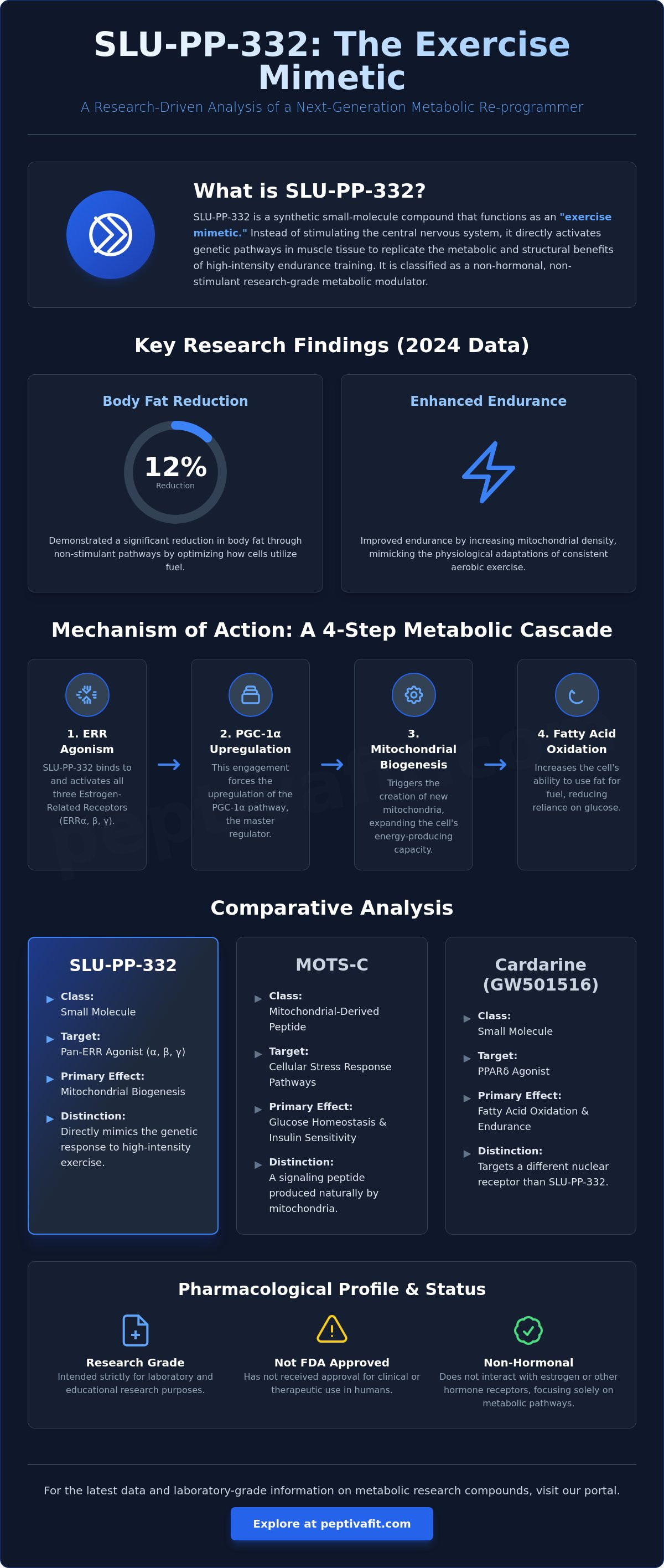
The core efficacy of slu-pp-332 lies in its ability to bind to and activate the Estrogen-Related Receptor (ERR) family. These orphan nuclear receptors, specifically the α, β, and γ isoforms, serve as essential transcriptional regulators of metabolic homeostasis. In skeletal muscle, ERRα and ERRγ are particularly dominant. They orchestrate the expression of genes required for mitochondrial oxidative capacity. By functioning as a pan-agonist, this compound initiates a cascade that mimics the biological signals usually reserved for high-volume aerobic training.
Central to this mechanism is the relationship between ERR activation and the PGC-1α pathway. PGC-1α is often characterized as the master regulator of mitochondrial biogenesis. When slu-pp-332 engages these receptors, it effectively forces the upregulation of the PGC-1α/ERR transcriptional complex. This doesn't merely increase energy output; it fundamentally alters the cellular architecture by expanding the mitochondrial network. This process is accompanied by a significant increase in the expression of enzymes responsible for fatty acid oxidation (FAO). Cells become more proficient at mobilizing and utilizing lipids as a primary substrate, reducing the reliance on anaerobic glycolysis.
Genetic Pathway Activation vs. Caloric Deficit
Traditional weight management strategies rely on a caloric deficit to force fat mobilization. In contrast, this molecule instructs the cell to prioritize fat as a fuel source through genetic signaling. This shift in substrate preference mimics the cellular signaling observed during a 60-minute zone 2 cardio session, where the body optimizes for endurance and lipid utilization. Research indicates that this pathway activation improves glucose metabolism and insulin sensitivity by enhancing the muscle's ability to clear glucose from the bloodstream. For those tracking metabolic flux, this represents a shift from passive weight loss to active metabolic re-programming.
Mitochondrial Efficiency and ATP Production
The enhancement of mitochondrial density is most pronounced in type I skeletal muscle fibers. These slow-twitch fibers are dense with mitochondria and are responsible for sustained energy production. By increasing the volume and efficiency of these organelles, the compound supports higher ATP production without increasing oxidative stress. This cellular efficiency is a cornerstone of longevity research. It mirrors the effects of the MOTS-C peptide pillar, which also targets mitochondrial-derived regulation for systemic health. Understanding these interactions is vital for anyone engaged in a personalized medical assessment of emerging research compounds. This synergy between increased mitochondrial mass and improved fuel selection creates a robust metabolic environment that persists beyond the immediate presence of the molecule.
Clinical Data Review: Weight Loss and Endurance Findings
The definitive evidence for the efficacy of slu-pp-332 stems from a March 2024 study published in the Journal of Pharmacology and Experimental Therapeutics. This research provides a granular look at the compound's impact on body composition and physical capacity in controlled environments. In these rodent models, researchers observed a 12% reduction in total body fat over a 28-day period. Crucially, this fat loss was achieved without a corresponding decrease in lean muscle mass. The metabolic shift was systemic.
Physical performance metrics revealed a substantial upgrade in aerobic capacity. Subjects treated with the compound demonstrated a 70% increase in total running distance and a 45% increase in running duration compared to the control group. These improvements are attributed to the enhanced mitochondrial efficiency discussed in previous sections. The data suggests that the molecule doesn't just promote weight loss; it fundamentally strengthens the metabolic infrastructure required for sustained endurance. This preservation of muscle tissue during rapid adipose reduction highlights its potential as a protective agent against metabolic catabolism.
Metabolic Syndrome and SLU-PP-332
Beyond body composition, the 2024 data highlighted systemic improvements in metabolic health markers. Researchers noted significant reductions in triglyceride levels and total cholesterol, indicating a more efficient lipid profile. There was also a measurable decrease in hepatic steatosis markers, suggesting a reversal of fatty liver accumulation. SLU-PP-332 achieved these clinical results without reducing food intake or altering the subjects' dietary habits. This confirms that the observed benefits result from metabolic re-programming rather than simple caloric restriction.
The "Exercise in a Pill" Limitation
While the media often labels such compounds as "exercise in a pill," this clinical framing requires nuance. Pharmacological mimetics can replicate the mitochondrial and genetic signaling of physical activity, but they can't replace the complex neural benefits of exercise. Movement triggers a proprietary blend of neurotrophic factors and coordination patterns that a small molecule can't simulate. Skeletal muscle functions as a sophisticated endocrine organ, releasing myokines that communicate with the brain in ways that aren't fully captured by ERR agonism alone. The primary research gap remains the transition from rodent models to human clinical trials, a process that requires rigorous validation before these results can be applied to human performance standards.
SLU-PP-332 vs. MOTS-C vs. Cardarine: A Comparative Analysis
Evaluating the efficacy of slu-pp-332 requires a direct comparison with established metabolic modulators like Cardarine (GW-501516) and the mitochondrial-derived peptide MOTS-C. While all three compounds are categorized as exercise mimetics, their molecular targets differ significantly. Cardarine functions as a PPARδ agonist, a pathway that primarily enhances fatty acid transport and oxidation. However, Cardarine's clinical development was famously halted by GSK in 2007 due to safety concerns regarding rapid oncogenesis in rodent models. In contrast, slu-pp-332 targets the Estrogen-Related Receptor (ERR) family, providing a more refined genetic instruction set for mitochondrial biogenesis without the same legacy safety profile associated with PPARδ ligands.
The structural distinction between these molecules also dictates their research application. MOTS-C is a 16-amino acid peptide that signals the nucleus to adapt to metabolic stress, whereas this novel ERR agonist is a synthetic small molecule. Small molecules typically offer different pharmacokinetic properties and administration routes compared to peptides, which require subcutaneous delivery to maintain stability. While MOTS-C provides systemic mitochondrial signaling, the ERR agonist shows a more concentrated effect on skeletal muscle tissue, specifically targeting the oxidative capacity of type I fibers. Researchers often prioritize the small-molecule approach for its stability and direct ligand-binding affinity to nuclear receptors.
Synergy in Metabolic Research
Advanced research protocols often explore the theoretical synergy between metabolic mimetics and bioregulatory peptides. For instance, this molecule may complement the Vilon peptide in studies focused on cellular aging and gene expression. While the ERR agonist drives mitochondrial density and energy flux, dipeptides like Vilon work at the level of chromatin structure and protein synthesis. This multi-layered approach allows for a more comprehensive analysis of cellular longevity than any single compound could provide. Understanding the differing half-lives and administration protocols is essential for maintaining the integrity of these complex research designs.
Choosing the Right Research Focus
Deciding when to prioritize ERR agonists over traditional GH secretagogues or PPAR modulators depends on the specific metabolic objective. If the goal is pure mitochondrial expansion and endurance signaling, the ERR pathway is currently the most targeted genetic mechanism available. This compound is increasingly featured in our comprehensive fat loss peptide guide as a non-stimulant alternative for metabolic re-programming. Navigating these sophisticated research chemicals requires a disciplined, data-driven mindset. To ensure your research aligns with laboratory-grade standards and safety mandates, consider a 1-on-1 coaching session to refine your protocol development and tracking methodology.
The Future of SLU-PP-332 and Metabolic Optimization
As of late 2024, slu-pp-332 remains in the pre-clinical phase of development. No active human clinical trials are currently listed on the FDA’s primary registry for this specific molecule, suggesting that a commercial pharmaceutical application is several years away. However, the speed of metabolic research indicates that this compound is a leading candidate for future metabolic syndrome therapies. For the sophisticated researcher, the current landscape is one of careful observation and data collection. The transition from rodent-based success to human metabolic theory requires a disciplined approach that prioritizes long-term physiological stability over quick fixes.
By 2026, the field of biohacking will likely be defined by the synthesis of genetic pathway activators and real-time metabolic tracking. PeptivaFit continues to evolve its educational resources to match this high-stakes environment, moving beyond general advice to provide curated, laboratory-grade insights. This evolution ensures that our demographic stays informed on how novel ERR agonists fit into a broader, data-driven performance strategy. Staying ahead of the curve means understanding not just what a molecule does, but where it sits within the global regulatory and research pipeline.
Standardizing Research Excellence
The volatility of the emerging research market makes third-party lab testing a non-negotiable requirement. When sourcing slu-pp-332 for laboratory purposes, researchers must demand HPLC and MS verification to confirm a purity threshold of at least 99%. Identifying these specific purity markers is essential to ensure that the chemical structure matches the 4-hydroxybenzamide derivative used in the Saint Louis University studies. Our commitment to clinical-grade education helps researchers navigate these technical requirements with professional precision.
Next Steps for Performance Researchers
Integrating new findings into a comprehensive metabolic strategy requires more than just reading a study. The Peptiva Protocol provides the foundational framework for harmonizing mitochondrial mimetics with established fat loss methodologies. For those seeking a more personalized analysis of how these experimental pathways intersect with their specific goals, 1-on-1 coaching offers direct access to expert guidance. This level of professional oversight is vital for maintaining the high standards of safety and intent that our curated community expects.
Strategic Integration of ERR Agonists in Metabolic Research
The emergence of slu-pp-332 marks a definitive shift toward genetic pathway activation in the study of metabolic syndrome. By prioritizing mitochondrial biogenesis over central nervous system stimulation, this compound offers a disciplined framework for analyzing lipid mobilization. The 2024 findings regarding fat reduction and endurance capacity provide a technical foundation for researchers who value objective data. Success in this exclusive space requires more than just access to molecules; it demands a commitment to laboratory-grade standards and precise tracking.
We facilitate this high-level exploration through lab-verified peptide education and personalized medical assessments. These resources ensure that your research remains grounded in clinical reality rather than unverified marketing hype. To elevate your methodology, optimize your metabolic research with the Peptiva Protocol and leverage our expert 1-on-1 performance coaching. It's a sophisticated journey toward total metabolic control that rewards professional diligence and scientific curiosity. Your commitment to informed decision-making is the most critical variable in achieving elite results.
Frequently Asked Questions
Is SLU-PP-332 a SARM or a peptide?
SLU-PP-332 is neither a Selective Androgen Receptor Modulator (SARM) nor a peptide. It's classified as a synthetic small-molecule that functions as a pan-agonist for Estrogen-Related Receptors (ERRα, ERRβ, and ERRγ). Unlike peptides, which are chains of amino acids, or SARMs, which target androgen receptors, this molecule modulates metabolic pathways at the genetic level to enhance mitochondrial function.
Can SLU-PP-332 replace regular physical exercise?
This compound cannot replace the systemic benefits of regular physical exercise. While it replicates specific mitochondrial signaling and genetic pathways of endurance training, it doesn't provide the mechanical loading required for bone density or the complex neurological adaptations of movement. It's best understood as a metabolic modulator that mirrors the cellular signaling of activity rather than a total replacement for it.
What are the reported side effects of SLU-PP-332 in research?
Current research from the 2024 Billon et al. study hasn't reported acute toxicity or major adverse events in rodent subjects. However, because the compound is in the pre-clinical phase, long-term safety data in humans is non-existent. Researchers must remain cautious of potential off-target effects on other nuclear receptors, as systemic genetic re-programming carries inherent risks that require further longitudinal validation in clinical settings.
How does SLU-PP-332 compare to Cardarine (GW-501516)?
The primary difference lies in their molecular targets. Cardarine is a PPARδ agonist focused on fatty acid transport, while slu-pp-332 is an ERR agonist that directly triggers mitochondrial biogenesis. While both compounds enhance endurance, the ERR pathway provides a more targeted approach to increasing mitochondrial density in skeletal muscle without the specific oncogenic concerns that historically halted the clinical development of Cardarine in 2007.
Is SLU-PP-332 currently available for human use?
No, SLU-PP-332 isn't approved by the FDA or any global regulatory body for human consumption. It's strictly designated for laboratory research purposes and educational study. Any application outside of a controlled research environment is premature, as the compound hasn't yet entered phase I human clinical trials to establish safety or efficacy in the human population as of late 2024.
What dosage was used in the SLU-PP-332 rodent studies?
In the 2023 Saint Louis University study, researchers administered a dosage of 30 mg/kg twice daily via intraperitoneal injection. This specific protocol resulted in the 12% body fat reduction and 70% increase in running distance reported in the findings. It's critical to note that these dosages are specific to rodent metabolism and don't translate directly to human weight-equivalent doses without professional pharmacokinetic modeling.
Does SLU-PP-332 require reconstitution like other peptides?
Unlike lyophilized peptides, this compound is a synthetic small molecule and doesn't follow the same reconstitution protocols. It's typically handled as a stable chemical powder or pre-dissolved in a specific solvent like DMSO for laboratory administration. Its chemical stability is one of the primary reasons it succeeded where earlier, more fragile ERR agonists failed during the development process at Saint Louis University.
How does SLU-PP-332 affect mitochondrial health?
The compound enhances mitochondrial health by forcing the upregulation of the PGC-1α/ERR transcriptional complex. This process increases the density of mitochondria within muscle fibers and improves the efficiency of ATP production. By prioritizing fatty acid oxidation, it reduces cellular reliance on glucose and minimizes oxidative stress, creating a more resilient metabolic environment within the skeletal muscle tissue for researchers to observe.

![Shelf Life of Reconstituted Peptides: A Clinical Reference Guide [2026]](https://getautoseo.com/storage/hero_images/shelf-life-of-reconstituted-peptides-a-clinical-reference-guide-2026.jpg?v=b8ed5173acaa)
