
What if you could surgically isolate the fat-burning power of human growth hormone while completely bypassing its systemic risks to insulin sensitivity and IGF-1 levels? For many disciplined researchers, the frustration of stubborn adipose tissue is often compounded by the legitimate fear of metabolic disruption or glucose instability. This clinical overview explores how hgh frag 176-191, also known as AOD-9604, offers a targeted approach to lipolysis by focusing exclusively on the C-terminal end of the growth hormone molecule.
You'll discover the precise scientific mechanism that allows this peptide to stimulate lipid metabolism without negatively impacting blood glucose or cellular growth. We'll examine the complex 2026 regulatory landscape, including the FDA's current Category 2 status and the strict WADA 2026 Prohibited List. By reviewing data from six Phase I/II clinical trials involving approximately 900 participants, you'll gain the clarity needed to evaluate this molecule's safety profile, its historical trial performance, and its role in modern laboratory research protocols. This guide provides the objective data required to understand how this fragment functions as a curated tool for metabolic optimization.
Key Takeaways
- Identify the specific molecular architecture that isolates fat-burning properties from the growth-promoting effects of the full growth hormone molecule.
- Understand the dual-action mechanism of hgh frag 176-191 as it simultaneously stimulates the breakdown of triglycerides and inhibits the formation of new fatty acids.
- Evaluate the metabolic precision of the fragment compared to full-length growth hormone to determine the most effective approach for body composition goals.
- Learn the essential laboratory protocols for peptide reconstitution and storage to maintain molecular integrity throughout your research.
- Discover how to incorporate these clinical findings into the data-driven PeptivaFit Protocol for optimized metabolic tracking and performance.
Understanding HGH Frag 176-191: The Molecular Architecture of Fat Loss
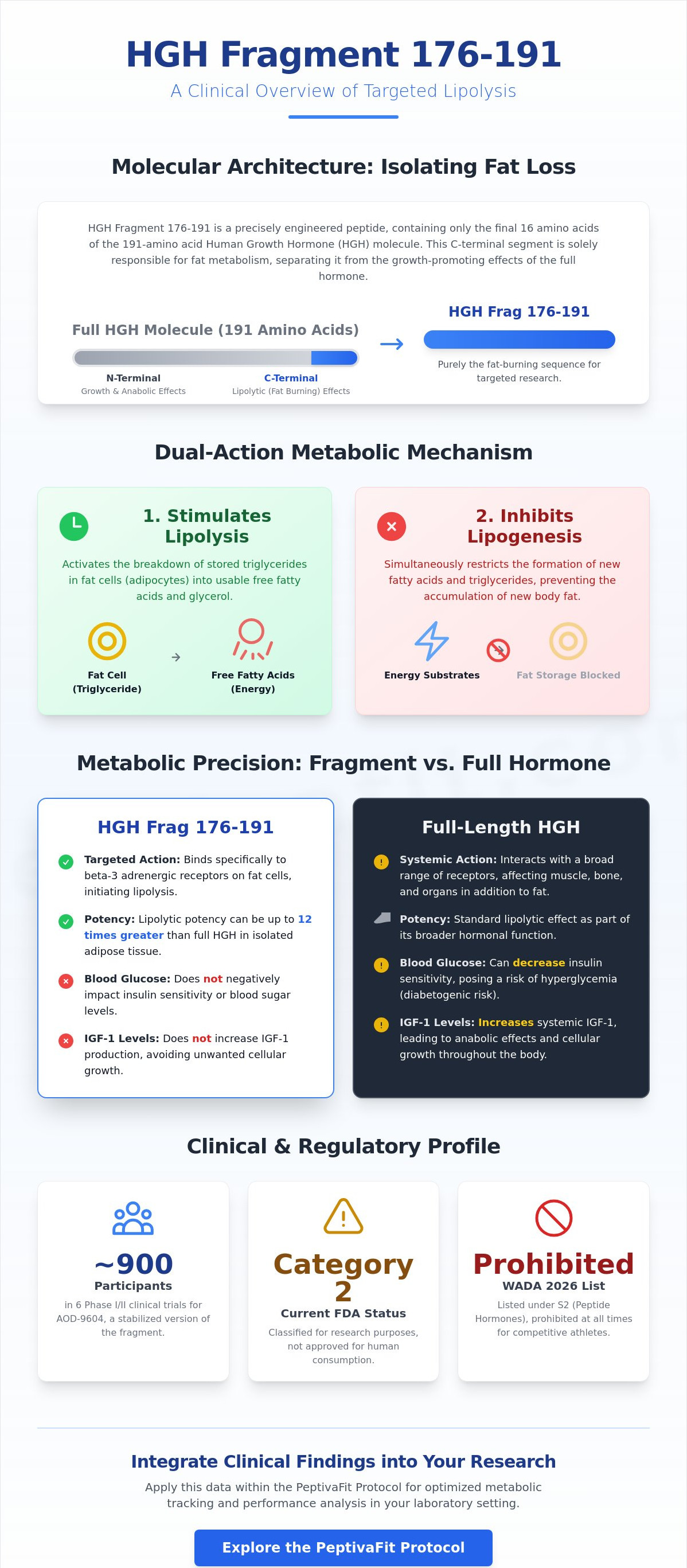
The HGH Fragment 176-191 is a truncated version of the human growth hormone molecule, specifically representing the C-terminal region. This sequence consists of the last 16 amino acids of the 191-amino acid GH polypeptide. Historically, researchers isolated this specific chain to separate the potent fat-burning properties of growth hormone from its anabolic and diabetogenic risks. By focusing on this 176 to 191 sequence, scientists identified the exact portion of the molecule responsible for lipid mobilization. This discovery allowed for metabolic research that avoids the common side effects of full-length HGH, such as increased IGF-1 production or decreased insulin sensitivity.
The C-terminal region is the specific key to adipose tissue signaling. While the N-terminal end of growth hormone is associated with growth-promoting and anabolic activities, the C-terminal end governs lipolytic activity. This molecular architecture ensures that the peptide communicates exclusively with fat cells. It doesn't bind to the growth hormone receptors found in muscle or bone, which prevents unwanted cellular proliferation. Instead, it focuses entirely on the metabolic breakdown of stored fat through high-affinity signaling.
The Relationship Between HGH Frag 176-191 and AOD-9604
AOD-9604 is a stabilized analog of the hgh frag 176-191 molecule. The primary technical distinction lies in the addition of a tyrosine residue at the N-terminal, which enhances the peptide's metabolic stability and half-life. Both molecules target the beta-3 adrenergic receptors located on the surface of adipocytes to trigger fat oxidation. While AOD-9604 was the subject of six Phase I/II clinical trials involving approximately 900 participants, many laboratory protocols still favor the raw hgh frag 176-191. This preference often stems from a need for high-purity analysis of the unmodified sequence in comparative molecular studies.
Targeting the Adipose Tissue: A Precision Tool
This fragment functions by mimicking the natural way growth hormone regulates lipid metabolism. It facilitates the breakdown of triglycerides into glycerol and free fatty acids, a process known as lipolysis. The significance of the Tyrosine residue in stabilized versions is its ability to protect the peptide from rapid enzymatic degradation in a laboratory environment. This ensures the molecule remains viable long enough to engage with cellular receptors. HGH Frag 176-191 is a non-anabolic, lipolytic-specific peptide fragment. This precision makes it a valuable asset for researchers focusing on metabolic optimization without the systemic complications of traditional hormone therapy.
The Mechanism of Action: How Fragment 176-191 Stimulates Selective Lipolysis
The metabolic efficacy of hgh frag 176-191 centers on its ability to initiate the lipolytic pathway without triggering systemic hormonal cascades. Lipolysis involves the enzymatic breakdown of stored triglycerides into their constituent parts: glycerol and free fatty acids. By stimulating the activity of hormone-sensitive lipase, the fragment accelerates the mobilization of these energy stores. Simultaneously, it exhibits a secondary mechanism: the inhibition of lipogenesis. This dual approach ensures that while existing fat is oxidized, the formation of new fatty acids within adipocytes is restricted. Research into the metabolic effects of HGH fragments indicates that this specific sequence mimics the natural regulation of lipid metabolism observed in full-length growth hormone but with significantly higher specificity.
Central to this mechanism is the fragment's interaction with beta-3 adrenergic receptors. These receptors are primarily located on white and brown adipose tissue and serve as the primary mediators for thermogenesis and lipolysis. Unlike full-length HGH, which interacts with a broader range of receptors across various tissues, hgh frag 176-191 demonstrates a surgical focus on these specific metabolic sites. Comparative data suggests that in isolated adipose tissue, the fragment's lipolytic potency can exceed that of the parent molecule by a factor of 12. This makes it a primary candidate for those exploring advanced metabolic tracking within a disciplined research framework.
Selective Signaling: Avoiding the IGF-1 Pathway
A significant limitation of full-length growth hormone is its propensity to elevate Insulin-like Growth Factor 1. High systemic IGF-1 levels can lead to unwanted cellular proliferation and organ growth. Because hgh frag 176-191 lacks the N-terminal growth-promoting domain, it doesn't compete for the growth hormone receptor. Clinical observations have confirmed that even at high research concentrations, the fragment doesn't alter IGF-1 levels. This allows for prolonged metabolic study without the risks associated with systemic growth signaling or unintended tissue hypertrophy.
Impact on Glucose Metabolism and Insulin Sensitivity
Full-length growth hormone is often diabetogenic, causing transient hyperglycemia and reduced insulin sensitivity by interfering with glucose uptake in peripheral tissues. The 176-191 fragment maintains metabolic neutrality in this regard. Data from Phase II trials of its analog, AOD-9604, which involved approximately 900 subjects, showed no adverse impact on fasting blood glucose or insulin tolerance. This makes the molecule relevant for research subjects with sensitive blood glucose profiles or those prioritizing metabolic stability over systemic anabolism. The absence of glucose disruption is a primary differentiator for this peptide in clinical research settings.
HGH Frag 176-191 vs. Full-Length HGH: Metabolic Precision
Full-length human growth hormone is a pleiotropic molecule that influences nearly every physiological system, from bone density to muscle protein synthesis. While this broad biological impact is beneficial for total systemic recovery, it's often inefficient for researchers focused exclusively on adipose reduction. Utilizing hgh frag 176-191 allows for a surgical focus on fat oxidation. By isolating the lipolytic domain, this peptide provides the fat loss of GH without the growth-related risks. This molecular specificity ensures that metabolic energy is directed toward breaking down lipid stores rather than systemic anabolism.
When evaluating situational use, the fragment often proves superior to a standardized tesamorelin dosage for direct fat mobilization. Tesamorelin functions as a growth hormone-releasing hormone (GHRH) analog, which stimulates the pituitary to release endogenous GH. While effective for visceral fat, it still results in a generalized elevation of growth hormone. In contrast, hgh frag 176-191 bypasses the pituitary and the IGF-1 pathway entirely. This makes it a more precise tool for targeting stubborn subcutaneous and visceral fat deposits without altering the subject's natural hormonal axis. Recent HGH fragment research continues to validate this targeted approach for metabolic optimization in disciplined research settings.
Side Effect Profile Comparison
Traditional growth hormone therapy is frequently associated with several clinical complications. These include extracellular water retention, carpal tunnel symptoms, and peripheral joint pain. These adverse effects are primarily driven by the hormone's growth-promoting and sodium-retaining properties located on the N-terminal end of the molecule. Because hgh frag 176-191 lacks this specific sequence, it typically avoids these issues. Clinical data from Phase IIb trials, which concluded in the mid-2000s, confirmed that subjects using the fragment reported side effect profiles comparable to placebo groups regarding joint pain and edema.
Synergy in Metabolic Protocols
Sophisticated research protocols often explore the synergy between direct lipolytic agents and secretagogues. Pairing the fragment with GHRH analogs like cjc-1295 creates a comprehensive metabolic environment. While the secretagogue optimizes the natural pulse of growth hormone for general wellness, the fragment provides a concentrated signal for fat oxidation. This dual-action strategy allows for high-level metabolic control. It's a cornerstone of the PeptivaFit approach to data-driven performance, where informed decision-making replaces the trial-and-error methods typical of mass-market fitness advice.
Research Protocols: Reconstitution, Storage, and Implementation
Precision in a laboratory setting requires standardized equipment and a disciplined approach to preparation. Researchers utilize 0.9% bacteriostatic water to inhibit bacterial growth and 31-gauge insulin syringes for high-resolution measurement. Establishing a consistent methodology for how to reconstitute peptides is essential for preserving the molecular integrity of hgh frag 176-191. The process involves a slow introduction of the diluent along the side of the glass vial to prevent structural shear. Once the lyophilized powder is fully dissolved, the solution should appear completely clear. Any cloudiness or visible particulates indicate contamination or significant molecular degradation.
Temperature management is a critical variable in maintaining peptide stability throughout a study. Lyophilized vials remain stable at room temperature for short periods, but researchers should store them at 4 degrees Celsius for long-term preservation. Once reconstituted, the hgh frag 176-191 molecule becomes significantly more fragile. Reconstituted fragments must be refrigerated at all times; they typically retain 95% potency for only 21 to 28 days. Exposure to direct sunlight or temperatures exceeding 25 degrees Celsius will rapidly denature the peptide chain, rendering the research results invalid.
Optimizing the Fasted State for Lipolysis
The presence of insulin acts as a potent inhibitor of the lipolytic signaling pathway. When insulin levels are elevated after a meal, the beta-3 adrenergic receptor response triggered by hgh frag 176-191 is effectively blunted. For this reason, research benchmarks prioritize a fasted state, typically in the morning or at least three hours after the last caloric intake. This physiological window ensures that the peptide's signaling for triglyceride breakdown isn't countered by the body's storage signals. Maintaining a low-carbohydrate environment for at least 60 minutes post-administration further maximizes the oxidation of mobilized free fatty acids.
Handling and Molecular Integrity
Molecular stability is a primary concern when handling truncated peptide sequences. The 176-191 fragment is a delicate chain that shouldn't be subjected to vigorous shaking or rapid temperature fluctuations. Researchers must verify the purity of their samples through third-party High-Performance Liquid Chromatography (HPLC) and Mass Spectrometry (MS) testing. As of May 2026, the prevalence of unregulated vendors makes this verification non-negotiable for clinical-grade data. To ensure your research meets these rigorous standards, you can access lab tested peptides through our curated resources.
Beyond the Molecule: Integrating HGH Frag 176-191 into the Peptiva Protocol
The PeptivaFit philosophy rejects the superficial "quick fix" mentality prevalent in mainstream fitness culture. We treat metabolic optimization as a rigorous, data-driven discipline that requires a structured framework for success. Integrating hgh frag 176-191 into your research requires more than just understanding its molecular structure; it demands a comprehensive approach to biological synchronization. Our fat loss peptide guide provides this necessary structure, detailing how to align lipolytic agents with your subject's circadian rhythms and metabolic state for maximum efficacy.
Before initiating any protocol involving hgh frag 176-191, a personalized medical assessment is a non-negotiable prerequisite. This baseline evaluation ensures that the research subject's metabolic markers, including fasting glucose and lipid profiles, are documented for precise tracking. Transitioning from theoretical peptide education to practical execution is most effectively achieved through expert 1-on-1 coaching. This professional oversight allows for the nuanced adjustment of protocols based on real-time data and laboratory feedback, ensuring that the research remains both safe and productive.
The Importance of Lab-Verified Sourcing
The peptide marketplace in May 2026 continues to be saturated with unregulated "black market" products that pose significant physiological risks. These substandard substances frequently contain heavy metals, residual solvents, or suffer from severe under-dosing, which can compromise the validity of your research. PeptivaFit mitigates these risks by ensuring every peptide meets strict clinical research standards. We prioritize sourcing that includes batch-specific High-Performance Liquid Chromatography (HPLC) and Mass Spectrometry (MS) verification. Professional oversight in interpreting these metabolic markers is the only way to maintain the integrity of a high-stakes research environment.
Achieving Sustainable Body Composition Changes
Peptides function as precision tools; they aren't replacements for fundamental metabolic discipline. The lipolytic effects of the 176-191 fragment are most pronounced when integrated into a holistic protocol of resistance training and precise nutritional tracking. Relying on the molecule alone ignores the systemic nature of human physiology and the requirement for a caloric environment that supports fat oxidation. To move beyond education and begin your disciplined journey toward optimization, secure your personalized medical assessment or a single consultation call to begin your protocol.
Precision Metabolic Optimization: Advancing Your Research Framework
The molecular architecture of hgh frag 176-191 represents a significant milestone in isolating lipolytic signaling from systemic growth risks. By focusing exclusively on the C-terminal region, researchers can target adipose tissue without the IGF-1 elevation or insulin resistance typically associated with full-length growth hormone. Data from six Phase I/II clinical trials involving 900 subjects confirm this molecule's specific safety profile and its ability to mobilize lipids through beta-3 adrenergic receptor interaction. Success in metabolic research depends on a disciplined adherence to fasted-state protocols and strict environmental controls for peptide stability.
Transitioning from clinical theory to laboratory execution requires a commitment to high-level standards. To ensure the integrity of your data, you must prioritize lab-verified peptide purity and professional oversight. Our curated approach combines personalized medical assessments with data-backed coaching to provide a sophisticated control mechanism for your performance goals. Optimize Your Metabolism with the Peptiva Protocol and gain access to the expertise required for elite-level optimization. You're now equipped with the scientific foundation to conduct informed, high-stakes metabolic research with absolute confidence.
Frequently Asked Questions
Is HGH Frag 176-191 safe for long-term use?
Clinical data regarding the long-term safety of hgh frag 176-191 in humans is limited to the duration of established research trials. Studies involving its analog, AOD-9604, demonstrated high tolerability over 24-week periods with no serious adverse events reported. Researchers typically recommend periodic breaks to maintain receptor sensitivity and allow for thorough metabolic assessment. Indefinite use isn't advised without professional oversight and regular diagnostic tracking.
Does HGH Frag 176-191 increase the risk of cancer like full HGH?
Current research indicates that this fragment doesn't promote cellular proliferation or elevate systemic IGF-1 levels. Because the molecule lacks the N-terminal growth-promoting domain of human growth hormone, it doesn't trigger the mitogenic pathways associated with tumor growth. This specific isolation of lipolytic function from anabolic signaling is why it's a preferred subject for metabolic research over full-length hormones.
How long does it take to see results from HGH Frag 176-191 research?
Measurable changes in lipid mobilization are typically observable within 14 to 21 days of consistent protocol adherence. Achieving significant shifts in body composition usually requires a research window of at least 12 weeks. These timelines depend heavily on the subject's baseline metabolic rate and strict maintenance of a fasted state during the administration window.
Can HGH Frag 176-191 be taken orally?
Oral administration of the raw hgh frag 176-191 sequence is largely ineffective due to rapid enzymatic degradation in the gastrointestinal tract. While stabilized analogs were explored for oral delivery in past trials, subcutaneous injection remains the gold standard for laboratory research. This method bypasses first-pass metabolism and ensures nearly 100% bioavailability of the peptide chain.
What is the difference between HGH Frag 176-191 and AOD-9604?
AOD-9604 is a derivative of the 176-191 fragment that includes an additional tyrosine residue at the N-terminal for enhanced stability. This structural modification increases the peptide's resistance to proteolysis, extending its half-life in a research setting. While both molecules target the same beta-3 adrenergic receptors, AOD-9604 was the specific version used in the six major human clinical trials.
Do I need to follow a specific diet while using HGH Frag 176-191?
A structured, calorie-controlled diet is necessary to ensure that mobilized fatty acids are actually oxidized for energy. The peptide facilitates the release of stored fat into the bloodstream, but these lipids will be restored if they aren't utilized through a caloric deficit. High insulin levels from carbohydrate-rich meals will effectively blunt the peptide's ability to signal for lipolysis.
Will HGH Frag 176-191 show up on a drug test?
The peptide is explicitly listed as a prohibited substance on the 2026 WADA Prohibited List under section S2. While standard workplace drug screenings don't typically include peptide panels, specialized athletic testing can detect the fragment. Professional athletes must avoid this molecule entirely to remain compliant with current anti-doping regulations and international sporting standards.
What happens if I don't reconstitute the peptide correctly?
Improper reconstitution leads to molecular denaturation, which renders the peptide biologically inactive. Shaking the vial or injecting the diluent too rapidly can shear the delicate amino acid chain of hgh frag 176-191. If the resulting solution is cloudy or contains visible particulates, the structural integrity of the molecule is compromised and it won't produce the desired lipolytic signaling in research subjects.

![Shelf Life of Reconstituted Peptides: A Clinical Reference Guide [2026]](https://getautoseo.com/storage/hero_images/shelf-life-of-reconstituted-peptides-a-clinical-reference-guide-2026.jpg?v=b8ed5173acaa)
