The assumption that growth hormone stimulation must inevitably trigger cortisol spikes or intense hunger is a misconception rooted in outdated peptide research. While older secretagogues frequently cause systemic disruption, ipamorelin stands as a uniquely selective pentapeptide with a molecular weight of 711.86 g/mol. It's the only clinical agent capable of stimulating the pituitary gland without activating the ghrelin receptors that drive unwanted side effects. For researchers and high-performance individuals, this selectivity makes it the gold standard for long-term metabolic optimization.
You've likely encountered the complexity of the current regulatory landscape, especially following the February 2026 HHS announcement regarding the reclassification of 14 key peptides. You understand that the price disparity between verified $450 vials and $80 budget alternatives often signals a compromise in laboratory purity. This clinical reference provides a data-driven analysis of ipamorelin’s mechanism, comparative benefits against traditional GHRPs, and precise research-grade protocols for fat loss and recovery. We'll examine how this selective secretagogue facilitates lean mass accrual and accelerated lipolysis while maintaining endocrine integrity.
Key Takeaways
- Analyze the unique molecular structure of ipamorelin to understand how it achieves pure growth hormone secretion without the endocrine disruption common in non-selective peptides.
- Distinguish the structural differences between GHRPs and GHRH analogs to master the synergistic pairing of secretagogues for optimized metabolic output.
- Track the longitudinal physiological impact across a six-month timeline; this includes immediate improvements in sleep architecture and long-term lipid profile enhancement.
- Establish rigorous research protocols by identifying optimal fasting windows and precise reconstitution techniques required for metabolic optimization.
- Evaluate the critical importance of lab-verified materials to ensure the integrity of your clinical data and the safety of any long-term research application.
Ipamorelin: The Molecular Mechanism of Selective GH Secretion
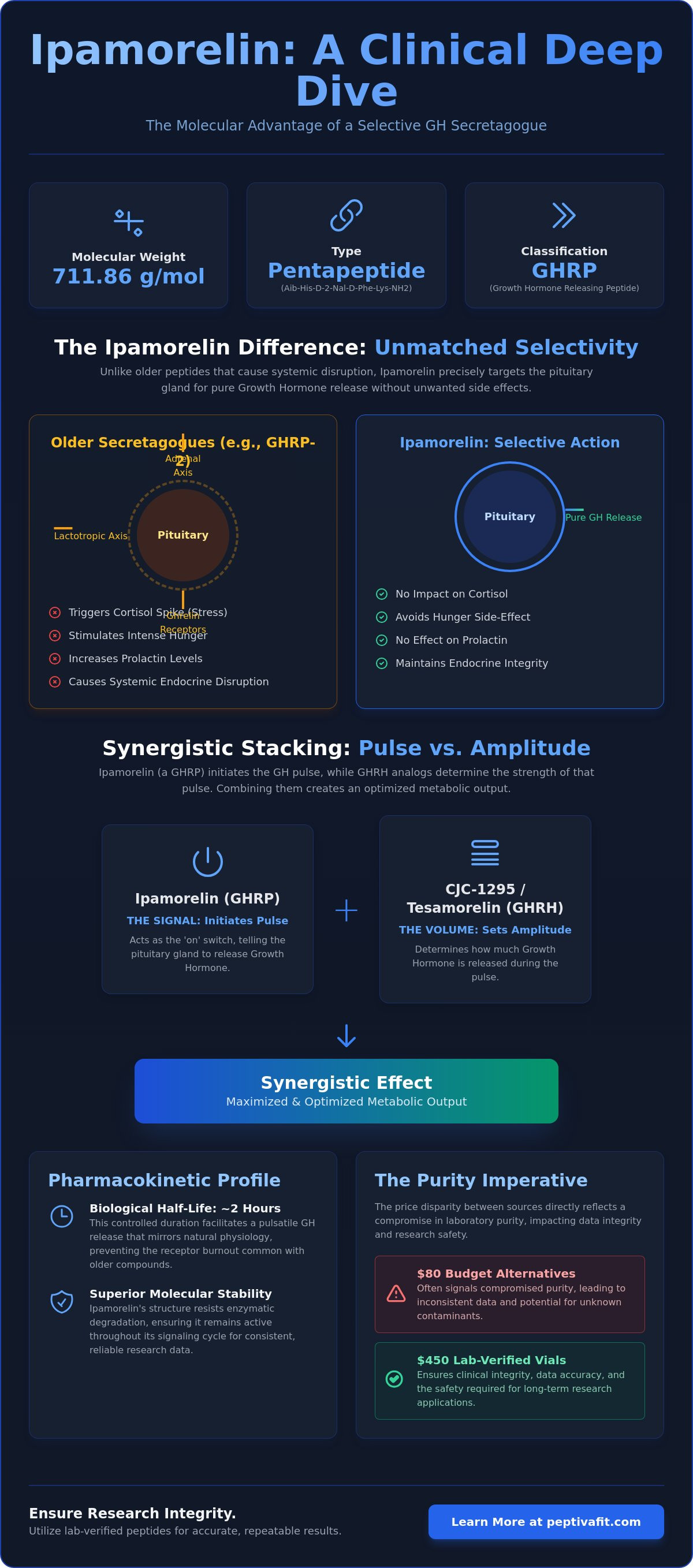
Ipamorelin is a synthetic pentapeptide with the sequence Aib-His-D-2-Nal-D-Phe-Lys-NH2. It's recognized in laboratory research as a potent and selective agonist of the growth hormone secretagogue receptor (GHS-R). Unlike first-generation secretagogues like GHRP-2, which often trigger a cascade of unintended hormonal responses, Ipamorelin demonstrates a refined pharmacological profile. It's specifically engineered to target the somatotrophs of the anterior pituitary gland while maintaining neutrality toward the adrenal and lactotropic axes. This specificity ensures it doesn't stimulate the release of Adrenocorticotropic Hormone (ACTH), cortisol, or prolactin, even at research dosages reaching 100 microg/kg. This lack of cross-reactivity is what defines its clinical utility for metabolic optimization.
Within the somatotropic system, the peptide's interaction with the pituitary gland is both direct and efficient. It doesn't just stimulate GH release; it amplifies the natural pulse. This amplification is key for researchers focused on lipolysis and lean mass accrual. Because the peptide avoids the hunger side effect common in ghrelin-mimetics, it's easier to maintain strict fasted states during administration, which is a requirement for maximizing secretagogue efficacy. The molecular stability of this pentapeptide provides a predictable foundation for laboratory-grade protocols, ensuring that the biochemical data remains consistent over long-term research periods.
Selective Agonism and the Somatotropic Axis
The peptide mimics the endogenous ligand ghrelin by binding to the GHS-R1a receptor. This binding triggers a secondary messenger system that inhibits somatostatin, the hormone responsible for suppressing growth hormone release. A landmark 1998 clinical study confirmed that ipamorelin's selectivity is its most significant asset. While other peptides in the GHRP family induce significant cortisol elevation and intense hunger by activating hypothalamic ghrelin receptors, ipamorelin remains functionally silent in these regions. Researchers observe a clean GH spike without the metabolic noise of increased appetite or systemic stress markers. This makes it a disciplined choice for subjects requiring precise data without confounding variables.
Pharmacokinetics and Biological Half-Life
The biological half-life of ipamorelin is approximately 2 hours. This duration facilitates a controlled, pulsatile release of growth hormone that closely mirrors natural human physiology. This pharmacokinetic profile is superior to the rapid, short-lived spikes seen with earlier compounds that often lead to receptor burnout. By maintaining a steady metabolic clearance rate, the peptide allows for consistent tracking of cellular recovery and lipid metabolism. Molecular stability is another differentiator; ipamorelin's structure provides greater resistance to enzymatic degradation compared to GHRP-2. This structural integrity ensures the peptide remains active throughout its signaling cycle, providing a reliable foundation for laboratory-grade protocols.
Comparative Analysis: Ipamorelin vs. Tesamorelin and CJC-1295
Understanding the hierarchy of growth hormone secretagogues requires a clear distinction between Growth Hormone Releasing Peptides (GHRPs) and Growth Hormone Releasing Hormone (GHRH) analogs. Ipamorelin belongs to the GHRP category, acting as a selective ghrelin mimetic that initiates a discrete growth hormone pulse. In contrast, molecules like CJC-1295 and Tesamorelin are GHRH analogs that influence the amplitude of these pulses. This distinction is critical for researchers; while a GHRP provides the neurological signal for release, the GHRH ensures the volume of that release is maximized. As detailed in the PubChem entry for Ipamorelin, its high receptor affinity makes it a superior choice for maintaining physiological rhythm without the desensitization often seen with less selective compounds.
The "Pulse vs. Amplitude" theory is the cornerstone of modern metabolic optimization. By utilizing ipamorelin to trigger a pulse and a GHRH analog to increase the amount of hormone released during that window, researchers achieve a synergistic effect that exceeds the capabilities of either peptide in isolation. This dual-pathway activation targets the somatotropic axis from two distinct biochemical angles, ensuring a more robust and predictable metabolic response. For those seeking a curated approach to these complex interactions, a personalized medical assessment can provide the necessary clinical clarity.
Ipamorelin vs. Tesamorelin for Fat Loss
While ipamorelin provides systemic benefits including improved sleep architecture and generalized recovery, Tesamorelin is specifically optimized for targeted lipolysis. Clinical data indicates that Tesamorelin excels at reducing visceral adipose tissue (VAT), often achieving a 15% to 20% reduction in abdominal fat in specific research populations. Conversely, ipamorelin is the preferred agent for subjects prioritizing overall lean mass preservation and systemic cellular repair. In high-performance research settings, the Tesamorelin dosage for bodybuilding is often contrasted with ipamorelin protocols to determine whether the primary objective is localized fat loss or a broader metabolic upgrade.
The Synergy of the Ipamorelin and CJC-1295 Stack
This specific combination is considered the clinical gold standard for longevity research. The stack exploits the fact that GHRPs and GHRHs bind to different receptors on the pituitary gland. By activating both the GHS-R and the GHRH receptor simultaneously, researchers observe a saturation dose effect, typically noted at 100mcg of each peptide. This protocol prevents the premature termination of the GH pulse, extending the window of elevated serum levels. This methodology is favored because it avoids the "bleed" effect associated with non-DAC versions of GHRHs, preserving the natural pulsatile nature of the human endocrine system.
Physiological Impact: A Six-Month Results Timeline
Tracking the efficacy of ipamorelin requires a disciplined, longitudinal perspective. Results are non-linear; they follow a specific biological cascade that's entirely contingent on protocol adherence and the use of lab-verified materials. Without high-purity peptides, laboratory data becomes unreliable and the metabolic response remains unpredictable. When researchers maintain a controlled environment, the physiological shifts occur in three distinct phases over a twenty-four-week period.
Immediate Biological Responses: Sleep and Recovery
The first thirty days of research focus on the optimization of sleep architecture. Growth hormone plays a critical role in REM and slow-wave sleep cycles, which are the primary windows for cellular repair and neurological restoration. Subjects often report a subjective increase in sleep depth within the first 10 days of administration. This shift is accompanied by a measurable decrease in systemic inflammation markers, which directly benefits joint health and overall mobility. Initial physiological markers of systemic recovery typically manifest within the first 14 to 21 days of consistent administration.
Safety data from the Ipamorelin clinical trial for gastrointestinal function underscores the peptide's high tolerability profile during these early phases. While that specific study focused on postoperative recovery, the systemic stability observed is highly relevant for metabolic researchers. This biological stability allows for a safe transition into the secondary metabolic phases, where the focus moves from recovery to active transformation.
Long-term Metabolic Transformation
During months two and three, the focus shifts toward metabolic regulation and structural integrity. Researchers observe improvements in skin elasticity as collagen synthesis accelerates, alongside more favorable lipid profiles, specifically regarding LDL and HDL ratios. These shifts are mediated by the sustained elevation of IGF-1, which acts as a secondary messenger for ipamorelin. By the start of month four, the cumulative effect on the basal metabolic rate (BMR) becomes evident through accelerated lipolysis and the preservation of lean tissue during caloric deficits.
The common "plateau" myth in peptide research is frequently a result of poor tracking or dietary non-compliance rather than receptor desensitization. Because ipamorelin is highly selective, it doesn't cause the rapid downregulation associated with non-selective secretagogues. Maintaining a consistent research protocol through the six-month mark allows for a comprehensive assessment of body composition changes, including a reduction in adipose tissue and improved muscular density. This long-term, methodical approach ensures that metabolic shifts are stabilized rather than transitory.
Research Protocol Optimization: Dosage and Reconstitution
Translating biochemical theory into measurable results requires a transition from understanding mechanisms to implementing rigorous laboratory standards. Even high-purity ipamorelin is susceptible to rapid degradation if handled without clinical precision. Protocol adherence is the only variable that separates successful metabolic optimization from failed research initiatives. Researchers must maintain a controlled environment to ensure the molecular integrity of the peptide remains uncompromised throughout the duration of the study.
Precision Dosing and Timing Strategy
Standard human research protocols differ significantly from the animal-based data often found on public databases. While animal studies may utilize doses as high as 100mcg/kg, clinical literature for metabolic optimization typically establishes a range of 200mcg to 300mcg daily. This dosage is often administered in a single evening pulse or split into two smaller administrations to align with natural circadian GH release patterns. Consistency in dosing is paramount for establishing a stable baseline for tracking physiological shifts.
Timing is a non-negotiable factor in peptide research. Insulin acts as a direct antagonist to growth hormone secretion; therefore, maintaining a strict 2 to 3 hour fasting window around administration is mandatory. Consuming carbohydrates or fats too close to the injection window can blunt the pituitary response by up to 60%. Researchers must prioritize this fasted state to ensure the peptide achieves its maximum physiological potential. For those seeking high-purity materials to support these protocols, you can access our lab tested peptides to ensure absolute research integrity.
Molecular Integrity and Storage Standards
The transition from a lyophilized powder to a liquid solution is a critical juncture where molecular integrity is frequently compromised. Following established reconstitution protocols is essential to prevent molecular shearing. Ipamorelin is a fragile pentapeptide; vigorous agitation or direct stream contact during the addition of Bacteriostatic Water can break the delicate peptide bonds, rendering the vial inert. The diluent should be dripped slowly down the side of the glass wall rather than directly onto the lyophilized cake.
Storage conditions dictate the longevity of the research material. While lyophilized vials remain stable at room temperature for up to 60 days, reconstituted peptides must be stored between 2°C and 8°C. Exposure to UV light or temperatures exceeding 25°C for extended periods will lead to rapid degradation. Visible indicators of loss of efficacy include cloudiness or the presence of particulates in the solution. To maintain laboratory standards, researchers should avoid the following pitfalls:
- Thermal Stress: Allowing reconstituted vials to sit at room temperature for more than 20 minutes.
- Mechanical Shearing: Shaking the vial rather than gently swirling to incorporate the diluent.
- Improper Diluents: Using sterile water instead of 0.9% benzyl alcohol bacteriostatic water for multi-dose applications, which increases the risk of bacterial growth.
The Peptiva Protocol: Integrating Lab-Verified Peptides
The transition from clinical theory to practical application is where most research initiatives fail. While the biological potential of ipamorelin is well-documented, the efficacy of any metabolic protocol is entirely dependent on the chemical integrity of the compound used. Serious researchers don't rely on the "gray market" of unverified chemicals; they require a disciplined supply chain that prioritizes laboratory-grade standards. PeptivaFit functions as the essential bridge between raw clinical data and the implementation of a sophisticated, data-driven fat loss strategy.
The Danger of Unverified Research Chemicals
The peptide industry is currently saturated with under-dosed and contaminated products that pose significant risks for immunogenicity. As of May 2026, the price disparity between unverified $80 vials and $300 to $450 premium-tier vials reflects more than just a brand markup; it indicates the presence of third-party purity verification. A valid Certificate of Analysis (CoA) for ipamorelin must demonstrate a purity level of at least 99% via High-Performance Liquid Chromatography (HPLC) and Mass Spectrometry. These reports ensure the absence of peptide-related impurities and pro-inflammatory endotoxins that can trigger an immune response or blunt the somatotropic pulse. PeptivaFit mandates a strict 99% minimum purity threshold for all laboratory research materials to maintain the highest levels of molecular integrity.
Personalized Consultation and Coaching
A "one size fits all" approach to peptide education is fundamentally flawed because it ignores individual biochemical variance and the nuances of the somatotropic axis. Effective metabolic optimization requires more than just a dosage schedule; it demands the integration of nutrition, load management, and sleep architecture tracking. Personalized medical assessments allow for the tailoring of a Somatotropic stack that accounts for the specific metabolic baseline of the researcher. This curated approach ensures that the synergy between ipamorelin and lifestyle variables is fully exploited to reach the desired outcomes of lipolysis and lean mass preservation.
Coaching provides the necessary oversight to adjust protocols based on real-time data, preventing the plateaus often associated with static, unmonitored research. By moving beyond generic information and into a structured clinical framework, you ensure that your investment in peptide research yields measurable, long-term results. To move from education to implementation, you can Access the Peptiva Protocol and Professional Medical Assessments through our private, curated platform.
Master Your Metabolic Architecture
Transitioning from academic understanding to clinical application requires a shift toward rigorous laboratory standards. You've explored how ipamorelin provides a selective pathway for growth hormone secretion without the systemic disruption of earlier secretagogues. Success in this field is dictated by two non-negotiable factors; molecular purity and professional protocol design. Utilizing materials with verified 99%+ purity ensures that your research data remains untainted by manufacturing impurities or pro-inflammatory endotoxins.
A disciplined approach to timing and reconstitution, combined with the synergistic pairing of GHRH analogs, establishes the foundation for sustainable lean mass preservation and lipolysis. This isn't about fitness trends. It's about sophisticated control over your biological data. Secure Your Personalized Medical Assessment and Lab-Verified Peptides to begin your transition into high-level performance optimization. Our platform provides the expert medical oversight and the comprehensive Peptiva Protocol guide necessary to transform these clinical insights into a functional fat loss strategy. You're now equipped to lead your metabolic optimization with precision and serious intent.
Frequently Asked Questions
Does Ipamorelin cause increased hunger like GHRP-6?
Ipamorelin doesn't stimulate hunger because it lacks affinity for the hypothalamic ghrelin receptors that trigger appetite. While GHRP-6 is known for causing intense hunger spikes, this pentapeptide remains selective to the pituitary gland. This selectivity allows researchers to maintain fasted states more effectively, which is essential for maximizing the growth hormone pulse and ensuring metabolic data remains clean.
Can Ipamorelin be used long-term without desensitizing the pituitary?
Long-term research indicates that this peptide doesn't desensitize the pituitary gland when administered within standard clinical ranges. Because it mimics the natural pulsatile release of growth hormone rather than creating a constant hormone bleed, the somatotropic axis remains responsive. Many researchers utilize a 5-day on, 2-day off schedule to ensure receptor sensitivity is maintained over durations exceeding 24 weeks.
How long does it take for Ipamorelin to show fat loss results?
Measurable changes in body composition and fat loss usually manifest between the 12th and 24th week of a disciplined protocol. While cellular recovery and sleep improvements occur within the first 21 days, lipolysis is a secondary metabolic effect that requires sustained IGF-1 elevation. Adherence to a strict fasting window and caloric management is required to see these results stabilized by the six-month mark.
Is a medical assessment required before starting the Peptiva Protocol?
A personalized medical assessment is a mandatory requirement for accessing the Peptiva Protocol. This ensures that every research initiative is grounded in the subject's unique metabolic data and baseline endocrine health. Moving from generic information to a curated clinical framework requires this initial oversight to minimize risk and ensure protocol efficacy for the individual researcher.
What is the difference between Ipamorelin and HGH?
The primary difference lies in the mechanism of action; ipamorelin stimulates the body’s endogenous production of growth hormone, whereas HGH is an exogenous replacement. Exogenous HGH can lead to pituitary shutdown and a total cessation of natural production. In contrast, secretagogues preserve the feedback loop of the somatotropic axis, providing a more disciplined approach to long-term metabolic regulation.
Can Ipamorelin be stacked with other peptides like BPC-157?
Stacking with BPC-157 is common in research focused on systemic tissue repair and musculoskeletal integrity. While the growth hormone secretagogue targets metabolic and cellular recovery, BPC-157 acts as an angiogenic and cytoprotective agent. This combination exploits different biological pathways, allowing for comprehensive recovery without receptor competition or cross-reactivity between the two distinct peptide sequences.
What happens if I miss a dose in my research protocol?
If a dose is missed, you should resume the research protocol at the next scheduled interval without doubling the administration. Doubling a dose can lead to a temporary desensitization of the pituitary receptors and may compromise the integrity of the collected data. Maintaining the established timing relative to fasted states is more important for long-term results than compensating for a single missed pulse.
How do I know if my Ipamorelin is high purity?
Verification of high purity requires a third-party Certificate of Analysis (CoA) that shows a minimum threshold of 99% via HPLC testing. As of 2026, premium suppliers provide these reports to confirm the absence of manufacturing byproducts or endotoxins. Vials sold for $80 or less often lack this verification, whereas lab-verified materials in the $300 to $450 range provide the necessary chemical assurance for serious clinical research.

![Shelf Life of Reconstituted Peptides: A Clinical Reference Guide [2026]](https://getautoseo.com/storage/hero_images/shelf-life-of-reconstituted-peptides-a-clinical-reference-guide-2026.jpg?v=b8ed5173acaa)
