Selecting a growth hormone secretagogue based on anecdotal evidence rather than molecular specificity is a clinical oversight that compromises metabolic outcomes. Most individuals seeking performance optimization understand that exogenous growth hormone carries a high risk profile, yet they're often paralyzed by the technical complexity of endogenous alternatives. This guide provides a rigorous clinical comparison of ipamorelin vs sermorelin for fat loss to resolve the confusion between GHRH and GHRP pathways.
You deserve a protocol defined by data rather than market hype. We'll analyze the distinct mechanisms of action, from ipamorelin's targeted ghrelin mimicry to sermorelin's broader pituitary stimulation. We also address the current regulatory status, including the April 2026 removal of Ipamorelin from the FDA's Category 2 list and the medical necessity documentation now required for compounded Sermorelin. This technical analysis provides the clarity needed to select a lab-verified strategy to reduce visceral fat, improve muscle tone, and restore your metabolic rate through a disciplined, scientific approach.
Key Takeaways
- Identify the physiological distinctions between GHRH and GHRP pathways to ensure your growth hormone stimulation aligns with specific metabolic objectives.
- Assess the clinical efficacy of ipamorelin vs sermorelin for fat loss by comparing their impact on lipolysis and the preservation of natural pituitary rhythms.
- Analyze why selective secretagogues are preferred over exogenous HGH for long-term body composition goals due to their reduced risk of insulin resistance and organ enlargement.
- Learn to verify molecular integrity by identifying essential data points in a Certificate of Analysis, protecting your protocol from sub-standard or contaminated research chemicals.
- Establish a data-driven foundation for your optimization strategy through baseline laboratory testing, including IGF-1 and HbA1c metrics, before initiating a peptide protocol.
Molecular Mechanisms: How Ipamorelin and Sermorelin Stimulate the Pituitary
Effective metabolic optimization demands a rigorous understanding of the somatotropic axis. Growth hormone secretagogues (GHSs) are not generic performance enhancers. They're precision ligands that modulate the pituitary gland's secretory capacity. By stimulating endogenous pulses rather than introducing exogenous hormones, these peptides avoid the aggressive suppression of natural endocrine function. This physiological preservation is a primary reason why researchers prioritize ipamorelin vs sermorelin for fat loss over traditional synthetic growth hormone.
Peptides function by bypassing or modulating the inhibitory feedback loops governed by somatostatin. When you introduce exogenous HGH, the body detects an excess and shuts down internal production. Secretagogues work differently. They amplify the natural signaling process, ensuring the pituitary remains active and responsive. Receptor affinity determines the intensity and duration of the resulting GH spike. This directly influences lipolytic efficiency and tissue repair.
GHRH vs. GHRP: Understanding the Pathways
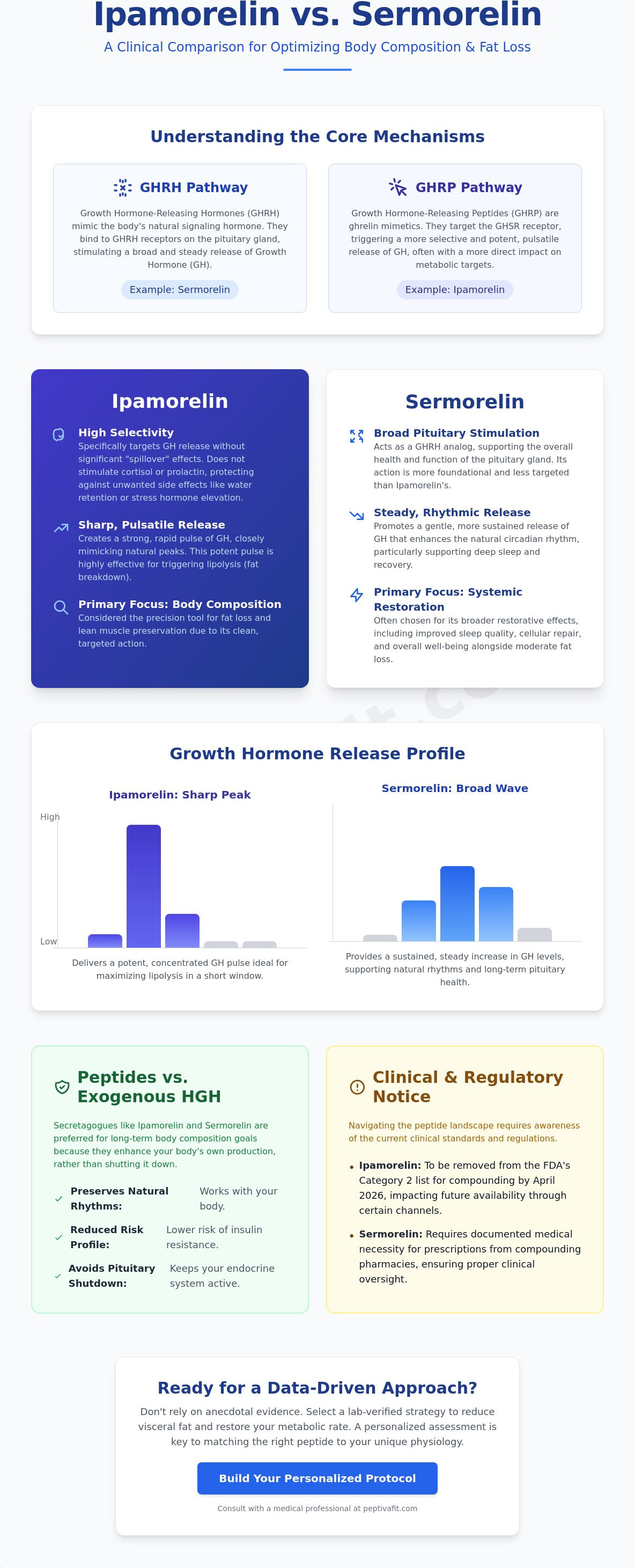
Sermorelin serves as a truncated analog of the body's natural Growth Hormone Releasing Hormone (GHRH). It's a 29-amino acid polypeptide that binds to the GHRH receptor to stimulate a broad, steady release of growth hormone. Ipamorelin belongs to the Growth Hormone Releasing Peptide (GHRP) class. As a selective pentapeptide and ghrelin mimetic, it targets the growth hormone secretagogue receptor (GHSR) with high specificity. Unlike earlier generations of GHRPs, ipamorelin doesn't trigger significant releases of cortisol or prolactin. This selectivity makes it a disciplined choice for those focused on body composition without unwanted hormonal spillover.
The Pituitary Pulse: Why Natural Rhythms Matter
The human body releases growth hormone in distinct, pulsatile waves. These peaks occur primarily during deep sleep stages. Peptides preserve this circadian rhythm by enhancing the amplitude of these pulses rather than creating a flat, unnatural elevation. This pulsatile action is safer for long-term pituitary health. It minimizes the risk of peripheral side effects like insulin resistance. The resulting GH elevation then triggers the liver to produce Insulin-like Growth Factor 1 (IGF-1). This hormone acts as the primary mediator for cellular recovery, metabolic rate enhancement, and systemic fat oxidation.
Choosing between these pathways involves analyzing your specific pituitary health and metabolic baseline. While both compounds influence the somatotropic axis, their binding characteristics dictate the speed and nature of the fat loss response. A data-driven approach to ipamorelin vs sermorelin for fat loss requires matching these molecular mechanisms to your individual physiological requirements.
Ipamorelin vs. Sermorelin: A Comparative Analysis of Efficacy and Side Effects
Transitioning from molecular theory to clinical application requires a rigorous assessment of how these secretagogues perform in a lived environment. While both compounds influence the somatotropic axis, their impact on body composition and systemic recovery differs in both velocity and scope. Choosing between ipamorelin vs sermorelin for fat loss isn't a matter of finding the "strongest" peptide; it's about identifying the molecule that aligns with your specific endocrine baseline and tolerance for metabolic fluctuation.
The primary clinical distinction lies in selectivity. Ipamorelin is frequently favored by those prioritizing body composition because it avoids the hormonal "spillover" seen with earlier generations of growth hormone releasing peptides. It doesn't stimulate the secretion of cortisol or prolactin, which can otherwise impede fat oxidation and cause fluid retention. Sermorelin, while less targeted in its lipolytic action, offers a broader restorative effect that many find essential for long-term health. A personalized medical assessment is the most efficient way to determine which of these pathways matches your current physiological state.
Ipamorelin: The Precision Ghrelin Mimetic for Targeted Lipolysis
Ipamorelin is often characterized as the most disciplined GHRP available for metabolic optimization. It targets the ghrelin receptor without the significant hunger stimulation associated with GHRP-6 or GHRP-2. This makes it exceptionally effective for individuals maintaining a caloric deficit. By facilitating targeted lipolysis while preserving lean muscle mass, it addresses the most difficult aspect of fat loss: preventing catabolism. Its selective nature ensures that the growth hormone pulse is clean, predictable, and focused on metabolic throughput rather than systemic stress.
Sermorelin: The Foundational GHRH for Metabolic Stability
Sermorelin acts as a foundational agent for those whose primary metabolic concern is age-related decline. It's often the entry point for optimization because it encourages the pituitary to function with youthful efficiency over a sustained duration. Beyond fat loss, sermorelin is highly regarded for its positive impact on sleep architecture. By improving the quality of deep-wave sleep, it creates a more favorable environment for nocturnal GH release. This systemic approach doesn't just burn fat; it restores the underlying metabolic stability required to maintain a leaner physique over time.
Clinical objectives dictate the selection. If your goal is rapid fat oxidation and muscle preservation during intense training, ipamorelin's precision is superior. If you're seeking a more gradual restoration of metabolic health and improved sleep quality, sermorelin provides a more holistic foundation. Each protocol demands strict adherence to laboratory monitoring to ensure that IGF-1 levels remain within an optimal, safe range.
Peptides vs. HGH for Fat Loss: Why Secretagogues are the Superior Choice
The clinical decision to utilize secretagogues over synthetic human growth hormone (HGH) is rooted in safety and physiological regulation. While exogenous somatropin provides a direct increase in GH levels, it bypasses the body's internal regulatory mechanisms. This often leads to supraphysiological levels that trigger adverse effects. Secretagogues, by contrast, work within the existing somatotropic axis. They stimulate the pituitary to release its own stored hormone in a pulsatile manner. This natural approach is why many professionals evaluate ipamorelin vs sermorelin for fat loss as a primary strategy before considering more aggressive, high-risk interventions.
Aesthetic outcomes also differ significantly between these two classes of compounds. Chronic use of exogenous HGH is frequently associated with "HGH gut," a condition characterized by the growth of visceral organs rather than just muscle tissue. Peptides don't carry this risk because they don't override the body's natural feedback loops. They promote fat oxidation while maintaining a lean, athletic profile. From an economic perspective, secretagogues offer a more sustainable long-term solution. High-dose HGH therapy requires a substantial financial commitment that often doesn't align with the incremental benefits it provides over a well-structured peptide protocol.
Avoiding the Pitfalls of Exogenous Somatropin
One of the most critical risks of exogenous HGH is the suppression of the pituitary gland. When you provide the body with a finished hormone, it ceases its own production. This creates a state of dependency and potential long-term endocrine dysfunction. Peptides maintain your body's natural checks and balances, ensuring the pituitary remains active and healthy. This is particularly important when considering peptides for metabolism and fat loss, as they support glucose metabolism and insulin sensitivity. Exogenous HGH often induces insulin resistance, whereas secretagogues tend to have a neutral or positive effect on glycemic control.
Synergistic Stacking: The CJC-1295 and Ipamorelin Paradigm
Maximum efficacy in a fat loss protocol is often achieved through the synergy of a GHRH and a GHRP. While analyzing ipamorelin vs sermorelin for fat loss, many researchers find that combining Ipamorelin with CJC-1295 (No DAC) yields the most robust results. This combination mimics the dual-signal approach the body uses naturally. The GHRH initiates the pulse, while the GHRP amplifies its intensity. This methodology mirrors the strategic precision found in tesamorelin dosage protocols, which are specifically designed to target stubborn visceral adipose tissue through calculated hormonal modulation.
Protocol Selection: Matching Peptide Profiles to Metabolic Objectives
Selecting an optimization protocol requires more than a cursory glance at benefit lists; it demands a forensic analysis of your current metabolic health. Determining the optimal choice between ipamorelin vs sermorelin for fat loss depends on your specific objective, whether that's rapid adipose reduction or sustained hormonal restoration. Baseline laboratory data provides the only objective roadmap for this process. Without a clear understanding of your starting point, any peptide administration is merely guesswork.
Rigorous baseline testing must include IGF-1 to establish growth hormone status, HbA1c for long-term glycemic control, and fasting insulin to assess sensitivity. These metrics allow for the calibration of a protocol that respects the "saturation dose." In peptide therapy, more is not always better. The saturation dose represents a physiological ceiling where the pituitary's receptors are fully occupied; exceeding this threshold doesn't proportionally increase growth hormone release. It only increases the metabolic burden on the system. To ensure your strategy is built on data rather than assumptions, request a personalized medical assessment to design a protocol tailored to your unique metabolic profile.
Assessing Insulin Sensitivity and Cortisol Management
Individuals experiencing high stress or elevated baseline cortisol levels often find ipamorelin's selective nature superior. Because it doesn't stimulate the adrenal axis, it allows for fat oxidation without adding to the body's total stress load. Conversely, sermorelin is frequently the preferred foundation for individuals over age 40. Its broader impact on the somatotropic axis helps restore a more youthful hormonal balance that extends beyond simple fat loss. Professional oversight is mandatory to monitor for metabolic adaptation and ensure the protocol remains effective over several months.
Dosing Schedules and Reconstitution Accuracy
Timing is a critical variable in peptide efficacy. Administration must occur in a fasted state, typically at night or immediately upon waking, to prevent insulin from blunting the growth hormone pulse. Even a small amount of circulating blood glucose can significantly reduce the amplitude of the GH release. Furthermore, the molecular integrity of the compound depends on how you handle the vial. Learning how to reconstitute peptides with precision is essential; improper technique or aggressive agitation can shear the delicate peptide bonds, rendering the solution inactive before it's even administered.
- Nightly Administration: Mimics the natural nocturnal GH surge.
- Fasted State: Ensures zero insulin interference with pituitary signaling.
- Precision Reconstitution: Protects the delicate molecular structure of the peptide.
- Activity Calibration: Protocols should be adjusted based on the intensity of your resistance training.
Navigating the Peptide Market: Ensuring Molecular Integrity with PeptivaFit
The transition from clinical theory to practical administration is where most optimization efforts fail due to poor supply chain integrity. The unregulated market is saturated with research chemicals that lack basic safety data. When evaluating ipamorelin vs sermorelin for fat loss, the molecular purity of the compound is just as critical as the protocol itself. Substandard products often contain bacterial endotoxins or residual solvents that trigger systemic inflammation. These impurities negate the metabolic benefits of the therapy and introduce unnecessary biological stress.
PeptivaFit bridges the gap between research-grade supply and clinical application by enforcing rigorous standards of transparency. A Certificate of Analysis (CoA) is the only document that provides objective proof of a compound's identity and purity. Without this verification, you're essentially guessing at the dosage and safety of your protocol. We prioritize data over marketing hype, ensuring that every molecule meets the high-level standards required for serious performance optimization.
The Peptiva Protocol: More Than Just a Supply
Success in metabolic optimization isn't found in a vacuum. Our fat loss peptide guide provides a structured framework that integrates pharmacological intervention with precise nutritional and training variables. We provide 1-on-1 coaching to assist in troubleshooting the inevitable metabolic plateaus that occur during a body recomposition phase. Every successful cycle starts with a personalized medical assessment. This ensures that the choice between ipamorelin vs sermorelin for fat loss is based on your unique endocrine profile rather than generic recommendations.
Lab Verification: The Non-Negotiable Standard
Purity is the only metric that matters in peptide procurement. PeptivaFit mandates a minimum of 99% purity for all research-grade molecules, confirmed through rigorous third-party laboratory verification. A Certificate of Analysis must show more than just a purity percentage; it should include High-Performance Liquid Chromatography (HPLC) and Mass Spectrometry (MS) data to verify molecular weight and identity. We utilize cold-chain logistics to prevent thermal degradation during transit. This maintains the structural integrity of the peptide from the lab to your door. Verifying the authenticity of your supply is the final, non-negotiable step in a disciplined optimization strategy.
Strategic Implementation of Growth Hormone Secretagogues
Success in body recomposition is the result of clinical precision rather than guesswork. Selecting between ipamorelin vs sermorelin for fat loss requires a deep understanding of your own pituitary health and metabolic baseline. We've established that while ipamorelin offers targeted ghrelin mimicry for rapid adipose oxidation, sermorelin provides a broader foundation for long-term hormonal stability. Both options are superior to the risks of exogenous HGH, provided they're sourced with absolute molecular integrity and administered under expert guidance.
Your metabolic health is too significant to leave to the unregulated gray market. Establishing a data-driven protocol is the only way to ensure sustainable results without compromising your endocrine system. We invite you to Access the Peptiva Protocol and Lab-Tested Peptides for Fat Loss to begin your optimization journey. Our framework includes lab-verified peptides with 99%+ purity standards, personalized medical assessments, and expert 1-on-1 coaching to navigate every stage of your metabolic transition. Take control of your performance with a strategy defined by science and discipline.
Frequently Asked Questions
Is Ipamorelin or Sermorelin better for losing belly fat?
Ipamorelin is superior for targeting visceral belly fat due to its high selectivity for the growth hormone secretagogue receptor. It stimulates lipolysis without inducing the cortisol or prolactin elevations that often accompany other peptides. This precision ensures that the metabolic focus remains on adipose oxidation rather than systemic stress or fluid retention. It's the preferred choice for those focused on lean body composition.
Can I stack Ipamorelin and Sermorelin together?
Stacking these compounds is a frequent clinical approach to achieve maximal pituitary stimulation. While the debate of ipamorelin vs sermorelin for fat loss often centers on which is better, the combination of a GHRH and a GHRP replicates the body's natural signaling. This synergy results in a more robust growth hormone pulse than using either compound in isolation, leading to enhanced metabolic outcomes.
How long does it take to see fat loss results with peptide therapy?
Most individuals observe physiological shifts in sleep quality and recovery within the first two weeks of a protocol. Visible changes in body composition and fat reduction generally require 8 to 12 weeks of consistent administration. The process is a long-term metabolic optimization rather than a rapid fix. Patience and adherence to the prescribed dosing schedule are essential for measurable success.
Do I need to follow a specific diet while using fat loss peptides?
Nutritional discipline is non-negotiable for success. You must maintain a caloric deficit and adequate protein intake to facilitate fat oxidation and muscle preservation. Peptides enhance your metabolic rate and growth hormone pulses, but they can't override a poor diet. Strategic timing, such as administering the peptide in a fasted state, is also required to prevent insulin from blunting the GH release.
What are the most common side effects of Ipamorelin and Sermorelin?
Common side effects are generally mild and include flushing, slight dizziness immediately after injection, or minor swelling at the administration site. These symptoms are typically transient and resolve quickly. Monitoring fasting insulin and glucose levels is a standard part of a disciplined protocol to ensure metabolic safety. Unlike exogenous HGH, these secretagogues rarely cause significant joint pain or carpal tunnel symptoms.
Are peptides safer than HGH for long-term use?
Peptides are significantly safer because they don't suppress your natural endocrine function. They work with your pituitary gland rather than replacing its output with synthetic hormones. This prevents the risk of permanent pituitary shutdown and the organ enlargement associated with high-dose exogenous somatropin. By maintaining the body's natural feedback loops, secretagogues offer a more sustainable path to metabolic health.
Do I need a prescription for Ipamorelin or Sermorelin in the United States?
A valid prescription is required to legally obtain these peptides from licensed U.S. compounding pharmacies. As of May 2026, prescribers must document specific medical necessity for sermorelin. While ipamorelin's status is currently being re-evaluated following its removal from the Category 2 list in April 2026, it remains a regulated substance. Obtaining these from unregulated gray market sources carries significant risks regarding purity and safety.
What happens if I stop using peptides after reaching my fat loss goal?
Your body will naturally return to its baseline growth hormone production levels once administration ceases. There is no biological "crash" or rebound effect, but your metabolic rate may return to its previous state. Maintaining your training intensity and nutritional standards is the only way to ensure your new body composition remains permanent. Many individuals transition to a maintenance protocol to preserve their gains.

![Shelf Life of Reconstituted Peptides: A Clinical Reference Guide [2026]](https://getautoseo.com/storage/hero_images/shelf-life-of-reconstituted-peptides-a-clinical-reference-guide-2026.jpg?v=b8ed5173acaa)
