

The most effective strategy for body recomposition isn't found in metabolic suppression, but in the disciplined orchestration of lipolytic pathways and growth hormone secretion. As of April 23, 2026, the regulatory landscape has shifted significantly; 14 key compounds like CJC-1295 and Ipamorelin transitioned to Category 1 for legal compounding. This shift provides a clinical opening for maximizing fat loss with peptides while strictly preserving the lean tissue often lost during aggressive deficits.
You've likely experienced the frustration of hitting a plateau with standard weight loss medications or the anxiety of sourcing research compounds from unverified vendors. This article delivers the science-backed protocols required to navigate these complexities with professional-grade precision. We'll examine data from the latest Retatrutide and Zepbound trials, which showed weight loss averages up to 24%, and outline a repeatable framework for metabolic optimization using lab-verified materials and professional guidance.
Key Takeaways
- Distinguish between systemic weight loss and targeted adipose mobilization to ensure lean tissue preservation during a calorie deficit.
- Identify the biological synergy required for maximizing fat loss with peptides through the strategic combination of GHRHs and GHRPs.
- Recognize the necessity of molecular integrity and the specific metabolic risks associated with unverified research compounds.
- Apply the "Fasted Window" rule and circadian timing to synchronize administration with peak endogenous hormone secretion.
- Access the Peptiva Protocol to transition from standardized advice to a disciplined, assessment-driven clinical framework.
Lipolysis vs. Weight Loss: The Clinical Distinction
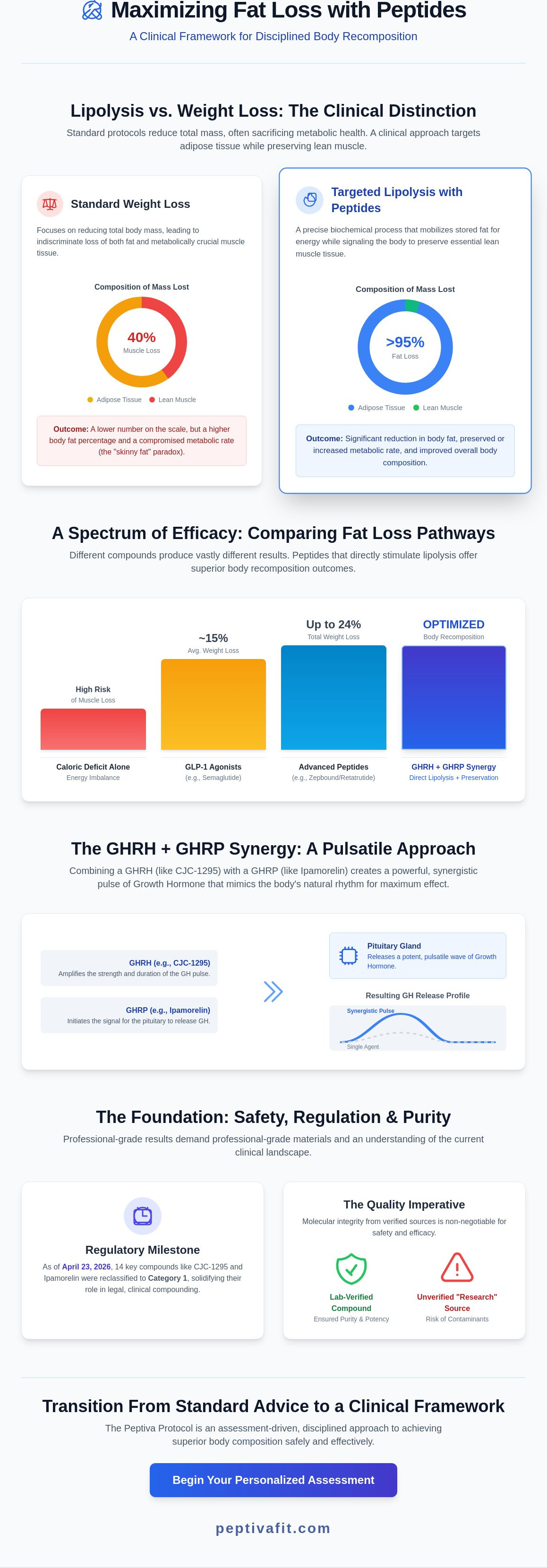
Standard weight loss protocols often fail because they focus on a singular, physiologically blunt metric: the reduction of total body mass. This approach fails to distinguish between the mobilization of visceral adipose tissue and the catabolism of skeletal muscle. In a clinical context, "weight loss" is frequently a deceptive term that masks metabolic degradation. True optimization requires a focus on lipolysis, the specific biochemical process of breaking down lipids and releasing fatty acids from adipose cells. By 2026, the standard for body composition has shifted away from simple calorie restriction toward the strategic modulation of hormonal signaling.
Traditional caloric deficits, while necessary for energy imbalance, frequently trigger a counter-regulatory response. When the body senses a prolonged energy shortage, it often prioritizes the preservation of fat stores for survival while breaking down metabolically expensive muscle tissue. This results in the "skinny fat" outcome, where an individual reaches a lower weight but possesses a higher body fat percentage and a compromised metabolic rate. Effectively maximizing fat loss with peptides involves intervening in this signaling cascade to ensure the body targets stored fuel rather than structural tissue.
While many anti-obesity medications primarily target appetite suppression through the central nervous system, peptide therapy offers a more nuanced approach. These compounds act as precise biological keys that unlock specific metabolic pathways, allowing for a disciplined and data-driven transformation that respects the complexity of human physiology.
The Mechanism of Adipose Tissue Mobilization
Adipose tissue mobilization is governed by specific amino acid chains that interact with beta-3 adrenergic receptors. These receptors are the primary drivers of thermogenesis and lipolysis in fat cells. When these pathways are activated, they stimulate the release of stored triglycerides into the bloodstream as free fatty acids. Growth Hormone (GH) plays a critical role here; it acts as a potent lipolytic agent by increasing the activity of hormone-sensitive lipase. To achieve professional-grade results, you must target the underlying metabolic rate by ensuring these GH pulses are optimized and frequent.
Preserving Lean Mass During Fat Loss
The primary danger of unmonitored weight loss is the loss of nitrogen, which serves as a clinical marker for muscle protein breakdown. Maintaining a positive nitrogen balance is essential for tissue preservation. Peptides such as Ipamorelin are preferred in high-level protocols because they stimulate GH secretion without significantly impacting hunger hormones or cortisol. This selectivity allows the individual to maintain lean mass even in a deficit. By maximizing fat loss with peptides, you aren't just losing weight; you're re-engineering your body's fuel preference to protect the very tissue that drives long-term metabolic health.
Strategic Peptide Selection for Maximum Fat Loss
While the broader market fixates on GLP-1 receptor agonists like Semaglutide, which achieved an average 15% weight loss in 68-week trials, these medications primarily function through central appetite suppression. Maximizing fat loss with peptides requires a more sophisticated approach that prioritizes direct lipolysis over simple caloric restriction. A comprehensive Scientific Review of Peptides for Obesity highlights that targeting specific metabolic pathways often yields superior body composition results compared to weight loss alone. To achieve professional-grade results, you must distinguish between agents that reduce intake and those that accelerate the mobilization of stored lipids.
The 2026 regulatory shift has confirmed the clinical relevance of these compounds. With the reclassification of 14 peptides to Category 1 in April 2026, researchers now have clearer pathways to utilize CJC-1295, Ipamorelin, and AOD-9604. Selecting the right primary agent depends on your specific metabolic markers and the type of adipose tissue you're targeting. For those requiring a tailored clinical roadmap, a personalized medical assessment ensures compound selection aligns with your unique physiological profile.
Growth Hormone Secretagogues (GHRHs and GHRPs)
The most effective strategy for elevating endogenous growth hormone involves the synergistic pairing of a Growth Hormone Releasing Hormone (GHRH) and a Growth Hormone Releasing Peptide (GHRP). CJC-1295 and Ipamorelin are frequently stacked to create a more potent, pulsatile release of GH than either could achieve in isolation. This pulsatile rhythm is superior to continuous elevation because it mimics the body's natural circadian patterns and minimizes the risk of receptor desensitization.
Optimizing Tesamorelin dosage is particularly effective for individuals targeting visceral adipose tissue. Clinical data suggests that Tesamorelin specifically addresses the deep abdominal fat associated with metabolic syndrome, which is often resistant to traditional interventions. It's a disciplined tool for those focusing on waist circumference and cardiovascular health markers.
Targeted Lipolytic Peptides
For individuals dealing with stubborn adipose stores, HGH Frag 176-191 offers a highly specific mechanism of action. This "fat loss fragment" is a stabilized analog of the factor that mediates the lipolytic effects of human growth hormone, but it lacks the growth-promoting and insulin-sensitizing effects of the full molecule. It targets the fat cells directly without interfering with blood glucose levels.
- AOD-9604: Originally developed as an anti-obesity drug, this peptide mimics the lipolytic region of human GH. It facilitates the breakdown of fat and prevents the transformation of non-fatty foods into body fat.
- Frag 176-191: This fragment is approximately 12.5 times more potent than the whole GH molecule for lipolysis, making it a cornerstone for aesthetic optimization.
The choice between these agents isn't arbitrary. It requires a clinical understanding of how different amino acid chains interact with your endocrine system. By moving beyond the "weight loss" hype of 2024 and 2025, you can employ a precise, data-driven framework for maximizing fat loss with peptides that respects the integrity of your lean tissue.
Molecular Integrity: The Foundation of Peptide Safety
Molecular integrity refers to the precise sequence of synthesized amino acids and the absolute absence of degradation or contaminants within a compound. For an individual serious about maximizing fat loss with peptides, this integrity is the only acceptable baseline. When a peptide sequence is compromised, its ability to bind to specific receptors is diminished, leading to unpredictable biological responses or complete lack of efficacy. The "grey market" frequently operates without these standards, often substituting clinical-grade materials with research chemicals that contain industrial fillers or heavy metals.
Purity is binary in a clinical context. A compound is either verified through rigorous analytical chemistry or it's a metabolic risk. Achieving 99%+ purity isn't a marketing claim; it's a technical requirement for ensuring the peptide behaves as intended once introduced to your biological system. Every batch must undergo third-party High-Performance Liquid Chromatography (HPLC) and Mass Spectrometry (MS) to confirm both the identity and the concentration of the amino acid chain. Without these verified data points, any protocol is based on speculation rather than science.
Professional oversight ensures that these high-purity compounds are applied within a safe physiological range. A Clinical Trial on GLP-1 Agonism and Diet demonstrates that even with potent agonists, the preservation of muscle mass depends heavily on the surrounding protocol and monitoring. Self-prescribing without baseline blood work ignores the critical interplay between growth hormone secretagogues and insulin sensitivity. Data dictates the protocol; your baseline markers determine the trajectory.
Identifying Lab-Verified Standards
A Certificate of Analysis (CoA) is your primary tool for verifying molecular integrity. This document should display clear HPLC and MS results for the specific lot number you possess. Purity levels below 99% often indicate the presence of synthesis byproducts that can cause localized inflammation or systemic immune responses. Beyond sourcing, the physical handling of these delicate chains is paramount. Even a high-purity compound can be ruined by improper peptide reconstitution, as aggressive agitation or incorrect diluents can shear the amino acid bonds and render the solution inactive.
The Role of Professional Oversight
Metabolic optimization is a dynamic process that requires constant calibration. Monitoring IGF-1 levels is essential when using secretagogues to ensure you stay within a therapeutic window that promotes lipolysis without inducing insulin resistance. Regular glucose sensitivity checks prevent the metabolic drift that can occur during long-term therapy. PeptivaFit bridges the gap between high-level research and clinical application by providing the 1-on-1 coaching and personalized medical assessments needed to navigate these variables. This disciplined approach ensures that maximizing fat loss with peptides remains a safe, repeatable, and data-driven endeavor.
Optimizing the Protocol: Timing, Stacking, and Lifestyle
The efficacy of any pharmacological intervention depends on the precision of its application. For those serious about maximizing fat loss with peptides, the timing of administration is just as critical as the choice of compound. Growth hormone (GH) secretion is highly sensitive to blood glucose and insulin levels. Introducing secretagogues during a postprandial state, when insulin is elevated, can significantly blunt the resulting GH pulse. Adhering to the "Fasted Window" rule ensures that the metabolic environment is primed for lipolysis. This typically requires a minimum of two to three hours of fasting before and at least thirty minutes after administration.
Circadian rhythm optimization further refines this process. Endogenous GH secretion naturally peaks during the first few hours of deep sleep. Administering GHRHs and GHRPs in the evening leverages this biological baseline, enhancing the magnitude of natural pulses. This timing also minimizes potential side effects like lethargy, which some users experience during daytime administration. Disciplined adherence to these timing windows separates elite protocols from standard consumer advice.
The Synergistic Fat Loss Stack
A sophisticated protocol moves beyond single-compound use to address multiple metabolic bottlenecks simultaneously. While secretagogues drive the mobilization of fatty acids, mitochondrial enhancers ensure these lipids are efficiently oxidized for energy. Integrating MOTS-c into a cycle provides this mitochondrial support, effectively turning up the "metabolic furnace" at a cellular level. This mitochondrial-derived peptide improves insulin sensitivity and increases glucose uptake in skeletal muscle, creating a more favorable environment for body recomposition.
Systemic homeostasis is equally vital during periods of rapid fat loss. BPC-157 is often included in advanced stacks not for direct lipolysis, but for its role in modulating the inflammatory response and supporting gut health, which can be stressed by aggressive deficits. A standard 12-week metabolic optimization cycle should be structured with planned "washout" periods. These breaks are necessary to prevent receptor desensitization and maintain long-term sensitivity to the compounds, ensuring the body continues to respond to the signaling agents.
Nutritional and Training Integration
Peptides are not a substitute for metabolic work; they are force multipliers. To protect lean tissue while maximizing fat loss with peptides, nutritional strategies like the Protein Sparing Modified Fast (PSMF) can be utilized. This high-protein, low-calorie approach provides the necessary amino acids for muscle maintenance while the peptides prioritize fat mobilization. Resistance training serves as the essential mechanical signal that tells the body to retain skeletal muscle despite the energy deficit. Without this stimulus, the risk of muscle catabolism remains high, regardless of the peptide protocol.
Managing the post-protocol phase is where most individuals fail. Transitioning out of a 12-week cycle requires a gradual return to maintenance calories and a continued focus on hormonal health to avoid a metabolic rebound. Success in this phase is often a matter of professional guidance and data-driven adjustments. For those ready to implement these high-level strategies, a single consultation call can provide the necessary clarity to refine your specific protocol.
The Peptiva Protocol: A Disciplined Approach to Fat Loss
The Peptiva Protocol represents the culmination of clinical research and disciplined application. It's far more than a static fat loss peptide guide; it's a dynamic framework designed for those who demand precision in their metabolic health. Achieving professional-grade results requires moving beyond the generic "stacks" found on public forums. Maximizing fat loss with peptides is only possible when every variable is accounted for through a structured, clinical lens. This protocol bridges the gap between raw data and physical transformation by prioritizing safety and individual biological response. We don't offer mass-market solutions, but rather a restricted, high-level path for the serious individual.
Personalized Metabolic Assessment
The journey begins with a comprehensive clinical evaluation. During a personalized medical assessment at PeptivaFit, we don't just look at body weight. We analyze specific biomarkers that dictate how your body will respond to secretagogues and lipolytic agents. This includes evaluating your baseline IGF-1 levels, fasting insulin, and glucose sensitivity. These data points allow us to translate your unique biology into a customized peptide strategy. We ensure long-term safety by monitoring these markers throughout the protocol, allowing for data-driven shifts that prevent metabolic adaptation and receptor desensitization.
Expert Coaching and Consultations
Even the most precise plan requires real-time calibration. Our 1-on-1 coaching provides the accountability and expertise needed to navigate the nuances of a 12-week cycle. Whether it's adjusting administration timing or refining nutritional integration, expert oversight ensures you remain on the path to metabolic mastery. For individuals who already have a baseline understanding but require specific protocol refinement, our single consultation calls offer high-level access to clinical expertise. This ensures your approach remains optimized as your body composition evolves.
Starting your journey with lab-verified excellence means you never have to guess about the purity of your compounds or the safety of your strategy. Maximizing fat loss with peptides is a serious endeavor that requires serious intent. If you're ready to move beyond transactional "deals" and enter a space of elite performance optimization, the Peptiva Protocol is your gateway to disciplined, science-backed results. Take the first step toward sophisticated control of your body composition by securing a professional assessment today.
Executing Your Metabolic Strategy
The transition from generalized weight loss to targeted adipose mobilization requires a shift from consumer-grade habits to clinical-grade protocols. You now understand that maximizing fat loss with peptides isn't merely a matter of administration, but a disciplined orchestration of molecular integrity, nutrient timing, and hormonal signaling. Success in 2026 is defined by the preservation of lean tissue and the verification of every compound used in your pursuit of body recomposition.
PeptivaFit provides the elite infrastructure necessary for this level of optimization. By integrating third-party lab-verified peptide supplies with personalized medical assessments, we ensure your strategy is built on data rather than speculation. Our expert 1-on-1 metabolic coaching offers the real-time adjustments required to bypass plateaus and maintain systemic homeostasis. This is a restricted path reserved for those who prioritize scientific standards over marketing hype.
Take the final step toward sophisticated control of your performance. Access the Peptiva Protocol and Professional Coaching to begin your journey with a framework designed for metabolic mastery. Your potential for transformation is limited only by the precision of your protocol.
Frequently Asked Questions
How long does it take to see visible fat loss with peptide therapy?
Visible changes in body composition typically manifest within four to eight weeks of disciplined adherence. Initial metabolic shifts occur immediately at the cellular level, but subcutaneous adipose mobilization requires consistent signaling over a prolonged period. Individuals starting with a higher body fat percentage may notice changes in clothing fit before visual definition appears. Maximizing fat loss with peptides is a cumulative process that rewards patience and protocol precision.
Can I stack fat loss peptides with GLP-1 medications like Semaglutide?
Stacking lipolytic agents with GLP-1 receptor agonists is a clinically sound strategy for addressing both appetite and fat mobilization. While GLP-1s reduce caloric intake, secretagogues like Ipamorelin ensure the body prioritizes adipose tissue over muscle mass. This synergy prevents the metabolic slowdown often associated with aggressive deficits. Each compound must be introduced methodically to monitor individual tolerance and ensure hormonal homeostasis remains stable throughout the cycle.
What is the best time of day to administer lipolytic peptides for maximum effect?
Administration is most effective during the evening or immediately before sleep while in a fasted state. This timing synchronizes with the body's natural nocturnal growth hormone pulses and minimizes interference from insulin. Maintaining a two-hour fasted window before administration is critical. Elevating blood glucose through late-night snacking will blunt the peptide’s ability to stimulate endogenous GH release, effectively neutralizing the metabolic benefit of the dose.
Do I need to cycle off fat loss peptides to prevent side effects?
Cycling is a mandatory component of a disciplined protocol to prevent receptor desensitization and maintain endocrine sensitivity. A standard 12-week administration period is typically followed by a four-week washout phase. This pause allows the pituitary gland to reset its natural signaling pathways. Continuous use without breaks can lead to diminished returns and potential shifts in insulin sensitivity, making periodic cessation essential for long-term metabolic health.
Why is lab-testing more important for fat loss peptides than other supplements?
Peptides are highly sensitive amino acid chains that require 99%+ purity to interact correctly with biological receptors. Unlike standard vitamins, "grey market" peptides often contain synthesis byproducts or industrial fillers that can trigger systemic inflammation or immune responses. Lab verification through HPLC and Mass Spectrometry is the only way to confirm molecular integrity. Without these tests, you're introducing unverified chemicals into your endocrine system, which carries significant metabolic risk.
What are the most common side effects of growth hormone secretagogues?
The most frequent observations include transient water retention, increased hunger, and localized tingling in the extremities. These effects are usually dose-dependent and subside as the body adapts to elevated GH levels. Monitoring IGF-1 and blood glucose is necessary to ensure the protocol doesn't negatively impact insulin sensitivity over time. Professional oversight allows for real-time dosage adjustments to mitigate these issues while maximizing fat loss with peptides safely.
Is a medical assessment required before starting the Peptiva Protocol?
A personalized medical assessment is a non-negotiable prerequisite for entry into the Peptiva Protocol. We operate as a restricted entity that prioritizes data-driven safety over mass-market convenience. This evaluation establishes your baseline biomarkers, including hormonal health and metabolic function, which dictates the specific selection of compounds. We don't provide protocols without a clinical understanding of your unique physiology, ensuring every intervention is both necessary and optimized.
Can peptides help target specific areas like visceral or abdominal fat?
Specific compounds are uniquely suited for targeting visceral and stubborn abdominal adipose stores. Tesamorelin is clinically documented for its ability to reduce visceral fat, the deep tissue associated with metabolic syndrome. Similarly, Fragment 176-191 targets subcutaneous fat by inhibiting lipogenesis and stimulating lipolysis. While "spot reduction" is a myth in traditional fitness, peptide therapy allows for the pharmacological targeting of specific fat cell receptors in resistant areas.

![Shelf Life of Reconstituted Peptides: A Clinical Reference Guide [2026]](https://getautoseo.com/storage/hero_images/shelf-life-of-reconstituted-peptides-a-clinical-reference-guide-2026.jpg?v=b8ed5173acaa)
