
![Medical Assessment for Peptide Therapy Optimization [2026]](https://getautoseo.com/storage/hero_images/medical-assessment-for-peptide-therapy-optimization-2026.jpg?v=12bf48dbbe54)
The most significant risk in peptide therapy isn't the molecule itself; it's the absence of a precise biological map. You likely understand that elite performance optimization requires more than just following a trend or purchasing research chemicals from unverified sources. You're right to be cautious about long-term side effects from unmonitored use, especially as the regulatory landscape shifts. Knowing exactly what to expect during a peptide therapy consultation is the only way to ensure your protocol is built on data rather than guesswork. This initial step is a scientific necessity for anyone serious about their cellular health.
We'll provide the clarity you need to transition from speculative research to a safe, personalized peptide protocol. You'll learn which biomarkers actually matter, including the current 2026 standards for IGF-1 monitoring, and how to identify a provider who values molecular integrity. This article delivers a clear checklist of required lab work and explains why a Personalized Medical Assessment is the non-negotiable gatekeeper of your wellness. By the end, you'll have the confidence that your strategy is tailored to your unique biology and backed by disciplined clinical standards.
Key Takeaways
- Understand why a standard physical is insufficient and how a targeted screening identifies the metabolic baselines required for molecular integrity.
- Identify the critical biomarkers, such as IGF-1 and fasting insulin, that dictate your body's response to growth hormone secretagogues.
- Gain clarity on what to expect during a peptide therapy consultation, ranging from the initial clinical history review to the comprehensive biomarker panel collection.
- Learn how to mitigate long-term risks by identifying contraindications like active malignancies or pre-diabetic states before beginning any protocol.
- Discover how a Personalized Medical Assessment serves as the essential gatekeeper to ensuring your protocol utilizes only lab-tested peptides.
The Clinical Necessity of a Medical Assessment for Peptide Therapy
A Personalized Medical Assessment is the foundational requirement for any disciplined performance protocol. It isn't a mere formality; it's a targeted screening of metabolic and hormonal baselines that dictates the safety of your journey. When you're evaluating what to expect during a peptide therapy consultation, realize that the focus shifts from general health to specific biological readiness. Standard annual physicals are designed to detect active disease, but they rarely investigate the nuanced biomarkers that determine if a peptide protocol will thrive or fail. Professional medical oversight acts as a necessary safeguard against pituitary exhaustion and insulin desensitivity, two primary risks associated with unguided or excessive use.
The Peptiva Protocol maintains strict ethical boundaries, requiring a Personalized Medical Assessment for every participant. This isn't about restriction; it's about providing a level of expertise that respects the complexity of human biology. By prioritizing data over hype, we ensure that your transition from research to implementation is both safe and effective. It's the only responsible way to approach advanced metabolic optimization.
Peptides vs. Traditional Pharmacology: Why Assessment Differs
Peptides are unique because they act as signaling molecules that interact with your body’s endogenous hormone production. While traditional pharmacology often involves replacing a hormone you're missing, peptides instruct your system to optimize its own output. This interaction requires a sophisticated understanding of your current endocrine state. Establishing a metabolic starting point is the only way to measure future progress with any degree of scientific accuracy. Engaging in unguided research without professional biomarker monitoring is a high-stakes gamble with your hormonal health. A structured assessment ensures that your body can handle the increased signaling without triggering a negative feedback loop.
The Goal of Molecular Integrity and Safety
We define molecular integrity as the intersection of product purity and biological stability. It involves ensuring that the lab-tested peptides you use are matched by a body capable of utilizing them effectively. Professional screening is vital for identifying pre-existing conditions, such as dormant malignancies or pre-diabetic states, that growth-oriented peptides might accidentally accelerate. This process moves the individual away from the "trial and error" approach common in consumer wellness. Instead, it places you within a framework of optimization driven by data. Every protocol must be justified by your unique biology to maintain long-term safety and efficacy.
- Endogenous Support: Ensuring the protocol complements rather than replaces natural production.
- Risk Mitigation: Identifying contraindications through 2026 clinical standards.
- Data Benchmarking: Using IGF-1 and fasting insulin levels to guide dosage adjustments.
Essential Biomarkers: What a Professional Lab Analysis Includes
Understanding what to expect during a peptide therapy consultation begins with a shift in diagnostic focus. While a standard blood panel might check for basic anemia, a professional analysis for peptide optimization prioritizes biomarkers like Insulin-like Growth Factor 1 (IGF-1) and Growth Hormone (GH) baselines. These metrics are critical when considering secretagogues, as they establish your current physiological ceiling. Without these data points, any protocol is merely speculative. Clinicians also demand a comprehensive lipid panel and high-sensitivity C-reactive protein (hs-CRP) to assess systemic inflammation and cardiovascular readiness before any signaling molecules are introduced.
Systemic safety requires verifying that your filtration organs can handle optimized metabolic signaling. Testing for Blood Urea Nitrogen (BUN), Creatinine, and liver enzymes such as AST and ALT is mandatory. These values ensure that the introduction of specific molecules won't place undue stress on your renal or hepatic systems. This level of scrutiny is what separates clinical-grade optimization from amateur experimentation. Every biomarker serves as a data point that justifies the protocol's existence or necessitates its adjustment.
Hormonal Panels and Pituitary Health
When preparing for your protocol, knowing what to expect during a peptide therapy consultation helps you understand why clinicians prioritize specific hormonal context. Total and Free Testosterone levels must be analyzed to provide the necessary framework for metabolic optimization. Low androgen levels can often mimic or exacerbate the symptoms of GH deficiency, making it vital to distinguish between the two. Additionally, a full thyroid panel including TSH, Free T3, and Free T4 is essential to determine your baseline metabolic rate. Understanding these feedback loops is critical when utilizing peptides like CJC-1295 or Ipamorelin, as they interact directly with pituitary signaling. For those concerned with the potential benefits and safety concerns of these interactions, a data-driven approach is the only path to clarity.
Metabolic Markers and Glucose Regulation
Long-term peptide protocols, particularly those focused on fat loss, can significantly impact insulin sensitivity. Monitoring HbA1c and Fasting Insulin is a non-negotiable requirement to prevent the development of insulin resistance during therapy. Clinical oversight focuses on how your body manages blood glucose under the influence of increased GH signaling. In the current 2026 clinical landscape, the optimal range for IGF-1 in a healthy 40+ male demographic is generally considered to be between 180 and 250 ng/mL for performance optimization. Maintaining these levels requires the precision found in a Personalized Medical Assessment to ensure the protocol remains within safe biological parameters.
Identifying Contraindications and Risk Mitigation Strategies
A Personalized Medical Assessment serves as the primary barrier against biological mismanagement. Identifying contraindications is the most critical phase of the process. When considering what to expect during a peptide therapy consultation, you should be prepared for a rigorous inquiry into your medical history. Active malignancy is a non-negotiable contraindication for Growth Hormone (GH) releasing peptides. Because these molecules promote cellular proliferation, they can't be safely administered to individuals with active or recent cancer. Additionally, individuals in pre-diabetic states require specific monitoring. While some peptides are insulin-sensitizing, others can temporarily elevate blood glucose, requiring a precise clinical balance to avoid metabolic distress.
The assessment also screens for physical predispositions such as a history of edema or carpal tunnel syndrome. GH-related protocols can cause transient fluid retention, which may exacerbate these conditions. Understanding what to expect during a peptide therapy consultation involves recognizing that your physical history dictates your protocol's boundaries. Disclosing all current medications is equally vital. Certain pharmaceuticals can interact with peptide signaling, potentially leading to adverse drug-peptide interactions or diminished efficacy. This transparency is mandatory for maintaining the integrity of the protocol.
Screening for Latent Pathologies
Clinicians prioritize cardiovascular health before introducing any compound that might impact fluid balance. A history of cardiac stress or hypertension requires a more conservative approach. The clinician’s role is to act as a gatekeeper, clearing a participant for the Peptiva Protocol only when the risk profile is sufficiently low. This ensures that optimization doesn't come at the expense of long-term systemic health. Every screening is a search for hidden risks that could compromise your biological stability.
Safe Implementation and Dose Titration
The assessment data directly dictates your starting dose. Starting low and titrating upward allows your system to adapt while minimizing initial side effects like joint discomfort or lethargy. If you're transitioning from other hormonal therapies, a managed washout period is often necessary to reset your endogenous baselines. Utilizing lab tested peptides is essential during this phase. Without verified molecular purity, the data from your assessment can't be accurately applied to the administered compound. Consistency between the lab results and the medication is the only way to ensure safety.
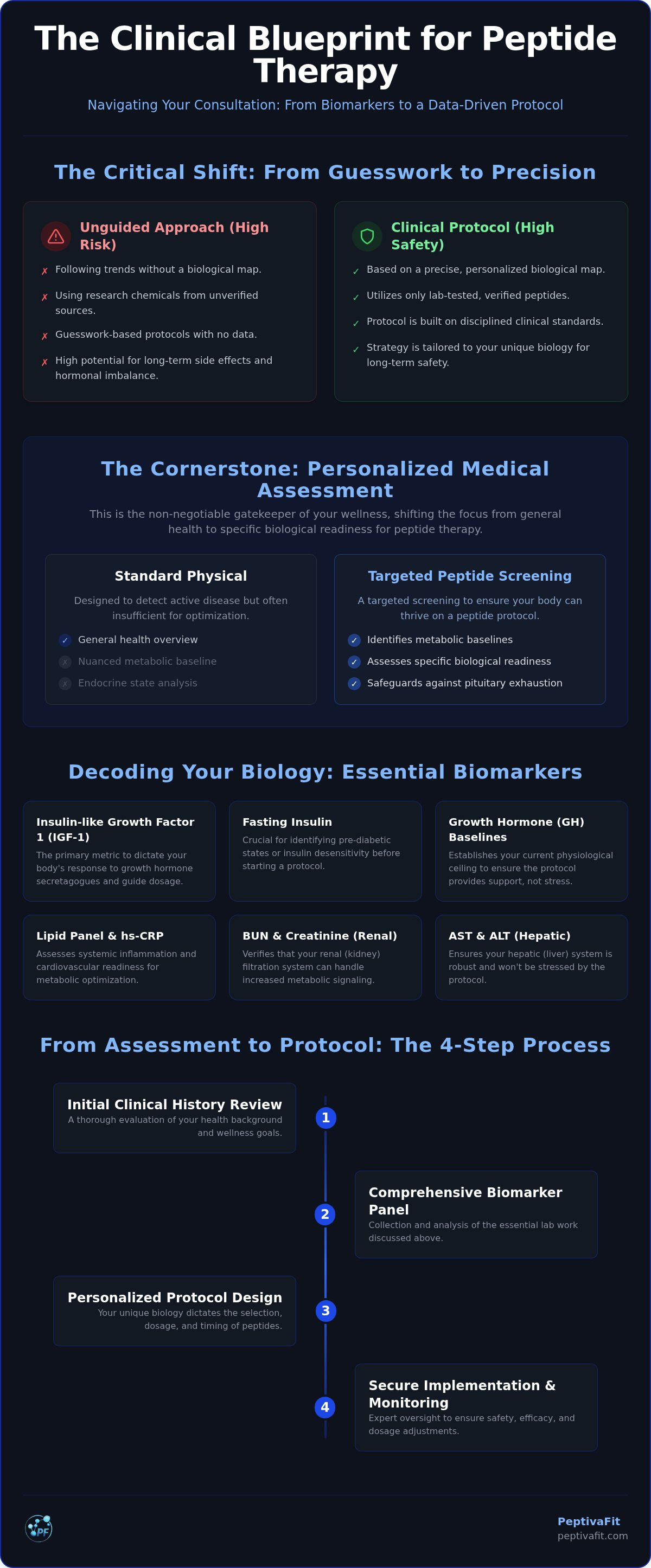
From Assessment to Protocol: The Implementation Phase
The transition from diagnostics to implementation is a methodical five-step process. Understanding what to expect during a peptide therapy consultation requires viewing the experience as a logical progression from raw data to a refined biological strategy. We don't rely on generic templates; instead, we follow a disciplined sequence to ensure your protocol is both safe and effective.
- Step 1: Initial clinical consultation. We conduct a deep dive into your specific performance goals and comprehensive medical history.
- Step 2: Blood draw. This is the diagnostic event where we collect the biomarkers required for a precise baseline.
- Step 3: Result review. A clinician identifies specific metabolic deficiencies or hormonal imbalances that require intervention.
- Step 4: Customization. We refine the Peptiva Protocol based on your unique biological signature.
- Step 5: Ongoing monitoring. Scheduled follow-up assessments ensure your dosage remains optimal as your physiology shifts.
As you navigate what to expect during a peptide therapy consultation, remember that the goal is a protocol that evolves with you. Data from your initial assessment serves as the benchmark for every subsequent adjustment.
Customizing Your Fat Loss Peptide Guide
Lab results dictate the specific molecular choice. For example, a participant with significant visceral adipose tissue and low IGF-1 might require a different approach than someone focused on localized lipolysis. This is where the tesamorelin dosage guide becomes a vital reference point for clinical application. A standard dose is a general starting point. A clinically indicated dose is a precise calculation based on your metabolic data. This distinction ensures the Peptiva Protocol remains superior to generic advice found in unguided circles. We prioritize the molecule that matches your specific metabolic hurdles.
The Role of 1-on-1 Coaching in Protocol Success
Data is a map, but 1-on-1 Coaching provides the navigation. Expert interpretation is necessary to integrate these molecules into a lifestyle that supports their function. A single consultation call can be the difference between a stalled protocol and a breakthrough when mid-protocol adjustments are required. Coaches use your assessment data to optimize nutrition and training. They ensure your biological environment is receptive to peptide signaling. This holistic approach prevents the "shotgun" method of supplementation and replaces it with a surgical, data-driven strategy. To begin this disciplined process, schedule your Personalized Medical Assessment today.
Securing Expert Oversight through PeptivaFit Consultations
PeptivaFit operates as a selective entity for individuals who demand scientific-grade precision in their performance protocols. Our Personalized Medical Assessment is the exclusive entry point for those seeking to move beyond the inaccuracies of unguided research. When you are determining what to expect during a peptide therapy consultation, you must understand that our process is designed for high-level data monitoring rather than mass-market convenience. We ensure that every clinical plan is executed using only lab-tested peptides, guaranteeing that the molecular integrity of the compounds matches the rigorous standards of your initial assessment.
The Peptiva Protocol functions as the essential bridge between clinical data and real-world results. While other providers may offer a cursory review of labs, we provide a comprehensive framework that interprets your biology through the lens of metabolic optimization. This methodical approach ensures that your transition into therapy is supported by expert oversight at every stage. We invite you to book a consultation to establish your metabolic baseline and begin a disciplined journey toward peak cellular health.
The PeptivaFit Advantage: Clinical Precision
Our focus remains strictly on scientific-grade standards that elevate your protocol above generic wellness trends. We offer personalized medical assessments for US-wide clients, providing a level of access previously reserved for elite research environments. We prioritize privacy and exclusivity, operating with a detached objectivity that favors data over emotional hype. PeptivaFit expects a high degree of personal responsibility and serious intent from its selective clientele. This mutual commitment to excellence is what ensures the long-term success and safety of our participants.
Next Steps for Serious Optimization
Preparation is the first step in demonstrating your commitment to the process. Before your first consultation call, you'll need to prepare by fasting for at least 12 hours prior to your blood draw and gathering any previous medical records that provide historical context for your metabolic health. Understanding what to expect during a peptide therapy consultation includes recognizing that our timeline is measured and deliberate. We don't offer quick fixes; instead, we provide a thorough analysis that typically takes several days to move from the initial call to the delivery of your customized protocol. This pace reflects the methodical nature of our work. Secure your personalized medical assessment today to initiate the process of data-driven optimization.
Establishing Your Blueprint for Molecular Optimization
Navigating the complexities of performance enhancement requires a departure from anecdotal advice in favor of clinical-grade precision. You now understand that knowing what to expect during a peptide therapy consultation is about more than just scheduling a call; it's about initiating a comprehensive biological investigation. This process ensures that your metabolic markers, such as IGF-1 and fasting insulin, are analyzed against 2026 standards to guarantee safety and efficacy.
A Personalized Medical Assessment acts as the mandatory gatekeeper, filtering out latent risks and establishing the foundation for a customized protocol. Through PeptivaFit, you gain access to lab-verified peptide molecular integrity and the expert interpretation of a dedicated coach. This disciplined approach bridges the gap between raw data and tangible optimization results. It's the only way to ensure your physiology is supported by facts rather than speculation.
If you're ready to take ownership of your cellular health with a scientifically rigorous strategy, the next step is clear. Secure Your Personalized Medical Assessment and Start the Peptiva Protocol to establish your biological baseline. We're prepared to guide your transition into a state of high-level performance.
Frequently Asked Questions
Is a medical assessment required for all peptide protocols?
A Personalized Medical Assessment is mandatory for all individuals participating in the Peptiva Protocol. We don't permit the use of signaling molecules without first establishing a precise biological baseline. This requirement ensures that every participant is screened for metabolic readiness and potential contraindications. By maintaining this strict clinical standard, we protect the long-term health of our clients and ensure that the administered protocol is justified by data.
Can I use lab results from my regular doctor for a peptide assessment?
Standard lab panels from a general practitioner typically lack the specialized biomarkers required for peptide optimization. While we can review recent records for historical context, a peptide-specific assessment focuses on metrics like IGF-1, fasting insulin, and high-sensitivity C-reactive protein. These values are rarely included in annual physicals. To ensure molecular integrity and protocol efficacy, we require a comprehensive panel that meets our specific clinical-grade standards for 2026.
What is the most important biomarker to check before starting peptides?
Identifying the most critical biomarker depends on the specific protocol, but Insulin-like Growth Factor 1 (IGF-1) is the primary metric for growth hormone secretagogues. It provides a snapshot of your current growth hormone production ceiling. Additionally, monitoring fasting insulin is vital to ensure your glucose metabolism can handle increased signaling. These markers are central to what to expect during a peptide therapy consultation, as they dictate the safety parameters of your customized strategy.
How often should I repeat my medical assessment while on a protocol?
We recommend repeating your biomarker analysis every three to six months, depending on the intensity of your protocol. Regular monitoring allows for precise dose titration and ensures that your system is responding correctly to the therapy. These follow-up assessments are necessary to detect any shifts in insulin sensitivity or pituitary function. Maintaining a consistent schedule of blood work is a requirement for anyone serious about long-term metabolic optimization and performance.
What happens if my medical assessment reveals a contraindication?
If a Personalized Medical Assessment identifies a contraindication, such as an active malignancy or significant cardiovascular stress, the protocol will be denied or modified. Safety is our primary objective, and we won't compromise biological stability for short-term gains. In such cases, our clinicians will discuss the findings and provide guidance on addressing the underlying health issues. We operate as a gatekeeper to ensure that only eligible candidates proceed with therapy.
How long does the medical assessment process take at PeptivaFit?
The timeline from your initial clinical inquiry to the delivery of a customized protocol typically spans seven to ten business days. This duration accounts for the time required for blood draw collection, laboratory processing, and the subsequent expert review of your biomarkers. We prioritize accuracy over speed to ensure every recommendation is backed by a thorough investigation of your unique biology. This measured pace reflects our commitment to scientific-grade standards.
Do I need a new assessment if I switch from fat loss to recovery peptides?
Switching from fat loss to recovery peptides requires a new Personalized Medical Assessment to verify that your system is prepared for a different signaling pathway. Peptides used for tissue repair or inflammation interact with your endocrine system differently than those designed for lipolysis. Understanding what to expect during a peptide therapy consultation involves recognizing that each protocol shift must be justified by current data. We never assume your previous baseline remains valid when changing compounds.
Are these assessments covered by standard health insurance?
Standard health insurance providers rarely cover assessments focused on performance optimization or elective peptide therapy. These services are categorized as specialized wellness and metabolic research rather than the treatment of a diagnosed illness. We operate as a private, selective entity, and participants should expect to cover the costs of labs and consultations as an investment in their personal health. This allows us to maintain our high clinical standards without the restrictions of insurance-led care.

![Shelf Life of Reconstituted Peptides: A Clinical Reference Guide [2026]](https://getautoseo.com/storage/hero_images/shelf-life-of-reconstituted-peptides-a-clinical-reference-guide-2026.jpg?v=b8ed5173acaa)
