

What if the primary constraint on your physical performance isn't your training volume, but the specific speed of your cellular signaling? Many elite performers now utilize lab-tested peptides for enhancing workout recovery to bypass the plateaus created by cumulative central nervous system fatigue and persistent joint nagging. You've likely realized that standard rest days and off-the-shelf supplements are often insufficient when your body's natural repair mechanisms can't keep pace with a high-intensity training load.
This clinical guide explores the strategic application of advanced bio-signaling to move beyond passive rest. By leveraging specific peptide sequences to optimize your growth hormone response and accelerate musculoskeletal repair, you can significantly reduce downtime and lower your injury frequency. We'll examine the data-driven protocols for compounds like BPC-157 and targeted secretagogues to help you reclaim sophisticated control over your physiological restoration and long-term wellness.
Key Takeaways
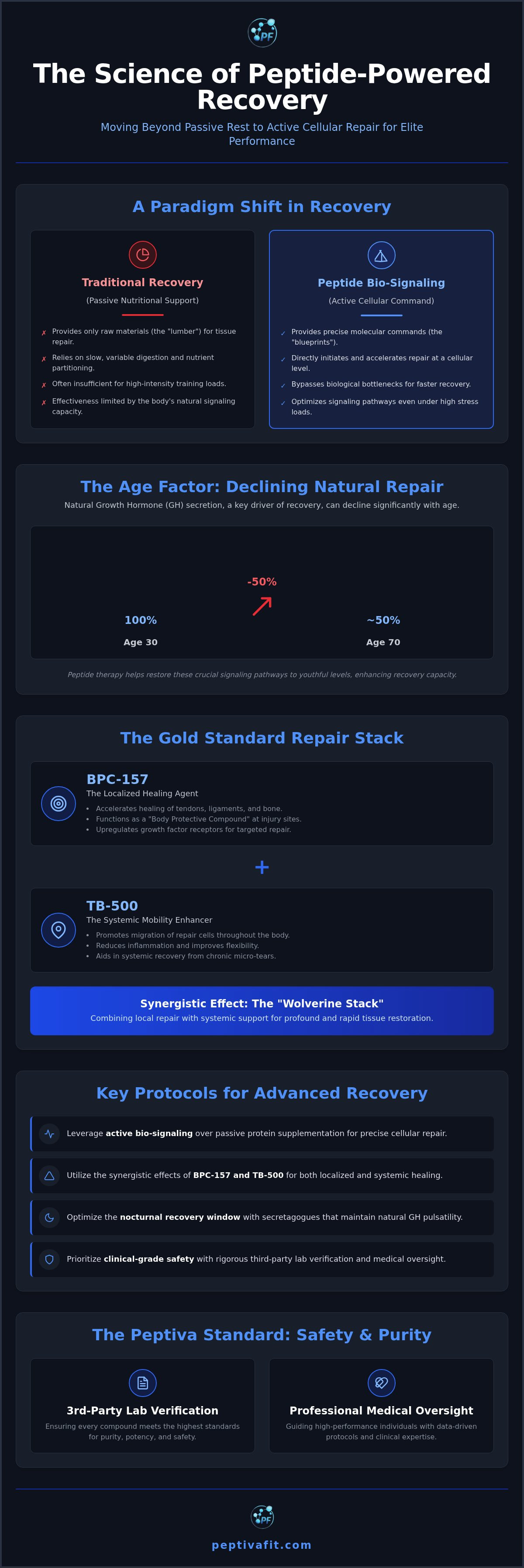
- Distinguish between passive protein supplementation and active bio-signaling to initiate precise molecular repair at the cellular level.
- Evaluate the synergistic effects of BPC-157 and TB-500 on localized tissue healing and systemic cellular migration.
- Optimize your nocturnal recovery window through growth hormone secretagogues that maintain natural physiological pulsatility without the risks of synthetic administration.
- Counteract central nervous system fatigue by identifying targeted peptides for enhancing workout recovery and mitochondrial metabolic resilience.
- Prioritize clinical-grade safety by adhering to the Peptiva Standard of rigorous third-party lab verification and professional medical oversight.
The Bio-Signaling Revolution: How Peptides Accelerate Workout Recovery
The efficacy of traditional recovery methods often reaches a ceiling when training intensity exceeds the body's natural signaling capacity. To understand the shift toward biological optimization, one must first ask: What are peptides? These short-chain amino acids act as precise molecular messengers, functioning as the instructional code that directs cellular behavior. Unlike traditional protein supplementation, which provides the raw building blocks for tissue, systemic peptide therapy provides the specific commands necessary to initiate repair. This distinction is critical; while protein is the lumber, peptides are the blueprints.
Natural muscle restoration relies heavily on the endogenous production of Insulin-like Growth Factor 1 (IGF-1) and growth hormone (GH). These hormones facilitate the proliferation of satellite cells and the synthesis of new myofibrillar proteins. However, as we age, natural GH secretion can decline significantly, often by 50% between the ages of 30 and 70. Utilizing lab-tested peptides for enhancing workout recovery allows for the restoration of these signaling pathways, bypassing the biological bottlenecks that lead to prolonged soreness and injury. Applying specific peptides for enhancing workout recovery ensures that signaling remains robust even under high-stress loads.
Cellular Communication vs. Nutritional Support
Nutritional support through macronutrients is a passive requirement for survival, but it doesn't dictate the speed of healing. Peptides trigger specific intracellular pathways, such as the mammalian target of rapamycin (mTOR) and mitogen-activated protein kinase (MAPK), which are critical for hypertrophic signaling. High-volume training demands often exceed what "macros and rest" can provide, leading to a state of chronic inflammation and delayed muscle protein synthesis. Peptide bio-signaling is a targeted regulatory intervention that modulates the body's internal environment to prioritize tissue integrity. This method allows for a more disciplined approach to recovery that isn't dependent on the slow, variable pace of natural digestion and nutrient partitioning.
The End of the 'Rest and Ice' Era
The modern athletic perspective has moved beyond the reactive "rest and ice" model toward a proactive framework of biological optimization. Passive recovery is no longer the standard for those seeking elite performance. Instead, integrating peptides into a holistic protocol that includes disciplined sleep hygiene and precise micronutrition creates a superior environment for restoration. This shift requires a move from generic advice to personalized medical assessments. For those seeking a definitive framework, the Peptiva Protocol provides the necessary context for integrating these compounds into a high-performance lifestyle while maintaining metabolic health.
The Gold Standard Repair Stack: BPC-157 and TB-500
Clinical restoration of damaged tissue requires a targeted approach that addresses both local structural integrity and systemic cellular movement. Within the high-performance community, the combination of BPC-157 and TB-500 has emerged as the definitive "Wolverine Stack" for its profound impact on connective tissue. While the bio-signaling revolution discussed previously establishes the foundation, these two molecules provide the specific mechanics for physical repair. BPC-157, or Body Protective Compound, functions primarily as a localized healing agent, while TB-500, a synthetic version of Thymosin Beta-4, facilitates the migration of repair cells across the entire body. Utilizing these specific peptides for enhancing workout recovery allows athletes to address injuries that traditional protocols often fail to resolve.
The synergy between these compounds is rooted in their distinct but complementary roles. BPC-157 is highly effective at upregulating growth factor receptors in fibroblasts, which are the cells responsible for collagen synthesis. Simultaneously, TB-500 utilizes its G-actin binding properties to improve cellular mobility, ensuring that the necessary biological resources reach the site of trauma efficiently. This dual-action approach is essential for repairing the chronic micro-tears and nagging joint issues that accumulate during high-volume training cycles.
Angiogenesis and Tendon-to-Bone Healing
Healing ligaments and tendons presents a unique physiological challenge due to their "white zone" status, characterized by extremely poor vascularity. Without adequate blood flow, these tissues cannot receive the nutrients or oxygen required for rapid turnover. The primary mechanism of BPC-157 for Musculoskeletal Healing involves the induction of angiogenesis, which is the formation of new blood vessels. By creating these new pathways, the peptide essentially "re-vascularizes" the damaged area. For a deeper technical breakdown of these mechanisms, consult our BPC-157 clinical reference guide. This process transforms a slow-healing, stagnant injury into an active site of biological restoration.
Systemic Inflammation Management
TB-500 plays a crucial role in modulating the inflammatory response without suppressing the natural adaptations required for muscle growth. Unlike non-steroidal anti-inflammatory drugs (NSAIDs) that can hinder long-term hypertrophy, TB-500 optimizes the inflammatory window to prioritize repair over swelling. TB-500 promotes muscle cell differentiation by facilitating the migration of progenitor cells to the site of damaged myofibrils. This systemic action ensures that even as you focus on a specific injury, your entire musculoskeletal system remains resilient. To ensure your protocol is built on a foundation of safety and precision, a personalized medical assessment is the most effective way to determine the appropriate integration of these lab-tested peptides into your recovery routine.
Growth Hormone Secretagogues: Optimizing the Nocturnal Recovery Window
While the structural repair mechanisms of BPC-157 and TB-500 are essential, the systemic rate of restoration is ultimately governed by the hormonal environment. Growth hormone (GH) serves as the primary catalyst for cellular regeneration, yet its natural production often declines due to age, stress, and high training volumes. Growth hormone secretagogues represent a sophisticated class of peptides for enhancing workout recovery by stimulating the pituitary gland to release its own endogenous stores. This method is fundamentally different from synthetic HGH administration. It preserves natural GH pulsatility and avoids the negative feedback loops that can lead to long-term pituitary suppression and metabolic dysfunction.
Maintaining this natural rhythm is vital for athletes who require sustained performance over years, not just months. By utilizing secretagogues, individuals can optimize their physiological response to training without the risks associated with high-dose exogenous hormones. This approach ensures that the body's internal regulatory systems remain intact while providing the necessary biological signals to accelerate tissue turnover and reduce systemic inflammation. Integrating these peptides for enhancing workout recovery allows for a more disciplined and sustainable training cycle.
CJC-1295 and Ipamorelin Synergy
The combination of CJC-1295, a Growth Hormone Releasing Hormone (GHRH) analog, and Ipamorelin, a Growth Hormone Releasing Peptide (GHRP), creates a potent synergy. CJC-1295 initiates the signal for GH release, while Ipamorelin suppresses somatostatin, the hormone responsible for inhibiting GH output. This dual-action mechanism results in a more significant and sustained GH pulse. To maximize the efficacy of this stack, a strict "no-food" window is required; consuming carbohydrates or fats within two hours of administration can trigger insulin spikes that blunt the GH response. For those seeking more specialized metabolic interventions, exploring Tesamorelin dosage protocols can offer additional strategies for targeting visceral fat and further optimizing GH levels.
Sleep Quality as a Recovery Catalyst
The vast majority of natural growth hormone release occurs during deep, slow-wave sleep (Stages 3 and 4). Secretagogues enhance this nocturnal window by improving sleep architecture, leading to more restorative rest and better REM cycles. Many performers monitor this improvement through Heart Rate Variability (HRV) and deep sleep tracking, which often show marked increases after initiating a secretagogue protocol. This improved sleep quality doesn't just accelerate muscle repair; it also facilitates fat loss and metabolic resilience as secondary benefits. Long-term hormonal optimization through these clinical-grade interventions supports both immediate performance goals and extended healthspan, making it a cornerstone of advanced recovery science.
Addressing Neural Fatigue: CNS and Mitochondrial Recovery
Musculoskeletal repair represents only one dimension of the restorative process. True optimization requires addressing the Central Nervous System (CNS) and the mitochondrial efficiency that powers it. Heavy training cycles often induce a state of neural fatigue that muscular rest alone cannot resolve. While earlier sections focused on structural repair and hormonal signaling, the CNS remains the primary governor of physical output. When the CNS is overloaded, explosive power drops and the mind-muscle connection weakens. Utilizing targeted peptides for enhancing workout recovery allows you to address this neurological bottleneck directly. Mitochondrial health is the foundation of this process. The speed at which your body resynthesizes ATP post-workout determines how quickly you can return to high-intensity sessions.
MOTS-c: Enhancing Metabolic Flexibility
MOTS-c is a mitochondrial-derived peptide that functions as a sophisticated regulator of metabolic resilience. It assists in maintaining glucose homeostasis and increases insulin sensitivity, both of which are often compromised during periods of overreaching. If your cellular engines are sluggish, even an optimized hormonal profile won't prevent a performance decline. For a deeper analysis of these mechanisms, refer to our MOTS-c comprehensive reference. MOTS-c is an exercise mimetic that supports cellular homeostasis by directing metabolic resources toward repair rather than storage.
Mitigating Neural Burnout
The cognitive brain fog associated with heavy training is a clinical indicator of neural burnout. Nootropic peptides like Semax and Selank offer a disciplined way to manage this state without the jittery effects of traditional stimulants. Semax supports BDNF (Brain-Derived Neurotrophic Factor) levels, which facilitates the survival of existing neurons and encourages the growth of new ones. This support is vital for balancing the sympathetic and parasympathetic nervous systems. Complete recovery isn't achieved until the body shifts out of a chronic fight or flight state and into a restorative parasympathetic mode. Effective recovery protocols must bridge the gap between cognitive drive and physical capacity. To integrate these advanced neural recovery strategies into your routine safely, schedule a personalized medical assessment to ensure clinical-grade oversight and data-driven results.
The Peptiva Standard: Sourcing, Safety, and Clinical Oversight
The advanced recovery protocols discussed in previous sections require high-fidelity compounds to be effective. Sourcing peptides for enhancing workout recovery from unregulated "gray market" vendors introduces significant physiological risks. These entities often bypass rigorous quality control, resulting in products contaminated with heavy metals or characterized by inaccurate concentrations. Mislabeling is a common occurrence in these markets; what is sold as a specific secretagogue may, in fact, be a different, less stable sequence. PeptivaFit mitigates these risks through a commitment to lab-verified peptide purity, ensuring that every batch undergoes third-party verification to confirm molecular identity and sterility.
Identifying Lab-Verified Purity
A Certificate of Analysis (COA) is the primary document required to validate a peptide's integrity. High-standard labs provide these reports to confirm that the compound is free from endotoxins and meets the stated purity percentage, typically 99% or higher. Beyond sourcing, the handling of these molecules is a critical factor in maintaining their bioactivity. The reconstitution process is a precise laboratory task that requires specific bacteriostatic solvents to prevent degradation. Improper storage, such as exposure to light or temperature fluctuations, can render even high-purity peptides inert. Disciplined adherence to these handling protocols is essential for anyone utilizing peptides for enhancing workout recovery.
The Value of Professional Oversight
Individual biology dictates the success of any recovery intervention. Personalized medical assessments are non-negotiable because they establish the baseline data required to tailor the Peptiva Protocol to your specific needs. Relying on generic advice ignores the complexities of individual hormonal responses and metabolic health. Professional oversight includes the monitoring of biofeedback and blood work to validate progress and adjust dosages as needed. This data-driven approach ensures that the protocol remains both safe and effective over the long term.
1-on-1 coaching further refines this process by interpreting the subtle signals of central nervous system fatigue and musculoskeletal strain. This elite level of guidance allows for real-time adjustments that a static guide cannot provide. By combining lab-tested peptides with clinical expertise, you move from experimental use to a disciplined, high-performance strategy. Optimize your recovery with the Peptiva Protocol today to secure the clinical-grade oversight your performance demands.
Mastering the Science of Physiological Restoration
Transitioning from passive rest to active bio-signaling represents the next evolution in high-performance training. By synchronizing structural repair with systemic hormonal optimization, you bypass the biological limitations of traditional recovery. True mastery of your physical output requires addressing both the musculoskeletal system and the central nervous system. Utilizing lab-tested peptides for enhancing workout recovery ensures that your cellular instructions are precise, potent, and safe.
The Peptiva Standard provides the clinical framework necessary for this level of optimization. Every protocol is backed by lab-verified peptide purity reports and custom medical assessments to ensure individual efficacy. With expert 1-on-1 coaching, you can fine-tune these advanced strategies based on your unique biofeedback. Don't settle for inconsistent results when you can command your body's repair mechanisms with scientific precision. Access the Peptiva Protocol and Start Your Recovery Journey today. Your potential for consistent performance is within reach.
Frequently Asked Questions
Are peptides for workout recovery legal for personal use?
In the United States, peptides intended for human use require a physician's prescription and must be sourced from licensed compounding pharmacies. As of 2026, several compounds like BPC-157 and TB-500 are legally compounded by 503A and 503B facilities. You should avoid "research-only" products sold online, as they lack regulatory oversight for human safety. PeptivaFit provides access to lab-verified compounds through a disciplined clinical framework that prioritizes legal compliance and purity.
How long does it take to see results from BPC-157 and TB-500?
Initial physiological responses to BPC-157 and TB-500 often manifest as a reduction in localized inflammation within 48 to 72 hours. However, the structural repair of tendons and ligaments is a methodical process that typically requires a protocol of four to twelve weeks for measurable outcomes. Consistency is vital during this period. Your specific timeline depends on the severity of the tissue damage and your adherence to the integrated Peptiva Protocol for recovery.
Can I stack multiple peptides for recovery simultaneously?
Stacking multiple peptides is a standard practice for achieving synergistic biological effects. For example, combining repair agents like BPC-157 with growth hormone secretagogues creates a comprehensive environment for both localized healing and systemic restoration. Utilizing specific peptides for enhancing workout recovery in a stack allows you to address different pathways simultaneously. This multi-layered approach is most effective when guided by professional 1-on-1 coaching to ensure each compound complements your unique metabolic profile.
What are the most common side effects of GH secretagogues like Ipamorelin?
Ipamorelin is a selective secretagogue that generally produces fewer side effects than older growth hormone releasing peptides. Some individuals report mild water retention, lightheadedness, or slight tingling in the extremities immediately following administration. Because it doesn't significantly impact cortisol or prolactin levels, it avoids many of the common hormonal disruptions associated with synthetic HGH. Any persistent symptoms should be addressed during your personalized medical assessment to ensure the protocol remains optimized for your safety.
Do I need to cycle peptides for workout recovery or can I use them year-round?
Most clinical protocols recommend specific cycles to prevent receptor desensitization and maintain the body's natural signaling sensitivity. A common approach involves utilizing peptides for eight to twelve weeks followed by a mandatory break period of four weeks. Some secretagogue protocols follow a "five days on, two days off" schedule to preserve natural pulsatility. Year-round use is generally avoided to ensure long-term efficacy and to allow the pituitary gland to maintain its endogenous regulatory functions.
How do peptides differ from SARMs or anabolic steroids for recovery?
Peptides differ fundamentally from SARMs and anabolic steroids in their mechanism of action. While steroids replace natural hormone production and SARMs target androgen receptors, peptides act as molecular messengers that stimulate your body's own natural repair processes. This distinction typically results in a more favorable safety profile with a lower risk of permanent endocrine suppression. Peptides provide a more disciplined, bio-identical method for enhancing workout recovery without the aggressive side effects of synthetic hormonal replacement.
What is the best way to store reconstituted peptides to maintain potency?
Once reconstituted with bacteriostatic water, peptides become highly sensitive to environmental factors. You must store these vials in a dedicated refrigeration unit between 36°F and 46°F to prevent molecular degradation. Avoid exposing the solution to direct sunlight or vigorous physical agitation, which can break the delicate amino acid chains. Maintaining this strict cold chain is essential for preserving the potency and integrity of the compound throughout the duration of your recovery cycle.
Is medical supervision necessary when starting a peptide protocol?
Medical supervision is a non-negotiable requirement for the responsible use of these compounds. Starting a protocol without a personalized medical assessment increases the risk of using incorrect dosages or low-quality supplies. Professional oversight allows for the monitoring of blood work and biofeedback to validate your progress and ensure safety. PeptivaFit provides the necessary clinical framework and coaching to move beyond experimental use into a sophisticated, data-driven strategy for long-term physical optimization.

![Shelf Life of Reconstituted Peptides: A Clinical Reference Guide [2026]](https://getautoseo.com/storage/hero_images/shelf-life-of-reconstituted-peptides-a-clinical-reference-guide-2026.jpg?v=b8ed5173acaa)
