![Peptide Injection Needle Size: Clinical Guide [2026]](https://getautoseo.com/storage/hero_images/peptide-injection-needle-size-clinical-guide-2026.jpg?v=3106a9f4ca4e)
The integrity of a high-purity peptide protocol is only as reliable as the precision of its delivery. While many focus exclusively on the biochemistry, the technical question of what size needle for peptide injections determines whether your research succeeds or results in unnecessary tissue trauma. It's understandable to feel a sense of hesitation when faced with unit-to-mL conversions or the clinical nuances of needle gauges. You've invested in lab-tested purity, so the tools you use must reflect that same standard of excellence to maintain molecular integrity.
This guide provides a professional selection framework to eliminate the guesswork and anxiety associated with subcutaneous and intramuscular administration. We will master the technical specifications of needle gauge, length, and syringe volume to ensure absolute dosing accuracy. You'll learn how to select the optimal 29 to 31 gauge hardware for subcutaneous sites and understand the specific protocols for 2026 that minimize injection-site scarring. By the end of this clinical guide, you'll have the data-driven confidence to manage your performance optimization with the discipline of a pragmatic expert.
Key Takeaways
- Identify the clinical standards for what size needle for peptide injections, prioritizing the 29 to 31 gauge range to optimize comfort and delivery precision.
- Differentiate between 5/16 inch and 1/2 inch needle lengths to ensure peptides reach the subcutaneous layer without entering muscle tissue.
- Select the appropriate syringe volume, ranging from 0.3mL to 1.0mL, to maintain absolute dosing accuracy for high-purity research compounds.
- Minimize injection-site trauma and scarring by applying professional-grade standards for needle gauge and rotation protocols.
- Align your hardware selection with the Peptiva Protocol to support the metabolic integrity of lab-tested peptide investigative research.
Fundamentals of Needle Selection for Peptide Administration
Precision in peptide administration isn't merely a matter of comfort; it's a fundamental requirement for pharmacological efficacy. Selecting the correct hardware ensures that the fragile molecular chains remain intact during the transition from vial to tissue. Understanding the Fundamentals of Needle Selection allows a researcher to maintain the strict standards required by the Peptiva Protocol. When determining what size needle for peptide injections, we must evaluate three primary pillars: gauge, length, and syringe volume. These factors dictate the flow dynamics and the specific depth of the delivery site. Unlike larger-scale vaccinations, peptide delivery relies on micro-dosing, where even a fraction of a milliliter is significant.
Peptides are almost exclusively administered via subcutaneous injection because of their delicate molecular structure. Unlike intramuscular delivery, which targets highly vascularized tissue for rapid systemic uptake, subcutaneous delivery utilizes the adipose layer. This allows for a more controlled, steady release of the compound into the bloodstream. Using larger, more invasive needles designed for muscle can shear the peptide molecules or cause localized bruising that interferes with absorption rates. Professional-grade administration requires a disciplined approach to hardware that respects the biochemistry of the compound.
The Clinical Rationale for Subcutaneous Delivery
Adipose tissue provides a stable environment for peptide absorption. By avoiding the muscle layer, researchers reduce the risk of localized irritation and unintended pharmacokinetic spikes. This site is preferred for its lower density of nerve endings compared to muscle, which directly addresses concerns regarding injection-site discomfort. For research purposes, subcutaneous injection depth typically targets the fatty layer located between the dermis and the underlying muscle fascia.
Anatomy of a Peptide Syringe
The hardware used for peptide delivery differs significantly from standard medical syringes. Most protocols require U-100 insulin syringes with integrated needles rather than luer-lock tips. Integrated needles eliminate the "dead space" where high-value, lab-tested peptides can become trapped and wasted. A "low dead space" design ensures that every micro-liter of the solution is expelled, maintaining the absolute dosing accuracy required for metabolic optimization. The syringe itself consists of the plunger, which creates the pressure; the barrel, which holds the precise volume; and the bevel, the slanted tip of the needle designed to pierce the skin with minimal trauma. High-quality administration tools are a non-negotiable component of a professional-grade protocol.
Understanding Needle Gauge: Balancing Comfort and Flow Dynamics
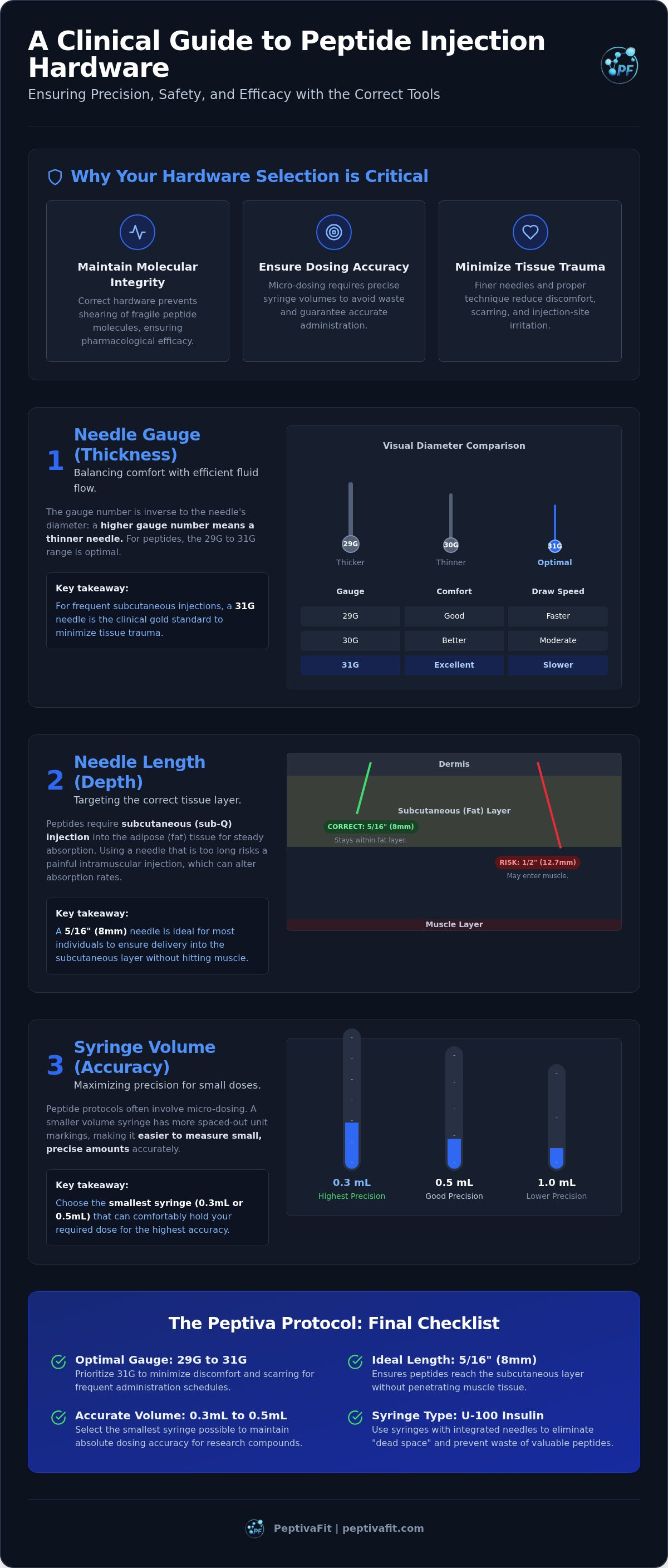
Needle gauge refers to the outer diameter of the shaft and follows an inverse numerical scale. As the gauge number increases, the physical diameter of the needle decreases. For researchers determining what size needle for peptide injections, this relationship is the primary factor in balancing tissue displacement with fluid dynamics. Most aqueous peptide solutions are best served by a range of 29G to 31G. While the CDC guidelines on subcutaneous injection often reference 23 to 25 gauge for general vaccinations, the micro-volume nature of peptide research allows for much finer instrumentation. Selecting the right gauge requires a disciplined understanding of how the fluid moves through the lumen.
31 Gauge: The Standard for Minimal Tissue Trauma
A 31G needle has an approximate diameter of 0.25mm. This ultra-fine specification is the clinical gold standard for protocols requiring daily or frequent administration. Its primary benefit is the significant reduction in nerve ending stimulation and subsequent scarring. However, the trade-off is draw speed. Because the internal lumen is so narrow, pulling fluid from a multi-dose vial requires patience and precise pressure management to avoid creating a vacuum. For those following the Peptiva Protocol, the precision of a 31G needle ensures that the administration remains a disciplined, nearly imperceptible process.
29G and 30G: When to Opt for a Slightly Thicker Needle
There are specific investigative scenarios where a 29G or 30G needle is superior. A 29G needle offers greater structural integrity, which is useful when piercing thicker rubber stoppers on large multi-dose vials. If a peptide has been reconstituted with a higher concentration of bacteriostatic water or if the compound itself increases the viscosity of the solution, a 31G needle may lead to excessive resistance during the plunger depression. This resistance can cause unstable administration, leading to more tissue trauma than the slightly larger 29G needle would. Researchers often find that a 29G needle provides a more reliable flow for larger volume reconstitutions.
The fluid dynamics within the needle lumen are governed by Poiseuille's Law, where the flow rate is highly sensitive to the radius of the tube. A 31G needle increases the pressure required to move the peptide through the shaft. If the injection is performed too quickly with an ultra-fine needle, the resulting turbulence can affect the molecular stability of sensitive chains. Therefore, a deliberate, slow depression of the plunger is mandatory when using higher gauges. To ensure your hardware matches your specific metabolic goals, a personalized medical assessment can provide the necessary clarity on tool selection for your unique protocol.
Needle Length and Injection Depth: 5/16 vs 1/2 Inch
Selecting the correct needle length is a clinical imperative for ensuring that peptide compounds are deposited accurately within the subcutaneous adipose layer. While gauge determines flow dynamics, length determines the precise depth of delivery. For those evaluating what size needle for peptide injections, the choice typically resides between 8mm (5/16 inch) and 12.7mm (1/2 inch) specifications. The objective is to penetrate the dermis and reach the fatty tissue while avoiding the underlying muscle fascia. Piercing the muscle layer can lead to unintended rapid absorption, which disrupts the steady-state pharmacokinetics required for metabolic optimization.
Body composition serves as the primary variable in this technical decision. A needle that's too short may result in an intradermal injection, which can cause localized irritation or a visible "wheal" on the skin. Conversely, a needle that's too long increases the risk of intramuscular delivery, particularly in leaner individuals. The angle of insertion also shifts based on the hardware; shorter needles are generally inserted at a 90-degree angle, while longer needles may require a 45-degree angle to remain within the subcutaneous space. Mastery of these depths is a core component of the Peptiva Protocol.
The 5/16 Inch (8mm) Standard
The 8mm needle has emerged as the modern standard for the majority of fat loss peptide protocols. Its length is sufficient to reach the adipose tissue in most adults without the risk of over-penetration. Because it's shorter, it allows for a direct, 90-degree entry that often eliminates the need for the "skin pinch" technique. This simplicity supports a more disciplined and consistent administration routine. Leaner researchers or those targeting areas with minimal fat coverage find that the 5/16 inch specification provides the most reliable depth control. It's the primary recommendation for maintaining tissue integrity over long-term investigative cycles.
The 1/2 Inch (12.7mm) Alternative
While less common for modern subcutaneous administration, the 12.7mm needle remains a necessary alternative for specific demographics. Individuals with higher levels of adiposity may require this extra length to ensure the peptide isn't trapped in the dermal layers. However, using a 1/2 inch needle requires a more advanced "pinch and poke" technique. By lifting a fold of skin, you create a deeper target area of fat and move it away from the muscle. This manual adjustment is critical for safety; without it, the 1/2 inch needle is far more likely to strike the muscle. Clinical considerations for what size needle for peptide injections should be refined during a personalized medical assessment to ensure your technique aligns with your physiological profile.
Syringe Volume and Measurement Precision for Small-Dose Peptides
While the technical specifications of what size needle for peptide injections are paramount, the volumetric capacity of the syringe barrel is equally critical for pharmacological precision. The relationship between the barrel diameter and the graduation markings directly influences the margin of error in micro-dosing protocols. A common clinical oversight is the assumption that a 1.0mL syringe is interchangeable with a 0.3mL syringe for all doses. In reality, the wider barrel of a 100-unit syringe makes small increments, such as 2 or 5 units, exceptionally difficult to visualize, which increases the risk of dosing variance.
A significant technical consideration often overlooked in mass-market advice is "dead space." This refers to the residual volume left in the syringe after the plunger is fully depressed. In standard syringes with detachable needles, this space can trap 0.05mL to 0.1mL of fluid. When utilizing expensive, lab-tested peptides, this waste is unacceptable. Professional protocols mandate integrated-needle syringes. These utilize a "low dead space" design to ensure that the entire measured dose is delivered, preserving the molecular integrity of the compound and the financial investment of the researcher.
The 0.3mL (30-Unit) Syringe: The Precision Gold Standard
The 0.3mL syringe is the definitive choice for any protocol requiring doses under 20 units. Its narrower barrel allows the graduation markings to be spaced further apart, providing superior visibility. Many high-precision 0.3mL syringes include half-unit markings, which are essential for the minute adjustments often required in metabolic optimization. This level of detail is particularly important once you have mastered How to Reconstitute Peptides, as the concentration of your solution will dictate the physical volume drawn. Using a 30-unit syringe for small volumes reduces the likelihood of parallax error during measurement.
1.0ML (100-Unit) Syringes: When Volume Trumps Precision
A 1.0mL syringe is appropriate only when the protocol requires larger volumes of diluent or when stacking multiple compounds in a single administration. The increased barrel width means that a single unit occupies a much smaller vertical space than it does on a 0.3mL syringe. This compression makes it easier to misread the dose by 2 or 3 units, which is a significant error when dealing with high-potency research compounds. To maintain absolute accuracy, researchers should avoid switching between syringe sizes without a disciplined recalibration of their visual measurement. For those seeking to eliminate these technical variables, a personalized medical assessment can define the exact hardware specifications required for your fat loss journey.
The Peptiva Selection Framework: Implementing Professional Standards
The Peptiva Protocol treats hardware selection as a critical variable in metabolic optimization rather than a secondary concern. Technical precision in administration ensures that the bioactivity of your compounds is preserved from the moment of reconstitution to systemic absorption. When determining what size needle for peptide injections, the decision must be integrated into a broader investigative framework that prioritizes safety and data-driven results. Utilizing lab-tested peptides is essential; high-purity compounds ensure that the solution remains free of particulate matter that could otherwise obstruct the narrow lumen of a 31-gauge needle. This consistency allows for a predictable flow rate, which is necessary for maintaining a disciplined administration schedule.
A professional-grade approach requires more than just the correct tools; it demands a rigorous environment. Sourcing clinical-grade supplies is the final step in securing your research environment. Inferior hardware often suffers from inconsistent bevel sharpness or structural weaknesses that can lead to increased tissue trauma. By adhering to the standards set within our framework, you ensure that every variable is controlled, allowing your metabolic progress to be tracked with absolute clarity. Professionalism in peptide therapy is defined by this level of attention to technical detail.
Hardware and the Peptiva Protocol
Maintaining a sterile field is a non-negotiable prerequisite for any administration. This includes the use of medical-grade swabs and the systematic rotation of injection sites to prevent the development of lipohypertrophy. Consistent hardware selection allows you to isolate variables when tracking your body's response to different sequences. For a deeper understanding of how these mechanical choices influence your results, refer to our Comprehensive Fat Loss Peptide Guide. This resource outlines the intersection of delivery mechanics and metabolic signaling.
Consultation and Customization
Your hardware requirements will likely shift as your body composition evolves. As you reduce adipose tissue, the necessity for an 8mm needle may transition toward shorter specifications to avoid the underlying muscle. These nuances are best addressed during a single consultation call, where your specific physiological profile can be evaluated. A personalized medical assessment provides the final word on your technique, ensuring that your choice of what size needle for peptide injections remains optimal for your current state. Before beginning any protocol, ensure you have verified the following safety parameters:
- Verification: Confirm the certificate of analysis (COA) for your lab-tested peptides.
- Integrity: Inspect the syringe packaging for any breach of the sterile seal.
- Precision: Cross-reference your intended dose with the syringe volume to ensure maximum graduation visibility.
- Disposal: Ensure a puncture-resistant sharps container is available for immediate post-administration use.
Implementing these professional standards transforms peptide administration from a task into a disciplined clinical process. Taking personal responsibility for these technical specifications is the hallmark of a serious researcher committed to long-term performance optimization.
Mastering the Mechanics of Precision Administration
Success in peptide therapy depends as much on the delivery mechanism as it does on the compound itself. Selecting the optimal 29G to 31G needle and matching its length to your specific body composition ensures that your research remains accurate and free from tissue trauma. Determining what size needle for peptide injections is a foundational step in any disciplined investigative protocol. By utilizing 0.3mL syringes with integrated needles, you eliminate the risk of dead space waste and maintain the absolute dosing accuracy required for metabolic optimization.
Professional-grade results require a commitment to clinical standards and high-purity tools. You've invested in your wellness; your administration technique should reflect that same level of responsibility. Optimize your fat loss journey with The Peptiva Protocol to access lab-verified peptide purity and expert medical oversight. This data-driven approach provides the sophisticated control necessary to achieve your performance goals. With the right hardware and a disciplined framework, you're prepared to manage your optimization journey with total confidence and clinical precision.
Frequently Asked Questions
Is a 31 gauge needle thinner than a 29 gauge needle?
Yes, a 31 gauge needle is significantly thinner than a 29 gauge needle. The gauge system follows an inverse numerical scale where higher numbers designate a smaller outer diameter. While a 29G needle measures approximately 0.33mm, the 31G specification is reduced to roughly 0.25mm. This reduction in diameter is essential for minimizing tissue trauma during frequent administration protocols. Choosing the higher gauge is a disciplined approach to preserving skin integrity over long-term investigative cycles.
Can I reuse the same needle for multiple peptide injections?
No, you must never reuse a needle for multiple peptide injections. Each administration requires a sterile, single-use instrument to maintain the integrity of the research site. Reusing needles leads to immediate blunting of the bevel, which increases tissue tearing and the risk of localized scarring. Additionally, the risk of infection, though statistically low at under 0.5% with proper technique, increases significantly when sterile protocols are compromised. Always prioritize safety and precision by discarding hardware after one use.
What is the best needle length for a lean individual?
For lean individuals, the 5/16 inch (8mm) needle is the standard clinical recommendation. This length ensures the compound reaches the subcutaneous adipose layer without penetrating the underlying muscle fascia. In cases of extremely low body fat, a 4mm or 6mm needle may be utilized to further reduce the risk of intramuscular delivery. Mastery of depth is critical for ensuring steady-state pharmacokinetics. If you are unsure what size needle for peptide injections matches your current body composition, a medical assessment is advised.
How do I convert units on an insulin syringe to milliliters?
On a standard U-100 insulin syringe, 100 units is equal to exactly 1.0 milliliter (mL). Therefore, each individual unit represents 0.01mL of fluid volume. For a 10-unit dose, you are administering 0.1mL. It is vital to distinguish between units of volume and milligrams of the actual peptide compound. Dosing accuracy depends on your reconstitution math. Using a 0.3mL syringe often provides the best visibility for these micro-volume conversions, ensuring your investigative data remains precise and reliable.
Will a 31G needle work for all types of peptides?
A 31G needle is suitable for the vast majority of aqueous peptide solutions, though it may not be optimal for all types. High-viscosity compounds or those reconstituted in larger volumes of bacteriostatic water can create excessive resistance within the narrow lumen. In these specific scenarios, a 29G needle provides better flow dynamics and structural integrity. Determining what size needle for peptide injections requires matching the hardware to the specific viscosity of your lab-tested peptides to ensure consistent administration.
What happens if I accidentally inject a peptide into the muscle?
Accidental intramuscular injection typically results in a more rapid systemic uptake than intended. This can disrupt the controlled, steady release provided by the subcutaneous adipose layer, potentially leading to a pharmacokinetic spike. While usually not a medical emergency, it may increase localized soreness or irritation at the site. Consistent depth control is a hallmark of professional-grade administration. Using the "pinch and poke" technique with 1/2 inch needles helps mitigate this risk for those with variable body fat levels.
What is a low dead space syringe and do I need one?
A low dead space syringe features an integrated needle designed to minimize the residual fluid left in the barrel after the plunger is fully depressed. Standard syringes with detachable needles can trap up to 0.1mL of solution, leading to significant loss of expensive research material. For those utilizing high-purity, lab-tested peptides, a low dead space design is a clinical necessity. It ensures absolute dosing accuracy and prevents the waste of active compounds, maintaining the economic and scientific integrity of your protocol.
Can I buy peptide needles without a prescription in the US?
In the United States, 48 states allow the purchase of syringes without a prescription, though specific regulations vary by jurisdiction. Delaware and Tennessee currently require a prescription for all sales. Other states, such as Connecticut and New Jersey, permit over-the-counter purchases but limit the quantity to 10 or fewer. Even in states where it is legal, individual pharmacy policies may still demand a prescription. It is your responsibility to verify the local compliance mandates in your specific region before sourcing administration tools.

![Shelf Life of Reconstituted Peptides: A Clinical Reference Guide [2026]](https://getautoseo.com/storage/hero_images/shelf-life-of-reconstituted-peptides-a-clinical-reference-guide-2026.jpg?v=b8ed5173acaa)
