
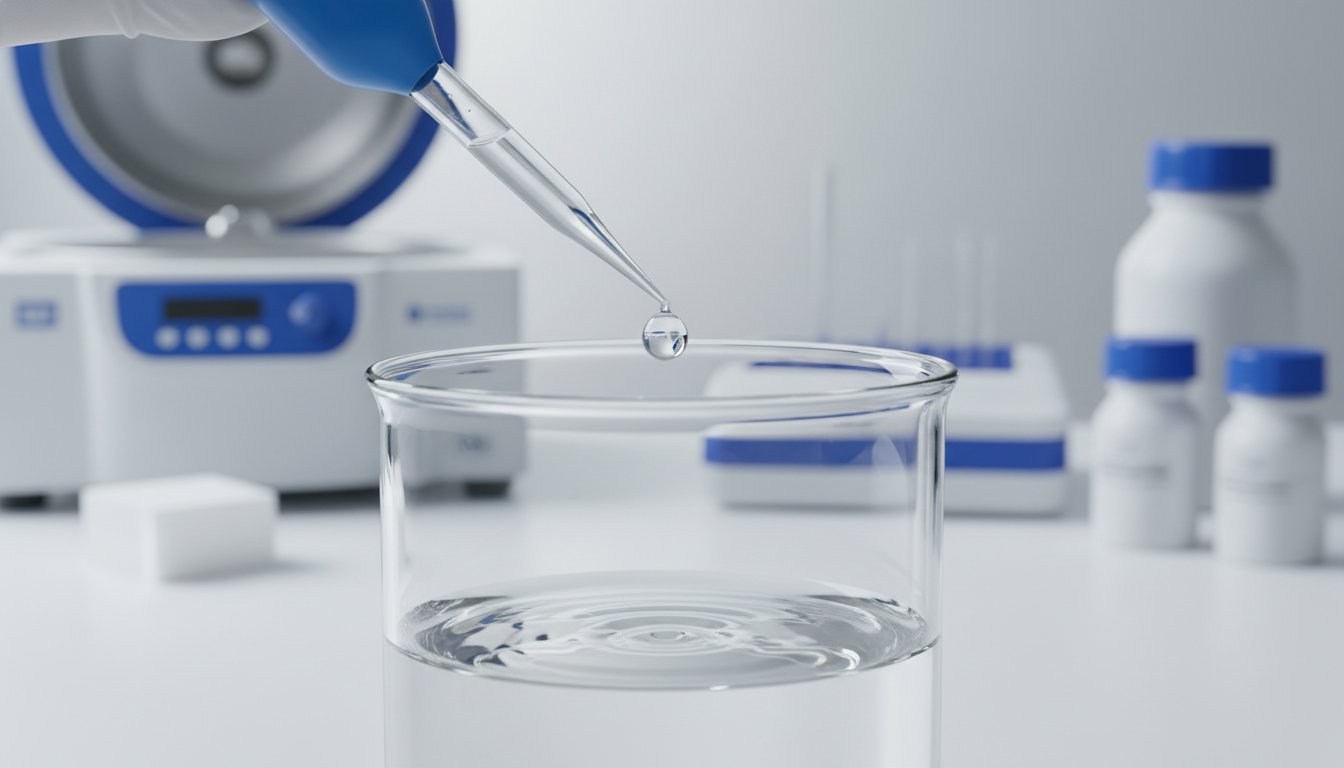
Relying on a standard dropper for high-stakes research protocols is a calculated risk that frequently introduces a 25% margin of error into your datasets. While the common pharmaceutical convention states there are 20 drops in 1 milliliter, this figure is a baseline rather than a universal constant. In a clinical environment, the question of how many drops are in 1 milliliter depends entirely on the intersection of surface tension and orifice diameter. You've likely experienced the frustration of wasted materials or inconsistent results when a solution's viscosity deviates from that of distilled water. Accurate measurement is the backbone of any successful protocol, yet the ambiguity of fluid dynamics often creates unnecessary variables.
This 2026 clinical reference is designed to help you master the science of volumetric precision so you can ensure accurate dosage and reconstitution in every application. You'll gain a definitive understanding of the 20-drop standard while learning how to adjust your measurements based on specific fluid properties. We'll also evaluate the professional tools, such as calibrated oral syringes and fine-tip droppers, that elevate your practice from mere estimation to laboratory-grade accuracy.
Key Takeaways
- Understand the pharmaceutical baseline where 1 mL of distilled water equals 20 drops while recognizing why this standard often fails in high-precision research environments.
- Identify how physical variables, such as liquid viscosity and dropper orifice diameter, dictate exactly how many drops are in 1 milliliter for non-aqueous solutions.
- Transition from approximate measurements to clinical-grade accuracy by utilizing micropipettes and insulin syringes for superior volumetric control in laboratory settings.
- Protect your research materials by mastering reconstitution protocols that prevent excess volume from compromising peptide stability and long-term potency.
- Leverage professional vetting and personalized medical assessments to eliminate the variables that lead to common dosing errors in performance optimization.
The Pharmaceutical Standard: Defining the 20-Drop Rule
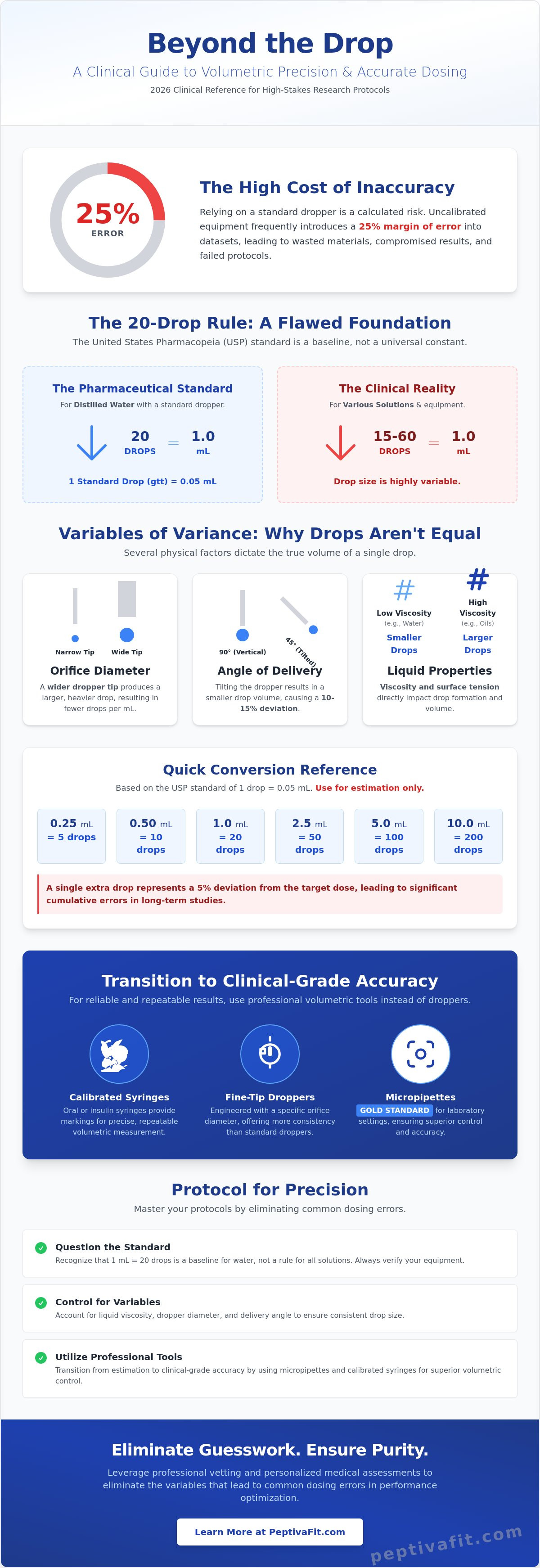
The foundation of liquid measurement in clinical settings rests upon the United States Pharmacopeia (USP) guidelines. This regulatory body established that a standard calibrated dropper, when held vertically, should deliver 20 drops of distilled water to equal a volume of 1 milliliter. To understand The Pharmaceutical Standard: Defining the 20-Drop Rule, one must recognize it as a historical compromise intended to unify apothecary practices. Historically, the medical community adopted this baseline to provide a predictable, albeit approximate, method for administering liquid medications. Each standard drop, abbreviated as "gtt" from the Latin gutta, is mathematically defined as 0.05 milliliters.
While this rule provides a starting point, researchers must distinguish between these theoretical standard drops and manufacturer-specific drops. A dropper provided with a specific reagent may be engineered to a different orifice diameter, altering the volume of each individual drop. If you're calculating how many drops are in 1 milliliter for a precision protocol, relying solely on the 20-drop rule without verifying your equipment's calibration introduces a significant risk of data contamination. This is why professional laboratory environments prioritize volumetric measurement over manual counting to maintain the integrity of their findings.
The Mathematical Conversion Table
For quick reference in a controlled environment, you can use the following conversions based on the 0.05 mL per drop standard. To perform a manual conversion, multiply your desired volume in milliliters by 20 to find the total drop count. However, you should use this as a guideline rather than a definitive measurement tool.
- 0.25 mL: 5 drops
- 0.50 mL: 10 drops
- 1.0 mL: 20 drops
- 2.5 mL: 50 drops
- 5.0 mL: 100 drops
- 10.0 mL: 200 drops
Rounding up in research settings can lead to significant cumulative errors. A single extra drop represents a 5% deviation from the target dose. In long-form longitudinal studies, these small variances compound into data points that no longer reflect the original hypothesis. Precision requires adherence to the exact volume rather than convenience-based rounding.
When the Standard Fails: The Margin of Error
The 20-drop rule is frequently inaccurate when applied to real-world laboratory equipment. Analysis shows that uncalibrated droppers can vary from 15 to 60 drops per mL depending on the tip's construction. Volume-based dosing is inherently more stable than count-based dosing. It eliminates the variables of tip angle and surface tension that plague manual counts. You must also account for drop-size drift over the course of a 30-day research protocol. As the liquid level in a container drops, changes in air pressure and residue buildup at the orifice can subtly alter the volume of each drop. This leads to inconsistent results in the final stages of your study if you don't calibrate your instruments regularly.
Variables of Variance: Why Drops Are Not Created Equal
The assumption that a drop is a fixed unit of volume ignores the fundamental principles of fluid mechanics. When determining how many drops are in 1 milliliter, the physical architecture of the delivery device is the primary determinant. Orifice diameter, specifically the external diameter of the dropper tip, dictates the surface area available for a drop to cling to before gravity overcomes its cohesive forces. A wider tip produces a larger, heavier drop, while a narrow tip yields a smaller volume. This mechanical variance is why a laboratory-grade dropper and a standard glass pipette rarely produce identical results.
The angle of delivery further complicates this calculation. Holding a dropper at a 90-degree vertical angle ensures the drop detaches precisely when its weight exceeds the surface tension. If you tilt the device to 45 degrees, the liquid spreads across the side of the tip, typically resulting in a smaller drop volume. This inconsistency can lead to a 10% to 15% deviation in total volume across a single milliliter of solution. For researchers seeking informed performance optimization, these minor mechanical shifts can compromise the integrity of a curated protocol.
Viscosity and surface tension are the internal forces that define liquid behavior. High-viscosity liquids, such as carrier oils or glycerin-based solutions, resist flow and form larger, bulbous drops. Conversely, alcohol-based carriers have low surface tension, causing them to detach from the tip much sooner, resulting in more drops per milliliter. Because of these factors, the question of how many drops are in 1 milliliter can yield answers ranging from 15 to 60 depending on the substance being measured.
Fluid Dynamics in Research Reconstitution
Reconstitution introduces new variables into your workflow. The drop size of bacteriostatic water for peptides changes once it's mixed with lyophilized powder. The resulting solution often has a higher density, which can alter the drop count required for accurate dosing. Temperature also plays a role; as a liquid warms, its density decreases, often leading to smaller drop sizes. You should also watch for the "First Drop" phenomenon. The initial drop from a dropper often contains air bubbles or residual pressure, making its volume inconsistent compared to subsequent drops in the sequence.
Environmental Impacts on Dosing
External factors like atmospheric pressure and humidity subtly influence volumetric precision. In high-altitude environments, lower pressure can affect the rate of drop detachment. Humidity is equally critical during slow, drop-by-drop titration. In dry environments, evaporation occurs at the tip before the drop even falls, concentrating the solution and skewing the total volume. Clinical environments prioritize climate-controlled storage to mitigate these risks, ensuring that measurements remain repeatable across different research sessions.
Beyond the Dropper: Measuring for Clinical Precision
While understanding how many drops are in 1 milliliter provides a conceptual baseline, it's rarely sufficient for rigorous laboratory research purposes. The transition from counting drops to using volumetric instruments marks the shift from estimation to clinical-grade accuracy. Micropipettes represent the gold standard in professional settings, offering accuracy within 0.1% of the target volume. These devices allow you to bypass the physics of surface tension entirely by using mechanical pistons to displace exact microliter quantities. If your protocol requires a high degree of repeatability, relying on the 20-drop pharmaceutical standard is a liability you can't afford.
For researchers who don't have access to micropipettes, insulin syringes serve as a superior volumetric alternative. These tools operate on a CC (cubic centimeter) or Unit scale, where 100 units typically equal 1.0 milliliter. Because the barrel of a syringe is calibrated to a fixed internal volume, it eliminates the "drop-size drift" caused by varying orifice diameters or delivery angles. You're no longer guessing how many drops are in 1 milliliter; you're measuring the fluid mass directly against a physical scale. This precision is vital when tracking performance metrics over a multi-week study, as it ensures the concentration of the solution remains constant across every session.
Transitioning to a "milligrams per milliliter" (mg/mL) framework is the final step in professional-grade tracking. This approach requires you to calibrate your measuring tools before beginning a new protocol. You can verify your equipment by using a high-precision digital scale; 1.0 mL of distilled water should weigh exactly 1.0 gram at room temperature. If your syringe or dropper deviates from this weight, you must adjust your calculations to compensate for the hardware's specific margin of error. This disciplined verification process is what separates curated research from anecdotal observation.
The Role of the Reconstitution Calculator
Digital tools provide an essential safeguard against the human calculation errors that frequently plague manual dosing. Utilizing a peptide reconstitution calculator allows you to input total volume and desired concentration to receive an exact measurement protocol. These tools eliminate the guesswork of drop-based dosing by providing clear, unit-based instructions. This is especially critical when working with high-value research materials where a single mathematical oversight can lead to the total loss of the sample's stability.
Professional Measuring Equipment
Stock solutions require specialized glassware to maintain volumetric integrity. Graduated cylinders are suitable for general measurements, but volumetric flasks are necessary when you need to reach a specific total volume with maximum precision. To minimize material loss, use low-retention pipette tips which are engineered to prevent liquid from clinging to the plastic walls. When drawing liquid into a syringe or pipette, always keep the tip fully submerged to avoid air bubbles, as even a small pocket of air will displace enough liquid to skew your final concentration.
Practical Application: Dosing and Reconstitution Safety
In advanced laboratory research, the margin for error is razor-thin. When utilizing lab tested peptides, precise measurement becomes a prerequisite for maintaining molecular integrity. The question of how many drops are in 1 milliliter takes on a new level of importance during the reconstitution phase. If you introduce excess volume, you risk "over-reconstitution." This excessive dilution can compromise the peptide's stability, leading to rapid degradation and skewed research outcomes. Maintaining a strict volumetric ratio ensures that the chemical bonds remain stable throughout the study's duration.
One often overlooked variable in these protocols is "Dead Space" volume. This refers to the 0.03 mL to 0.1 mL of liquid that remains trapped in the needle hub or the dropper tip after the plunger is fully depressed. When your protocol relies on counting drops, this hidden volume can result in an 8% under-delivery of the active compound. Professional researchers account for this by using low-dead-space syringes or by factoring this constant into their initial calculations. To ensure your research remains compliant with 2026 clinical standards, you must adopt rigorous Standard Operating Procedures (SOPs) that document every milliliter utilized. For those committed to the highest standards of accuracy, access our curated performance tracking tools to eliminate measurement variance.
Titration Protocols for Advanced Research
Micro-dosing requires a level of precision that manual drop counting cannot reliably provide. The methodology involves scaling a protocol from a 1 mL stock solution to larger volumes without losing concentration accuracy. Drop-precision is often the limiting factor here. A single extra drop in a small-volume titration can increase the dose by 5% or more. Maintaining a clinical log is essential for tracking volume, the specific date of reconstitution, and the type of fluid used. This documentation allows you to identify trends and adjust your protocols based on hard data rather than intuition.
Safety and Contamination Prevention
Purity is the cornerstone of effective research. Cross-contamination occurs easily when multi-use droppers or syringes are handled without discipline. The "One Tool, One Liquid" rule is a mandatory protocol in clinical settings. You must never introduce a used measuring tool back into a stock solution. This ensures that every measurement remains free from exogenous contaminants. Proper disposal protocols for used tools are equally critical; you should treat them as biohazardous material to maintain the safety and sterility of the laboratory environment.
The Peptiva Perspective on Informed Dosing
PeptivaFit operates on the principle that informed decision-making requires absolute data integrity. While many researchers begin their journey by asking how many drops are in 1 milliliter, our approach moves beyond simple arithmetic to embrace a disciplined, laboratory-grade methodology. We integrate strict volumetric precision into every fat loss peptide guide we curate. This ensures that your metabolic optimization is built on a foundation of reproducible facts rather than anecdotal estimates. Guesswork has no place in a high-performance protocol. By adopting a clinical register for your measurements, you secure a level of sophisticated control that separates elite research from standard fitness advice.
The value of professional oversight can't be overstated when navigating the complexities of peptide education. Personalized medical assessments act as a critical safeguard against the dosing errors that frequently derail unguided research. It's a common mistake to assume that all liquids behave identically. High-grade supplies require a matching high-grade methodology to be effective. We view education as a form of empowerment, transitioning our clientele from a state of uncertainty to a state of data-driven confidence. When you understand exactly how many drops are in 1 milliliter for your specific solution, you eliminate the variables that compromise your results.
Professional Coaching for Protocol Execution
Our 1-on-1 coaching services provide a pragmatic mentor to help you navigate the technical hurdles of measurement and reconstitution. Troubleshooting these variables in real-time prevents the waste of high-value research materials. We specialize in customizing protocols based on your unique metabolic data and safety profile, ensuring that every milliliter used is accounted for. This commitment to clinical standards reflects our role as a serious guide in the biohacking space. We expect a high level of personal responsibility from our clientele, and we provide the technical framework necessary to meet that standard.
Next Steps for Your Research Journey
Mastering the basics of liquid measurement is merely the first step toward advanced metabolic optimization. As you move from foundational knowledge to more complex protocols, the need for precision only intensifies. You can access our private, curated research materials and expert-led protocols to further refine your approach. This transition requires a shift in mindset where tracking becomes a daily discipline. Final mandate: precision is the prerequisite for performance. Without it, you aren't conducting research; you're simply guessing.
Advancing Toward Laboratory-Grade Accuracy
Transitioning from simple estimation to clinical precision represents the final stage of protocol maturity. While the pharmaceutical standard offers a conceptual answer to how many drops are in 1 milliliter, your research demands a more rigorous methodology. You've identified that liquid viscosity, orifice diameter, and delivery angle create a margin of error that can reach 25% if left uncalibrated. Replacing manual drop counts with calibrated syringes or micropipettes ensures your data remains untainted by volumetric drift.
Success in performance optimization depends on the intersection of high-grade materials and disciplined execution. PeptivaFit provides the necessary infrastructure for this level of control through lab-verified peptide standards and personalized medical oversight. By adopting a data-driven metabolic optimization framework, you eliminate the variables that compromise research outcomes. Access the Peptiva Protocol for Professional Fat Loss Guidance to refine your methodology and secure superior results. Your commitment to precision is the foundation of your future success.
Frequently Asked Questions
Is the 20-drop per 1 mL rule universal for all liquids?
No, the 20-drop standard is a pharmaceutical baseline specifically calibrated for distilled water at room temperature. Different liquids possess unique surface tensions and densities that alter drop formation. For example, high-viscosity carrier oils often yield only 12 to 15 drops per milliliter, while ethanol-based solutions can produce more than 30 drops within the same volume.
What is the most accurate way to measure 0.1 mL of a peptide solution?
The most reliable method is using a calibrated 0.3 mL or 0.5 mL insulin syringe or a professional micropipette. These instruments utilize a fixed internal barrel volume that eliminates the physics-based variables of drop counting. On a standard U-100 syringe, the 10-unit mark represents exactly 0.1 mL, providing a level of precision that manual droppers cannot replicate.
How do I know if my dropper is calibrated to the 20-drop standard?
You can verify your equipment by using a digital scale with 0.01g sensitivity. Dispense exactly 20 drops of distilled water onto the scale; the final weight should be 1.00 gram at a temperature of 20 degrees Celsius. If your measurement deviates by more than 0.05 grams, your dropper isn't calibrated to the USP standard and shouldn't be used for high-precision protocols.
Does the temperature of the bacteriostatic water change how many drops are in a milliliter?
Yes, temperature fluctuations directly influence liquid density and surface tension. As the temperature of bacteriostatic water rises, its surface tension decreases, which typically results in smaller individual drops and a higher drop count per milliliter. Clinical environments maintain research materials at a constant 2 to 8 degrees Celsius to ensure that the question of how many drops are in 1 milliliter remains consistent across every session.
Can I use a standard kitchen measuring spoon for research dosing?
No, kitchen measuring tools are manufactured with a margin of error that often exceeds 15%, making them unsuitable for laboratory research purposes. A standard teaspoon is approximately 4.93 mL, but its lack of calibration prevents it from providing the volumetric integrity required for peptide reconstitution. Precision research requires tools with clear, clinical-grade graduations.
What happens if I accidentally add too many drops during reconstitution?
Adding excess volume leads to over-reconstitution, which can compromise the molecular stability of the lyophilized compound. This error dilutes the concentration, forcing you to recalculate your entire dosing protocol to avoid under-dosing. If the volume exceeds the vial's safety limits, the increased internal pressure may compromise the rubber stopper's seal and introduce exogenous contaminants.
Why do different droppers produce different sized drops for the same liquid?
Drop size is determined by the external diameter of the dropper tip rather than the liquid alone. A wider orifice provides more surface area for the liquid to cling to, requiring more mass to accumulate before gravity overcomes the surface tension. This is why a glass pipette and a plastic dropper will yield different answers when calculating how many drops are in 1 milliliter of the same solution.
How can I convert milligrams to drops accurately?
You must first establish the concentration of your solution in milligrams per milliliter (mg/mL). Divide the total mg per mL by the number of drops your specific calibrated dropper delivers per milliliter. For a 10mg/mL solution using a 20-drop standard, each drop contains exactly 0.5 mg of the compound, provided the liquid's viscosity matches the dropper's calibration.

![Shelf Life of Reconstituted Peptides: A Clinical Reference Guide [2026]](https://getautoseo.com/storage/hero_images/shelf-life-of-reconstituted-peptides-a-clinical-reference-guide-2026.jpg?v=b8ed5173acaa)
