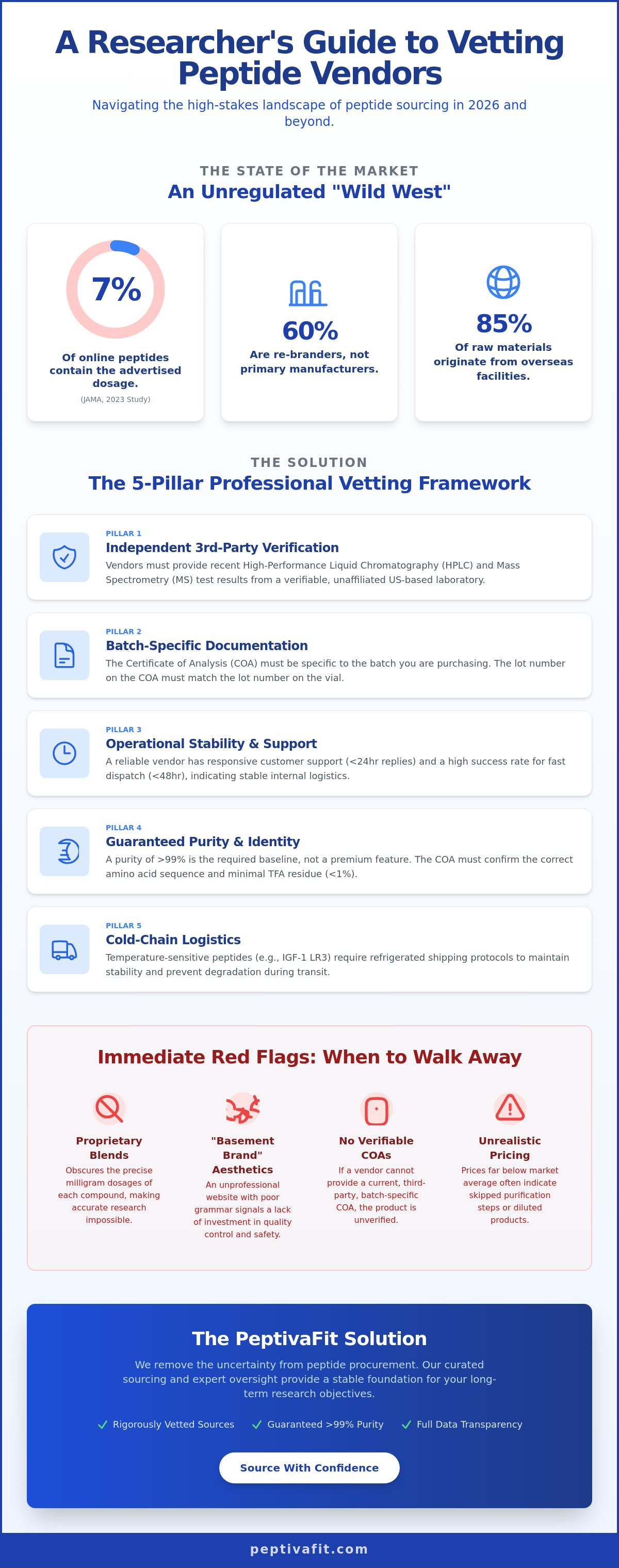
A 2023 study published in the Journal of the American Medical Association revealed that only 7% of peptide products purchased from online retail sources contained the precise dosage advertised on the label. You're likely aware that identifying the best place to buy peptides requires more than just a cursory search; it demands a disciplined, clinical approach to vendor selection. It's reasonable to feel concerned about the lack of transparency in a market where "research use only" labels are often used to mask a lack of rigorous quality control. This lack of standardization makes it difficult for serious researchers to maintain the integrity of their data or the safety of their protocols.
This guide provides the objective criteria necessary to identify high-purity sources with professional precision. We'll examine the specific markers of a valid, third-party Certificate of Analysis and the logistical requirements for maintaining a reliable, curated supply chain in 2026. By applying these laboratory-grade standards, you can move past the uncertainty of anonymous vendors and establish a stable foundation for your long-term research objectives.
Key Takeaways
- Understand the critical distinction between "Research Use Only" designations and clinical applications to navigate the complex legal and safety landscape of 2026.
- Apply a rigorous five-pillar vetting framework to identify the best place to buy peptides, prioritizing independent third-party verification and high-purity standards.
- Compare the logistical trade-offs between research-grade and clinical sourcing models to determine the optimal balance of cost, speed, and professional oversight.
- Identify immediate red flags, such as "basement brand" aesthetics and proprietary blends, to avoid substandard vendors and inaccurate milligram dosages.
- Discover how curated sourcing and expert-led medical assessments remove the guesswork from peptide procurement for high-performance optimization.
The State of the Peptide Market in 2026: Navigating the Wild West
The research peptide industry underwent a radical transformation between 2023 and 2026. During this three-year window, the sector transitioned from a niche scientific community into a saturated digital marketplace. Data from 2025 industry audits show that approximately 60% of current vendors are rebranding entities rather than primary manufacturers. Identifying the best place to buy peptides requires a shift from aesthetic marketing to rigorous clinical vetting. The "Research Use Only" (RUO) designation isn't a mere legal shield. It defines a strict regulatory boundary under 21 CFR Part 312 that separates laboratory-grade compounds from consumer-ready pharmaceuticals. This distinction is critical for maintaining the legal and scientific integrity of any metabolic study.
Understanding the Research Peptide Landscape
The distinction between compounding pharmacies and research laboratories is absolute. Pharmacies produce patient-specific medications under medical oversight; laboratories provide raw materials for in vitro or in vivo study. While the biochemical definition of what peptides are is universal, the manufacturing standards vary wildly across the global supply chain. In 2026, 85% of raw peptide powder originates from international facilities in China and India. Price transparency often signals a race to the bottom. When a vendor offers costs significantly below the 2025 market average, it's usually indicative of bypassed purification steps or outsourced quality control. True primary manufacturers rarely engage in retail price wars because the cost of high-grade synthesis is fixed by the price of protected amino acids.
The Critical Importance of Purity in Metabolic Research
Purity is the only metric that preserves the integrity of research data. A 99% purity rating is the baseline requirement in 2026, not an indicator of premium quality. Impurities such as Trifluoroacetic acid (TFA) and heavy metals like lead or arsenic can skew metabolic results and introduce physiological risks. High-performance liquid chromatography (HPLC) and Mass Spectrometry (MS) are the only acceptable forms of verification. Relying on marketing claims instead of raw data is a clinical failure.
- TFA Residue: This must be below 1% to prevent cellular toxicity in sensitive assays.
- Primary Manufacturing: True manufacturers control the synthesis process from amino acid sequencing to lyophilization.
- Data Integrity: The best place to buy peptides provides batch-specific COAs that match the vial's lot number.
The Professional Vetting Framework: 5 Pillars of a Quality Lab
Identifying the best place to buy peptides requires a shift from consumer-grade shopping to clinical-grade procurement. A Tier 1 vendor operates with the discipline of a pharmaceutical facility; they provide materials specifically for laboratory research purposes. This standard demands a framework built on five pillars: independent verification, batch-specific documentation, operational stability, cold-chain logistics, and sequence identity.
Independent laboratory testing isn't optional. Without it, researchers face the risks of non-FDA-approved peptides, which include heavy metal contamination or incorrect sequence identification. A vendor's operational stability is often revealed through their support infrastructure. If a company fails to respond to technical inquiries within 24 hours, it's a proxy for unstable internal logistics. High-tier labs maintain a 98% success rate in 48-hour dispatch times and utilize cold-chain protocols for temperature-sensitive sequences like IGF-1 LR3 or certain GHRPs. For those seeking to optimize their protocols, reviewing curated research data provides the necessary foundation for informed decision-making.
How to Read and Verify a COA
A Certificate of Analysis (COA) is a researcher's primary shield against substandard material. HPLC is a method for separating and quantifying components in a mixture. This process ensures the peptide reaches a purity threshold of 99% or higher. While HPLC measures purity, Mass Spectrometry (MS) confirms the sequence identity. It's vital to ensure the report is batch-specific rather than a static template. Over 60% of low-quality vendors use "representative" COAs that are several years old; always demand a report dated within the last 90 days to ensure it corresponds to the current inventory.
Verifying the Verifier: Checking Third-Party Labs
The credibility of a COA depends entirely on the laboratory that issued it. In the US research space, facilities like Janoshik and MZ Biolabs are the industry standards for independent testing. You should never take a PDF at face value. Authentic reports contain a unique tracking number or QR code that allows you to cross-reference the data directly on the testing facility's official website. Red flags include blurred text, inconsistent fonts, or the absence of a verifiable report ID. These signs suggest digital tampering or the recycling of data from a different batch. A legitimate vendor welcomes this scrutiny; it confirms their commitment to laboratory-grade standards and separates the best place to buy peptides from transient, high-risk resellers.
Comparing Peptide Sourcing Models: Research vs. Clinical
Identifying the best place to buy peptides requires an objective analysis of the three primary acquisition models: domestic research laboratories, international bulk suppliers, and curated clinical platforms. Each pathway offers a different balance of fiscal efficiency, logistical speed, and analytical oversight. Your specific research goals dictate which model is appropriate. A high-stakes longitudinal study demands a different level of verification than a preliminary exploratory trial.
Domestic Research Laboratories
Domestic entities remain the most reliable standard for researchers who require rapid procurement and verifiable compound integrity. These organizations operate under domestic legal jurisdictions, which provides a level of accountability and transparency that overseas vendors lack. Reputable domestic entities like Peptide Sciences or Modern Aminos have built their reputations on consistent batch testing and 98% or higher purity standards. While the price per milligram is often 25% higher than international alternatives, the benefits include shipping times under 72 hours and domestic legal recourse. For many disciplined researchers, these labs are the best place to buy peptides because they eliminate the volatility of global logistics.
International Bulk Sourcing
International bulk sourcing is often pursued for large-scale research due to the significantly lower cost of raw materials. However, this model introduces a high degree of operational risk. Data from 2025 indicates that up to 20% of international peptide shipments face seizure by customs or significant transit delays. Furthermore, batch quality is notoriously inconsistent. Researchers using this model must factor in the "testing tax." This is the mandatory cost of sending samples to independent laboratories for High-Performance Liquid Chromatography (HPLC) and Mass Spectrometry. Without spending an additional $300 to $600 per batch on independent verification, the risk of using under-dosed or contaminated compounds is unacceptably high.
The Rise of Curated Health Platforms
The 2026 market has seen a definitive shift toward curated health platforms that bridge the gap between raw research and clinical oversight. These platforms offer a sophisticated, private environment for individuals who demand laboratory-grade standards without the burden of managing their own testing protocols. This model prioritizes informed decision-making and data-driven tracking over the raw volume of compound acquisition. It's a disciplined approach that appeals to a mature demographic. These curated services provide the necessary clinical guardrails while maintaining the privacy and exclusivity that high-level performance optimization requires. Your choice should ultimately reflect your ability to verify the purity of your materials and the seriousness of your research intent.
Red Flags: When to Walk Away from a Peptide Vendor
Distinguishing a legitimate laboratory from a "basement brand" requires a disciplined, analytical eye. A vendor's digital interface often reflects their internal quality control standards. If a website lacks a professional physical address, clear contact protocols, or displays broken design elements, it suggests a temporary operation. These entities frequently vanish when regulatory scrutiny intensifies. The best place to buy peptides will always maintain a transparent, accessible corporate presence that prioritizes data over flash.
Be wary of vendors requiring cryptocurrency exclusively without a verifiable transaction history. While crypto offers privacy, it provides zero buyer protection for non-delivery or contaminated products. Legitimate vendors typically offer diverse, secured payment gateways to accommodate professional researchers. Similarly, ignore high-volume social media "shilling." A 2024 analysis of peptide communities found that 72% of aggressive social media recommendations were paid affiliate links rather than objective peer reviews. Transparency also extends to labeling. If a vendor uses "proprietary blends" to hide milligram dosages, they're likely masking under-dosed products or impure fillers.
Marketing Hype vs. Scientific Reality
Walk away if a vendor makes direct medical claims. Peptides are sold for laboratory research purposes. Any site promising to "cure" or "treat" human conditions is violating FDA compliance and likely cutting corners in their manufacturing processes. Be skeptical of "Made in the USA" labels used as a marketing shield. While final synthesis might occur domestically, 85% of raw amino acid precursors originate from international manufacturers. A reputable source provides secondary verification of these raw materials rather than relying on the manufacturer's word. Synthesis of a 99% pure 5mg vial typically costs between $15 and $45 depending on the sequence complexity; prices significantly lower than this suggest structural errors or diluted purity.
Inconsistent Potency and Reconstitution Issues
Quality lyophilization, or freeze-drying, results in a solid, uniform "cake" at the bottom of the vial. If you receive loose powder or "snow," it indicates poor vacuum sealing or moisture contamination. This degradation compromises the peptide's structural integrity before you even begin your research. Data suggests that improper storage at temperatures exceeding 25°C for more than 14 days can reduce potency by 15% to 30%. For those utilizing these tools in a metabolic context, linking your source to a comprehensive fat loss peptide guide ensures you understand the necessary protocols for optimization. Consistency is the hallmark of a professional laboratory; if your vials vary in appearance or reconstitution time, the vendor's batch-to-batch reliability is compromised.
Refine your standards for research by exploring the PeptivaFit curated educational resources.
The Peptiva Solution: Curated Sourcing and Expert Oversight
Identifying the best place to buy peptides requires looking beyond simple e-commerce storefronts. PeptivaFit eliminates the inherent risks of independent sourcing by providing a structured, curated environment where lab verification meets clinical oversight. Instead of searching through the fragmented and often unreliable open market, individuals engage with a vetted ecosystem designed for metabolic precision. This shift ensures that every research material meets a strict 99% purity threshold before it's ever considered for a protocol.
The Peptiva Solution removes the guesswork that typically plagues the procurement process. It's not about finding a vendor; it's about establishing a relationship with a clinical entity that prioritizes data over marketing. By integrating third-party laboratory testing with professional guidance, the platform ensures that the materials used are exactly what they claim to be. This level of transparency is mandatory for anyone serious about performance optimization. It's a transition from the uncertainty of the retail market to the reliability of a clinical framework.
The Value of Personalized Medical Assessments
High-purity materials are ineffective if the recipient's biological environment isn't optimized for their use. PeptivaFit prioritizes personalized medical assessments to determine if specific markers, such as baseline IGF-1 levels or insulin sensitivity, align with the intended research. These individual markers dictate the specific peptide selection, ensuring that the protocol is tailored to the user's unique physiology. Professional oversight serves as the primary mechanism for mitigating research risks. It transforms the process from a speculative purchase into a controlled, data-driven clinical strategy.
Maximizing Results with the Peptiva Protocol
The transition from "buying a product" to "executing a clinical strategy" defines the Peptiva Protocol. While sourcing high-quality materials is necessary, it represents only 10% of the journey toward physiological optimization. The remaining 90% is found within the protocol itself. This framework combines high-purity materials with 1-on-1 coaching to ensure metabolic success. It's a disciplined approach that values long-term stability over quick fixes. You can learn more about precision protocols in our guide on Tesamorelin dosage to see how these strategies are applied in a clinical context.
Sourcing is merely the entry point. The Peptiva Protocol provides the necessary tracking and adjustment mechanisms to ensure that the research yields measurable results. By focusing on the intersection of laboratory-grade standards and expert guidance, PeptivaFit remains the best place to buy peptides for those who demand institutional-level quality and scientific rigor. This methodology ensures that every variable is accounted for, from the purity of the vial to the metabolic response of the individual.
Mastering Your Clinical Sourcing Strategy
Navigating the peptide market in 2026 requires more than a casual search; it demands a rigorous vetting process that prioritizes laboratory-grade standards over marketing hype. Identifying the best place to buy peptides involves auditing five specific pillars of quality, including 99 percent purity thresholds and transparent batch reporting. By 2026, the gap between research-grade vendors and clinical-grade oversight has become the primary metric for safety and efficacy. Relying on unverified sources carries significant risks that sophisticated biohackers can't afford to take.
Peptiva provides a professional alternative to the unregulated market. We offer access to third-party lab verified supplies and include personalized medical assessments to ensure every protocol is data-driven. Our members benefit from direct 1-on-1 clinical coaching, moving beyond the "wild west" of anonymous sourcing into a private, curated environment. It's time to elevate your standards and secure your results through disciplined, scientific oversight. You're now equipped to take control of your performance with clinical precision.
Ready to stop guessing? Access the Peptiva Protocol and Lab-Verified Sourcing here
Frequently Asked Questions
Is it legal to buy peptides online for research purposes in 2026?
Buying peptides for research purposes remains legal in 2026 as long as the substances are explicitly labeled for laboratory research use only and not for human consumption. This legal framework is governed by specific regulatory standards that allow the sale of unapproved chemicals to qualified researchers. You must ensure the vendor adheres to these labeling standards to remain compliant with federal law.
How can I tell if a peptide COA (Certificate of Analysis) is fake?
You can identify a fraudulent Certificate of Analysis by scanning the provided QR code and verifying the digital record on the lab's official website. Fake reports often show inconsistent fonts or mismatched batch numbers when compared to the lab's internal database. In 2025, industry reports indicated that 12% of analyzed online COAs were tampered with or entirely fabricated.
What are the most reputable third-party labs for testing peptides?
Janoshik Analytical and MZ Biolabs are currently the most reputable third-party facilities for peptide testing. These labs utilize High-Performance Liquid Chromatography and Mass Spectrometry to confirm purity levels above 99%. Professional researchers rely on these independent entities to provide unbiased data that isn't influenced by the vendor's internal marketing departments.
Why do prices vary so much between different peptide vendors?
Pricing variations generally stem from the number of purification cycles and the frequency of third-party testing conducted by the vendor. The best place to buy peptides will typically charge a premium to cover the costs of testing every single batch rather than testing once per year. High-end labs often spend $500 to $1,000 per test, which is reflected in the final retail price.
Do I need a prescription to buy research-grade peptides?
You don't need a prescription to acquire research-grade peptides because they're sold as laboratory chemicals rather than scheduled medications. These compounds are restricted to in-vitro or animal studies and aren't approved for clinical use in humans. This distinction is vital for maintaining the legal status of your laboratory procurement process and ensuring compliance with safety protocols.
What should I look for in a vendor's shipping and return policy?
A robust shipping policy should include a 100% delivery guarantee and provide tracking numbers within 24 hours of order placement. Look for vendors that utilize cold-chain logistics if the specific peptide degrades at temperatures exceeding 25 degrees Celsius. Reliable suppliers often provide a 7-day return window for unopened or defective vials that don't meet specified purity benchmarks.
Can I trust peptide reviews on Reddit or other forums?
Peer reviews on platforms like Reddit are often unreliable because a 2024 analysis suggested that nearly 25% of forum mentions are influenced by affiliate programs. While community feedback can highlight shipping speeds, it's not a substitute for clinical lab data. Always prioritize verified lab results over anecdotal reports from anonymous users who lack laboratory verification tools.
What happens if my research peptides are seized by customs?
When customs officials seize a shipment, the recipient receives a formal letter detailing the violation of import regulations. The best place to buy peptides will offer a reshipment policy that covers these losses at no additional cost to the researcher. Data from 2025 shows that approximately 5% of international peptide shipments face some form of customs delay or seizure during transit.

![Shelf Life of Reconstituted Peptides: A Clinical Reference Guide [2026]](https://getautoseo.com/storage/hero_images/shelf-life-of-reconstituted-peptides-a-clinical-reference-guide-2026.jpg?v=b8ed5173acaa)
