
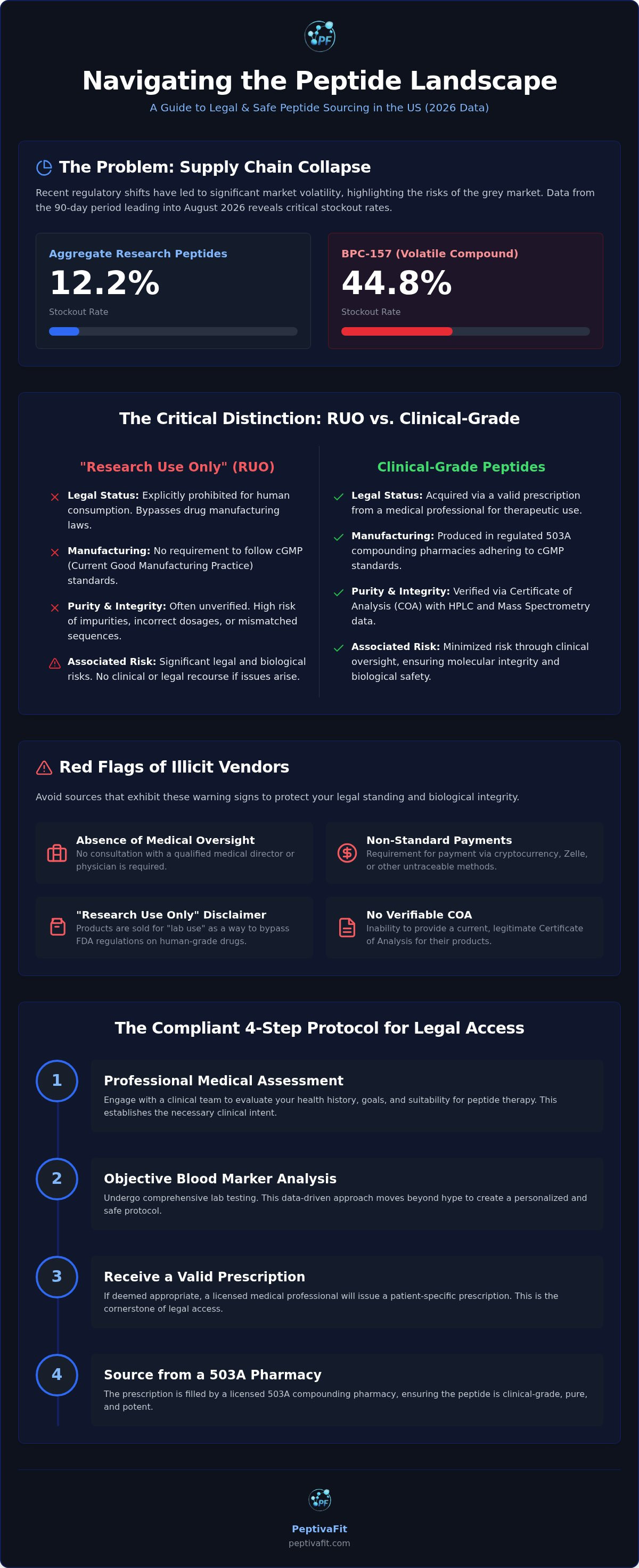
In the 90-day period leading into August 2026, the aggregate stockout rate for research-grade peptides hit 12.2 percent, while BPC-157 reached a volatile 44.8 percent. These figures represent more than just supply chain issues; they signal the collapse of the "research use only" loophole as regulatory scrutiny intensifies. If you've found yourself caught between suspicious grey-market vials and a desire for metabolic optimization, you're likely searching for the only sustainable path forward: a verified, legal way to buy peptides in the US that doesn't compromise your biological integrity.
It's frustrating to face a landscape where FDA pharmacy compounding recommendations and HHS policy shifts seem to change monthly. You deserve a protocol that prioritizes data over hype and safety over sensation. This guide provides the clinical clarity you need to move past the uncertainty of research chemicals and into a regulated framework of lab-verified sourcing. We'll examine the 2026 PCAC recommendations for compounds like TB-500 and Semax; clarify the essential role of medical oversight; and outline a disciplined strategy for securing high-grade peptide therapy within the current legal architecture.
Key Takeaways
- Distinguish between the FDA’s 2026 recommendations for pharmacy compounding and the legal vulnerabilities inherent in "research use only" chemicals.
- Establish a secure, legal way to buy peptides in the US by integrating clinical oversight with lab-verified sourcing protocols.
- Identify critical red flags for illicit vendors, including the absence of a medical director and the requirement for non-standard payment methods like cryptocurrency.
- Implement a disciplined framework for metabolic optimization based on objective blood markers and professional medical assessment.
- Access high-grade peptide therapy through a compliant, four-step process that ensures both molecular integrity and long-term biological safety.
The Regulatory Landscape of Peptides in the US (2026)
The classification of peptide therapeutics within the United States is governed by a strict binary: they are either regulated drugs or biologics. For the sophisticated individual seeking metabolic optimization, understanding this framework is the first step in identifying a legal way to buy peptides in the US. By August 2026, the regulatory environment has moved beyond the ambiguities of previous years. The FDA now maintains rigorous oversight over how these substances are manufactured, marketed, and administered.
Between 2023 and 2025, a series of enforcement actions narrowed the available supply chain. These shifts forced a consolidation of the market, leaving compounding pharmacies as the primary legal conduit for patient access. These pharmacies operate under 503A regulations; they can only provide peptides when a specific prescription exists for a specific patient. This ensures that the substances entering your system meet clinical standards for purity and potency. It's a system designed to eliminate the risks associated with unverified manufacturing.
FDA Oversight and the Category 2 List
The FDA Bulk Drug Substances list serves as the gatekeeper for what compounding pharmacies can legally produce. Peptides placed on the Category 2 list are restricted due to safety concerns or a lack of demonstrable efficacy. In July 2026, the Pharmacy Compounding Advisory Committee (PCAC) recommended that six key peptides, including BPC-157, TB-500, and MOTS-c, be added to the 503A bulks list. While this is a non-binding recommendation and the formal rulemaking process is ongoing, it signals a potential expansion of the legal supply chain. Conversely, research labs continue to sell these compounds under the "Research Use Only" (RUO) banner. This label is a legal necessity for labs to bypass drug manufacturing requirements. It explicitly prohibits human consumption, creating a clear boundary that users shouldn't cross if they value regulatory compliance.
The Legal Importance of Clinical Intent
Legality is defined by the intent of use. When you acquire peptides through a medical professional, the intent is therapeutic. This clinical context provides the necessary legal protection for both the prescriber and the patient. Bypassing this oversight by purchasing RUO chemicals for self-administration carries significant risks. In the event of a regulatory audit or medical complication, the absence of a verified prescription and a personalized medical assessment leaves the individual without legal or clinical recourse. Professional oversight isn't just a safety measure; it's the primary legal safeguard that distinguishes legitimate therapy from grey-market experimentation. Securing a legal way to buy peptides in the US requires a commitment to this disciplined, medically-led approach.
Research Chemicals vs. Clinical Grade: Understanding the Distinctions
The distinction between a research chemical and a clinical-grade peptide isn't merely a matter of labeling; it's a fundamental difference in molecular integrity and legal standing. While many enthusiasts attempt to find a legal way to buy peptides in the US through laboratory supply companies, these substances are categorized as "Research Use Only" (RUO). This classification exists specifically to bypass the rigorous safety profiles required for human administration. Choosing RUO molecules involves a calculated risk where the consumer bears the full burden of potential impurities or mismatched sequences.
Clinical-grade peptides are synthesized in facilities that adhere to Current Good Manufacturing Practice (cGMP) standards. These products are intended for therapeutic use and undergo multi-stage validation to ensure they match the biological requirements of the human body. Recent tension highlighted in the FDA advisory panel recommendations from August 2026 underscores the divide between regulatory scientists and external advisors regarding which compounds meet these safety thresholds. For those serious about metabolic optimization, the only responsible path is through these verified clinical channels.
Decoding the Certificate of Analysis (COA)
A Certificate of Analysis is the minimum baseline for any peptide acquisition. To verify purity, you must look at High-Performance Liquid Chromatography (HPLC) and Mass Spectrometry (MS) reports. HPLC measures the chemical purity by separating the components of the peptide, while MS confirms the molecular mass to ensure the substance is actually the peptide it claims to be. Clinical-grade peptides must demonstrate a minimum of 99% purity, ensuring that residual solvents, counter-ions, and truncated sequences are virtually non-existent. Without third-party lab verification, a COA is just a document; it requires independent validation to be considered a reliable safety marker.
The physiological cost of using unverified molecules can be high. Impurities in "grey market" peptides often lead to immunogenic responses, where the body develops antibodies against the peptide or its contaminants. This doesn't just negate the benefits; it can lead to long-term systemic inflammation. Relying on a personalized medical assessment ensures that your protocol is built on a foundation of clinical integrity rather than experimental guesswork.
The Liability of Unregulated Sourcing
Sourcing peptides from unregulated entities carries significant legal and personal liability. Federal authorities increased enforcement actions throughout late 2025 and 2026, leading to the abrupt closure of several prominent "research" suppliers. Importing restricted substances across state lines without a prescription can trigger regulatory scrutiny that most individuals aren't prepared to manage. You can read more about Why Lab-Tested Peptides Are Essential for Safety to understand the full scope of these risks. Legal acquisition requires a documented clinical intent, which only a prescribing physician can provide. Bypassing this step places your health and your legal standing in a precarious "grey market" position.
Identifying Red Flags: How to Avoid Illicit and Unverified Sources
Securing a legal way to buy peptides in the US requires a disciplined eye for institutional red flags. Many vendors operate in a state of total anonymity, lacking a verifiable physical presence or a credentialed medical director. This lack of transparency is a primary indicator of a grey-market operation. Legitimate entities are anchored by clinical accountability and professional liability. If a source obscures its leadership or physical location, it cannot be trusted with your biological data or long-term health.
Transactional methods often reveal the true nature of a supplier. Sources requiring cryptocurrency or "friends and family" transfers on apps like Zelle or PayPal are intentionally bypassing the consumer protections built into the traditional banking system. These methods are common among illicit vendors who lack the regulatory clearance for standard merchant accounts. Additionally, any platform selling peptides for human use without a mandatory medical screening is operating outside the law. The Regulatory Status of Peptides dictates that clinical use must be preceded by a professional consultation to ensure medical necessity. Be wary of "miracle cure" marketing that ignores clinical data or promises immediate results without discussing potential side effects.
The Danger of Counterfeit Peptides
Low-grade vials often contain hazardous fillers or mislabeled sequences. It's common for cheaper analogs like GHRP-2 to be sold as higher-value compounds like Ipamorelin. These counterfeit products bypass standard legal protections because they are marketed as research chemicals, leaving the buyer with no recourse if the product is contaminated or biologically inert. Common fillers found in these vials, such as mannitol or sucrose, can cause localized reactions or systemic issues if they aren't of pharmaceutical grade. Purity isn't an option; it's a requirement for biological safety.
Verifying Laboratory Legitimacy
Verification of a lab's registration status can be performed by searching the FDA's establishment registration database or checking state-level pharmacy board records for compounding entities. Look for ISO 9001 or ISO 17025 certifications, which signal a commitment to standardized quality management and testing protocols. Generic "placeholder" reports are insufficient. You must demand batch-specific testing that correlates directly to the lot number on your vial. This level of scrutiny is what separates a serious metabolic protocol from high-risk experimentation. Finding a legal way to buy peptides in the US involves more than clicking a button; it requires verifying that the lab operates within a sterile, monitored environment.
The 4-Step Protocol for Legally Accessing Peptide Therapy
The transition from understanding regulations to active implementation requires a structured, clinical approach. A legal way to buy peptides in the US isn't found through a simple checkout process on a research chemical website. It's an integrated protocol that begins with objective data and ends with supervised administration. This four-step framework ensures that your metabolic goals are achieved through a compliant and safe pathway that prioritizes your biological integrity over convenience.
Step 1: The Personalized Medical Assessment
A comprehensive medical assessment is the non-negotiable foundation of any legitimate protocol. Detailed blood work provides the objective markers necessary to justify a clinical prescription and define your specific metabolic needs. This baseline allows a professional to identify potential contraindications, such as pre-existing hormonal imbalances or markers of systemic inflammation, before any peptide is introduced. You can learn more about The Role of Personalized Medical Assessments to understand how these screenings protect your health. By establishing a documented medical necessity, you move from the uncertainty of the grey market into a protected clinical sphere.
Step 2: Securing Professional Oversight
Bypassing professional guidance is the most common error in peptide therapy. While "DIY" research might seem cost-effective, it lacks the diagnostic precision required for long-term safety. A medical professional ensures your protocol remains within legal bounds by aligning your treatment with the 2026 PCAC recommendations and current FDA standards. This oversight is critical for managing risks like immunogenicity, which remains a primary concern for regulatory bodies. Reviewing Peptides for Metabolism and Fat Loss: A Clinical Overview provides further insight into how these protocols are managed under expert care.
The final stages of the protocol involve sourcing and monitoring. Once a prescription is issued, you must source your peptides from a 503A compounding pharmacy. These entities are the only authorized manufacturers of patient-specific peptide medications in the US. Finally, the fourth step is the implementation of professional coaching. Continuous monitoring of efficacy through data-driven tracking ensures that the peptides are performing as intended without adverse metabolic shifts. This disciplined approach is the only sustainable, legal way to buy peptides in the US while maintaining high levels of personal responsibility.
If you're ready to transition from unverified experimentation to a disciplined, medically-led metabolic strategy, initiate your personalized medical assessment today.
Clinical Oversight and Lab-Verified Integrity: The Peptiva Approach
The PeptivaFit Protocol represents the culmination of clinical precision and regulatory compliance. While many individuals continue to risk their biological integrity on anonymous forums, we provide a structured, legal way to buy peptides in the US that prioritizes safety through lab-verified integrity. This framework isn't merely a sourcing method; it's a comprehensive fat loss protocol designed for high-performance individuals who demand data-driven results. By integrating personalized medical assessments with elite 1-on-1 coaching, we eliminate the variables that lead to systemic failure in unregulated environments.
Exclusivity is a functional requirement of our operational model. We operate as a restricted entity to maintain the highest levels of individual attention and privacy. Our commitment to molecular integrity means every compound utilized within the protocol undergoes rigorous third-party lab verification. This ensures that the peptides you administer match the exact sequences required for effective metabolic optimization. Mass-market advice often fails because it lacks this granular level of scientific oversight and individual accountability. True optimization requires a level of scrutiny that grey-market vendors simply cannot provide.
Why Selectivity Matters in Peptide Therapy
The PeptivaFit philosophy centers on quality and safety over mass-market appeal. We don't attempt to appeal to a broad audience; instead, we focus on a specific, mature demographic that understands the inherent complexities of performance enhancement. Restricted access allows us to uphold higher standards of clinical care and maintain a secure, private environment for our members. Choosing PeptivaFit is the pragmatic choice for those serious about health optimization. It signifies a transition from the chaotic grey market to a disciplined, expert-led investigative process that values long-term biological stability over a quick fix.
Your Next Steps Toward Metabolic Optimization
Immediate clarity regarding your metabolic status is available through a single consultation call. This initial interaction serves as a vital bridge between high-stakes curiosity and a concrete, clinical plan. Moving from the role of an independent researcher to a clinically-monitored client is the most significant step you can take toward securing your health. This transition ensures that your protocol is backed by documented medical necessity and professional accountability. Our 1-on-1 coaching provides the necessary feedback loops to adjust your protocol based on real-time physiological data.
The path to optimization requires maturity and a commitment to scientific-grade standards. You can apply for the PeptivaFit Protocol and secure your clinical assessment to begin this process. Secure your future performance through a framework that values data over hype and safety over sensation.
Securing Your Metabolic Future Through Clinical Precision
The transition from experimental investigation to sustained metabolic optimization requires a commitment to clinical standards. You've identified the risks of grey-market sourcing and the volatility of research chemicals. Securing a legal way to buy peptides in the US is no longer a matter of navigating loopholes; it's about establishing a documented medical necessity through professional channels. This disciplined approach ensures that your biological data remains private and your protocols are anchored in objective blood markers rather than laboratory guesswork.
PeptivaFit operates as a selective, private health platform for those who prioritize safety over sensation. We provide a framework where lab-verified molecular integrity and professional clinical oversight are the standard, not the exception. By choosing a path defined by data and regulatory compliance, you protect your long-term wellness from the hazards of unverified manufacturing. It's time to move beyond the uncertainty of the grey market and take control of your metabolic health with precision.
Apply for a Personalized Medical Assessment and Peptide Protocol and begin your journey toward optimized performance today.
Frequently Asked Questions
Is it legal to buy peptides for personal use in the United States?
It's legal to buy peptides for personal use provided they're obtained through a licensed healthcare professional for a documented therapeutic reason. Purchasing substances marketed as research chemicals for human consumption is a direct violation of FDA regulations. This clinical framework remains the only verified legal way to buy peptides in the US for individuals seeking metabolic optimization. Adhering to this structure ensures both regulatory compliance and biological safety.
Do I need a prescription to buy peptides legally?
A valid prescription from a licensed provider is a strict requirement for the legal use of peptides in human subjects. The FDA regulates these compounds as drugs, meaning they must be dispensed by a legitimate pharmacy under professional supervision. Attempting to acquire these substances without a prescription bypasses critical safety protocols. This lack of oversight increases the risk of adverse reactions and places the user in a precarious legal position.
What is the difference between "Research Only" and "Prescription" peptides?
The primary distinction lies in the intended use and manufacturing standards. Research-only peptides are intended for laboratory experimentation and aren't subject to the safety requirements of human drugs. Prescription peptides are clinical-grade molecules synthesized in cGMP-compliant facilities for human therapy. While research chemicals are often cheaper, they lack the third-party validation for purity and molecular integrity that defines a high-performance clinical protocol.
Can the FDA seize peptides ordered from international sources?
Federal agencies, including the FDA and Customs and Border Protection, regularly seize international shipments of unapproved peptides. Importing these substances without a valid prescription or proper laboratory documentation is a violation of federal law. Throughout 2026, enforcement actions have targeted international grey-market vendors to prevent the distribution of unverified chemicals. Relying on domestic, clinically-aligned suppliers is the only way to ensure your supply chain remains secure and legal.
Are peptides like BPC-157 and TB-500 legal in 2026?
In August 2026, BPC-157 and TB-500 remain in a transitional regulatory state. The FDA's Pharmacy Compounding Advisory Committee has recommended their inclusion on the 503A bulks list, which would allow for legal compounding. However, this recommendation doesn't permit their sale as research chemicals for human use. They must still be part of a medically supervised protocol and obtained through authorized clinical channels to be considered a legal acquisition.
How can I tell if a peptide website is a legitimate business?
Legitimate businesses are defined by transparency and clinical accountability. A legitimate site will require a personalized medical assessment and will be led by a credentialed medical director. They also provide batch-specific certificates of analysis from independent laboratories. If a website accepts cryptocurrency or lacks a verifiable physical address, it's likely an illicit operation. Verifying institutional registration is a necessary step in finding a legal way to buy peptides in the US.
What are the legal risks of buying peptides from a grey-market lab?
Purchasing from grey-market labs carries significant risks, including potential legal liability and exposure to contaminated substances. These labs operate outside the regulatory framework, meaning their products aren't subject to standardized purity testing. Users have no legal recourse if a product is mislabeled or causes harm. As federal scrutiny of these entities intensifies in 2026, the risk of supply chain disruption and regulatory intervention for the buyer has increased substantially.
Does PeptivaFit provide the peptides directly or just the protocol?
PeptivaFit delivers the Peptiva Protocol, a comprehensive framework that includes 1-on-1 coaching and medical assessments. We don't sell peptides directly. Our role is to provide the clinical oversight and diagnostic precision needed to use these substances safely. We facilitate access to lab-verified peptides through authorized pharmacies, ensuring that your protocol is both legally compliant and biologically effective. This distinction ensures that we maintain the highest standards of professional accountability.

![Shelf Life of Reconstituted Peptides: A Clinical Reference Guide [2026]](https://getautoseo.com/storage/hero_images/shelf-life-of-reconstituted-peptides-a-clinical-reference-guide-2026.jpg?v=b8ed5173acaa)
