

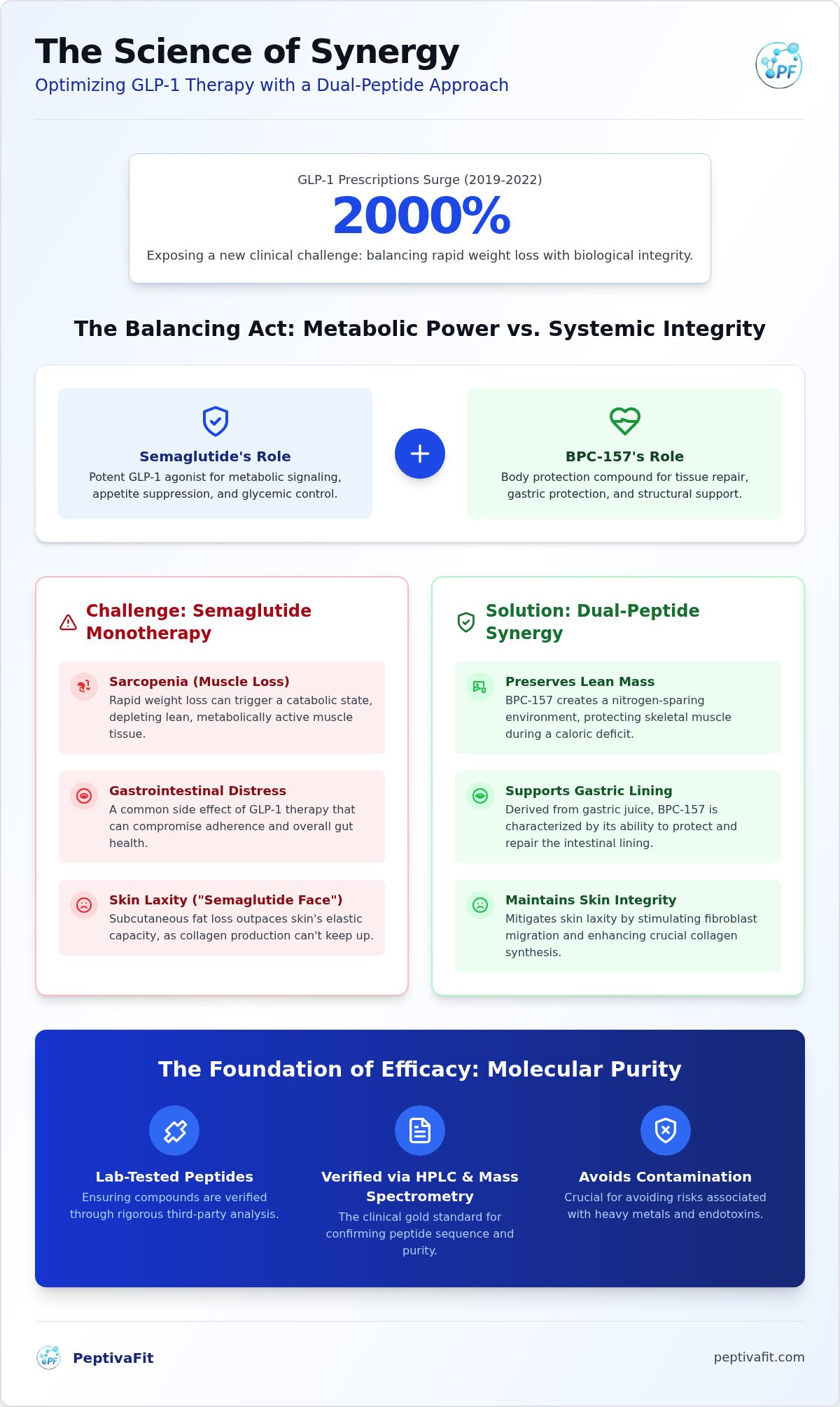
The unprecedented 2000% surge in GLP-1 prescriptions between 2019 and 2022 has exposed a significant clinical challenge: the divergence between rapid weight loss and the preservation of biological integrity. While semaglutide offers transformative glycemic control, the associated risks of gastrointestinal distress and sarcopenia often compromise long-term outcomes. For the disciplined individual, combining semaglutide and bpc 157 represents a sophisticated scientific investigation into metabolic optimization. This dual-peptide approach targets the intersection of endocrine signaling and tissue repair, aiming to stabilize the internal environment while the body undergoes rapid recomposition.
It's understood that sustainable health requires more than just a lower number on the scale; it demands the protection of lean muscle and gut function. This clinical review explores how the molecular synergy of these compounds can maximize fat loss while actively mitigating the side effects that frequently derail GLP-1 therapy. We will analyze the data-driven framework of the PeptivaFit Protocol, examine the rigorous regulatory landscape and safety considerations as of August 2026, and provide a methodical overview of how to maintain structural integrity during a metabolic shift.
Key Takeaways
- Understand the biological mechanisms behind combining semaglutide and bpc 157 to balance potent metabolic signaling with targeted tissue repair and gastric protection.
- Discover how BPC-157 acts as a countermeasure against GLP-1 induced sarcopenia by supporting muscle and tendon integrity during rapid fat loss phases.
- Learn the critical role of the Peptiva Protocol in establishing a structured titration schedule and a personalized medical assessment to ensure safety and efficacy.
- Identify the clinical necessity of utilizing only lab-tested peptides verified through HPLC and mass spectrometry to avoid the risks of heavy metal contamination and endotoxins.
- Explore the anti-inflammatory benefits of this dual-peptide approach for maintaining a high metabolic rate through the preservation of lean, metabolically active tissue.
The Molecular Synergy of Combining Semaglutide and BPC-157
The investigation into combining semaglutide and bpc 157 represents a shift toward more nuanced metabolic management. Semaglutide functions as a potent GLP-1 receptor agonist, primarily utilized for its ability to stimulate insulin secretion and suppress appetite through central nervous system pathways. In contrast, BPC-157 is a body protection compound derived from human gastric juice, characterized by its ability to accelerate the healing of tendons, muscles, and the intestinal lining. The primary research objective in this dual-administration model is to achieve significant adipose tissue reduction while ensuring that systemic integrity remains uncompromised. This concept of synergistic optimization allows one peptide to drive the primary metabolic goal while the other maintains the underlying biological infrastructure.
Mechanism of Action: GLP-1 and Angiogenesis
Semaglutide exerts its influence by mimicking the GLP-1 hormone, targeting the hypothalamus to regulate caloric intake and improve glycemic control. This often results in a rapid reduction of body mass, which can place stress on structural tissues. BPC-157 addresses this by promoting angiogenesis, the formation of new blood vessels, and enhancing collagen synthesis. These two pathways are distinct and don't compete for the same receptor sites; semaglutide operates on the GLP-1 receptor, while BPC-157 modulates various growth factors and nitric oxide pathways. This lack of interference ensures that the metabolic benefits of the GLP-1 agonist aren't diluted by the regenerative actions of the body protection compound.
The Clinical Rationale for Dual-Peptide Research
Modern clinical approaches are moving away from single-molecule monotherapies in favor of sophisticated multi-peptide stacks. This evolution reflects a growing understanding that metabolic health isn't a vacuum. When caloric intake is aggressively restricted, the body's repair mechanisms can slow down, leading to the common pitfalls of GLP-1 therapy. Maintaining molecular integrity during combined administration is paramount; it requires high-purity compounds and precise protocols to avoid unintended interactions. The synergy of these peptides functions as a precise balance between metabolic signaling and tissue repair. By integrating these two distinct biological signals, researchers aim to create a more resilient environment for body recomposition that prioritizes long-term physiological stability over short-term weight loss.
Mitigating GLP-1 Induced Sarcopenia and GI Distress
Rapid lipolysis frequently induces a catabolic state where the body prioritizes immediate energy over structural maintenance. This often leads to sarcopenia, or the significant depletion of lean muscle mass, which remains the primary clinical objection to aggressive weight loss therapies. By combining semaglutide and bpc 157, researchers aim to preserve nitrogen balance and protect skeletal tissue during periods of sustained caloric deficit. While the GLP-1 agonist drives metabolic signaling, the body protection compound provides the regenerative stimulus necessary to maintain biological infrastructure.
The phenomenon often termed "Semaglutide Face" is another direct consequence of rapid subcutaneous fat loss exceeding the skin's natural elastic capacity. Skin laxity occurs when collagen production cannot keep pace with the reduction in facial volume. BPC-157 assists in mitigating this effect by stimulating fibroblast migration and collagen synthesis. This structural support is essential for maintaining skin density and aesthetic integrity while the metabolic signaling of the Semaglutide injection drives systemic fat reduction.
Preserving Lean Mass During Rapid Lipolysis
Combining these compounds creates a nitrogen-sparing environment that is critical for long-term health. BPC-157 enhances the recovery of skeletal muscle cells after exertion, ensuring that the physiological stress of a caloric deficit doesn't lead to permanent muscle wasting. It's a sophisticated approach to body recomposition that requires a disciplined framework. Integrating resistance training with the Peptiva Protocol ensures that the signals for tissue retention are prioritized alongside fat oxidation. This dual-action strategy prevents the "skinny fat" outcome often seen in poorly managed protocols.
Gastrointestinal Protection and Gastric Emptying
One of the most persistent challenges of GLP-1 therapy is the impact on gastric motility, which often manifests as nausea and significant GI distress. BPC-157 supports gut mucosal health and helps regulate the gut-brain axis, acting as a biological buffer against the slowed motility induced by the medication. Clinical observations indicate that users on combined protocols report improved comfort and higher compliance rates due to the stabilization of the intestinal lining. Managing these side effects is a technical process; if you're experiencing persistent distress, seeking professional 1-on-1 coaching can help refine your administration strategy and ensure your system remains balanced during the fat loss phase.
Clinical Applications of BPC-157 in Weight Management
The preservation of metabolically active tissue is a critical variable in successful long-term weight management. While caloric restriction typically triggers a reduction in resting metabolic rate (RMR), the integration of regenerative compounds aims to stabilize this decline. By combining semaglutide and bpc 157, the clinical objective shifts from simple weight reduction to high-quality body recomposition. BPC-157 supports this by protecting muscle fibers and connective tissues from the catabolic signals often amplified during aggressive fat loss phases. Maintaining a higher ratio of lean mass ensures that the metabolic engine remains functional, preventing the rapid weight regain that frequently follows the cessation of GLP-1 therapy.
The efficacy of these protocols depends entirely on the molecular purity of the compounds utilized. Using lab tested peptides is a non-negotiable requirement for any serious researcher. Contaminants such as heavy metals or endotoxins can interfere with metabolic pathways, potentially causing systemic stress that counteracts the benefits of the therapy. This focus on safety is underscored by a 2024 study on compounded semaglutide, which highlights the regulatory scrutiny surrounding the inclusion of BPC-157 in compounded formulations. Individuals must prioritize verified, third-party tested batches to ensure they're operating within a framework of clinical safety and regulatory awareness.
Systemic Anti-Inflammatory Effects
Chronic inflammation is a hallmark of obesity and a primary driver of metabolic resistance. BPC-157 modulates inflammatory cytokines, which may lead to improved insulin sensitivity and a more efficient lipolytic environment. A "clean" internal environment, free from excessive systemic inflammation, allows the body to respond more effectively to the hormonal signals sent by semaglutide. Reducing this inflammatory load is essential for overcoming plateaus and ensuring that the cellular environment is optimized for fat oxidation rather than fat storage.
Support for Connective Tissue and Skin Elasticity
Significant volume loss creates structural challenges for the dermal layer and underlying connective tissues. When skin laxity occurs, it's often a sign that the rate of fat loss has exceeded the body's capacity for tissue remodeling. While GHK-Cu is often cited for dermal integrity, BPC-157 provides a foundational signal for fibroblast migration and angiogenesis. BPC-157 acts as a biological scaffold for tissue during rapid weight shifts. This support helps maintain the aesthetic and functional integrity of the skin, preventing the hollowed or sagging appearance sometimes associated with rapid biological transformations.
Structural Guidance for a Combined Peptide Protocol
Implementing a sophisticated stack requires more than just biological knowledge; it demands a structured, methodical approach to administration. Before initiating any dual-peptide investigation, a personalized medical assessment is a mandatory prerequisite. This ensures that baseline health markers are established and potential contraindications are identified. Combining semaglutide and bpc 157 isn't a one-size-fits-all process. It's a high-stakes protocol that relies on continuous data monitoring to ensure metabolic safety and structural integrity remains intact during the fat loss phase.
Titration and Dosage Precision
Standard protocols for GLP-1 agonists utilize a conservative titration schedule to minimize gastrointestinal volatility. Typically, this involves a four-week period at a sub-therapeutic dose, such as 0.25 mg, before incremental increases. This allows the gastric system to adapt to the slowed motility. BPC-157 administration often follows a daily subcutaneous schedule to maintain steady-state plasma concentrations, particularly when systemic repair is the objective. Intermittent dosing may be sufficient for localized injury, but systemic protection during rapid lipolysis demands consistency. Accuracy is paramount; using a rigorous reconstitution guide ensures that the molecular concentration matches the intended research dosage. Small errors in liquid volume can lead to significant variances in physiological response, potentially compromising the synergy of the stack.
Monitoring Metabolic Markers
A data-driven approach requires consistent tracking of specific lab markers to validate the efficacy of the protocol. We prioritize monitoring HbA1c, fasting insulin, and C-Reactive Protein (CRP) to assess systemic inflammation and glycemic control. Beyond blood work, tracking heart rate variability (HRV) provides a real-time window into the autonomic nervous system's stress levels. Body composition tracking via DEXA or high-grade bioimpedance is also essential to confirm that weight loss is coming from adipose tissue rather than skeletal muscle mass. If satiety signals become blunted or recovery rates stall, it's a clear sign that the protocol requires professional adjustment. For those navigating complex biological responses or plateauing results, scheduling a single consultation call provides the expert oversight necessary to refine your specific administration strategy. This level of monitoring separates serious optimization from reckless experimentation, ensuring your progress is both sustainable and safe.
Ensuring Molecular Purity through Lab-Tested Peptides
The integrity of a biological investigation relies entirely on the quality of the compounds used. When combining semaglutide and bpc 157, the risk profile changes if the substances haven't undergone rigorous verification. Unverified research peptides often contain heavy metals, residual solvents, or endotoxins that can trigger systemic inflammatory responses, effectively negating the regenerative benefits of the stack. Under-dosing is another prevalent issue in the grey market, where a vial labeled for 5mg might only contain a fraction of that amount, leading to inconsistent research outcomes and metabolic instability.
Scientific-grade optimization requires third-party HPLC (High-Performance Liquid Chromatography) and Mass Spectrometry (MS) testing for every batch. These tests verify both the purity and the exact molecular mass of the peptide. The disciplined protocols required for combining semaglutide and bpc 157 demand a higher standard of sourcing than standard consumer-grade supplements. High-stakes performance optimization is an investment in biological longevity, not a hunt for the lowest cost. We utilize the BPC-157 clinical reference as the benchmark for evaluating molecular quality and ensuring compliance with established safety standards.
Identifying Red Flags in Peptide Sourcing
A legitimate Certificate of Analysis (CoA) must be verifiable and recent. Molecular integrity is the non-negotiable foundation of the Peptiva Protocol. When evaluating a source, look for these specific indicators of quality:
- Purity Thresholds: Verification of 98% or higher purity via HPLC.
- Batch Transparency: Batch numbers that match third-party lab reports.
- Molecular Mass: Mass Spectrometry data confirming the exact identity of the peptide.
Vendors in the grey market often provide outdated or forged documents to mask impurities. If a supplier cannot provide transparent data, they shouldn't be considered for clinical-grade applications. It's a matter of personal responsibility and scientific discipline.
The Value of Professional Clinical Oversight
Professional 1-on-1 coaching provides a layer of safety that self-guided research simply cannot match. Integrating medical assessments allows you to rule out contraindications before starting any new stack. Interpretation of biological feedback is a skill developed through experience; adjusting your protocol based on data rather than intuition is critical. Achieving long-term metabolic stability requires a methodical, supervised approach that ensures your progress is both measurable and sustainable.
Advancing Towards Biological Integrity
The investigation into combining semaglutide and bpc 157 reveals a sophisticated path for individuals prioritizing metabolic efficiency alongside structural preservation. We've established that the synergy between central glycemic control and peripheral tissue repair is vital for avoiding the common pitfalls of GLP-1 therapy, such as sarcopenia and GI distress. This clinical approach demands absolute precision in both sourcing and administration. Relying on lab-verified HPLC/MS testing ensures your biological environment isn't compromised by impurities or inaccurate concentrations.
Sustainable transformation isn't a product of chance; it's the result of disciplined, data-driven protocols. By integrating expert 1-on-1 medical consultations and comprehensive clinical fat loss guides, you can navigate the complexities of peptide therapy with authoritative confidence. You're now equipped to move beyond standard consumer-grade advice toward a state of optimized health and performance. This is a journey of personal responsibility and scientific rigor.
Access the Peptiva Protocol and Professional Peptide Coaching to secure your position within a framework built on scientific integrity and specialized oversight. Your commitment to high-level wellness requires a professional standard that values data over hype.
Frequently Asked Questions
Can you mix Semaglutide and BPC-157 in the same syringe for administration?
Mixing peptides in the same syringe isn't advised for clinical-grade investigations. Each compound possesses a specific molecular weight and pH stability profile. Combining them in a single delivery vehicle could lead to premature degradation or altered absorption rates. For maximum efficacy, administer each peptide using separate injection sites. This ensures that the metabolic signaling of the GLP-1 agonist remains distinct from the regenerative pathways of the body protection compound.
Is BPC-157 effective at reducing the nausea caused by Semaglutide?
BPC-157 is frequently utilized to stabilize the gastric environment and reduce nausea. By supporting gut mucosal health and modulating the gut-brain axis, it acts as a buffer against the slowed gastric emptying common with GLP-1 therapy. Clinical observations suggest that users on this dual stack report significantly higher compliance rates. The compound addresses the root of GI distress rather than merely masking the symptoms during the protocol.
How does BPC-157 help prevent muscle loss during a Semaglutide protocol?
BPC-157 preserves lean mass by accelerating the recovery of skeletal muscle cells and enhancing collagen synthesis. When combining semaglutide and bpc 157, the body receives a signal to protect structural integrity while adipose tissue is oxidized. This nitrogen-sparing effect is essential for preventing sarcopenia. It allows for high-quality body recomposition rather than simple weight loss, which often results in a depleted, "skinny fat" physique.
What is the typical duration for a combined Semaglutide and BPC-157 protocol?
The duration of a combined protocol typically spans 12 to 24 weeks, depending on the research objective. This timeframe usually mirrors the active fat loss phase where metabolic stress is highest. However, the exact length should be determined through a personalized medical assessment. Long-term metabolic health requires a disciplined approach, and protocols should be cycled or adjusted based on real-time data monitoring and satiety signals.
Can BPC-157 help mitigate 'Semaglutide Face' or skin sagging?
BPC-157 helps mitigate skin laxity by stimulating fibroblast migration and angiogenesis. Rapid volume loss can exceed the skin’s ability to remodel, leading to sagging or "Semaglutide Face." By acting as a biological scaffold, BPC-157 supports dermal density and aesthetic integrity. This regenerative action ensures that the facial structure remains resilient even as systemic fat levels decrease rapidly during the fat loss protocol.
Do I need a medical assessment before combining these two peptides?
A personalized medical assessment is a non-negotiable requirement before initiating any peptide stack. Establishing baseline markers for HbA1c, fasting insulin, and liver function is critical for safety. You shouldn't attempt combining semaglutide and bpc 157 without professional oversight to rule out pre-existing conditions. This disciplined approach ensures that the metabolic shift doesn't place undue stress on your biological systems or create long-term hormonal imbalances.
Are there any known contraindications when stacking these compounds?
Potential contraindications include a history of proliferative diseases or certain cancers, as BPC-157 promotes angiogenesis. Additionally, individuals with a history of pancreatitis should exercise extreme caution with GLP-1 agonists. These risks underscore the necessity of clinical screening. A professional guide can help identify these red flags, ensuring that your optimization strategy doesn't conflict with your underlying health status or specific genetic predispositions.
How do I ensure the BPC-157 and Semaglutide I am using are lab-verified?
Verification requires a current Certificate of Analysis (CoA) featuring HPLC and Mass Spectrometry data. These tests confirm the peptide's purity and molecular mass, ensuring the vial contains exactly what is labeled. Don't rely on generic claims from a supplier. Every batch must be third-party tested to rule out heavy metals or endotoxins. Maintaining molecular integrity is the only way to guarantee the safety of your clinical investigation.

![Shelf Life of Reconstituted Peptides: A Clinical Reference Guide [2026]](https://getautoseo.com/storage/hero_images/shelf-life-of-reconstituted-peptides-a-clinical-reference-guide-2026.jpg?v=b8ed5173acaa)
