
![Are Online Peptide Companies Legitimate? A Clinical Verification Guide [2026]](https://getautoseo.com/storage/hero_images/are-online-peptide-companies-legitimate-a-clinical-verification-guide-2026.jpg?v=3e2be77d585a)
In April 2026, the FDA’s decision to remove twelve peptides from the Category 2 restricted list fundamentally transformed the bio-optimization sector, yet this regulatory shift has also invited a surge of predatory vendors into the market. You likely understand that while access has expanded, the inherent risk of injecting unverified or toxic substances remains a significant barrier to safe optimization. When asking are online peptide companies legitimate, the answer depends entirely on a vendor's willingness to provide verifiable, batch-specific data rather than marketing rhetoric.
This clinical guide provides the specific analytical standards and red flags necessary to distinguish professional laboratories from high-risk resellers. You will gain a clear framework for verifying third-party lab reports and identifying the critical difference between retail vendors and clinical-grade suppliers. We will examine the updated 2026 regulatory environment and provide the technical protocols required to ensure your source meets the highest purity mandates. By the end of this analysis, you will possess the data-backed confidence to select a supplier that prioritizes scientific integrity over market hype.
Key Takeaways
- Define the rigorous analytical standards required to validate the purity of synthesized amino acid chains within the 2026 regulatory framework.
- Evaluate whether are online peptide companies legitimate by demanding batch-specific, independent third-party verification rather than static or outdated reports.
- Identify critical red flags of high-risk vendors, including the absence of a physical business presence and the exclusive use of non-reversible payment platforms.
- Implement a clinical verification checklist to audit Certificates of Analysis (COA) and cross-reference laboratory data with independent testing databases.
- Understand the essential role of professional medical oversight and personalized assessments in ensuring metabolic safety and protocol efficacy.
The Landscape of Online Peptide Vendors in 2026
The global peptide therapeutics market reached an estimated $163.98 billion in early 2026, fueled by a 300% increase in consumer interest regarding metabolic optimization. This rapid expansion has created a polarized environment where clinical-grade suppliers exist alongside high-risk "basement" operations. Determining if are online peptide companies legitimate requires an analytical approach that prioritizes batch-specific data over marketing claims. A truly legitimate entity is defined as one that provides verifiable, high-purity synthesized amino acid chains, backed by independent laboratory validation rather than static, outdated documents.
The ubiquity of the "Research Purposes Only" (RPO) designation serves as a primary legal shield for many vendors. While this label allows for the distribution of unapproved peptides under specific legal frameworks, it often creates a dangerous gray area for the consumer. In this unregulated space, the burden of safety shifts entirely to the buyer. You must distinguish between regulated compounding pharmacies operating under section 503A and the retail "grey market" sites that frequently lack the sterile environments necessary for safe synthesis.
Understanding the Synthetic Peptide Supply Chain
Quality begins at the point of synthesis. Professional laboratories utilize domestic synthesis with high-performance liquid chromatography (HPLC) to ensure purity levels exceeding 99%. Conversely, low-tier vendors often import bulk powders that may contain residual solvents or heavy metals. Lyophilization, or freeze-drying, is a critical step that removes moisture to ensure the peptide remains stable during transit. Because high-purity synthesis and rigorous purification are resource-intensive, price often serves as a direct indicator of quality. Low-cost options typically signify skipped steps in the purification or testing phases.
Regulatory Status and Compliance Standards
The regulatory landscape shifted significantly on April 15, 2026, when the FDA removed twelve peptides from the Category 2 "do not compound" list. While this improved access, it also increased the necessity for Good Laboratory Practice (GLP) standards in manufacturing. Molecular integrity is the maintenance of the precise chemical structure and biological activity of an amino acid sequence throughout the manufacturing and storage process. When evaluating if are online peptide companies legitimate, you must verify that their manufacturing partners adhere to these strict clinical protocols. Data dictates safety; without a current, batch-specific Certificate of Analysis, a vendor cannot be considered a viable source for high-stakes optimization.
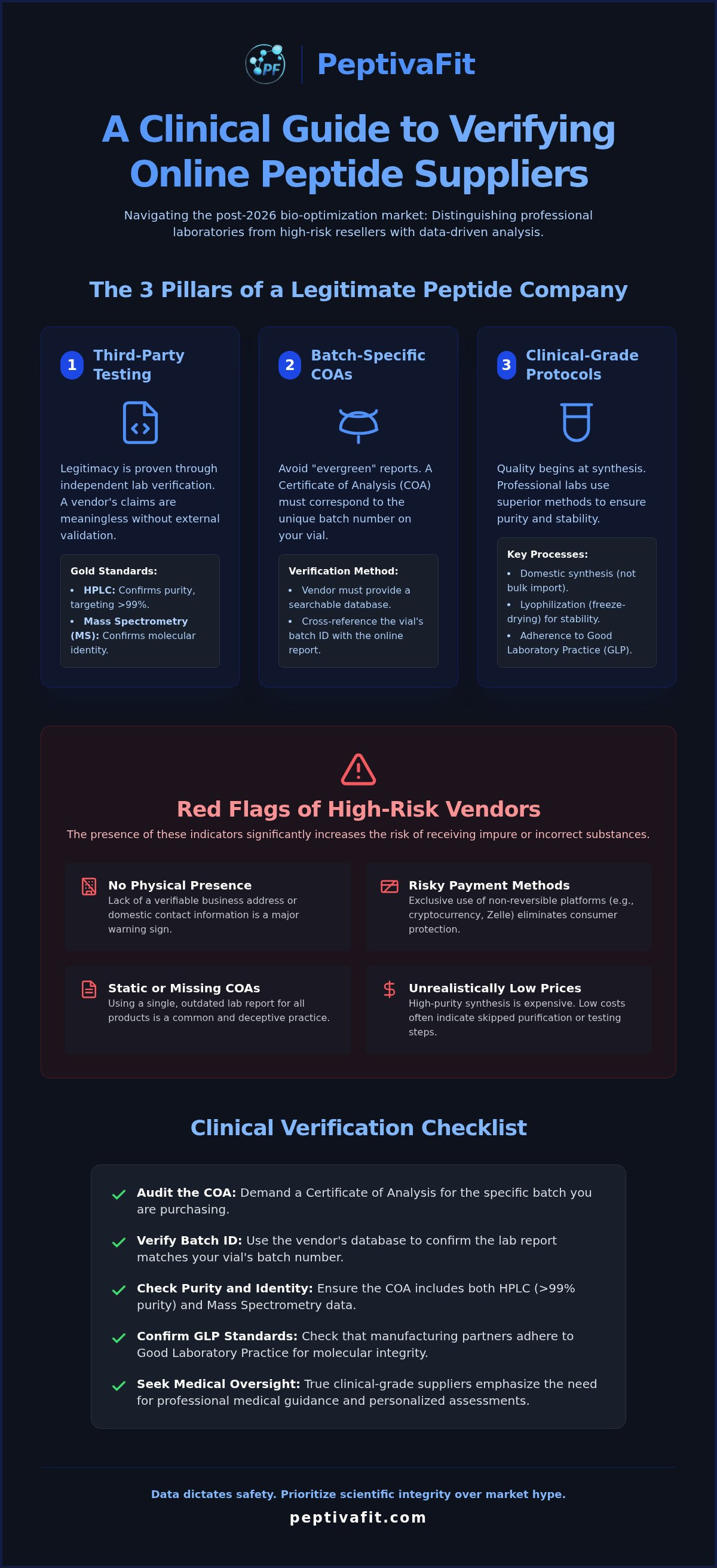
The 3 Pillars of a Legitimate Peptide Company
Determining if are online peptide companies legitimate requires a move away from aesthetic branding toward raw analytical data. Legitimate laboratories operate on three non-negotiable pillars: independent third-party testing, batch-specific verification, and clinical-grade storage protocols. These standards exist to protect the researcher from immunological reactions caused by residual trifluoroacetic acid (TFA), heavy metals, or truncated peptide sequences. When these pillars are absent, the risk of systemic inflammation or localized site reactions increases significantly.
HPLC and Mass Spectrometry: The Gold Standards
High-Performance Liquid Chromatography (HPLC) and Mass Spectrometry (MS) represent the only acceptable methods for verifying peptide integrity. HPLC measures the purity percentage by separating the components of a mixture, ensuring that the target peptide constitutes at least 98% to 99% of the vial's contents. Mass Spectrometry confirms the identity of the molecule by measuring its mass-to-charge ratio. A purity claim without both reports is clinically meaningless. Without MS, a vendor could sell a high-purity vial of an entirely different, cheaper substance. Data must be the primary driver of your selection process.
Batch-Specific vs. Generic Lab Reports
The most common deception in the peptide industry involves the use of "evergreen" or static Certificates of Analysis (COA). These are outdated reports from a single high-quality batch used to sell subsequent, untested batches for months or years. You must ensure that lab tested peptides are linked to a specific batch number found on the vial itself. Legitimate vendors provide a searchable database where you can cross-reference your unique batch ID with a current report. Failure to provide this transparency is a significant indicator of risk, often cited in FDA warning letters directed at non-compliant vendors selling mislabeled or unapproved substances.
Storage and handling protocols form the final pillar. Peptides are fragile signaling molecules. Exposure to heat or improper lyophilization leads to molecular degradation, which reduces efficacy and increases the risk of adverse reactions. Professional labs maintain a strict cold chain and use vacuum-sealed vials to prevent oxidation. If you are serious about your metabolic optimization, verify these standards before beginning any protocol. For those seeking a higher level of precision, a personalized medical assessment can provide the necessary oversight to navigate these technical requirements safely.
Red Flags: Identifying Illegitimate Peptide Vendors
Identifying a professional laboratory involves more than just reading a website's marketing copy. It requires a clinical eye for operational red flags that signal a lack of scientific integrity. When investigating if are online peptide companies legitimate, you must first scrutinize the vendor's physical and financial transparency. Predatory entities frequently hide behind a total lack of verifiable contact information or physical business addresses. If a company operates exclusively through non-reversible, high-risk payment platforms without offering standard alternatives, it suggests they cannot meet the compliance standards required by traditional merchant processors. Data dictates that financial gatekeeping is often a primary indicator of a vendor's long-term stability and accountability.
Price transparency is equally critical. High-purity synthesis and rigorous HPLC purification are resource-intensive processes. Pricing that significantly undercuts the domestic market average usually indicates a lack of purification or the presence of truncated sequences. Furthermore, any vendor promising specific medical "cures" for products labeled "for research purposes" is operating in direct violation of regulatory frameworks. This lack of professional discipline is a hallmark of "basement" operations that prioritize sales volume over metabolic safety.
Deceptive Marketing and 'Cloned' Lab Reports
The rise of digital manipulation has made spotting photoshopped Certificates of Analysis (COAs) a necessary skill for the serious researcher. You must look for pixelation around the purity percentages or font mismatches that suggest a report has been altered. Many retail sites fall into the "white label" trap, where they purchase bulk stock from overseas distributors and slap their own branding on the vials without conducting independent verification. These vendors often don't know the true origin or purity of their own stock. Be wary of "shill" reviews on social media and forums; legitimate laboratories rely on data and clinical results rather than aggressive, hype-driven marketing campaigns.
Poor Packaging and Shipping Protocols
Peptides are fragile signaling molecules that require specific handling to maintain their molecular integrity. Improper shipping in non-insulated or high-heat environments can lead to "crashed" peptides, where the powder loses its structural stability. Vacuum-sealed vials are a non-negotiable safety feature that prevents atmospheric oxidation and ensures the long-term stability of the lyophilized powder. If a vendor ships vials in loose, unprotected packaging, they are demonstrating a fundamental disregard for the delicate nature of the compounds. Ensuring are online peptide companies legitimate means verifying that their cold-chain and handling protocols meet clinical standards before you commit to a metabolic protocol.
Verification Checklist for Informed Researchers
Establishing whether are online peptide companies legitimate requires a methodical auditing process that mirrors clinical laboratory standards. You shouldn't rely on a vendor's self-reported data without external corroboration. A disciplined researcher treats every purchase as a scientific investigation, demanding specific evidence of purity and molecular identity before proceeding with any protocol. Use the following five-step checklist to evaluate a supplier's clinical integrity:
- Step 1: Locate the Certificate of Analysis (COA) and verify the testing date against the current 2026 calendar year.
- Step 2: Cross-reference the laboratory's name with the independent testing facility's official database to ensure the report isn't a fabrication.
- Step 3: Analyze the HPLC chromatogram for "noise" or secondary peaks that indicate the presence of truncated sequences or residual solvents.
- Step 4: Evaluate the vendor's transparency regarding their synthesis process, specifically looking for mentions of solid-phase peptide synthesis (SPPS) and purification methods.
- Step 5: Ensure the vendor provides technical peptide reconstitution data to ensure the molecule remains stable during the preparation phase.
How to Read a HPLC Purity Report
The "Area %" on a High-Performance Liquid Chromatography (HPLC) report is the primary metric for purity. Clinical standards dictate that anything below 98% is sub-standard for high-stakes optimization. You must also identify the "Retention Time," which serves as a molecular fingerprint; it must match the known standards for the specific peptide sequence you've acquired. A clean baseline on the chromatogram is a non-negotiable indicator of a highly purified product. If the baseline shows significant fluctuations, it suggests the presence of impurities that could trigger an adverse immunological response.
Verifying with the Testing Laboratory Directly
Authenticity cannot be assumed in an unregulated market. You should email the third-party laboratory directly to confirm a report's validity. Ask specific questions, such as whether the vendor submitted that specific batch on the date listed. Modern legitimate laboratories have integrated QR-code verification on vial labels, allowing you instant access to the raw data. This level of transparency is the hallmark of a professional entity. If you require a more rigorous framework for your health journey, a personalized medical assessment provides the clinical oversight necessary to navigate these technical requirements with absolute precision. Understanding if are online peptide companies legitimate is the first step in a long-term commitment to metabolic excellence through data-backed decision-making.
The Peptiva Standard: Beyond the Transaction
High-purity molecules are merely the raw components of a sophisticated optimization strategy. While verifying if are online peptide companies legitimate is essential for basic safety, the analytical data on a lab report doesn't dictate how a specific sequence will interact with your unique physiological profile. Legitimate sourcing is the baseline requirement, but achieving clinical results requires a disciplined framework that extends far beyond the point of purchase. Without professional guidance, even the highest-purity peptides can lead to suboptimal outcomes or avoidable systemic stress. Data is only valuable when it is applied with clinical precision.
The PeptivaFit Protocol was developed to bridge the critical gap between laboratory supply and metabolic success. This shift from a "customer" to a "client" involves moving away from high-risk, blind experimentation toward a data-driven, supervised methodology. Professional oversight ensures that your protocol remains both efficient and compliant with current safety standards, providing a level of security that retail vendors cannot offer. You are not just purchasing a product; you are engaging in a managed process of biological optimization.
The Role of Personalized Medical Assessments
Comprehensive metabolic screening and blood work must precede the introduction of any exogenous signaling molecule. While online vendors prioritize sales volume, they lack the infrastructure to identify contraindications such as pre-existing insulin resistance or specific hormonal imbalances that may complicate a protocol. A personalized medical assessment allows for the precise calibration of dosage based on your specific biomarkers and fat loss objectives. This diagnostic phase transforms a speculative endeavor into a controlled, scientific optimization process tailored to your unique biological needs. Safety is never an accident; it is the result of rigorous data monitoring.
Professional Coaching and Consultation
Specialized education and technical support are the final components of the PeptivaFit standard. Engaging in 1-on-1 coaching provides the necessary expertise to navigate complex therapeutic stacks, such as those involving BPC-157 for tissue repair or Tesamorelin for visceral fat reduction. For individuals who require tactical troubleshooting for plateaus or administration issues, single consultation calls offer direct access to clinical-grade analysis. PeptivaFit operates as a selective and restricted entity for serious individuals who understand that performance optimization is a long-term commitment requiring maturity and compliance. When you evaluate if are online peptide companies legitimate, you must consider whether the provider offers the clinical support infrastructure necessary to safely achieve your metabolic goals.
Advancing Toward Clinical-Grade Optimization
Legitimacy in the bio-optimization sector is a function of analytical transparency and professional oversight rather than marketing spend. You now possess the technical framework to verify that a Certificate of Analysis is only valid when it is batch-specific, current, and cross-referenced against independent laboratory databases. When determining if are online peptide companies legitimate, you must look beyond the digital storefront to the raw HPLC chromatograms and the clinical infrastructure supporting the molecule. High-purity sourcing is the essential first step, but it represents only one half of a successful metabolic strategy.
True performance enhancement requires a transition from speculative experimentation to a disciplined medical framework. By prioritizing data-backed decision-making, you eliminate the risks associated with unverified vendors and impure substances. Access the Peptiva Protocol and Verified Lab Standards to integrate lab-verified peptide supplies with personalized medical assessments and expert 1-on-1 coaching packages. Take command of your metabolic health with the discipline and scientific precision your biology deserves.
Clinical Verification: Frequently Asked Questions
How do I know if a peptide lab report is fake?
A fraudulent lab report is often identified by digital artifacts, font mismatches, or pixelation around the purity percentages. You must cross-reference the report ID directly with the third-party laboratory's database. If the lab cannot confirm the batch number or the date of synthesis, the document is a fabrication. Legitimate reports always include clear contact information for the testing facility and a clean HPLC chromatogram baseline.
Is it legal to buy peptides online for personal research in 2026?
Legal access to therapeutic peptides in 2026 requires a prescription from a licensed physician and fulfillment through a compounding pharmacy. While the FDA removed twelve peptides from the Category 2 list in April 2026, they are not approved as over-the-counter supplements. The "research purposes only" designation is a legal framework for laboratory study, and it does not authorize or ensure safety for human consumption or personal optimization.
What is the difference between a research peptide and a pharmaceutical peptide?
Pharmaceutical peptides are produced in cGMP-compliant facilities and undergo rigorous sterility and stability testing for human use. Research peptides are intended for laboratory investigations and lack the same regulatory oversight, often containing residual solvents or truncated sequences. While the molecular structure may be identical, the manufacturing standards and purification protocols differ significantly, impacting the overall safety and metabolic efficacy of the compound.
Can I trust peptide reviews on Reddit or third-party forums?
Forum reviews lack the objective analytical data necessary for safety and are frequently compromised by biased "shill" marketing. Personal anecdotes cannot substitute for HPLC and Mass Spectrometry reports. These platforms often prioritize brand hype over scientific integrity, making them unreliable for clinical decision-making. You should rely exclusively on verifiable laboratory data and professional medical oversight rather than anonymous testimonials from unverified users on social media.
Why do some peptide companies only accept cryptocurrency or bank wires?
Limited payment options like cryptocurrency suggest the vendor cannot meet the compliance audits required by traditional credit card processors. Legitimate businesses maintain stable merchant accounts by adhering to strict regulatory and financial standards. Non-reversible payment platforms offer zero consumer protection and serve as a primary red flag when evaluating if are online peptide companies legitimate. Financial transparency is a non-negotiable indicator of a company's clinical and operational integrity.
What should I do if a company refuses to provide batch-specific COAs?
Immediate termination of the transaction is the only disciplined response if a vendor refuses to provide batch-specific data. A company that hides its analytical reports is likely distributing impure or mislabeled substances. Data is the only currency of safety in the peptide market. Without a current Certificate of Analysis linked to your specific vial, you are engaging in high-risk experimentation that lacks any clinical safeguards.
What are the risks of using peptides from an illegitimate online source?
Injecting unverified substances carries the risk of systemic toxicity, localized inflammation, and permanent immunological reactions. Impure peptides often contain heavy metals or residual trifluoroacetic acid from the synthesis process. These contaminants can cause severe adverse effects that undermine your optimization goals. Illegitimate sources prioritize profit over purity, frequently skipping the expensive lyophilization and purification steps required to ensure molecular integrity and biological safety.
How can I verify the purity of peptides like BPC-157 or Semaglutide?
Purity verification depends entirely on batch-specific HPLC and Mass Spectrometry data issued by an independent facility. The HPLC report must show a purity level of at least 98% to meet clinical standards. Mass Spectrometry confirms that the molecular mass matches the intended peptide sequence. To determine if are online peptide companies legitimate, you must verify these documents were generated within the 2026 calendar year and match your specific batch number.

![Shelf Life of Reconstituted Peptides: A Clinical Reference Guide [2026]](https://getautoseo.com/storage/hero_images/shelf-life-of-reconstituted-peptides-a-clinical-reference-guide-2026.jpg?v=b8ed5173acaa)
