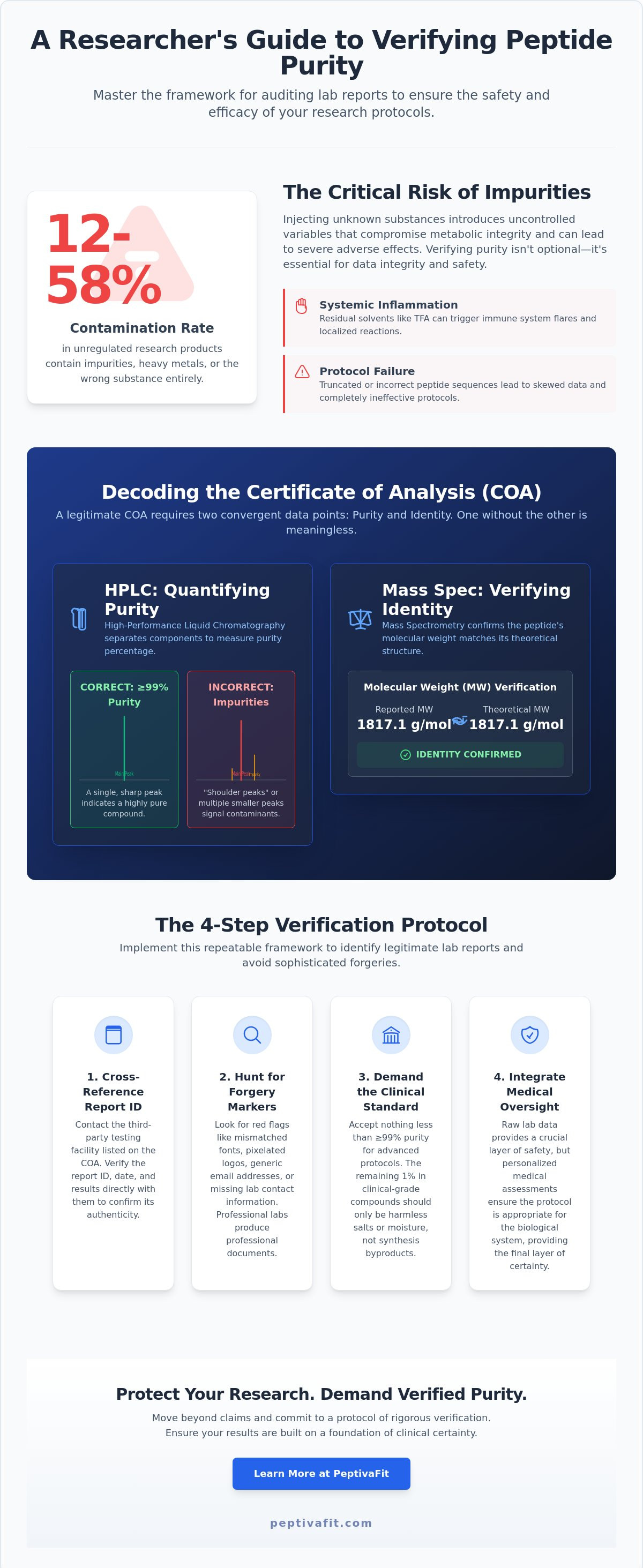
Between 12% and 58% of unregulated research products have been found to contain contaminants, heavy metals, or entirely different substances than those advertised. You understand that a digital document provided by a vendor isn't an absolute badge of safety; it's a claim that requires rigorous scientific interrogation. Mastering the process of verifying peptide purity reports is the only way to protect your capital and ensure the metabolic integrity of your research following the April 23, 2026, peptide reclassifications. The fear of injecting unknown impurities is a logical response to an opaque market, but data remains the ultimate safeguard for the disciplined researcher.
This guide establishes a repeatable protocol for auditing lab reports so you can move beyond surface-level percentages to verify the actual chain of custody. You'll learn to distinguish between molecular identity and purity standards while identifying the markers of an authentic Certificate of Analysis. We provide the forensic tools necessary to interpret High-Performance Liquid Chromatography and Mass Spectrometry data accurately. This methodical approach offers the clinical certainty and peace of mind required to maintain sophisticated performance protocols without the risk of utilizing bunk or under-dosed products.
Key Takeaways
- Master the technical nuances of HPLC and Mass Spectrometry to confirm that the molecular weight of your compound aligns with its theoretical sequence.
- Implement a repeatable framework for verifying peptide purity reports by cross-referencing lab report IDs directly with ISO-certified testing facilities.
- Learn to identify sophisticated forgery markers, such as mismatched fonts and missing lab contact information, which often signal compromised data.
- Understand why a 99% purity threshold is the necessary clinical benchmark for maintaining metabolic integrity during advanced research protocols.
- Discover how integrating personalized medical assessments provides a final layer of safety that raw lab data alone cannot guarantee.
The Critical Importance of Peptide Purity in Metabolic Research
Peptide purity isn't a subjective quality; it's a precise quantitative measurement of the ratio between the target amino acid sequence and all other substances present in the vial. In a controlled research environment, a purity level of 98% or higher is the non-negotiable standard. When you're verifying peptide purity reports, you're looking for evidence of a refined manufacturing process that has successfully removed synthesis byproducts, residual solvents, and bacterial endotoxins. Any deviation from this standard introduces uncontrolled variables that can compromise the metabolic integrity of your research and the safety of the biological system.
The 12% to 58% contamination rate found in unregulated research chemicals highlights the volatility of the current market. These "bunk" products often contain heavy metals or entirely different substances than what's listed on the label. For the disciplined researcher, high purity isn't just about efficacy. It's about ensuring that the data collected is a true reflection of the peptide's action rather than a reaction to underlying contaminants. The Certificate of Analysis (COA) serves as the primary document to confirm these standards have been met before any protocol begins.
The Biological Risks of Impure Peptides
Residual solvents and reagents used during the synthesis process, such as Trifluoroacetic acid (TFA), can trigger systemic inflammatory responses if not properly filtered. These impurities can lead to localized site reactions or more severe immune system flares. Truncated sequences present another significant danger. This happens when the peptide chain is incomplete, resulting in a molecule that might have the correct "name" but lacks the proper length to function. If you're utilizing a fat loss peptide guide to optimize your metabolism, these structural errors can lead to total protocol failure or unintended side effects that skew your results.
Research Grade vs. Pharmaceutical Grade
The distinction between "Research Use Only" (RUO) and pharmaceutical-grade manufacturing often lies in the composition of the remaining 1% of the product. In clinical-grade compounds, this 1% consists of harmless salts or moisture. In lower-quality research batches, it might contain synthesis isomers that are difficult to detect without sophisticated equipment. High-Performance Liquid Chromatography (HPLC) is the gold standard for identifying these impurities by separating the components of a sample based on their molecular properties. Following purification, the process of lyophilization, or freeze-drying, is critical. This technique stabilizes the molecular structure for long-term storage, ensuring the peptide doesn't degrade before it's reconstituted. Without an audited COA, you lack the necessary confirmation that these rigorous steps were actually performed.
Decoding the COA: High-Performance Liquid Chromatography (HPLC) and Mass Spec
A Certificate of Analysis (COA) is a dual-layered document where the data from two distinct analytical techniques must converge. While the previous section established why purity matters, auditing the technical graphs within a COA is how you verify those claims. A purity report is functionally useless without a corresponding identity test. You can have a 99% pure substance that is entirely the wrong compound. Sophisticated auditing requires cross-referencing the HPLC chromatogram with the Mass Spectrometry (MS) data to ensure they describe the same molecular entity.
HPLC: Quantifying Molecular Purity
High-Performance Liquid Chromatography (HPLC) operates by separating a sample into its component parts. When you're verifying peptide purity reports, the primary focus is the "main peak." This should be a singular, sharp vertical line on the graph. Any "shoulder peaks" or smaller bumps at the base of the main peak indicate the presence of isomers, degraded material, or synthesis byproducts. The retention time, which is the specific moment the peptide exits the column, must remain consistent across different batches of the same compound to signal manufacturing stability.
The integration table at the bottom of the HPLC report is where the "Area Percent" is calculated. This is not a guess; it's a mathematical ratio of the area under the main peak compared to the total area of all detected peaks. If the baseline of the graph is "noisy" with many small fluctuations, the calculated purity may be artificially inflated or simply inaccurate. Professional researchers look for a clean baseline to ensure the reported percentage reflects reality. If you require absolute certainty in your data, sourcing lab tested peptides is the only disciplined way to maintain protocol safety.
Mass Spectrometry: Confirming Molecular Identity
While HPLC quantifies purity, Mass Spectrometry (MS) confirms identity by measuring molecular weight. Every peptide has a theoretical weight based on its amino acid sequence. The MS report should show a prominent [M+H]+ peak that matches this theoretical value. For instance, if you're auditing a report for BPC-157 peptide, the observed mass must align precisely with its known molecular structure. If these numbers don't match, the purity percentage on the HPLC is irrelevant because the substance is not what was ordered.
It's common to see secondary peaks in MS reports, which are often artifacts of the ionization process rather than actual impurities. However, a significant discrepancy between the expected mass and the observed mass is a terminal red flag. These analytical standards are not unique to the research community. They are foundational to FDA-funded peptide detection methods used in high-stakes regulatory environments. If the data doesn't align, the batch should be rejected immediately to protect the integrity of your metabolic research.
The Peptiva Verification Protocol: Cross-Referencing Third-Party Data
Verification is not a passive act of reading; it is an active process of forensic auditing. While a vendor may display a PDF on their storefront, that document only represents a claim until it is validated through an independent chain of custody. Given that 12% to 58% of unregulated products fail to meet their label claims, a disciplined researcher must assume all unverified reports are potentially compromised. Establishing a repeatable framework for verifying peptide purity reports is the only method to ensure the molecular integrity of your compounds.
Our protocol requires a five-step investigation to move from blind trust to clinical certainty:
- Step 1: Locate the unique Report ID and the specific testing facility name. Authentic reports always feature a traceable serial number.
- Step 2: Confirm the lab’s credentials. High-tier facilities maintain ISO/IEC 17025 accreditation, which ensures they follow standardized analytical procedures.
- Step 3: Perform direct verification. Use the lab’s official portal or contact them via a professional inquiry to confirm the report in your possession matches their internal records.
- Step 4: Audit the batch numbers. The lot number on your physical vial must correspond exactly to the data on the Certificate of Analysis (COA).
- Step 5: Engage in peer-group auditing. Cross-reference your results with independent community testing databases to see if other researchers have identified discrepancies with the same vendor batch.
Direct Lab Verification Procedures
You should never trust a report hosted solely on a vendor’s server. These files are easily manipulated with basic editing software to hide impurities or inflate percentages. Instead, utilize the "Report Verification" tools provided by major analytical labs like Janoshik or MZ Biolabs. By entering the Report ID directly into the lab’s database, you bypass the vendor entirely. When drafting a professional inquiry to a lab, include the report ID and a clear scan of the document. This level of scrutiny aligns with the rigorous standards found in FDA guidance on synthetic peptide analysis regarding the identification of impurities.
Batch Consistency and Date Auditing
The "Freshness Factor" is a critical marker of vendor transparency. A lab report from two years ago is a significant red flag; it suggests the vendor is selling through old stock or, more likely, using an outdated report to represent a new, untested batch. Peptides are sensitive to environmental degradation. Therefore, the COA date must be reasonably close to your purchase date. Furthermore, knowing how to reconstitute peptides correctly is impossible without accurate concentration data from a recent report. If the vial markings don't match the documentation, the chain of custody is broken and the material should be considered research-compromised.
Identifying Sophisticated Fakes: Common Red Flags in Lab Reports
Forgery in the research chemical industry has evolved beyond simple clerical errors into sophisticated digital manipulation. When verifying peptide purity reports, you must look past the headline percentage to scrutinize the document's structural and metadata integrity. A report that lacks a verifiable physical address, a direct laboratory phone number, or a specific technician's signature is functionally worthless. These generic headers are often used by vendors to obfuscate the fact that no actual testing occurred at a certified facility.
The "Perfect 100%" Myth is one of the most prominent red flags in fraudulent documentation. In high-volume peptide synthesis, achieving absolute 100.0% purity is statistically improbable due to the inherent nature of chemical reagents and atmospheric moisture. Authentic clinical-grade reports typically show values between 98.2% and 99.8%. Any document claiming perfection is likely a marketing asset rather than a scientific record. Furthermore, mismatched dates often reveal a vendor's attempt to recycle old data; if the test date precedes the batch manufacturing date listed on the vial, the chain of custody is irrevocably broken.
Digital Manipulation Red Flags
Digital forensics can expose forgeries that the naked eye might miss. One primary method is inspecting the PDF metadata. If the "Created By" or "Modified By" field lists software like Adobe Photoshop or Canva instead of professional chromatography data systems like Empower or Chromeleon, the report has likely been altered. You should also look for inconsistencies in graph resolution. A common tactic involves pasting a high-resolution graph from a legitimate report onto a low-resolution template. If the text appears blurry while the chromatography peaks are sharp, the document is a composite fake. To eliminate these risks entirely, always source your materials from providers of lab tested peptides who maintain transparent, verifiable records.
Chemical Red Flags in the Data
A sophisticated auditor looks for chemical contradictions between the marketing claims and the analytical data. For instance, if a vendor advertises a peptide as an Acetate salt version but the Mass Spectrometry data indicates a Trifluoroacetic acid (TFA) salt molecular weight, the product is mislabeled. These salt versions significantly impact the weight and concentration of the compound. Additionally, impossible chromatography baselines that appear "too clean" suggest the data was digitally drawn rather than generated by a machine. Legitimate HPLC graphs always contain a degree of baseline noise or small, irrelevant peaks representing atmospheric interference. If the baseline is a perfect, flat line, the data has been sanitized, rendering the report scientifically invalid.
Elevating Standards: Integrating Verified Peptides into Your Protocol
Data verification is the foundation, but clinical application is the structure. While verifying peptide purity reports ensures you have the correct substance, professional oversight acts as the final layer of risk mitigation. A personalized medical assessment allows for the calibration of protocols based on individual biomarkers rather than generic data. This transition from a solo researcher to an optimized subject requires a disciplined integration of verified data and expert guidance. You can't rely on raw percentages alone to dictate your biological future; you need a framework for interpreting how those percentages interact with your unique metabolism.
Precision in purity directly dictates precision in administration. For instance, calculating a precise tesamorelin dosage depends entirely on the verified concentration of the lyophilized powder. If a vial is under-dosed or contains unidentified isomers, the metabolic response becomes unpredictable. High-purity compounds ensure that the biological feedback you receive is a direct result of the peptide's mechanism of action. This allows for methodical adjustments to your protocol without the noise of impurities. When the compound is verified, the variable of "bunk product" is eliminated, leaving only the data of your own physiological response.
The PeptivaFit Quality Standard
We operate with a restricted supply chain that prioritizes molecular integrity over mass-market availability. Our commitment to providing only lab-verified, high-purity research materials involves a multi-stage audit of every batch. This isn't a passive review of documents provided by manufacturers. Instead, we conduct independent forensic analysis to confirm every claim before a vial is ever considered for our clients. The Peptiva Protocol: Fat Loss Peptide Guide offers a structured, safe journey for those who refuse to compromise on their metabolic health, providing the data-driven confidence that only verified purity can offer.
Professional Guidance and Coaching
Raw data can be overwhelming without a framework for interpretation. This is why 1-on-1 coaching is essential for understanding how your unique physiology responds to specific sequences. You aren't just looking for a number on a page; you're looking for a repeatable biological result. A single consultation call can provide the necessary audit of your current protocol to identify potential inefficiencies or safety risks that a raw COA might miss. True optimization is a long-term process that demands high levels of personal responsibility and clinical accuracy. Secure your metabolic future by applying for the Peptiva Protocol today and move beyond the uncertainty of unregulated research.
Securing Your Metabolic Integrity through Rigorous Auditing
The transition from a passive consumer to a disciplined researcher requires a commitment to forensic accuracy. You now possess the analytical framework to distinguish between authentic data and sophisticated digital forgeries. By prioritizing the convergence of HPLC purity metrics and Mass Spectrometry identity markers, you eliminate the variables of contamination and under-dosing that plague the unregulated market. This methodical approach ensures that every metabolic intervention is based on molecular fact rather than vendor claims.
Mastering the process of verifying peptide purity reports is the final safeguard for your biological safety. While raw data provides the foundation, it's true optimization that is achieved through professional oversight and clinical-grade standards. The Peptiva Protocol offers a comprehensive solution, combining 1-on-1 coaching with personalized medical assessments to ensure your data translates into measurable results. It's time to take control of your research by moving beyond the uncertainty of surface-level percentages.
Access the Lab-Verified Peptiva Protocol for Fat Loss to integrate clinical-grade verification and data-driven metabolic optimization into your journey. Your commitment to excellence deserves a protocol that values precision as much as you do.
Frequently Asked Questions
What is the difference between peptide purity and peptide content?
Peptide purity refers to the percentage of the target amino acid sequence relative to other peptide impurities. In contrast, peptide content represents the actual weight of the peptide molecule in the total mass of the powder, which includes counterions and residual water. Most high-quality products have a peptide content of approximately 80% even if the purity is 99%. Understanding this distinction is vital for verifying peptide purity reports and calculating precise dosages.
How can I tell if an HPLC report has been photoshopped?
Digital manipulation is often revealed through metadata analysis and visual discrepancies. Examine the PDF properties for software artifacts like Photoshop or Canva and look for "floating" text that doesn't align with the document's grid. If the chromatography graph has a higher resolution than the surrounding text, the report is likely a composite forgery. Direct verification with the testing facility remains the only foolproof method to confirm authenticity.
Is 99% purity actually achievable for all peptides?
While 99% is the clinical gold standard, it isn't always statistically probable for every complex sequence. Most research-grade compounds aim for a minimum threshold of 98% to ensure metabolic integrity. Peptides with highly hydrophobic sequences or long chains may naturally have slightly lower yields during synthesis. However, any report claiming exactly 100.0% should be viewed with extreme skepticism as it ignores the reality of chemical reagents.
Why do some labs use "Area %" instead of absolute quantification?
Area Percent is the standard metric in chromatography because it calculates the relative abundance of the target molecule compared to all detected peaks. Absolute quantification requires a certified reference standard for every specific peptide, which is often cost-prohibitive for research batches. By using Area Percent, labs provide a reliable ratio of the main peak's area to the total integrated area, which effectively quantifies the purity of the synthesis.
What are the most common contaminants found in low-quality peptides?
Low-quality batches frequently contain residual synthesis reagents like Trifluoroacetic acid (TFA) and bacterial endotoxins. Other common contaminants include heavy metals like lead or arsenic and truncated peptide sequences where the chain was not fully formed. These impurities can trigger systemic inflammation or localized immune responses. Identifying these risks is a primary driver for verifying peptide purity reports before starting any metabolic protocol.
Can I send a sample of my own peptides to a lab for verification?
Independent third-party verification is a hallmark of a disciplined researcher. You can and should send samples to ISO/IEC 17025 accredited laboratories to confirm vendor claims. This process involves sending a sacrificial vial from your specific batch for blind testing. While this adds an additional cost, it provides an unbiased layer of security that vendor-provided documentation cannot replicate.
What should I do if a vendor refuses to provide a batch-specific COA?
If a vendor refuses to provide a batch-specific COA, you should immediately terminate the transaction and find a new source. Refusal suggests the vendor is either selling unverified stock or utilizing "representative" reports that don't reflect the current batch. Transparency is the minimum requirement for research-grade materials. In a market where 12% to 58% of products are compromised, a lack of documentation is a terminal red flag.
How does peptide purity affect the reconstitution process?
Molecular purity significantly influences the solubility and stability of the reconstituted solution. High-purity peptides generally dissolve clearly in bacteriostatic water without leaving visible particulates or "cloudiness." If a sample remains cloudy after proper reconstitution, it often indicates the presence of hydrophobic impurities or incorrect salt versions. These contaminants can cause the peptide to degrade faster, which ultimately compromises the accuracy of your research data.

![Shelf Life of Reconstituted Peptides: A Clinical Reference Guide [2026]](https://getautoseo.com/storage/hero_images/shelf-life-of-reconstituted-peptides-a-clinical-reference-guide-2026.jpg?v=b8ed5173acaa)
