

On August 3, 2026, a federal judge sentenced a peptide vendor to 70 months in prison for selling unapproved drugs under forged certificates. This case highlights a critical vulnerability in the current market where polished interfaces often mask systemic failures in purity. Identifying red flags for peptide websites is no longer a secondary concern; it's a mandatory discipline for those who prioritize biological integrity. You likely recognize that the risk of injecting contaminated or underdosed substances is a direct consequence of a marketplace that lacks transparency and accountability.
This guide establishes a repeatable framework to verify laboratory data and isolate fraudulent vendors before they compromise your research. You'll learn to interpret HPLC and Mass Spectrometry reports with clinical precision, moving beyond the surface-level claims of "research use only" suppliers. We will analyze the 2026 regulatory shifts from the FDA and PCAC, providing you with the technical literacy required to ensure your supplies meet the highest standards. This analysis culminates in a medically-overseen protocol built for those who value data-driven safety over the convenience of unregulated sourcing.
Key Takeaways
- Identify sophisticated forgery techniques in Certificates of Analysis, including AI-generated data and digitally manipulated HPLC reports.
- Distinguish between high-risk resellers and legitimate laboratories by evaluating their domestic infrastructure and chain-of-custody protocols.
- Recognize critical red flags for peptide websites, such as the lack of batch-specific documentation and the use of legal loopholes to bypass quality control.
- Implement a professional-grade vetting protocol that includes independent verification of laboratory task numbers to confirm the authenticity of supplied data.
- Understand how the integration of personalized medical assessments and professional oversight provides a necessary safety net in the 2026 peptide landscape.
The Proliferation of Unverified Peptide Vendors in 2026
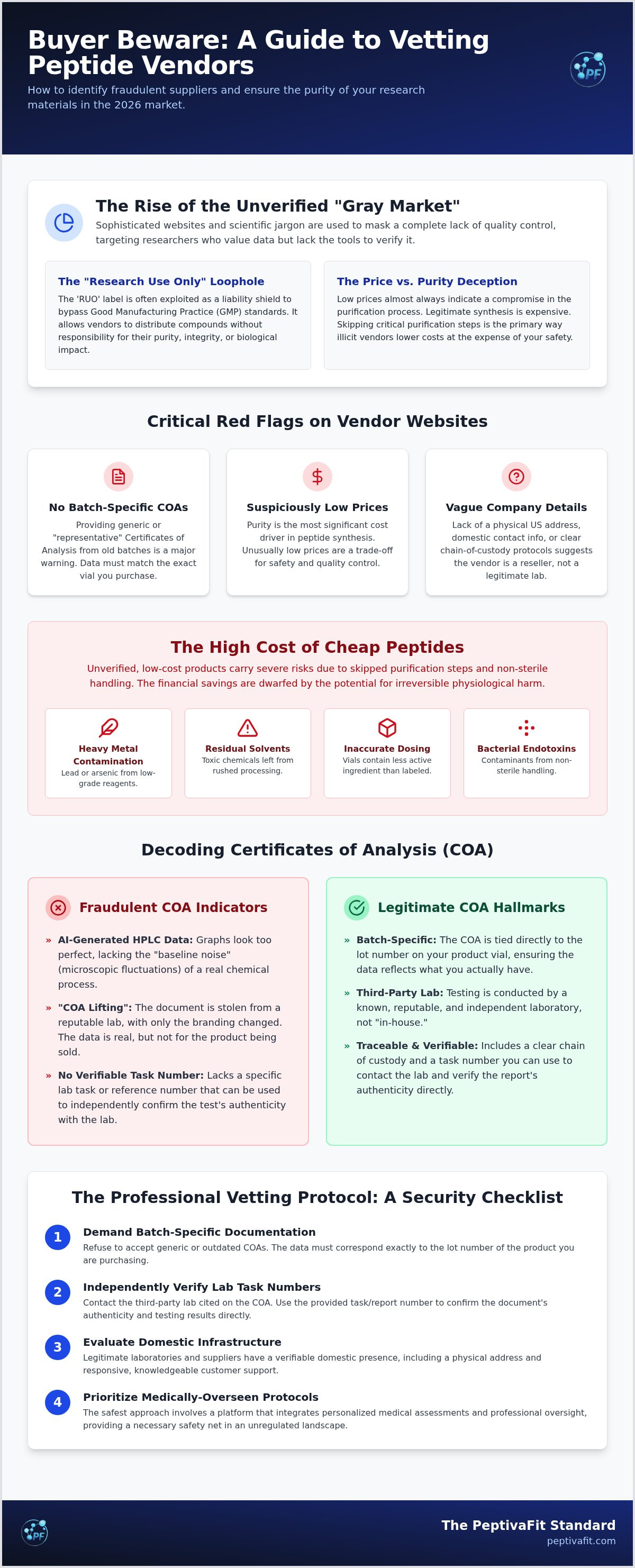
The "Gray Market" in 2026 has evolved into a sophisticated ecosystem designed to evade regulatory scrutiny while projecting an image of clinical legitimacy. This sector operates in the space between legitimate pharmaceutical compounding and illicit manufacturing. The risks are systemic. Vendors often utilize high-end web design and scientific terminology to mask a complete lack of internal quality control. This mimicry is one of the most dangerous red flags for peptide websites, as it targets individuals who value data but lack the tools to verify it. Selecting a supplier based on price-per-milligram is a flawed strategy. It fails to account for the specialized expertise and resource-heavy nature of chemical peptide synthesis, where purity is the most significant cost driver.
The 'Research Use Only' Legal Loophole
The "Research Use Only" (RUO) designation is frequently exploited as a liability shield rather than a legitimate regulatory category. While the FDA has intensified its focus on "intended use" throughout 2026, many vendors still hide behind RUO labels to avoid the rigorous standards of Good Manufacturing Practice (GMP). This terminology allows unscrupulous entities to distribute compounds without assuming responsibility for their structural integrity or biological impact. It’s a calculated attempt to bypass the safety protocols that govern human-grade materials. For any serious researcher, lab tested peptides are the only acceptable standard. An RUO label without accompanying, verifiable third-party data is a signal of operational opacity.
The High Cost of Cheap Peptides
Competitive pricing in this industry often indicates a compromise in the purification process. Legitimate synthesis requires multiple rounds of High-Performance Liquid Chromatography (HPLC) to remove byproducts and truncated sequences. When these steps are skipped to lower costs, the result is a contaminated product. A lower price point is almost always a trade-off for safety. In a field where biological precision is paramount, the financial savings of a cheap supplier are dwarfed by the potential for irreversible physiological harm.
Risks associated with low-cost, unverified peptides include:
- Heavy metal accumulation: Lead or arsenic introduced via low-grade reagents.
- Residual solvents: Toxic chemicals like acetonitrile left behind by rushed lyophilization.
- Inaccurate dosing: Significant variance between the label and the actual content.
- Bacterial endotoxins: Contaminants introduced during non-sterile handling or packaging.
You don't want to discover that your research was compromised by a vendor who prioritized profit over purity. Identifying these vulnerabilities early is the only way to maintain the integrity of your metabolic optimization protocol.
Technical Red Flags: Identifying Fraudulent Certificates of Analysis (COA)
The Certificate of Analysis (COA) functions as the only technical barrier between a researcher and a potentially toxic compound. In the 2026 market, many vendors treat these documents as marketing collateral rather than scientific proof. One of the most glaring red flags for peptide websites is the presentation of "representative" COAs. These are generic reports from years past that do not reflect the specific batch you are purchasing. A legitimate vendor must provide batch-specific data that correlates exactly with the product in your possession. Without this link, the document is statistically irrelevant.
Forgery methods have moved beyond simple Photoshop edits into AI-driven data generation. Scammers often engage in "COA lifting," where they steal a report from a reputable competitor and replace the branding. This practice is a primary reason the FDA Warning on Unapproved Peptides highlights the danger of unverified marketing claims. A document is only as valid as its source; if the vendor cannot prove a direct chain of custody from the lab to the vial, the purity claims are void.
Spotting AI-Generated HPLC Chromatograms
Real-world High-Performance Liquid Chromatography (HPLC) is a physical process involving friction, pressure, and chemical interaction. This results in "baseline noise," appearing as microscopic fluctuations in the graph. AI-generated chromatograms often lack this entropic detail. If a graph shows perfectly symmetrical peaks and a silent, flat baseline, it was likely rendered by software rather than a physical detector. Too-perfect data is a hallmark of fraud in 2026. You can further secure your research by insisting on lab tested peptides that display natural baseline variance.
Verifying Lab Credentials with Third-Party Databases
Legitimate laboratories like Janoshik Analytical, MZ Biolabs, and ACS Lab maintain searchable databases to combat forgery. You should never accept a PDF at face value. Use the unique task number or QR code to verify the report on the laboratory's own secure portal. A "Ghost Lab" red flag occurs when the testing facility has no independent digital presence, physical address, or contact information. If you cannot independently verify the lab's credentials, the report is a fabrication.
Cross-Referencing Mass Spectrometry Data
Mass Spectrometry functions as the fingerprint of molecular identity. This analytical technique measures the mass-to-charge ratio of the peptide to confirm its chemical structure. You must cross-reference the reported molecular weight on the COA with the known sequence of the peptide. If the Mass Spec data shows a deviation beyond a fraction of a Dalton, the substance is either degraded or an entirely different compound. This verification ensures that the molecular "fingerprint" matches the intended research target without exception.
Infrastructure Indicators: Distinguishing Resellers from Legitimate Labs
The physical and digital infrastructure of a vendor provides a window into their operational integrity. Most consumers fail to distinguish between a primary laboratory and a simple reseller. This lack of distinction is among the most overlooked red flags for peptide websites. A reseller operates as a middleman, often never touching the product they sell. This creates a dangerous break in the chain of custody. Without direct oversight of the manufacturing environment, these entities cannot guarantee that the storage temperatures or handling protocols meet clinical standards.
Legitimate vendors in 2026 maintain a transparent domestic presence. This includes a verifiable physical address and multiple channels of professional communication. If a website about page is filled with generic stock imagery and lacks specific details about their facility or leadership, you're likely dealing with a shell company. High-level customer support is another indicator of credibility. A clinical-grade provider employs staff capable of discussing molecular weights and salt concentrations, rather than just order status. They operate with a sense of responsibility that a simple e-commerce reseller cannot replicate.
The Dropshipping Trap
Many modern peptide sites are merely front-ends for unverified overseas factories. You can identify these by monitoring shipping logistics. Extremely long lead times or tracking numbers that originate from non-domestic hubs are significant red flags for peptide websites. These vendors often have no insight into the batch-to-batch variance of their supply. This lack of data makes it impossible to follow a precise protocol. For instance, understanding how to reconstitute peptides safely requires knowing the exact purity and salt content of the source. Without this information, you risk creating a solution with incorrect osmolarity or unstable pH levels.
Payment Method Irregularities
The financial behavior of a vendor often mirrors their regulatory compliance. Historically, the peptide market relied on anonymous payment gateways. In 2026, the shift toward secure, professional merchant processing distinguishes legitimate players from high-risk entities. A vendor that exclusively accepts non-reversible payment methods, such as cryptocurrency or Zelle, is a major concern. These methods facilitate exit scams where a vendor disappears after a large volume of sales. Legitimate organizations invest in the infrastructure required to maintain traditional banking relationships. This subjects them to higher levels of financial oversight and accountability, protecting you from total loss.
The Professional Vetting Protocol: A Step-by-Step Security Checklist
The vetting process requires a transition from passive consumption to active investigation. You must adopt a systematic approach to isolate elite suppliers from high-risk entities. This protocol serves as your primary defense against the red flags for peptide websites identified in previous sections. A disciplined researcher never assumes quality based on a professional user interface. Instead, they demand technical proof and operational transparency.
- Step 1: Request batch-specific COAs before any financial commitment. Legitimate vendors maintain an accessible library of current reports for every product in their inventory.
- Step 2: Independently verify the COA task number. Contact the named laboratory directly to authenticate the data. If the lab cannot confirm the report, the vendor is fraudulent.
- Step 3: Analyze clinical depth. A professional site prioritizes data, molecular structure, and stability profiles over aggressive marketing claims or lifestyle imagery.
- Step 4: Audit community reputation. Search verified research forums for consistent reports of third-party testing failures or shipping irregularities originating from non-domestic hubs.
- Step 5: Ensure the vendor provides or requires a medical assessment. A supplier that operates without clinical oversight is ignoring the fundamental safety requirements of peptide research.
Auditing the Digital Footprint
Investigate the backend of the operation to ensure you aren't dealing with a transient entity. Use WHOIS data to determine the domain age. A website registered within the last six months is a significant risk, as "pop-up" sites frequently appear to liquidate sub-standard stock before disappearing to avoid legal repercussions. Branding must be consistent across all platforms. Discrepancies between social proof and laboratory reports often indicate "COA lifting" from reputable competitors. Be cautious of the "free sample" trap. Legitimate laboratories operate with high overhead due to synthesis and purification costs. They rarely offer unsolicited free products, as this practice is often a tactic used to offload contaminated or degraded batches.
Interrogating Customer Support
Technical competence is a non-negotiable requirement for any supplier. Ask specific questions regarding the trifluoroacetate (TFA) content or the specific lyophilization parameters used during production. Vague or evasive responses regarding storage temperatures and long-term stability are critical red flags for peptide websites. Professional oversight is essential when researching peptides for metabolism and fat loss to ensure molecular integrity is maintained throughout the protocol. If you require a higher standard of verification and professional guidance, you can access the Peptiva Protocol to secure lab-verified supplies and clinical support.
The Peptiva Standard: Integrated Medical Oversight and Lab Verification
The identification of red flags for peptide websites is a defensive necessity, but true optimization requires an offensive strategy rooted in clinical precision. PeptivaFit operates as a restricted entity for individuals who demand more than just a verified vial. The PeptivaFit Protocol bridges the gap between raw research chemicals and actionable physiological results by integrating lab-verified supplies with professional oversight. This is a disciplined environment where data replaces guesswork, ensuring that every intervention is supported by structural integrity and metabolic logic. We don't just sell compounds; we provide a high-level framework for those who are serious about their performance and wellness.
A personalized medical assessment serves as the ultimate safeguard against the systemic failures of the unregulated market. While other vendors focus on the transaction, we prioritize the individual's baseline health markers and long-term goals. This assessment is not a formality; it's a clinical requirement that ensures the protocol is tailored to your specific metabolic profile. By establishing this high-level entry point, we maintain an atmosphere of exclusivity and safety that is absent in mass-market retail. We serve a disciplined, high-performance demographic that understands that biological shortcuts are only viable when backed by rigorous data.
Beyond the Vial: The Power of the Protocol
A peptide is only as effective as the framework surrounding its use. The PeptivaFit Protocol provides more than just access to lab-tested compounds. It offers a comprehensive system for metabolic monitoring that ensures your research yields measurable, safe results. Our 1-on-1 coaching ensures that laboratory data is translated into actionable progress. We monitor specific metabolic markers to ensure that fat loss is achieved without compromising lean tissue or endocrine health. This level of clinical-grade guidance is the only way to navigate the complexities of advanced self-optimization with absolute confidence.
Your Path to Metabolic Optimization
Transitioning from a state of searching for vendors to executing a protocol represents a shift in maturity and intent. A science-backed approach to body composition requires a commitment to data and a rejection of the high-risk shortcuts discussed throughout this guide. Your research deserves a foundation of absolute certainty. Don't leave your biological integrity to chance by ignoring the red flags for peptide websites that lead to contamination and financial loss. Apply for the PeptivaFit Protocol and secure your medical assessment today to ensure your journey meets the highest clinical standards.
Elevating Your Standards for Biological Integrity
Navigating the 2026 peptide market requires more than just caution; it demands a technical vetting protocol that prioritizes data over marketing. You now understand that identifying red flags for peptide websites involves deep analysis of HPLC baseline noise, domestic infrastructure, and the validity of third-party laboratory task numbers. This discipline ensures that your research is built on a foundation of structural purity rather than the opacity of "research use only" loopholes. True optimization is never found in the bargain bin of unverified vendors; it's the result of rigorous verification.
At PeptivaFit, we eliminate these variables by providing independent lab verification for every batch and integrating personalized medical oversight into our core offering. This exclusive environment is designed for those who value elite results through disciplined, data-driven protocols. Our 1-on-1 coaching ensures that your progress is both safe and actionable. Secure your metabolic future with the lab-verified Peptiva Protocol and gain access to the clinical expertise required for true metabolic optimization. Your commitment to safety is the first step toward superior performance.
Frequently Asked Questions
Is it legal to buy peptides online in 2026?
Buying peptides online for human use remains a complex regulatory area in 2026. While the FDA Pharmacy Compounding Advisory Committee recently recommended six peptides for the 503A bulk drug list, many others remain restricted. Purchasing compounds labeled "Research Use Only" for personal administration violates federal "intended use" doctrines. You must ensure your source operates within the legal framework of professional compounding or authorized clinical research to avoid significant liability.
How can I tell if a peptide COA has been Photoshopped?
Authenticating a Certificate of Analysis requires looking for microscopic fluctuations in the HPLC chromatogram. A digitally manipulated report often displays a perfectly flat baseline or symmetrical peaks that lack the natural entropy of physical chemical testing. You should also check for font inconsistencies or alignment issues in the document header. The most reliable method is to cross-reference the unique task number directly with the laboratory's secure database.
What are the most common contaminants found in 'gray market' peptides?
Common contaminants in the unregulated market include heavy metals like lead and arsenic, which are often introduced via low-grade reagents. Residual solvents such as acetonitrile may remain if the lyophilization process was rushed or incomplete. Additionally, bacterial endotoxins can compromise a batch if handling occurs in non-sterile environments. Identifying these risks is one of the primary reasons to monitor red flags for peptide websites before initiating any procurement.
Why do some peptide websites only accept cryptocurrency?
Reliance on non-reversible payment methods like cryptocurrency is a strategy used by high-risk vendors to evade financial monitoring. Legitimate 2026 suppliers invest in professional merchant processing to provide accountability and buyer protection. Anonymous gateways allow "pop-up" sites to liquidate sub-standard inventory and disappear before legal repercussions can occur. A vendor's refusal to use transparent banking systems is a significant indicator of operational instability and potential fraud.
Can I trust 'verified' reviews on a vendor's own website?
Internal website reviews are frequently curated or entirely fabricated to create a false sense of clinical authority. These testimonials lack the verification of independent third-party platforms and often use AI-generated language to mimic genuine user experiences. You should prioritize data-driven evidence, such as batch-specific lab reports, over subjective marketing claims. A disciplined researcher relies on verifiable chemical analysis rather than the unverified praise found on a vendor's storefront.
What should I do if I suspect I have purchased a counterfeit peptide?
If you suspect a product is counterfeit, you must immediately discontinue its use to prevent physiological harm. Secure the vial and any accompanying documentation for potential independent testing. You should also report the vendor to regulatory bodies like the FDA or FTC, especially if they used deceptive advertising or forged lab data. Transitioning to a medically-overseen protocol is the only way to ensure your future supplies meet clinical standards.
Does a high price always guarantee better peptide quality?
A high price point isn't a definitive guarantee of structural purity. Some fraudulent vendors intentionally inflate costs to create a "premium" facade that masks a lack of laboratory verification. Conversely, extremely low prices often signal that the manufacturer skipped essential purification steps like multiple rounds of HPLC. You must evaluate a supplier based on their technical transparency and chain-of-custody protocols rather than using retail price as a proxy for quality.
Why is a medical assessment necessary before starting a peptide protocol?
A medical assessment is the only way to ensure a peptide protocol doesn't conflict with your existing health markers or endocrine balance. Professional oversight allows for the monitoring of metabolic variables that can't be assessed through self-administration alone. This process identifies potential contraindications and ensures that your research leads to safe, actionable progress. It's a necessary step to avoid the red flags for peptide websites that prioritize sales over safety.

![Shelf Life of Reconstituted Peptides: A Clinical Reference Guide [2026]](https://getautoseo.com/storage/hero_images/shelf-life-of-reconstituted-peptides-a-clinical-reference-guide-2026.jpg?v=b8ed5173acaa)
