

The most effective way to accelerate fat loss with peptides is often to stop taking them entirely. You've likely experienced the frustration of initial success followed by a sudden, unexplained plateau where your results simply vanish. This diminishing return isn't a failure of your discipline; it's a biological defense mechanism known as receptor desensitization. When you implement peptide cycling for fat loss without a clinical framework, you risk overwhelming your somatotropic axis and triggering pituitary fatigue. You deserve a strategy that values data over hype and scientific precision over common "bro-science" myths.
We understand that you're serious about your performance and demand a sophisticated level of control over your metabolic health. This article outlines how to master strategic scheduling to prevent hormonal suppression and maximize long-term fat loss results. We'll preview the biological necessity of rest phases and how professional oversight ensures your receptors remain responsive. By the end of this guide, you'll understand how our Peptiva Protocol, 1-on-1 coaching, and personalized medical assessments provide the lab-verified structure needed for sustainable metabolic optimization.
Key Takeaways
- Establish the biological necessity of strategic washout periods to prevent receptor desensitization and maintain long-term metabolic sensitivity.
- Analyze how precise pulse management of GHRH and GHRP protects the somatotropic axis from entering a refractory state.
- Evaluate the specific clinical applications of short-term and macro-cycle protocols to optimize peptide cycling for fat loss results.
- Identify the essential biomarkers, including IGF-1 and HbA1c, required for rigorous data-driven monitoring of metabolic flux and insulin sensitivity.
- Implement a professional clinical framework through the Peptiva Protocol to ensure your adjustments are guided by 1-on-1 expert coaching and lab-verified data.
The Biological Imperative for Peptide Cycling in Fat Loss
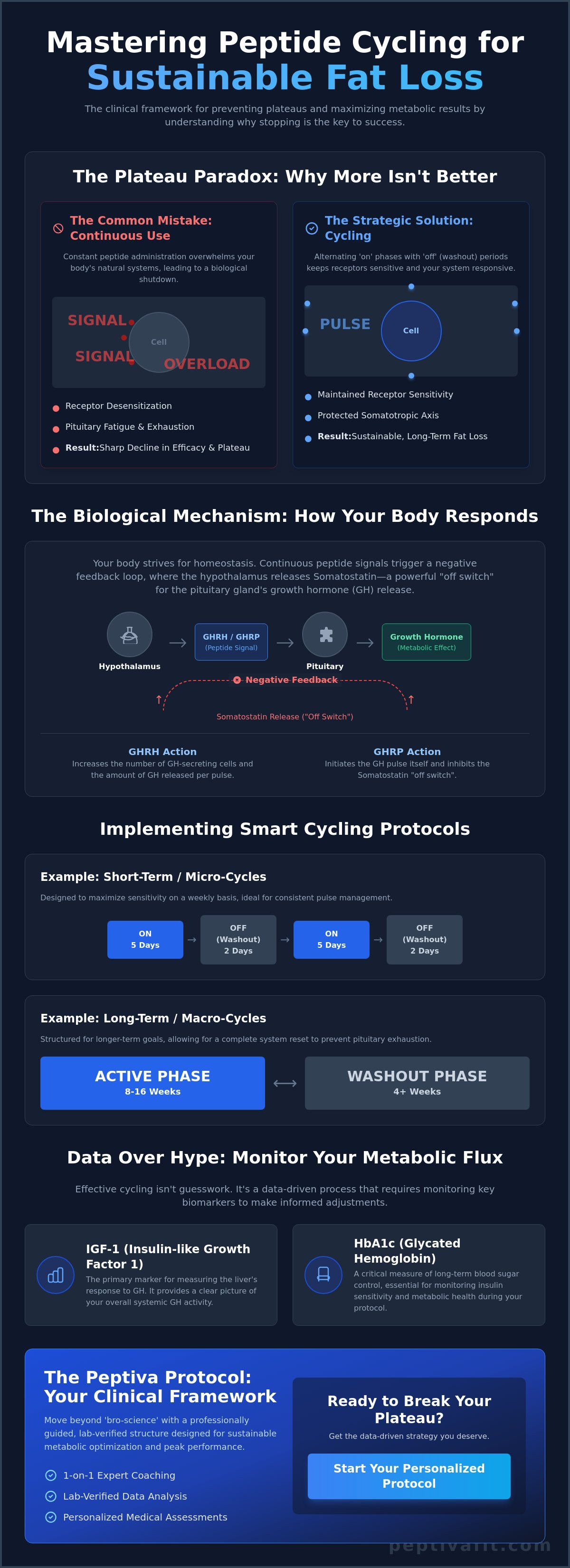
Peptide cycling for fat loss is defined as the strategic alternation between active administration phases and structured washout periods. It is not merely a suggestion for longevity; it is a physiological requirement for maintaining metabolic responsiveness. When the body is introduced to exogenous signaling molecules, it naturally seeks to preserve biological homeostasis. This self-regulating state is the primary reason why many individuals experience a sharp decline in efficacy after the initial weeks of a new protocol. Without a clinical framework to manage these signals, the body perceives the constant presence of peptides as a disruption and initiates a series of counter-regulatory measures to neutralize their effect.
Chronic exposure to these compounds often leads to receptor downregulation, a process technically known as internalization. In this state, the target cells physically remove receptors from their surface, pulling them into the cytoplasm where they cannot be activated. This differs significantly from peptides used for localized tissue repair, where constant signaling may be tolerated for short durations to facilitate healing. For systemic fat loss, which relies on the delicate somatotropic axis, this "blunting" effect renders further administration useless and potentially counterproductive. Mastery of these cycles ensures that your cellular receptors remain sensitive to every dose.
Understanding Receptor Desensitization and Refractory Periods
G-protein coupled receptors (GPCRs) are the molecular gatekeepers that respond to Growth hormone secretagogues (GHSs). When these receptors are stimulated without reprieve, they undergo a phosphorylation process that leads to desensitization. This triggers a refractory period, a biological window where the cell is incapable of responding to further peptide signals regardless of the dosage used. During this time, continuing your protocol yields zero metabolic benefit. It's vital to distinguish between systemic fatigue, which affects your overall energy, and localized receptor saturation, which specifically halts lipolysis at the cellular level. Strategic cycling allows these receptors to recycle back to the cell surface, restoring your body's ability to mobilize adipose tissue.
Homeostasis: The Enemy of Sustained Lipolysis
The human body is exceptionally proficient at adjusting growth hormone pulse frequency to maintain its preferred baseline. When you introduce secretagogues, the hypothalamus monitors the resulting rise in growth hormone and responds by increasing the secretion of somatostatin. Somatostatin acts as a powerful "off switch" for the pituitary gland. This negative feedback loop explains why increasing your dose often leads to less fat loss over time; the more you push the system, the harder the body pushes back. Professional peptide cycling for fat loss accounts for this hormonal counter-regulation by incorporating specific breaks that lower somatostatin levels. This disciplined approach prevents the pituitary from entering a state of exhaustion, ensuring that each administration phase produces a robust and effective metabolic pulse.
Mechanism of Action: Protecting the Somatotropic Axis
Optimization of the metabolic landscape requires a sophisticated understanding of the mechanism of the somatotropic axis. This complex system, involving the hypothalamus and the pituitary gland, governs the production and release of growth hormone (GH). Effective peptide cycling for fat loss relies on the synergy between Growth Hormone Releasing Hormones (GHRH) and Growth Hormone Releasing Peptides (GHRP). While GHRH increases the number of secreting cells and the amount of GH per pulse, GHRP initiates the pulse itself by inhibiting somatostatin. Together, they create a physiological response that is significantly more potent than the sum of their individual parts.
The pituitary gland functions as a finite biological reservoir. It stores synthesized growth hormone in specialized secretory granules. If this reservoir is stimulated incessantly through chronic administration, the gland's ability to replenish its stores is outpaced by the demand for release. This leads to a state of secretory exhaustion. Clinical tesamorelin dosage protocols are specifically designed to respect these biological limits by utilizing pulse management. Furthermore, the efficacy of these pulses depends entirely on the chemical stability of the compounds used. Precise peptide reconstitution is mandatory to preserve the delicate amino acid chains, as degraded molecules cannot effectively bind to their target receptors.
GHRH Analogs vs. GHRP Secretagogues: Cycling Nuances
Different analogs require distinct cycling strategies to maintain sensitivity. GHRH analogs like CJC-1295 can cause a phenomenon known as "GH Bleed" if used incorrectly. This is a state where growth hormone levels remain chronically elevated rather than following a natural pulsatile rhythm. This constant elevation can lead to insulin resistance and reduced lipolytic efficiency. Peptide cycling for fat loss mitigates this risk by incorporating washout periods that reset the pituitary threshold. These breaks allow the somatotropic axis to return to its baseline, ensuring that the next administration phase remains highly effective. For those seeking a structured approach to these biological variables, a personalized medical assessment can provide the necessary baseline data for long-term success.
Targeted Lipolysis: HGH Frag 176-191 and AOD-9604
Certain peptides operate through non-hormonal pathways to accelerate fat oxidation. HGH Fragment 176-191 and AOD-9604 target the beta-3 adrenergic receptors on adipocytes directly, bypassing the pituitary gland entirely. While these fragments don't risk pituitary fatigue, they still benefit from metabolic rest periods to prevent the body from adapting to the lipolytic signal. When stacked with secretagogues during an active cycle, these compounds provide a multi-layered approach to adipose tissue reduction. However, even these targeted agents require a disciplined schedule to ensure that the body's fat-burning machinery doesn't become refractory to the exogenous signal.
Standard vs. Advanced Cycling Protocols for Fat Loss
Implementing an effective strategy for peptide cycling for fat loss requires moving beyond generic recommendations toward data-driven scheduling. The most common framework is the 5 Days On, 2 Days Off protocol, which is primarily utilized for moderate body recomposition and maintenance. For individuals targeting significant adipose tissue reduction, an advanced macro-cycle of 12 Weeks On, 4 Weeks Off provides the necessary duration to shift metabolic setpoints. Alternatively, the Pulse method involves three weeks of high-intensity administration followed by one week of complete cessation to prevent the somatotropic axis from reaching a refractory state. Success with any protocol depends heavily on administration timing; peptides should ideally be delivered in a fasted state or immediately prior to fasted cardio to leverage the synergistic effect of low insulin levels on growth hormone release.
The 5/2 Protocol: Maintenance and Sensitivity
A 48-hour washout period is typically sufficient to restore receptor sensitivity for most users following a moderate-dose regimen. This two-day break prevents the chronic elevation of somatostatin, ensuring that the pituitary gland remains responsive to the next week's signals. It's common to experience a psychological dip during off-days as the acute metabolic boost recedes; however, maintaining disciplined nutritional standards is critical. During this washout, caloric intake should remain stable, focusing on high-protein distribution to preserve lean mass while the body recalibrates its endogenous hormonal production. This protocol serves as a baseline for those prioritizing long-term stability over aggressive transformation.
Advanced Macro-Cycling: The 12-Week Transformation
Structuring a full 90-day transformation requires a more rigorous approach to peptide cycling for fat loss. This macro-cycle allows for deep metabolic flux, but it demands a mandatory four-week hard reset upon completion to ensure total hormonal recovery. Users must remain vigilant for signs of plateauing, which frequently emerge around the eight-week mark as the body's homeostatic mechanisms begin to override the exogenous signals. If fat loss stalls despite consistent protocol adherence, it often indicates receptor saturation rather than a need for higher dosages. In these instances, a premature washout period may be more effective than continuing the cycle. For those managing complex cycles, professional oversight is necessary to identify these subtle physiological shifts and adjust the protocol in real-time.
Monitoring Metabolic Flux: Data-Driven Cycle Management
Subjective feedback is an insufficient metric for managing a sophisticated metabolic intervention. To ensure that peptide cycling for fat loss remains both safe and effective, practitioners must rely on objective laboratory data. The primary marker for assessing the efficacy of growth hormone secretagogues is Insulin-like Growth Factor 1 (IGF-1). While growth hormone pulses are transient and difficult to capture, IGF-1 provides a stable reflection of your systemic somatotropic activity. Monitoring this value allows for precise adjustments to administration frequency, ensuring that your levels remain within an optimized physiological range without inducing receptor burnout.
Data dictates the cycle. Beyond IGF-1, rigorous monitoring of fasting blood glucose and HbA1c is mandatory to prevent the development of transient insulin resistance. Growth hormone naturally antagonizes insulin; therefore, chronic stimulation without structured washout periods can lead to elevated blood sugar levels. Establishing a baseline through personalized medical assessments before initiating any protocol is the only responsible way to proceed. This clinical oversight ensures that your fat loss journey doesn't inadvertently compromise your long-term metabolic health. If you're ready to transition from guesswork to a scientifically validated framework, book a personalized medical assessment to secure your baseline data.
Essential Blood Work Markers for Peptide Users
A comprehensive blood panel serves as the diagnostic compass for your cycle. IGF-1 tracking confirms that your secretagogues are successfully signaling the liver and peripheral tissues. Simultaneously, measuring fasting insulin helps detect early-stage metabolic interference before it manifests as weight gain or fatigue. High levels of C-Reactive Protein (CRP) can indicate systemic inflammation, which often blunts the lipolytic response. By analyzing these markers every 8 to 12 weeks, you can determine if your current washout period is sufficient or if a longer macro-cycle reset is required to maintain sensitivity.
Mitigating Side Effects through Strategic Cycling
Clinical peptide cycling for fat loss is the most effective tool for managing common side effects like peripheral edema and carpal tunnel-like tingling. These symptoms often stem from excessive water retention caused by sodium sparing effects of growth hormone. When these symptoms arise, it's a clear signal that the somatotropic axis is overstimulated. Strategic breaks allow for the normalization of prolactin and cortisol, which can sometimes drift upward during intensive cycles. During these off-phases, many users incorporate BPC-157 to support systemic recovery and maintain tissue integrity. This disciplined approach ensures that side effects remain manageable and that the primary focus stays on sustainable adipose tissue reduction.
Implementing the Peptiva Protocol for Fat Loss
Mastering the biological variables of peptide cycling for fat loss requires a transition from fragmented experimentation to a unified clinical framework. The Peptiva Protocol serves as this definitive structure, consolidating the science of receptor sensitivity and metabolic timing into an actionable guide. While understanding the theory of washout periods is essential, the practical application often requires real-time calibration based on individual physiological feedback. This is where 1-on-1 coaching becomes indispensable, providing the expert oversight necessary to adjust dosages and cycle lengths as your metabolic flux evolves. By utilizing lab-tested peptides, you eliminate the volatility associated with unverified sources, ensuring that every administration delivers the precise molecular signal required for adipose tissue oxidation.
The shift from "research" use to a structured optimization journey is a hallmark of the mature practitioner. This process begins with a rigorous evaluation of your current metabolic state and long-term objectives. A disciplined approach to peptide cycling for fat loss is not about finding a quick fix; it's about establishing a sustainable rhythm that respects your body's homeostatic limits. Through professional guidance, you can navigate the complexities of secretagogue synergy and pulse management with confidence. This level of sophisticated control is only possible when your protocol is built on a foundation of data and clinical experience rather than anecdotal evidence.
Why Lab-Verified Purity is Non-Negotiable
The use of "research-grade" peptides from unregulated vendors introduces significant risks that can compromise your entire cycle. Contaminated or under-dosed compounds don't just fail to produce results; they often trigger systemic immune responses. These inflammatory reactions can lead to the formation of anti-drug antibodies, which effectively neutralize the peptide and ruin future receptor sensitivity. PeptivaFit maintains a strict commitment to third-party lab verification to ensure molecular integrity. This standard of purity is the baseline for predictable outcomes, allowing you to focus on optimization rather than troubleshooting the quality of your supplies. High-purity compounds ensure that the binding affinity at the receptor site remains optimal throughout your active phase.
Next Steps: Consultation and Protocol Design
Your journey toward metabolic optimization begins with a clear choice between targeted advice and comprehensive management. A single consultation call is ideal for those seeking specific answers on protocol structure or administration timing. For those requiring a deeper level of integration, our 1-on-1 coaching provides continuous support and data analysis throughout your macro-cycles. Before your session, it's vital to prepare a detailed medical history to facilitate a professional metabolic assessment. This data-driven approach ensures your strategy is tailored to your unique hormonal profile. Embark on a disciplined, scientific-grade fat loss journey today by securing your personalized medical assessment.
Advancing Toward Clinical Metabolic Mastery
The transition from superficial advice to a clinical framework is the only path to sustainable results. You now understand that peptide cycling for fat loss is a biological requirement to protect the somatotropic axis and prevent receptor internalization. By respecting homeostatic thresholds and utilizing structured washout periods, you maintain the cellular sensitivity necessary for continuous lipolysis. Success in this specialized field demands more than simple administration; it requires rigorous data monitoring through IGF-1 tracking and metabolic assessments.
Maintaining molecular integrity and precise dosing is non-negotiable for individuals serious about their performance. Our methodology provides the scientific-grade standards and professional guidance needed to navigate these physiological complexities. Optimize your metabolic cycle with The Peptiva Protocol to leverage lab-verified molecular purity, clinical-grade dosing protocols, and expert 1-on-1 medical oversight. You possess the intellectual foundation to exercise sophisticated control over your wellness. We're ready to assist as you commit to a more disciplined and data-driven metabolic future.
Frequently Asked Questions
Is it necessary to cycle all peptides used for fat loss?
Cycling is mandatory for any peptide that signals the pituitary gland or mimics growth hormone releasing hormones. While some non-hormonal fragments are less prone to immediate feedback loops, the body eventually adapts to any exogenous metabolic signal. Strategic peptide cycling for fat loss ensures that your adipose tissue remains responsive to lipolytic triggers. Without these breaks, you risk permanent receptor internalization and a complete loss of protocol efficacy. This disciplined approach is essential for long-term transformation.
Can I stay on CJC-1295 and Ipamorelin indefinitely if I feel good?
Continuous administration is not recommended because the somatotropic axis requires periods of rest to maintain its signaling integrity. Even if you feel energetic, your receptors are undergoing a process of desensitization that will eventually halt your fat loss progress. Prolonged use without washout periods can also lead to chronic elevations in somatostatin; this peptide acts as a biological brake on your natural growth hormone production. Disciplined scheduling is the only way to ensure long-term metabolic optimization.
What happens to my fat loss progress during the 'off' weeks of a cycle?
Your progress won't reverse during washout periods if your nutritional and training standards remain consistent. Instead, the body uses this time to clear exogenous molecules and reset its homeostatic setpoint. While you may notice a slight reduction in water retention or the acute metabolic boost associated with secretagogues, your fat oxidation rate remains influenced by the previous weeks of administration. These breaks are a biological investment that ensures the next phase of your cycle is as effective as the first.
Does peptide cycling prevent permanent suppression of natural growth hormone?
Structured breaks allow the body's natural negative feedback loop to recalibrate and maintain endogenous production. Unlike exogenous growth hormone, which can lead to significant suppression, secretagogues work by encouraging your pituitary to release its own stores. However, constant stimulation can still exhaust these reservoirs. Peptide cycling for fat loss protects the pituitary gland's long-term health by ensuring it isn't forced to operate at a super-physiological level indefinitely. This maintains the integrity of your natural hormonal rhythms.
How do I know if my receptors are desensitized and I need a break?
The most reliable indicator of receptor desensitization is a sudden plateau in fat loss despite no changes in your diet or activity levels. You might also notice a disappearance of minor side effects, such as the transient tingling in your hands or mild water retention; this suggests the body is no longer responding to the signal. Laboratory markers like elevated fasting blood glucose or a stagnant IGF-1 level also provide clinical confirmation that a washout period is necessary.
Can I switch peptides during a cycle to avoid desensitization?
Switching between different GHRH analogs or GHRP secretagogues is ineffective because they often target the same receptor sites. For example, moving from Ipamorelin to GHRP-2 won't reset your sensitivity since both compounds act on the ghrelin receptor. You can only avoid desensitization by switching to a compound that utilizes an entirely different metabolic pathway, such as moving from a secretagogue to a direct lipolytic fragment. However, even these combinations eventually require a complete systemic break to remain effective.
Are there specific supplements that support receptor sensitivity during a cycle?
Optimizing receptor sensitivity often involves managing the secondary metabolic effects of growth hormone, particularly insulin resistance. Supplements like Berberine or Alpha Lipoic Acid can help maintain healthy blood glucose levels; this indirectly supports the efficacy of your peptide protocol. Additionally, ensuring adequate magnesium and zinc intake supports the underlying enzymatic processes required for peptide signaling. These interventions should complement your clinical protocol rather than replace the necessity of structured and disciplined washout periods.
How long should a 'washout' period last for maximum effectiveness?
The duration of your washout period must be proportional to the length and intensity of your active administration phase. For a standard weekly protocol, a 48-hour break is typically sufficient to restore receptor sensitivity. If you have completed a 12-week macro-cycle, a minimum of four weeks of complete cessation is required for a full hormonal reset. These timelines ensure that the somatotropic axis has enough time to clear inhibitory somatostatin and return to its baseline signaling state before your next phase.

![Shelf Life of Reconstituted Peptides: A Clinical Reference Guide [2026]](https://getautoseo.com/storage/hero_images/shelf-life-of-reconstituted-peptides-a-clinical-reference-guide-2026.jpg?v=b8ed5173acaa)
