

The most expensive peptide protocol you'll ever buy is the one that fails because it was synthesized in an unverified lab or administered without metabolic data. You've likely noticed that the peptide therapy for weight loss cost fluctuates wildly across the industry, with monthly ranges spanning from $150 to over $1,300. It's frustrating to face a market where "research grade" labels hide behind lower prices while medical clinics bundle hidden fees into opaque subscriptions.
We agree that transparency is a prerequisite for any serious health optimization strategy. This guide provides a disciplined breakdown of the variables that dictate pricing, from molecular purity to the logistical costs of professional oversight. You'll gain a clear framework to evaluate the total cost of ownership for these protocols, including the return on investment found in expert coaching versus the risks of DIY experimentation. We'll examine why pharmaceutical standards matter and how to budget for the diagnostic bloodwork that ensures your safety and long term progress.
Key Takeaways
- Distinguish between high-risk industrial research chemicals and pharmaceutical-grade peptides verified through rigorous HPLC/MS purity testing.
- Identify how specific molecular sequences and manufacturing standards directly dictate the total peptide therapy for weight loss cost.
- Understand why personalized medical assessments and biomarker monitoring are essential investments to prevent wasted capital and metabolic complications.
- Learn to bypass the significant overhead markups of local wellness centers by utilizing direct consultation and foundational protocol education.
- Evaluate the long-term financial ROI of professional 1-on-1 coaching compared to the hidden costs of unguided, trial-and-error experimentation.
The Financial Landscape of Peptide Therapy for Weight Loss
Understanding the peptide therapy for weight loss cost requires a shift from viewing it as a simple retail transaction to viewing it as a multifaceted clinical investment. This financial commitment is composed of three distinct pillars: molecular hardware (the peptides), professional oversight, and foundational education. While some online sources might list generic prices, a high-standard protocol is tailored to specific metabolic pathways. For instance, GLP-1 receptor agonists target insulin sensitivity and satiety, whereas growth hormone secretagogues focus on lipolysis and lean mass preservation. Each pathway carries its own manufacturing complexity and subsequent price point.
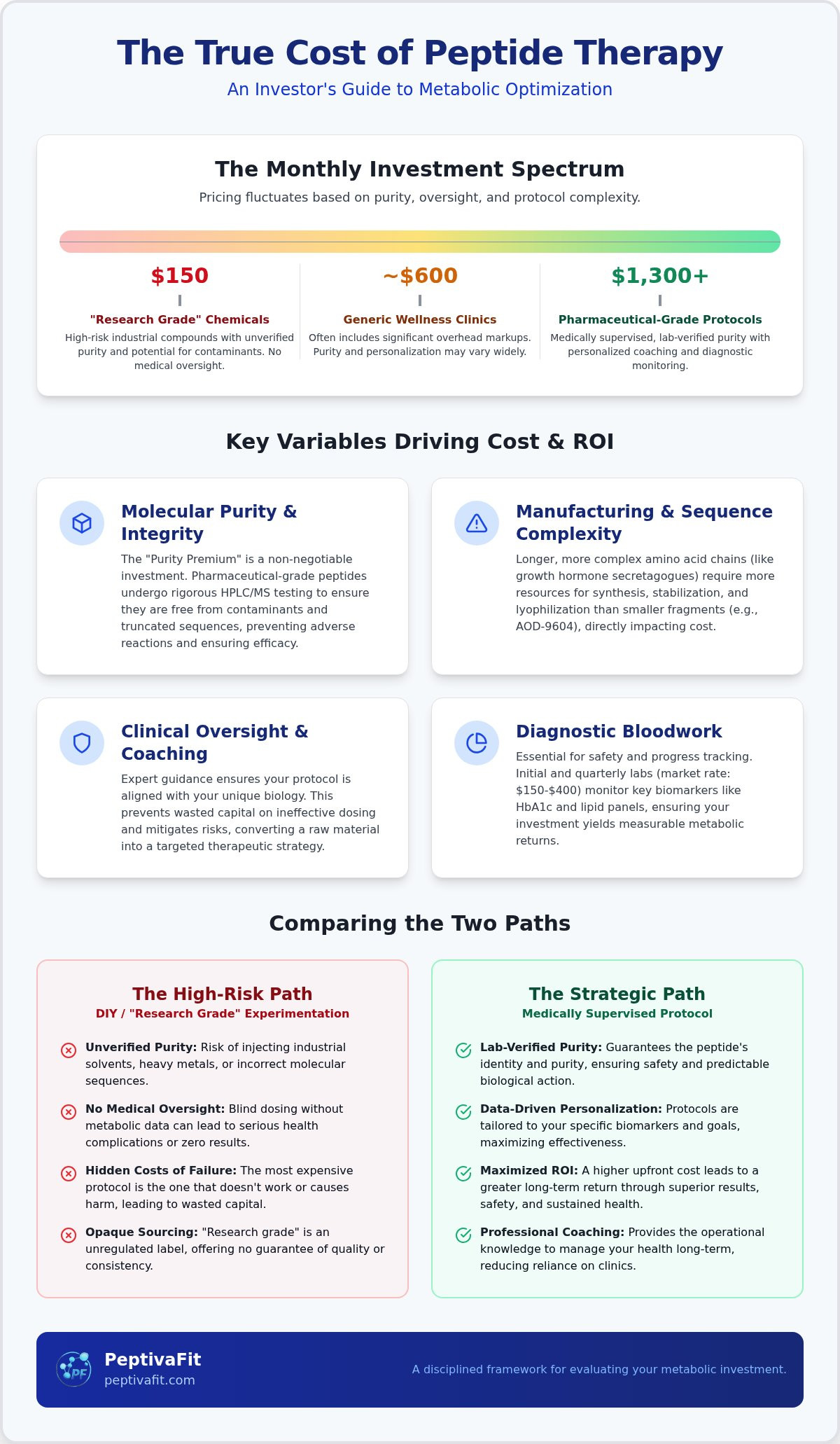
Market data from 2026 indicates that the financial commitment for metabolic optimization varies significantly based on the delivery model. Brand-name pharmaceutical options often see retail list prices exceeding $1,000 per month, creating a barrier for many serious individuals. Conversely, precision research protocols and compounded options offer a different financial profile, though they require more rigorous verification of molecular integrity. It's vital to recognize that "weight loss" is an umbrella term; a protocol designed for a 15% reduction in total body mass requires different capital allocation than one focused purely on visceral fat reduction.
Retail Clinics vs. Specialized Health Platforms
Many brick-and-mortar wellness centers operate with significant overhead, including high-traffic real estate and large administrative staffs. These costs are inevitably passed to the patient through inflated membership fees or marked-up vials. In contrast, specialized health platforms prioritize scientific-grade standards and rigorous lab testing over physical amenities. This lean model allows capital to be redirected toward HPLC/MS verification and data-driven monitoring. The current market shows a clear shift toward national digital consultations, which provide elite-level metabolic optimization without the geographic "retail markup" of local clinics.
The Total Cost of Ownership (TCO) Framework
A pragmatic approach to budgeting involves looking beyond the sticker price of a single vial. A true TCO framework includes several critical line items:
- Personalized medical assessment: This is a non-negotiable entry cost. It ensures your biology aligns with the chosen sequence, preventing the financial waste of ineffective, blind dosing.
- Diagnostic bloodwork: Initial and quarterly labs, which can range from $150 to $400 in the general market, are essential for monitoring biomarkers like HbA1c and lipid panels.
- Educational resources: Investing in a structured resource, such as the Peptiva Protocol, provides the operational knowledge needed to manage your metabolic health. This reduces long-term reliance on expensive, repetitive clinic visits.
By prioritizing lab-verified purity and professional coaching over the convenience of local "weight loss storefronts," you ensure that your investment yields a measurable metabolic return.
Key Variables Influencing Peptide Pricing and ROI
Calculating the precise peptide therapy for weight loss cost requires an analysis of molecular architecture and manufacturing standards. Pricing is not arbitrary; it's a direct reflection of the complexity involved in synthesizing specific amino acid chains. A sequence like AOD-9604, a small fragment of the human growth hormone molecule, involves a different synthesis protocol than a full-length secretagogue. The longer and more complex the sequence, the higher the resource requirement for stabilization and lyophilization. Molecular integrity is fragile, and the costs associated with preventing degradation during transport and storage are built into the premium of medical-grade compounds.
Beyond the sequence itself, the "Purity Premium" is a significant driver of the total investment. High-standard providers utilize High-Performance Liquid Chromatography (HPLC) and Mass Spectrometry (MS) to verify that a batch is free from residual solvents and truncated sequences. When evaluating the Cost-Effectiveness of Obesity Treatments, data suggests that the upfront cost of verified purity is a protective measure against the financial and physical toll of adverse reactions. A single consultation call can help clarify which sequence and purity standard aligns with your specific physiological requirements.
Lipolytic Fragments vs. Growth Hormone Secretagogues
Targeted lipolytic fragments, such as Frag 176-191, focus exclusively on fat oxidation without affecting insulin sensitivity or systemic growth hormone levels. This specificity often results in a more moderate cost profile compared to systemic secretagogues like CJC-1295 or Ipamorelin. Stacking these peptides can create metabolic synergy, but it also scales the monthly budget proportionally. The specific requirements for a clinical-grade Tesamorelin dosage represent a high-tier investment due to the intricate regulatory-grade manufacturing processes involved in its synthesis.
The Hidden Costs of Unverified Peptides
Opting for "research grade" peptides from unverified sources introduces significant financial and biological risks. These products often lack third-party lab verification, meaning they may contain heavy metals or bacterial endotoxins. The immediate savings disappear when these impurities cause systemic inflammation or metabolic stalling, leading to expensive corrective medical interventions. Investing in Why Lab-Tested Peptides Are Essential for Safety is the only way to ensure your capital is actually contributing to fat loss rather than health complications. Dosage frequency also plays a role, as individual metabolic rates determine whether a vial lasts twenty days or thirty, directly impacting your recurring peptide therapy for weight loss cost.
Clinical Oversight: A Necessary Investment for Safety
Clinical oversight is often viewed as a secondary expense, yet it remains the most effective hedge against the financial "cost of failure." Many individuals attempt to bypass professional guidance to reduce their immediate peptide therapy for weight loss cost, only to find that unguided protocols lead to metabolic non-responsiveness or adverse reactions. A Forbes analysis of GLP-1 medication costs highlights the significant monthly investment required for these therapies. Without a clinician to adjust dosages based on real-time data, that investment is frequently squandered on sub-optimal metabolic responses. Professional oversight ensures that every milligram of a compound is utilized effectively, maximizing the biological return on your capital.
Establishing a clinical baseline is the only way to measure your metabolic ROI with precision. This process involves more than a cursory glance at a weight scale. It requires a deep dive into specific biomarkers such as fasted insulin, IGF-1, and inflammatory markers. By monitoring these variables, professional oversight ensures that the hardware, the peptides themselves, is being utilized by a biological system that is primed for fat loss. When your internal chemistry is monitored, you avoid the expensive mistake of "blind" dosing, where compounds are administered without knowing if the body's receptors are even responsive.
The Value of Personalized Medical Assessments
A personalized medical assessment serves as a critical gatekeeper in your protocol. These evaluations identify specific contraindications, such as pre-existing thyroid abnormalities or glucose dysregulation, that could transform a standard fat loss cycle into an expensive medical complication. Tailoring the sequence to your specific insulin sensitivity and growth hormone levels ensures that you aren't overpaying for higher dosages than your receptors can actually process. This precision prevents the financial waste associated with using excessive amounts of expensive sequences like Tesamorelin when a more moderate approach might yield better data-driven results.
Single Consultation Calls vs. Long-Term Coaching
For individuals who already possess a baseline understanding of metabolic health, a single consultation call represents the most efficient entry point. This model allows you to secure professional validation of your strategy without being locked into the expensive, high-overhead "package" traps common at local wellness spas. However, for complex metabolic optimization, the financial benefits of 1-on-1 coaching become apparent through accelerated results. Expert guidance reduces the total duration of therapy by optimizing the synergy between peptides and lifestyle variables, ultimately lowering the total peptide therapy for weight loss cost over the entire duration of the protocol. Unlike retail-focused clinics that prioritize physical amenities, specialized platforms focus on the data-driven monitoring necessary for long-term safety and financial efficiency.
Budgeting for Success: How to Allocate Your Capital
Pragmatic financial planning for metabolic optimization requires a shift from impulsive purchasing to strategic capital allocation. The total peptide therapy for weight loss cost isn't merely the sum of the vials on your shelf; it's the aggregate of your educational foundation, your diagnostic monitoring, and your physical supplies. A disciplined approach prioritizes lab-verified purity over the seductive price points of "discount" sources that lack third-party verification. By allocating your budget toward verified sequences, you're investing in a predictable physiological outcome rather than gambling with industrial-grade research chemicals.
A successful "stacking" strategy involves prioritizing peptides based on your primary fat loss goals. For instance, if visceral fat reduction is the priority, your capital might be more effectively directed toward a growth hormone secretagogue. Conversely, if you're focused on immediate lipolysis, a targeted fragment may be the more cost-efficient choice. This goal-oriented budgeting ensures that your resources aren't diluted across too many sequences, which can lead to metabolic noise rather than clarity.
The Foundations: Guides and Education
The The Peptiva Protocol: A Clinical Guide to Fat Loss represents a foundational knowledge investment. Unlike recurring clinic fees, this is a one-time allocation that provides the operational framework needed to manage your own metabolic health indefinitely. Utilizing a structured protocol prevents the "trial and error" spending that often plagues unguided individuals. When you understand the precise synergy between different molecular sequences, you can eliminate unnecessary supplements and focus your capital on the most potent biological levers.
Supply Chain Management for the Individual
Managing your supply chain involves more than just peptide acquisition. You must factor in ancillary costs, including bacteriostatic water, medical-grade syringes, and alcohol prep pads. While these are minor line items, they're essential for maintaining sterile reconstitution and administration protocols. Bulk purchasing can offer a volume discount, yet you must weigh this against the molecular shelf-life and thermal stability of the compounds. Protecting your investment requires strict adherence to storage requirements; heat and light are the primary drivers of peptide degradation. Referencing a professional guide on how to reconstitute peptides ensures you maximize the longevity and integrity of every vial. For those ready to implement a data-driven strategy, you can secure your lab-tested peptides and personalized assessment here.
The Peptiva Advantage: Optimizing Your Metabolic ROI
PeptivaFit operates as a selective entity, prioritizing scientific investigation over the "luxury experience" marketed by local wellness spas. These brick-and-mortar clinics often inflate the peptide therapy for weight loss cost to cover non-clinical expenses, such as high-traffic real estate and administrative bloat. By eliminating this retail markup, resources are redirected toward what actually drives outcomes: rigorous lab testing and personalized medical assessments. This model addresses the "cost of failure," which is the significant financial burden of investing in unverified protocols that yield zero metabolic change. True ROI isn't found in the lowest price per vial, but in the efficiency of the biological response.
Ensuring safety through disciplined, personalized medical oversight is the cornerstone of our approach. We view peptide therapy as a strategic investment in lifelong metabolic health rather than a temporary fix. When you combine lab-verified peptides with the software of a structured guide, you move from guesswork to precision. This high-standard environment is designed for individuals who understand that metabolic optimization requires a professional-grade framework to be both safe and effective over the long term.
Professional Coaching as Financial Insurance
Dosing errors and metabolic plateaus represent the most common ways capital is wasted in unguided therapy. 1-on-1 coaching functions as a form of financial insurance, ensuring that every milligram of product is administered correctly and adjusted in real-time. When fat loss momentum stalls, a professional coach identifies the physiological bottleneck, whether it's insulin resistance or growth hormone suppression. This direct access to clinical expertise prevents the "trial and error" spending that often exceeds the cost of the coaching itself. Expert oversight ensures the protocol remains dynamic, evolving alongside your biology to maintain a high metabolic return.
Conclusion: Investing in Scientific-Grade Results
There is a fundamental distinction between the price you pay and the value you achieve. While the peptide therapy for weight loss cost may seem significant when viewed as a monthly expense, it's a strategic allocation toward metabolic longevity. High-purity peptides, combined with disciplined medical oversight, provide a level of control over body composition that traditional methods cannot match. For the serious metabolic optimizer, the goal isn't to find the cheapest sequence, but the most effective protocol. Choosing lab-verified integrity over industrial-grade uncertainty is the only way to secure predictable, scientific-grade results. Join the Peptiva Protocol and optimize your metabolic investment today.
Securing Your Metabolic Future
The true peptide therapy for weight loss cost is defined by the integrity of the molecular sequences and the precision of the clinical oversight provided. We've established that prioritizing lab-verified purity through HPLC/MS testing is the only way to ensure biological safety and predictable results. Personalized medical assessments prevent the financial waste of blind dosing, while expert 1-on-1 coaching ensures your protocol evolves alongside your data. This disciplined approach transforms a recurring expense into a strategic investment in your long-term health.
Optimization is a commitment to physiological excellence rather than a temporary fix. By choosing a research-informed framework, you eliminate the retail overhead of local clinics and focus your capital on measurable metabolic outcomes. It's time to transition from trial-and-error experimentation to a high-standard, data-driven protocol that respects both your biology and your budget. You deserve a strategy that prioritizes data over hype and safety over sensation.
Access the Peptiva Protocol and Professional Peptide Coaching to secure your metabolic investment today. Your journey toward refined performance and lasting wellness begins with clinical precision.
Frequently Asked Questions
Is peptide therapy for weight loss covered by health insurance?
Peptide therapy for weight loss is typically not covered by traditional health insurance providers, as most sequences are considered elective or compounded. However, some individuals successfully utilize HSA or FSA funds by securing a letter of medical necessity from a qualified healthcare practitioner. You should verify your specific plan's guidelines regarding compounded medications and metabolic optimization services before beginning a protocol to ensure your capital is allocated correctly.
How much does a typical monthly supply of weight loss peptides cost?
The peptide therapy for weight loss cost varies significantly based on the chosen sequence and manufacturing standards. In the 2026 market, compounded protocols typically range from $150 to $500 per month for most patients. Specialized growth hormone secretagogues or brand-name GLP-1 medications can exceed $1,000 monthly. These figures reflect the recurring expense for the molecular compounds themselves and don't include the necessary medical oversight required for safety.
Why are some peptides significantly more expensive than others?
Pricing discrepancies are driven by molecular complexity and the "Purity Premium" associated with pharmaceutical-grade manufacturing. Longer amino acid chains require more resources for synthesis, stabilization, and lyophilization. Regulatory-grade sequences like Tesamorelin involve more rigorous production standards than simpler fragments. Additionally, peptides verified through HPLC/MS testing carry a higher investment because they guarantee the absence of heavy metals and bacterial endotoxins, which unverified "research grade" products often contain.
What are the hidden costs of starting a peptide therapy protocol?
Beyond the vials, hidden costs include diagnostic bloodwork, medical consultation fees, and ancillary supplies. Initial and quarterly labs to monitor biomarkers like HbA1c and lipid panels can cost between $150 and $400 out-of-pocket. You must also budget for bacteriostatic water, medical-grade syringes, and alcohol prep pads for sterile reconstitution. Neglecting these essential components can lead to metabolic non-responsiveness, which is the most expensive hidden cost of all.
Can I save money by purchasing research peptides without a consultation?
Attempting to save capital by purchasing unverified research peptides without professional oversight is a high-risk strategy that often results in wasted resources. These industrial-grade products lack the purity verification necessary for human metabolic optimization. Without a personalized medical assessment, you risk blind dosing, which can lead to metabolic stalling or health complications. The financial burden of correcting these issues far outweighs the initial savings of bypassing clinical expertise and lab-verified products.
How much should I budget for the initial medical assessment and bloodwork?
A pragmatic budget for initial diagnostic monitoring and professional evaluation typically falls between $250 and $550. This includes comprehensive bloodwork to establish a metabolic baseline and a personalized medical assessment to ensure sequence compatibility. While some platforms charge monthly membership fees, others offer single consultation calls as a more efficient entry point. Establishing these data points is a non-negotiable investment that protects your metabolic health and clarifies your total peptide therapy for weight loss cost.
Does the cost of peptide therapy decrease over time as I lose weight?
Your monthly investment may fluctuate but doesn't automatically decrease with weight loss. While a lower body mass might eventually require a reduced dosage, the focus often shifts from aggressive fat loss to metabolic maintenance or lean mass preservation. These subsequent phases may involve different, more complex sequences to prevent metabolic adaptation. Continuous biomarker monitoring determines the most cost-effective path forward, ensuring you aren't overpaying for higher dosages than your evolving biology requires.
What happens if I stop the protocol early due to budget constraints?
Terminating a protocol prematurely can lead to metabolic rebound and the loss of your initial progress. Peptide therapy works by signaling specific physiological pathways that require consistency to achieve a new metabolic set point. Stopping abruptly without a structured titration or maintenance plan can stall fat loss momentum. If budget constraints arise, it's safer to consult with a professional to adjust the protocol rather than abandoning the investment and risking a total metabolic reset.

![Shelf Life of Reconstituted Peptides: A Clinical Reference Guide [2026]](https://getautoseo.com/storage/hero_images/shelf-life-of-reconstituted-peptides-a-clinical-reference-guide-2026.jpg?v=b8ed5173acaa)
