

The most significant barrier to body composition optimization isn't a lack of effort, but a failure of cellular signaling. You've likely encountered a fat loss plateau where even the strictest caloric deficits and training blocks fail to yield results. This metabolic stalemate is often a byproduct of age, stress, or mitochondrial dysfunction that traditional interventions cannot resolve. This clinical reference clarifies the role of peptides for metabolic health and fat loss, providing a technical framework to understand how specific sequences influence lipolysis and energy expenditure at the molecular level.
Following the HHS reclassification of 14 peptides to Category 1 on February 27, 2026, the pathway for accessing these research-grade sequences has become more transparent for those under professional medical supervision. We'll analyze the functional differences between lipolytic peptides like AOD-9604 and mitochondrial optimizers such as MOTS-c. You'll learn the essential criteria for identifying lab-verified products and how to navigate the evolving regulatory landscape. This guide moves past the noise of mainstream fitness to offer a disciplined, evidence-based approach to metabolic restoration and performance optimization.
Key Takeaways
- Learn why peptides for metabolic health and fat loss don't just suppress appetite but function as precision-signaling molecules to modulate specific metabolic pathways.
- Differentiate between direct lipolytic agents like AOD-9604 and growth hormone secretagogues that influence body composition via the pituitary axis.
- Analyze the clinical application of Tesamorelin for targeting stubborn abdominal fat through IGF-1 modulation and systemic metabolic signaling.
- Evaluate the impact of mitochondrial-specific peptides like SS-31 on stabilizing cardiolipin to enhance cellular bioenergetics and electron transport.
- Establish a framework for implementing a research-based protocol that prioritizes laboratory-grade purity and personalized clinical oversight.
Understanding Peptides for Metabolic Health and Fat Loss
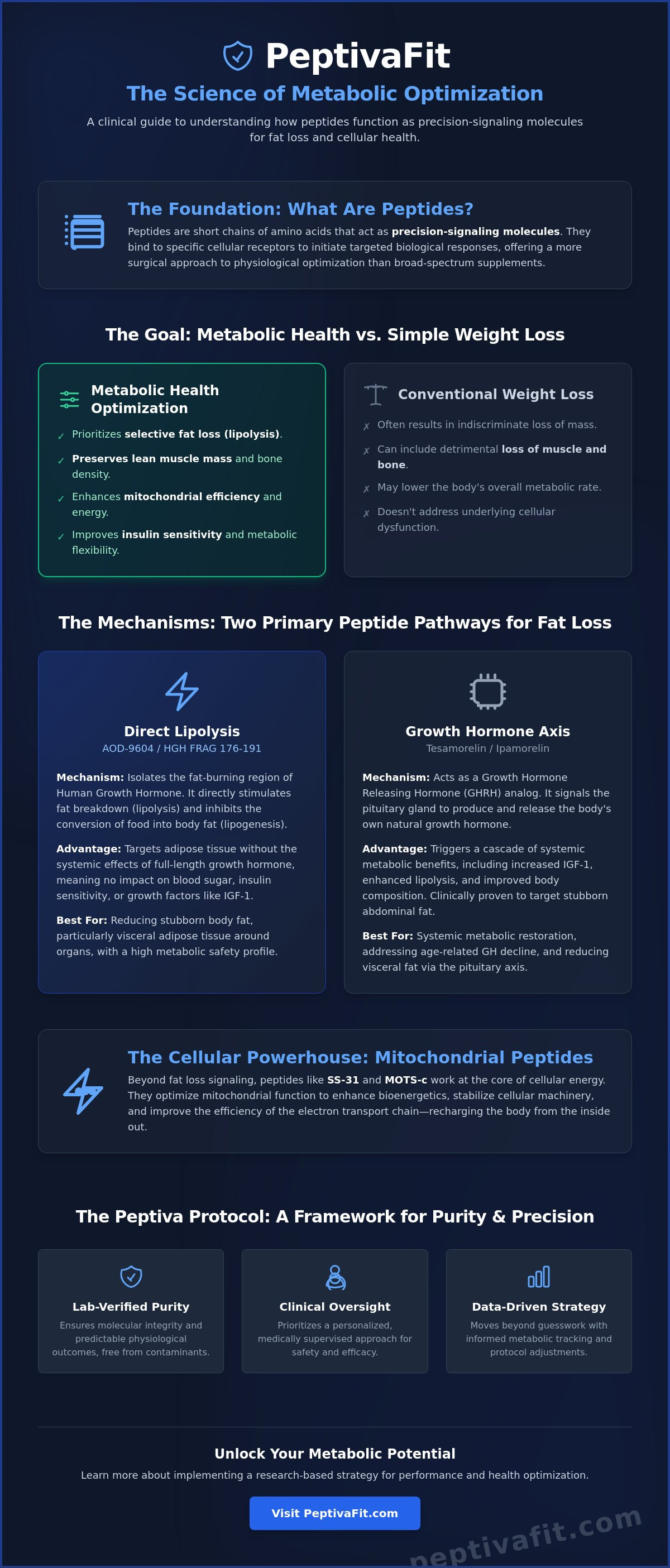
Peptides are not merely supplements; they are short chains of amino acids that function as precision-signaling molecules. These sequences modulate specific metabolic pathways by binding to cellular receptors and initiating targeted biological responses. Unlike broad-spectrum pharmaceuticals, peptides for metabolic health and fat loss offer a more surgical approach to physiological optimization. They act as messengers that can instruct the body to prioritize lipid oxidation, enhance cellular repair, or improve glucose disposal. This level of specificity is critical for those who have reached a plateau where traditional diet and exercise interventions no longer yield progress.
A fundamental distinction exists between hormonal mimicry and direct metabolic activation. Many mainstream treatments utilize Glucagon-like peptide-1 (GLP-1), which primarily influences the endocrine system to manage appetite and insulin secretion. While effective for weight management, these differ from research-grade sequences that target metabolic pathways directly without necessarily altering the body's hunger signals. As we age, the endogenous production of these vital peptides naturally declines. This age-related reduction is a primary driver of metabolic dysfunction and stubborn fat accumulation. To counteract this, the use of high-purity, lab-verified sequences is a clinical necessity. Molecular integrity and batch-tested purity ensure that the research outcomes remain accurate and the physiological impact is predictable.
The Molecular Mechanism of Peptide Signaling
Peptide signaling begins when a sequence binds to a high-affinity receptor on the cell surface. This interaction triggers a specific intracellular cascade, such as the activation of the adenylate cyclase pathway or the modulation of the somatotropic axis. These signals can have systemic metabolic effects, such as improving overall insulin sensitivity, or localized effects, such as targeting visceral adipose tissue. The Peptiva Protocol serves as a rigorous framework for informed metabolic tracking, allowing for the precise monitoring of these signaling pathways. It's an approach that values data-driven adjustments over the guesswork common in standard fitness circles.
Metabolic Health vs. Simple Weight Loss
Clinical metabolic health is defined by three primary markers: insulin sensitivity, mitochondrial efficiency, and lipid balance. Most people focus on "weight loss," which often includes the detrimental loss of lean muscle mass and bone density. In contrast, a sophisticated fat loss strategy prioritizes selective lipolysis, the breakdown of stored triglycerides into free fatty acids for energy. This process preserves the metabolic rate by protecting muscle tissue. Metabolic flexibility is the body’s ability to switch fuel sources efficiently between carbohydrates and fats based on availability and demand. Achieving this flexibility is the ultimate goal of any advanced metabolic intervention, ensuring the body remains an efficient energy processor regardless of nutritional intake.
Direct Lipolysis: The Role of AOD-9604 and HGH Fragment
While Section 1 established the signaling nature of peptide therapy, the research surrounding AOD-9604 and HGH Fragment 176-191 focuses on a more granular objective: the direct liberation of stored energy. AOD-9604, or Anti-Obesity Drug, is a C-terminal fragment of the Human Growth Hormone molecule. Specifically, it's a modified version of the 176-191 amino acid sequence. Its primary function is to isolate the fat-burning properties of growth hormone without the growth-promoting or diabetogenic effects. By targeting the beta-3 adrenergic receptors, these peptides for metabolic health and fat loss stimulate lipolysis and inhibit lipogenesis, the process where non-fatty foods are converted into body fat.
The clinical advantage of these fragments over full-length growth hormone is their metabolic safety profile. Full-length GH often triggers an increase in IGF-1 levels and can negatively impact blood glucose and insulin sensitivity. Fragmented sequences do not possess these risks. They don't compete for the growth hormone receptor, meaning they don't interfere with natural hormone production or glucose disposal. Research into HGH Frag 176-191 has historically focused on its ability to reduce visceral adipose tissue, the high-risk fat surrounding internal organs that often resists traditional weight loss efforts.
AOD-9604 vs. HGH Frag 176-191: Key Distinctions
Choosing between these two sequences requires an understanding of molecular stability and research environment. AOD-9604 is generally considered the more stable analog due to the addition of a tyrosine at the N-terminal end, which enhances its half-life and absorption. While HGH Frag 176-191 is highly effective, it's notoriously sensitive to the presence of insulin, requiring a strictly fasted state for efficacy. AOD-9604 offers slightly more flexibility, though maximal results in lipid oxidation still occur in low-insulin environments.
| Feature | AOD-9604 | HGH Frag 176-191 |
|---|---|---|
| Molecular Stability | High (Modified) | Moderate (Raw Fragment) |
| Fasting Requirement | Flexible but recommended | Strictly required |
| Primary Research Focus | Systemic Lipolysis | Visceral Fat Reduction |
Clinical Applications in Fat Loss Research
AOD-9604 holds a unique position in the industry with its GRAS (Generally Recognized as Safe) status in the United States. This designation reflects a safety profile that is rare among research-grade peptides. However, efficacy isn't guaranteed by the sequence alone; it's heavily dependent on timing and the metabolic environment. These peptides act as a catalyst for fat breakdown, but the liberated fatty acids must still be oxidized through energy expenditure. This is why researchers emphasize a synergy between peptide application and metabolic demand. For a deeper dive into specific administration strategies, review our Comprehensive Fat Loss Peptide Guide.
Understanding the transition from fat liberation to fat oxidation is essential. While AOD-9604 handles the breakdown, Mitochondria-derived peptides like MOTS-c ensure the cellular machinery is capable of burning that fuel. If you're looking for a personalized strategy to integrate these findings into your own wellness data, consider a single consultation call to review your specific metabolic markers.
The Growth Hormone Axis: Tesamorelin and Ipamorelin
The somatotropic axis is a sophisticated regulatory system governing growth, cellular repair, and lipid metabolism. While the previous section detailed fragments that act directly on fat cells, GHRHs (Growth Hormone Releasing Hormones) and GHRPs (Growth Hormone Releasing Peptides) work upstream. They signal the pituitary gland to release endogenous growth hormone in natural, pulsatile waves. This method preserves the body's delicate feedback loops, making these peptides for metabolic health and fat loss a preferred choice for long-term physiological optimization. By leveraging the pituitary's own capacity, researchers can induce a systemic metabolic shift without the risks associated with exogenous hormone replacement.
Tesamorelin: Targeting Visceral Adipose Tissue
Tesamorelin is a stabilized GHRH analog specifically designed to reduce visceral adipose tissue (VAT). Unlike subcutaneous fat, which sits just under the skin, VAT is deep abdominal fat that surrounds internal organs. It is highly inflammatory and directly linked to insulin resistance and metabolic syndrome. Research protocols often utilize specific Tesamorelin dosage strategies to modulate IGF-1 levels, which in turn facilitates the breakdown of this dangerous fat. The efficacy of Tesamorelin is significantly enhanced when researchers maintain high-intensity training and strict circadian discipline, as the peptide acts as a signal amplifier for existing metabolic demands.
Ipamorelin and CJC-1295: The Metabolic Foundation
The combination of a GHRH like CJC-1295 and a GHRP like Ipamorelin creates a synergistic effect that is more robust than using either sequence alone. While the GHRH initiates the signal for a hormone pulse, the GHRP amplifies the volume of that pulse by inhibiting somatostatin, the body's natural "stop signal" for hormone release. This dual-pathway approach is a cornerstone of research involving peptides for metabolic health and fat loss.
- Muscle Preservation: Ipamorelin is highly valued for its muscle-sparing effects during calorie-restricted fat loss phases, preventing the metabolic slowdown associated with tissue loss.
- Selective Signaling: Unlike earlier generations such as GHRP-6, Ipamorelin does not significantly stimulate ghrelin. It avoids the intense hunger spikes that often derail metabolic research.
- Recovery Support: By improving deep-wave sleep quality, these sequences support the nocturnal hormonal environment necessary for sustained lipid oxidation.
Pituitary desensitization is a primary concern in long-term hormone research. Constant, "bleed-like" stimulation can lead to a loss of receptor sensitivity and diminished results. To maintain accuracy and safety, protocols must prioritize a pulsatile release pattern. This ensures the pituitary gland remains responsive and that the metabolic benefits, such as improved lipid profiles and enhanced recovery, remain consistent over the duration of the study. This disciplined approach to signaling is what separates clinical-grade protocols from standard wellness advice.
Mitochondrial Bioenergetics: Deep Dive into SS-31 and MOTS-C
While previous sections addressed fat liberation and pituitary signaling, the final stage of metabolic optimization occurs within the mitochondria. Many researchers find that even with elevated lipolysis, fat loss stalls due to mitochondrial dysfunction. This cellular engine failure is often the root cause of metabolic plateaus. Without efficient energy conversion, liberated fatty acids remain unoxidized, leading to re-esterification and storage. To address this, specific peptides for metabolic health and fat loss target the structural integrity of the mitochondrial inner membrane. Mitochondrial health determines the efficiency of the electron transport chain, which is the final destination for all oxidized fuel. When these organelles are damaged by oxidative stress or aging, they lose their capacity to convert fatty acids into adenosine triphosphate (ATP). This results in a metabolic bottleneck where the body has the signal to lose weight but lacks the cellular machinery to execute it.
SS-31: Repairing the Metabolic Engine
SS-31, also known as Elamipretide, represents a unique class of peptides that bind specifically to cardiolipin. Cardiolipin is a phospholipid essential for the architecture of the mitochondrial inner membrane and the function of the electron transport chain (ETC). By stabilizing cardiolipin, SS-31 reduces the production of reactive oxygen species (ROS) and improves ATP production efficiency. This repair process reverses age-related metabolic decline by restoring the mitochondria's ability to handle high fuel loads. SS-31 allows for better fat oxidation by repairing mitochondrial architecture, ensuring that liberated lipids are actually burned rather than recycled. This structural restoration is a prerequisite for any meaningful long-term change in metabolic rate, as it ensures the cellular environment can support increased energy demands.
MOTS-C and SLU-PP-332: The Future of Exercise Mimicry
The MOTS-C peptide is a mitochondrial-derived signaling molecule that functions as a potent exercise mimetic. It improves insulin sensitivity and glucose disposal by signaling the body to behave as if it were under high-intensity physical stress. This is distinct from the mechanism of SLU-PP-332, an Estrogen-Related Receptor (ERR) agonist. While MOTS-C primarily influences metabolic flexibility through AMP-activated protein kinase (AMPK) pathways, SLU-PP-332 targets the genetic expression of oxidative fibers. Both sequences represent a shift toward peptides for metabolic health and fat loss that don't rely on the central nervous system.
Using these molecules signals the body to burn fat as if it were performing high-intensity exercise, even during periods of rest. This synergy enhances mitochondrial density and function, providing long-term longevity benefits beyond simple aesthetics. If your research data indicates a persistent plateau despite optimized signaling, it's likely a bioenergetic bottleneck. You can access advanced tracking tools and expert guidance through our 1-on-1 coaching to identify these specific cellular limitations and refine your optimization strategy.
The Peptiva Protocol: Implementing a Research-Based Strategy
Successful metabolic optimization requires more than just acquiring specific sequences. It demands a disciplined framework that integrates cellular signaling with rigorous data tracking. The Peptiva Protocol is designed for individuals who prioritize clinical precision over anecdotal trends. Before initiating any research, a personalized medical assessment is a non-negotiable requirement. This baseline ensures that the chosen peptides for metabolic health and fat loss align with your specific hormonal profile and metabolic needs. Without this data, any intervention remains speculative and potentially counterproductive.
Metabolic tracking is the differentiator between simple weight loss and true physiological restoration. While the scale provides a blunt metric, it fails to account for shifts in visceral fat, lean muscle mass, and mitochondrial efficiency. Our approach moves beyond the surface to measure what matters: insulin sensitivity, lipid balance, and body composition. By utilizing 1-on-1 coaching, researchers can optimize the nuances of administration, ensuring that every variable is controlled for maximal efficacy and safety.
Safety and Quality Control in Peptide Research
The peptide industry is often clouded by suppliers who lack transparency. Red flags include a lack of third-party Certificates of Analysis (COAs) and vague labeling that obscures molecular integrity. In a clinical setting, purity is paramount. Precision in peptide reconstitution is vital to maintaining the stability of the amino acid chains. Any error in the dilution process can lead to degraded sequences and inaccurate research outcomes. Under the "Research Only" legal framework, the responsibility of informed use falls on the individual. This necessitates a high level of personal accountability and a commitment to using only lab-verified peptides to ensure data accuracy.
The 3 Pillars of Metabolic Optimization
Success in metabolic health is built upon three foundational pillars that work in synergy to bypass traditional plateaus. This structured approach ensures that every intervention is purposeful and data-driven.
- Pillar 1: Molecular Signaling. Utilizing targeted peptides for metabolic health and fat loss to initiate direct lipolysis and pituitary signaling as discussed in previous sections.
- Pillar 2: Metabolic Foundation. Prioritizing mitochondrial health and insulin sensitivity to ensure the cellular engine can oxidize liberated fatty acids.
- Pillar 3: Clinical Oversight. Employing regular lab testing and professional coaching to interpret data and refine the protocol based on real-time physiological responses.
This methodology transforms a scattered biohacking attempt into a curated, high-level strategy for performance and wellness. It's a long-term process that values stability over quick fixes, providing the sophisticated control necessary for elite body composition results.
Mastering the Future of Metabolic Optimization
The landscape of metabolic optimization has undergone a significant transformation. The transition from broad appetite suppression to precision cellular signaling allows for a more surgical approach to body composition. By integrating lipolytic fragments, growth hormone secretagogues, and mitochondrial repair sequences, you can address the physiological bottlenecks that cause progress to stall. The 2026 reclassification of key research sequences provides a clearer pathway for those prioritizing data-driven wellness under expert guidance. It's no longer about simple caloric deficits; it's about optimizing the molecular environment for long-term health.
Successfully utilizing peptides for metabolic health and fat loss requires a commitment to molecular integrity and clinical oversight. Substandard supplies and unmonitored protocols introduce unnecessary variables into your research. To ensure the highest standards of safety and efficacy, you must prioritize lab-verified products and personalized data tracking. This disciplined approach ensures that your efforts translate into measurable, long-term physiological improvements rather than temporary fixes.
Take the next step in your performance journey. Access the Peptiva Protocol and Professional Metabolic Coaching to receive a personalized medical assessment and expert 1-on-1 clinical oversight with lab-verified peptide supplies. This curated framework provides the sophisticated control necessary to master your metabolic health. Your pursuit of excellence deserves a disciplined, evidence-based foundation.
Frequently Asked Questions
Are peptides for fat loss safe for long-term use?
Safety depends on the specific sequence and the presence of professional clinical oversight. While sequences like Ipamorelin maintain the somatotropic axis through pulsatile release, long-term use without monitoring can lead to receptor desensitization. A personalized medical assessment is required to establish baseline markers and ensure the protocol remains within safe physiological boundaries over extended research periods.
How long does it take to see metabolic results with peptide therapy?
Physiological shifts in insulin sensitivity and lipid oxidation typically manifest within 4 to 8 weeks of consistent administration. Significant changes in body composition, specifically visceral fat reduction, generally require a 12-week research window. These timelines vary based on the individual's baseline mitochondrial health and their adherence to a prescribed metabolic tracking framework.
Can I combine AOD-9604 with GLP-1 agonists like Semaglutide?
Combining AOD-9604 with GLP-1 agonists is a common strategy in advanced research because they target distinct metabolic pathways. GLP-1s primarily manage appetite and glucose disposal; however, AOD-9604 focuses on direct lipolysis. This multi-pathway approach can be more effective for peptides for metabolic health and fat loss than monotherapy, provided the user monitors for cumulative metabolic stress.
Do peptides for metabolic health require a specific diet?
Nutritional timing is critical for the efficacy of lipolytic peptides. Sequences like AOD-9604 and HGH Fragment 176-191 are highly sensitive to insulin. They're most effective when administered in a fasted state. Maintaining a diet that supports metabolic flexibility ensures the fatty acids liberated by the peptides are actually oxidized for energy rather than returned to storage.
What is the difference between research-grade peptides and pharmaceutical drugs?
Pharmaceutical drugs are FDA-approved for specific medical conditions and sold via traditional pharmacies. Research-grade peptides are intended for laboratory research purposes and are often synthesized to specific purity standards for experimental accuracy. The distinction lies in the legal framework and the requirement for the user to be informed about molecular integrity and reconstitution protocols.
How do I know if my peptides are high purity and lab-tested?
Verification requires a third-party Certificate of Analysis (COA) for every batch. High-purity products undergo High-Performance Liquid Chromatography (HPLC) and Mass Spectrometry to confirm both the identity of the sequence and its percentage of purity. We only utilize lab-verified peptides to ensure that research data isn't compromised by contaminants or degraded amino acid chains.
What happens if I stop taking metabolic peptides?
Stopping a peptide protocol doesn't typically result in a hormonal crash, but the enhanced signaling pathways will eventually return to their baseline endogenous levels. If the user hasn't established a strong metabolic foundation through mitochondrial repair and lifestyle discipline, the fat loss results may diminish over time. This is why we emphasize the 3 Pillars of Metabolic Optimization for long-term stability.
Is SS-31 effective for fat loss if I am not currently exercising?
SS-31 is a mitochondrial repair agent rather than a direct stimulant. While it optimizes the electron transport chain and repairs cellular architecture, it doesn't burn fat on its own. You must create metabolic demand through exercise to utilize the improved ATP production capacity. Without physical activity, the benefits of SS-31 remain limited to cellular repair rather than visible fat loss.

![Shelf Life of Reconstituted Peptides: A Clinical Reference Guide [2026]](https://getautoseo.com/storage/hero_images/shelf-life-of-reconstituted-peptides-a-clinical-reference-guide-2026.jpg?v=b8ed5173acaa)
