
![Peptides for Stubborn Body Fat: A Clinical Guide to Targeted Lipolysis [2026]](https://getautoseo.com/storage/hero_images/article_1508560_1780792057.jpg)
What if the resistance you're experiencing isn't a failure of willpower, but a specific biological receptor imbalance that ignores traditional caloric deficits? For many high-performance individuals, the standard "eat less, move more" model fails to address the alpha-2 adrenergic receptors that lock down adipose tissue in specific regions. Utilizing peptides for stubborn body fat offers a sophisticated, molecular approach to lipolysis that bypasses these metabolic bottlenecks. You understand that reaching your physical peak requires more than generic advice. It demands precise, data-driven interventions that respect your body's complex regulatory systems.
We agree that plateaued progress is unacceptable when you've maintained strict adherence to your training and nutrition. This clinical guide will unlock the science behind metabolic optimization, providing you with the clarity needed to distinguish between "grey market" risks and evidence-based protocols. You'll gain a comprehensive understanding of lipolytic mechanisms and discover how specific, lab-verified peptide sequences target resistant adipose tissue. We'll preview the latest 2026 regulatory updates, including the upcoming July FDA advisory committee review of compounding standards, and outline safe, professional stacking strategies for optimal body composition.
Key Takeaways
- Understand the biological role of alpha-2 receptor density and localized blood flow in creating fat loss plateaus that resist traditional caloric deficits.
- Evaluate the clinical efficacy of peptides for stubborn body fat, including why AOD-9604 and Tesamorelin are considered the gold standards for targeted lipolysis.
- Learn the scientific rationale for stacking growth hormone secretagogues with mitochondrial peptides to enhance the rate of systemic lipid oxidation.
- Determine how to interpret a Certificate of Analysis (COA) to ensure peptide purity and navigate the complexities of the 2026 regulatory landscape.
- Explore the Peptiva Protocol as a comprehensive, data-driven framework for transitioning from fragmented experimentation to a professional metabolic strategy.
The Science of Resistance: Why Stubborn Body Fat Persists
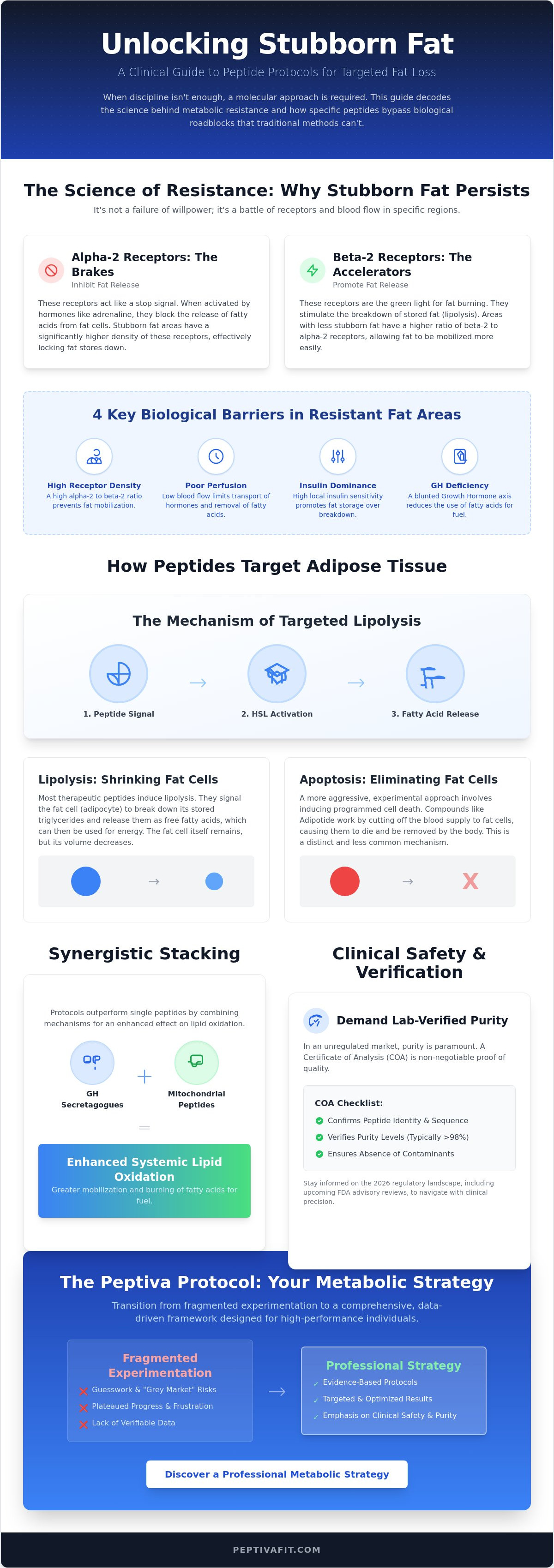
Stubborn fat isn't a failure of discipline; it's a physiological reality defined by its biochemical composition. Unlike subcutaneous fat in more metabolic regions, resistant adipose tissue possesses a disproportionately high density of alpha-2 adrenergic receptors. While beta-2 receptors act as accelerators for fat mobilization, alpha-2 receptors function as brakes. When catecholamines like adrenaline bind to these alpha-2 sites, they suppress the release of fatty acids. This explains why fat in the lower back, hips, and lower abdomen often remains unaffected even as systemic body fat levels decrease.
Traditional cardiovascular exercise frequently fails to trigger lipolysis in these resistant areas because they typically suffer from poor blood flow. When blood flow is restricted, catecholamines can't efficiently reach the fat cells, and any mobilized fatty acids aren't transported to the muscles for oxidation. Instead, they simply re-esterify back into the adipocyte. Utilizing peptides for stubborn body fat allows for a targeted intervention that addresses these metabolic bottlenecks at the cellular level.
Alpha-2 vs. Beta-2 Adrenoceptors
The ratio of these receptors dictates regional fat loss. In stubborn areas, the alpha-2 density is significantly higher than in more metabolic fat depots. This imbalance creates a state of regional resistance. High levels of cortisol amplify this issue, particularly in visceral fat, by increasing the activity of lipoprotein lipase (LPL), the enzyme responsible for fat storage. Peptides modulate the Growth Hormone (GH) axis to antagonize the antilipolytic effects of insulin. By enhancing GH signaling, these protocols increase the sensitivity of beta-receptors, effectively unlocking resistant stores that were previously inaccessible through diet alone.
The Mechanism of Targeted Lipolysis
Lipolysis is the chemical breakdown of triglycerides stored within adipocytes into glycerol and three free fatty acids. Peptides serve as precise signaling molecules that initiate this cascade by activating hormone-sensitive lipase (HSL). It's vital to distinguish between lipolysis, which shrinks the fat cell's volume, and apoptosis, which is the programmed death of the cell itself. For instance, Prohibitin-targeting peptide 1 (Adipotide) is an experimental compound designed to induce apoptosis by disrupting the vascular supply to white adipose tissue. While most therapeutic peptides for stubborn body fat focus on mobilizing fatty acids for oxidation, understanding these distinct pathways is essential for a disciplined metabolic strategy.
To summarize the biological barriers to fat loss in resistant areas:
- Receptor Density: High alpha-2 to beta-2 ratio prevents catecholamine-induced mobilization.
- Poor Perfusion: Low blood flow limits the transport of signaling hormones and the removal of fatty acids.
- Insulin Dominance: High local insulin sensitivity promotes fat storage (lipogenesis) over breakdown.
- GH Deficiency: A blunted Growth Hormone axis reduces the body's ability to prioritize long-chain fatty acids as fuel.
Primary Peptides for Targeting Stubborn Adipose Tissue
The identification of specific amino acid sequences has shifted the focus from general weight loss to localized adipose reduction. Utilizing peptides for stubborn body fat requires a nuanced understanding of how different fragments interact with metabolic pathways. While traditional growth hormone (GH) therapy involves systemic effects, specific fragments allow for targeted lipolysis without disrupting glucose homeostasis or IGF-1 levels. This precision is vital for individuals who have already optimized their nutrition and training but remain hindered by regional fat depots.
When selecting peptides for stubborn body fat, the choice between a direct fragment and a secretagogue depends on the specific fat depot being targeted. Recent Johns Hopkins research on novel peptide therapy underscores the potential of using precise amino acid sequences to enhance mitochondrial function and inhibit excessive glucose production. This level of molecular targeting represents the next evolution in metabolic optimization.
AOD-9604 and HGH Frag 176-191
AOD-9604 and HGH Frag 176-191 are derived from the C-terminal end of the human growth hormone molecule. Specifically, they target the region responsible for fat metabolism while omitting the portion that triggers growth and insulin resistance. AOD-9604 is essentially HGH Frag 176-191 with an added tyrosine to stabilize the molecule. These compounds don't bind to the GH receptor in a way that stimulates systemic growth. Instead, they mimic the way natural GH regulates fat metabolism by stimulating the breakdown of triglycerides. This makes them ideal for users focusing on subcutaneous fat reduction who want to avoid the diabetic-inducing risks associated with full-length GH.
Tesamorelin: Targeting Visceral Fat
Tesamorelin stands as the gold standard for addressing visceral adipose tissue (VAT), the deep "organ fat" that typically resists diet and exercise. Originally developed to treat lipodystrophy in HIV patients, clinical trials demonstrated its ability to reduce VAT by 15-18% over a 26-week period. Unlike AOD-9604, Tesamorelin is a growth hormone-releasing factor (GRF) analog that stimulates the pituitary gland to produce its own GH in a pulsatile manner. This natural rhythm helps maintain metabolic health while specifically targeting the high-risk fat depots surrounding internal organs. For practitioners seeking specific administration frameworks, the Tesamorelin dosage guide provides a clinical foundation for metabolic optimization protocols.
Ipamorelin and CJC-1295 are often used in conjunction with these targeted fragments to provide a systemic metabolic foundation. By acting as secretagogues, they ensure the body's baseline GH production remains optimal, which supports the lipolytic signaling of fragments like HGH Frag 176-191. This synergistic effect ensures that the mobilized fatty acids are actually oxidized for energy. Individuals seeking a structured approach to these compounds often find the Peptiva Protocol provides the necessary data-driven oversight for safe application.
Synergistic Stacking: Why Protocols Outperform Single Peptides
Isolated peptide administration often fails to produce significant results because human physiology is built on redundancy. When you attempt to mobilize fatty acids using only one pathway, the body frequently compensates by downregulating sensitivity elsewhere. A sophisticated approach to peptides for stubborn body fat requires a multi-modal strategy that addresses mobilization, transport, and final oxidation. This systemic view is supported by The Science of Peptides in Obesity Treatment, which highlights how different peptide classes influence metabolic regulation through varied biological mechanisms.
Randomly cycling research chemicals without a structured protocol increases the risk of systemic inflammation. Chronic inflammation triggers cortisol release, which, as established, encourages fat storage in the midsection. A disciplined protocol ensures that each compound works in harmony, preventing the metabolic friction that causes most unverified strategies to fail. It's about creating a biological environment where fat loss is the path of least resistance.
Secretagogues vs. Direct Lipolytics
A common error in self-directed research is the failure to distinguish between a secretagogue and a direct lipolytic. Ipamorelin, a selective GH secretagogue, creates a pulsatile release of endogenous growth hormone; this serves as the "pulse" that prepares the metabolic environment. Conversely, HGH Frag 176-191 provides the "target" by specifically binding to adipose tissue receptors. Without the secretagogue, the fragment may lack the hormonal background to be fully effective. Timing is critical. Administering these compounds during fasted states, particularly before cardiovascular work, maximizes the lipolytic cascade. For a deeper dive into these mechanisms, consult our clinical overview on peptides for metabolism and fat loss.
Mitochondrial Efficiency and Fat Burning
Mobilizing fat is only half the battle. Once triglycerides are broken down into free fatty acids, they must be transported into the mitochondria to be oxidized for energy. If your cellular energy centers are inefficient, those fatty acids simply circulate and eventually return to storage. This is where the MOTS-C peptide becomes essential. As a mitochondrial-derived peptide, MOTS-C enhances insulin sensitivity and promotes the expression of genes involved in beta-oxidation. It ensures that the fat mobilized by peptides for stubborn body fat is actually incinerated rather than recycled. Cellular energy is the primary bottleneck in most fat loss journeys. Addressing this through mitochondrial support transforms a stalled fat loss phase into a successful metabolic shift.
Clinical Safety and the Necessity of Lab-Verified Research
Clinical safety is not an auxiliary consideration; it's the foundation of any metabolic intervention. The proliferation of "grey market" vendors has introduced significant risks, including contamination with heavy metals such as lead or arsenic and critical sequence errors. When utilizing peptides for stubborn body fat, the molecular structure must be exact. Even a single amino acid substitution can render a peptide ineffective or, worse, trigger an immunogenic response where the body develops antibodies against its own endogenous hormones. This risk makes professional oversight and rigorous testing non-negotiable for anyone serious about long-term health.
A disciplined approach to safety requires the ability to interpret a Certificate of Analysis (COA). This document is the only objective proof of a compound's purity and quantity. It's not enough for a vendor to claim high quality; they must provide batch-specific data that matches the product in your possession. Without this verification, you're essentially conducting an uncontrolled experiment on your own physiology, which contradicts the goal of sophisticated self-optimization.
Identifying High-Quality Research Peptides
The Peptiva Standard defines a tier of quality that exceeds standard consumer expectations. Verifying the molecular integrity of research peptides involves two primary methods: High-Performance Liquid Chromatography (HPLC) and Mass Spectrometry. HPLC determines the purity level by separating the components of the sample, while Mass Spectrometry confirms the specific molecular mass and amino acid sequence. You should look for a purity rating of at least 98%. Red flags include vendors who provide outdated or blurred COAs, lack batch-specific numbers, or offer prices that are significantly below the market average for high-grade synthesis.
The Importance of Proper Reconstitution
Acquiring a high-purity compound is only the first step. Molecular integrity remains vulnerable during the preparation phase. Correct peptide reconstitution is vital to prevent mechanical degradation of the delicate amino acid chains. Using bacteriostatic water is mandatory to inhibit microbial growth, as standard sterile water lacks the benzyl alcohol necessary for multi-use vials. Additionally, temperature control is essential. Most lyophilized peptides for stubborn body fat require refrigeration at 2°C to 8°C post-reconstitution to prevent denaturing. Failure to maintain these standards results in a degraded product that won't deliver the intended lipolytic signaling.
Safety also involves your unique biological profile. A personalized medical assessment ensures that your systemic health markers, such as kidney and liver function, are compatible with targeted lipolysis protocols. Before beginning any research phase, ensure your source provides lab tested peptides to guarantee you are working with verified, high-purity compounds.
The Peptiva Protocol: Integrating Peptides into a Metabolic Strategy
The era of fragmented, self-directed experimentation with peptides for stubborn body fat is yielding to a more disciplined, data-driven approach. While the molecular potential of these sequences is undeniable, their efficacy is often lost in the absence of a structured framework. Implementation requires more than just high-purity compounds; it demands a comprehensive understanding of how these tools interact with your unique hormonal baseline. The transition from random cycles to a unified metabolic journey is the hallmark of the sophisticated optimizer.
The Peptiva Protocol represents this evolution. It moves beyond the simplistic "buy and apply" model, positioning peptides as precision levers within a broader metabolic strategy. Success in adipose reduction isn't found in a single vial but in the synergy between molecular signaling, nutrient timing, and systemic health monitoring. This high-level oversight ensures that every intervention is purposeful and every result is measurable.
A Holistic Approach to Adipose Reduction
The Peptiva Protocol functions as a comprehensive fat loss framework that integrates clinical guides, lab testing, and professional oversight. It's essential to recognize that peptides are tools for optimization, not replacements for metabolic foundations like insulin sensitivity and circadian health. Within our exclusive community, we prioritize a disciplined lifestyle that supports the lipolytic signaling initiated by these compounds. This holistic view prevents the common pitfall of relying on exogenous sequences to compensate for a neglected biological environment.
Adherence to a protocol is where most individuals falter. Our 1-on-1 coaching provides the real-time adjustments necessary to navigate the complexities of metabolic adaptation. Whether it's adjusting dosages based on inflammatory markers or refining the timing of a GH secretagogue pulse, professional guidance mitigates the risks of plateauing. For those at the beginning of their journey, a single consultation call serves as a critical diagnostic tool for identifying the specific metabolic blocks that have rendered previous efforts futile.
Next Steps for Metabolic Optimization
Beginning a professional metabolic strategy starts with a personalized medical assessment. This diagnostic phase is non-negotiable for determining which peptides for stubborn body fat are appropriate for your specific receptor density and fat distribution patterns. Once your baseline is established, you can transition into a professional coaching engagement designed to maximize your physiological output while maintaining strict safety standards. This process ensures that your investment in peptide therapy translates into tangible, long-term body composition shifts rather than temporary fluctuations.
Your physical peak is a matter of biological precision and personal responsibility. If you're ready to move beyond generic advice and enter a space that demands serious intent, you can explore the Peptiva Protocol and access lab-verified peptides here. Taking control of your metabolic destiny requires the right data, the right tools, and the discipline to execute a proven framework.
Mastering Your Metabolic Destiny
The transition from plateaued progress to targeted lipolysis requires shifting from generic advice to molecular precision. You've seen that resistant adipose tissue is governed by specific receptor densities that ignore traditional deficits. Using peptides for stubborn body fat isn't about finding a shortcut; it's about utilizing the correct biological keys to unlock stored energy. Success depends on maintaining the highest standards of molecular integrity and adhering to a disciplined, data-driven framework.
True optimization happens when lab-verified purity meets professional oversight. Our approach ensures that every intervention is supported by personalized medical assessments and expert 1-on-1 coaching to navigate your unique metabolic landscape. You don't have to guess about sequence accuracy or reconstitution protocols. It's time to apply a rigorous clinical standard to your performance and wellness goals. This level of control is reserved for those who prioritize data over hype.
Apply for the Peptiva Protocol and access lab-verified peptides to begin your structured transformation. Your commitment to excellence deserves a protocol that matches your intent.
Frequently Asked Questions
Which peptide is most effective for targeting stubborn belly fat?
AOD-9604 and HGH Frag 176-191 are the most effective peptides for stubborn body fat in the abdominal region. These fragments specifically target the high density of alpha-2 receptors that characterize midsection adipose tissue. They initiate lipolysis without the systemic growth effects or insulin resistance associated with full-length growth hormone.
Are peptides for fat loss safe for long-term use?
Peptide protocols aren't typically designed for indefinite use and should be cycled under professional supervision. Long-term safety depends on periodic cessation to prevent receptor desensitization and to monitor systemic health markers. A disciplined approach involves 8 to 12 week cycles followed by a washout period to maintain metabolic sensitivity.
Do I need a prescription for peptides like Tesamorelin or AOD-9604?
Legally obtaining peptides like Tesamorelin for therapeutic use requires a prescription from a licensed medical professional. While "research chemicals" are sold without prescriptions, they're strictly prohibited for human consumption. The 2026 regulatory landscape, including the July FDA advisory meetings, continues to refine the compounding standards for these sequences.
How long does it take to see results from a fat loss peptide protocol?
Most individuals observe measurable changes in stubborn adipose tissue within 8 to 12 weeks of consistent protocol adherence. Initial metabolic shifts occur sooner, but the visible reduction of resistant depots requires sustained lipolytic signaling. Results are contingent upon maintaining the nutritional and training foundations outlined in the Peptiva Protocol.
Can I stack fat loss peptides with recovery peptides like BPC-157?
Stacking lipolytic peptides with recovery sequences like BPC-157 is a common strategy for comprehensive optimization. BPC-157 helps manage systemic inflammation, which can otherwise trigger cortisol and encourage fat storage. This combination ensures that the body remains in a recovered, low-stress state conducive to efficient fat oxidation.
What happens if I stop using peptides after reaching my fat loss goal?
Stopping a peptide protocol won't cause an immediate fat rebound if your metabolic foundations remain stable. However, the enhanced lipolytic signaling will cease, and your fat loss rate will return to your natural baseline. Long-term maintenance requires the data-driven habits established during the active protocol phase.
Why is lab-testing so critical for peptide research?
Lab-testing is critical to verify that a peptide's amino acid sequence is accurate and free from heavy metal contamination. Researching peptides for stubborn body fat without a Certificate of Analysis (COA) exposes you to immunogenic risks and sequence errors. High-purity standards, typically 98% or higher, are the only way to guarantee predictable physiological responses.
Can peptides help with visceral fat specifically?
Tesamorelin is specifically designed to target visceral adipose tissue, the deep fat surrounding internal organs. Clinical trials have demonstrated its ability to reduce visceral fat by 15% to 18% over a 26-week period. This makes it the superior choice for addressing metabolic health risks associated with organ-specific fat accumulation.

![Shelf Life of Reconstituted Peptides: A Clinical Reference Guide [2026]](https://getautoseo.com/storage/hero_images/shelf-life-of-reconstituted-peptides-a-clinical-reference-guide-2026.jpg?v=b8ed5173acaa)
