

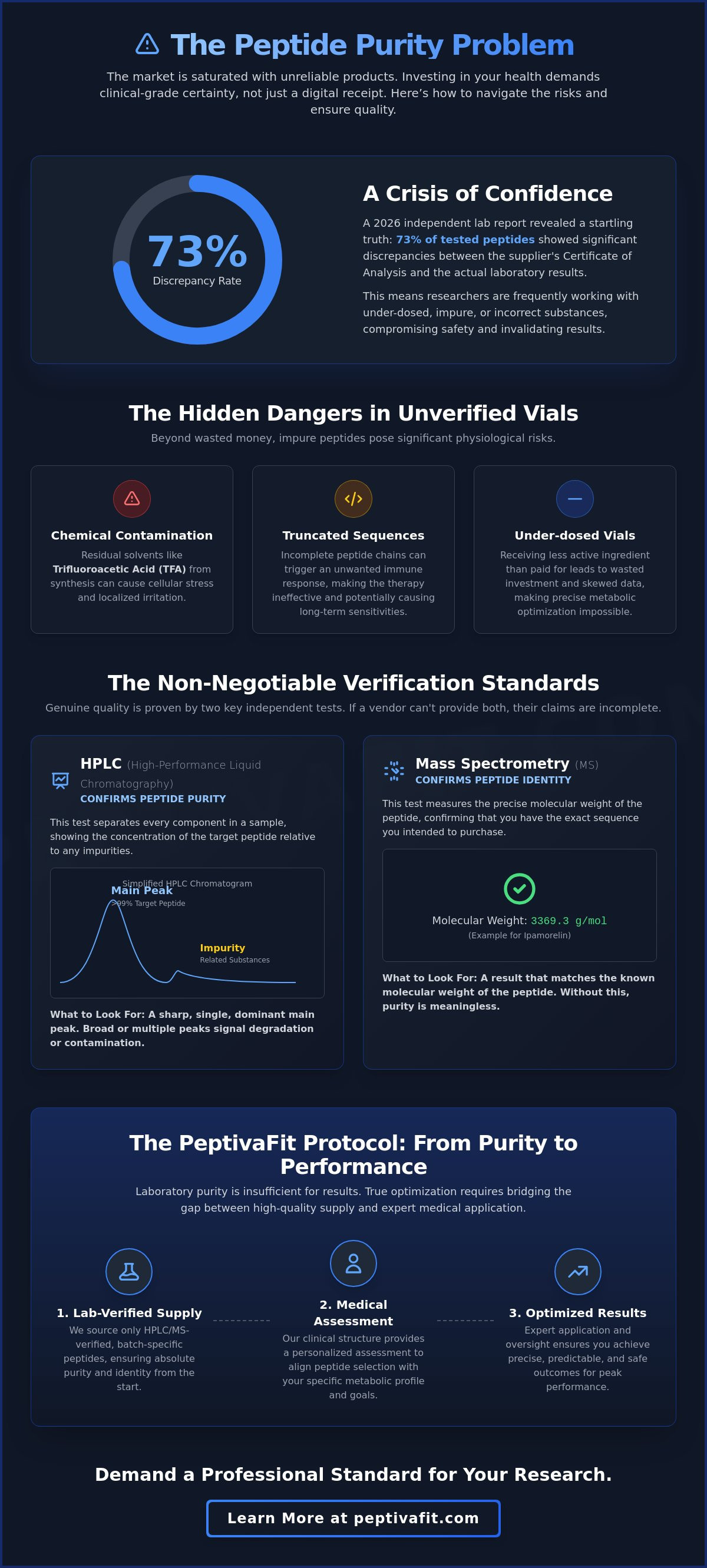
Did you know that a 2026 report from an independent testing lab indicated that 73% of peptides showed measurable discrepancies between the supplier's Certificate of Analysis and actual laboratory results? This data confirms the reality that most individuals face; the search for third party tested peptides for sale is often compromised by unreliable reporting and under-dosed products. You're right to be concerned about heavy metal contamination and the lack of transparency in standard research sourcing. Investing in your metabolic health requires more than just a digital receipt; it demands clinical-grade certainty.
We agree that the current market environment is unnecessarily complex and poses significant risks to those seeking serious performance optimization. In this guide, you'll learn how to identify genuine laboratory-verified peptides and understand why medical oversight remains the critical missing link in standard sourcing protocols. We'll provide a clear framework for interpreting the July 2026 FDA regulatory updates and establishing a professional standard for your personal research through HPLC-verified data and disciplined medical assessment.
Key Takeaways
- Identify why High-Performance Liquid Chromatography (HPLC) and Mass Spectrometry are non-negotiable standards for confirming peptide identity and molecular integrity.
- Establish a professional selection framework to find legitimate third party tested peptides for sale by evaluating vendor transparency and batch consistency.
- Understand how to decipher Certificates of Analysis beyond simple purity percentages to detect residual solvents or hidden fillers.
- Discover why laboratory purity is insufficient for results without a personalized medical assessment to align peptide selection with your specific metabolic profile.
- Learn how to bridge the gap between high-quality supply and expert application using the clinical structure of the Peptiva Protocol.
The Critical Importance of Third-Party Verification in Peptide Research
Third-party verification is the only objective safeguard against the proliferation of substandard materials in the research market. In a landscape where "Research Use Only" labels often mask a lack of quality control, independent verification provides a rigorous scientific audit. This process involves an unbiased, accredited laboratory utilizing High-Performance Liquid Chromatography (HPLC) and Mass Spectrometry (MS) to confirm both purity and identity. A 2026 report from an independent testing facility revealed that 73% of peptides tested showed significant discrepancies between the vendor's claims and actual laboratory results. For the serious researcher, these figures represent more than just a margin of error; they indicate a systemic failure in unverified supply chains.
The complexity of Chemical peptide synthesis creates multiple opportunities for contamination. Without stringent oversight, "bathtub labs" often produce sequences containing residual solvents or truncated peptide chains. By 2026, the standard for excellence has shifted from static, outdated PDF reports to real-time, batch-specific verification. Validating third party tested peptides for sale is no longer an optional luxury. It is a fundamental requirement for maintaining the integrity of your metabolic data and personal safety.
Independent vs. In-House Testing
In-house testing presents a fundamental conflict of interest that no serious investigator should accept. When a vendor performs their own analysis, the incentive to overlook minor impurities or under-dosed vials is high. Professional sourcing relies exclusively on accredited, US-based laboratories that operate independently of the seller. To ensure authenticity, you must verify that the Certificate of Analysis (COA) includes a unique batch number that corresponds directly to the product in your possession. Many reputable labs now offer digital verification portals where you can cross-reference these batch numbers to confirm the report hasn't been altered.
The Consequences of Unverified Sourcing
The risks of sourcing unverified peptides extend far beyond financial loss. Impure products often contain Trifluoroacetic acid (TFA), a common byproduct of the synthesis process. If not properly removed, residual TFA can cause significant cellular stress and localized irritation. Furthermore, truncated sequences; fragments of the intended peptide that were not fully formed; can trigger immunogenic responses, leading the body to develop antibodies against the therapy. This effectively renders the sequence useless and may cause long-term sensitivities. Beyond these physiological risks, purchasing under-dosed products results in wasted investment and skewed results, making it impossible to achieve precise metabolic optimization.
Deciphering Certificates of Analysis (COA): What 99% Purity Actually Means
The "99% purity" claim is often used as a marketing shield by vendors, yet without a technical understanding of the Certificate of Analysis (COA), this number remains abstract. A true COA isn't just a percentage; it's a multi-layered diagnostic report. When searching for third party tested peptides for sale, you must prioritize reports that include both High-Performance Liquid Chromatography (HPLC) and Mass Spectrometry (MS). These tools confirm that the substance is both pure and correctly identified. If a vendor cannot provide both, their claims of quality are scientifically incomplete.
The HPLC chromatogram is a visual representation of the chemical's profile. The "Main Peak" should dominate the graph, representing the target peptide molecule. Any smaller peaks indicate "related substances" or impurities. While 99% is the gold standard, some complex sequences naturally settle at 98% due to the inherent difficulty of the synthesis process. High-quality production often aligns with the Good Manufacturing Practice (GMP) for APIs, ensuring that even these minor impurities are identified and cataloged before the product reaches the researcher.
Reading the HPLC Main Peak
The area under the curve in an HPLC report defines the concentration of the peptide relative to other detected substances. If the main peak is sharp and narrow, it suggests high molecular integrity. Broad or jagged peaks often signal degradation or the presence of residual solvents. It's also vital to look for "related substances," which are often truncated versions of the target peptide. These fragments can interfere with biological signaling, making the total purity percentage less relevant than the specific nature of what remains in that final 1% of the vial's content.
Mass Spec Verification
While HPLC measures purity, Mass Spectrometry confirms identity. It compares the "Observed Mass" against the "Theoretical Mass." If these numbers don't align within a tight margin, you may be researching an entirely different sequence. This is critical for distinguishing between similar molecules like GHRP-2 and GHRP-6, which share similar properties but have distinct molecular weights. A comprehensive report should also account for residual moisture and acetate content. High moisture levels can lead to rapid degradation, effectively lowering the potency before the vial is even opened.
A significant misconception is that purity equals dosage. A vial can be 99% pure but only contain 3mg of a 5mg advertised dose. Potency testing is a separate, more expensive metric that many vendors skip. To protect your research, look for red flags in lab reports such as missing QR codes, inconsistent fonts, or the absence of a direct contact number for the testing facility. For those who require absolute precision in their metabolic journey, a personalized medical assessment can help bridge the gap between raw laboratory data and clinical application.
Beyond the Vial: Why Testing Alone Is Insufficient for Results
A high-purity laboratory report serves as a baseline, not a conclusion. While the market for third party tested peptides for sale focuses heavily on chemical verification, this data is meaningless if the user's biological foundation is compromised. A pure peptide is simply a tool. Its efficacy depends entirely on the metabolic environment into which it is introduced. This is the "Clean Lab Report" Fallacy; the belief that chemical purity automatically translates to safety or results. Even a 99% pure sequence can produce adverse effects if it's the wrong choice for your specific biology.
Individual metabolic responses vary significantly based on pre-existing conditions and genetic predispositions. For instance, a growth hormone secretagogue may be HPLC-verified for purity, but if the user has undiagnosed insulin resistance, the peptide could exacerbate blood glucose issues. Professional oversight is required to manage these variables. Stacking multiple sequences without a clinical framework often leads to receptor desensitization, where the body's signaling pathways become unresponsive due to overstimulation. This isn't just a failure of the product; it's a failure of the protocol. Achieving optimization requires a synthesis of pure materials and precise physiological data.
The Role of Personalized Medical Assessments
A baseline medical evaluation is non-negotiable for serious optimization. Evaluating kidney and liver markers ensures that the body can effectively process and clear exogenous compounds. Additionally, understanding your current insulin sensitivity is vital when introducing peptides that affect growth hormone levels. For a deeper analysis of these clinical requirements, consult The Role of Personalized Medical Assessments. Data-driven decisions prevent the long-term metabolic strain associated with unguided research. You can't optimize what you haven't measured.
Avoiding the "Guesswork" in Research
Relying on decentralized forums for dosage and frequency is a high-risk strategy. These communities often ignore the nuances of biological synergy and antagonism. Without professional guidance, researchers frequently encounter avoidable side effects like "peptide bloat," systemic lethargy, or significant water retention. Transitioning from a blind researcher to a data-driven optimizer requires a shift in perspective. You must move beyond the search for third party tested peptides for sale and focus on how those materials integrate with your unique physiology. Clinical consultations provide the necessary guardrails to ensure your investment yields measurable, safe, and sustainable metabolic improvements.
How to Evaluate Peptide Vendors: A Professional Selection Framework
Selecting a supplier for metabolic research requires a shift from consumer convenience to a rigorous clinical audit. The abundance of third party tested peptides for sale online creates a paradox of choice where aggressive marketing often masks scientific inadequacy. For those looking to explore Weight Management Research through a verified European supplier, EuroLab Peptides provides the raw data required for a technical verification. This transparency begins with the disclosure of the specific laboratory used for testing, such as Janoshik or MZ Biolabs. If a vendor obscures the name of their testing facility, the data's integrity is immediately compromised.
Molecular stability is highly sensitive to environmental factors. While lyophilized peptides are more resilient, prolonged exposure to high temperatures during shipping can trigger degradation. A disciplined vendor understands these risks and implements appropriate logistics to protect the sequence's integrity. Beyond shipping, their support staff must demonstrate a high level of technical proficiency. They should be able to answer complex questions regarding how to reconstitute peptides, ensuring that the researcher doesn't inadvertently damage the molecular structure during the preparation phase.
The Sourcing Checklist
A systematic evaluation of a vendor's supply chain is the only way to ensure batch consistency. Use the following criteria to audit your source:
- Lab Credentials: Verify that the testing facility is a recognized, independent entity with a history of peptide analysis.
- Batch Synchronization: Ensure the batch numbers printed on your vial labels correspond exactly to the unique identifier on the provided COA.
- Report Recency: High-turnover vendors should refresh their lab reports every three to six months to reflect the current inventory.
Red Flags in Online Peptide Sales
In the "gray market" of research chemicals, certain behaviors signal a high risk of contamination or under-dosing. Be cautious of vendors who refuse to provide batch-specific COAs upon direct request or those who utilize "representative" reports from several years ago. Pricing is another indicator of quality. As of May 2026, the market price for a 5mg vial of BPC-157 ranges from approximately $34.99 to $77.95. If a vendor offers prices significantly lower than the cost of raw material synthesis, it's highly probable the product contains fillers or residual solvents. A lack of a clear "Research Use Only" compliance framework suggests a vendor that doesn't respect the regulatory boundaries of the industry. For those seeking a clinical standard of excellence, you can access lab tested peptides through our specialized protocols.
Integrating Lab-Verified Peptides into the Peptiva Protocol
Sourcing third party tested peptides for sale is a necessary first step; however, a vial of pure material is biologically inert without a structured application framework. The Peptiva Protocol serves as a comprehensive fat loss peptide guide designed to transform raw chemical data into measurable metabolic outcomes. PeptivaFit functions as the essential bridge between high-quality supply and expert clinical application. By integrating 1-on-1 coaching into your research, you move beyond the trial and error approach that characterizes most unregulated sourcing.
Every successful optimization journey begins with a baseline. A personalized medical assessment provides the physiological context required to select the correct sequences for your specific goals. This assessment identifies the biomarkers that dictate how your body will respond to various metabolic stimulants. Without this data, even the purest peptides are being introduced into an unmapped environment. We prioritize a disciplined approach where every decision is backed by your unique biological data.
The Peptiva Advantage
We provide exclusive access to a vetted supply chain of third party tested peptides for sale, ensuring that every vial meets our rigorous standards for HPLC and MS verification. Our protocols aren't static; they're data-monitored systems that adjust based on your real-world progress and laboratory feedback. This ecosystem effectively eliminates the risk of "fake" or under-dosed products. It allows you to focus entirely on your performance and recovery rather than questioning the integrity of your materials.
Next Steps for the Serious Researcher
Precision requires commitment. Your first step is booking a single consultation call to discuss your specific metabolic objectives with a professional mentor. From there, downloading the Peptiva Protocol provides the structured roadmap needed for sustained fat loss and physiological maintenance. By choosing this path, you're committing to a standard of excellence that prioritizes long-term health over short-term, unverified gains. We expect the same level of discipline from our clients that we apply to our sourcing standards.
Establishing a Clinical Standard for 2026
The landscape of peptide research in 2026 demands a transition from speculative purchasing to clinical-grade precision. You've learned that chemical purity is only half of the equation. The other half is the biological context provided by your own physiological data. Identifying reliable third party tested peptides for sale is a critical baseline; however, it's the professional application of those materials that dictates your ultimate success. Precision isn't found in a discount code; it's found in the rigorous interpretation of HPLC and Mass Spectrometry reports.
PeptivaFit bridges the gap between raw laboratory data and transformative metabolic results. By combining HPLC/MS verified sourcing with personalized medical assessments and 1-on-1 clinical coaching, we eliminate the dangerous guesswork that often plagues standard research protocols. You don't have to navigate these regulatory and chemical complexities alone. We invite you to access the Peptiva Protocol and lab-verified peptides to begin your disciplined journey toward metabolic optimization today. You're now equipped with the necessary framework to demand a higher standard from your sources and your personal health strategy.
Frequently Asked Questions
What does "third-party tested" actually mean for peptides?
Third-party testing refers to an independent audit of a substance by an unbiased laboratory that has no financial interest in the sale of the product. These accredited facilities utilize High-Performance Liquid Chromatography (HPLC) and Mass Spectrometry (MS) to verify the purity and molecular identity of the sequence. This external validation ensures that the vendor's marketing claims are supported by objective scientific data rather than internal projections.
How can I verify a Certificate of Analysis (COA) is legitimate?
You must cross-reference the unique batch number found on the COA with the testing laboratory's official database or digital verification portal. Legitimate reports from recognized facilities often include QR codes or direct contact information for the verifying chemist to prevent forgery. If the document displays inconsistent fonts, missing lab credentials, or lacks a specific date of analysis, you should consider the data compromised.
Why is HPLC testing superior to other methods of peptide verification?
HPLC is the industry standard because it provides a high-resolution separation of a substance's individual components, allowing for the precise detection of impurities. By measuring the area under the main peak on a chromatogram, chemists can determine the exact concentration of the target molecule. This method is essential for ensuring that third party tested peptides for sale meet the rigorous purity thresholds required for serious metabolic research.
Are lab-tested peptides safer than those without testing?
Lab-tested peptides are significantly safer because they've been screened for toxic residual solvents, heavy metals, and truncated sequences that can trigger immunogenic responses. While all research carries inherent risks, verification ensures you aren't inadvertently introducing contaminants like Trifluoroacetic acid (TFA) into your system. Testing provides the transparency necessary to manage your biological variables with a level of clinical certainty that unverified products cannot offer.
What is the risk of buying peptides from vendors who only do in-house testing?
The primary risk of in-house testing is a fundamental conflict of interest where the vendor acts as their own quality control. This lack of independent oversight frequently results in the distribution of under-dosed vials or batches that contain significant synthesis byproducts. Without a third-party audit, there's no objective guarantee that the vendor isn't ignoring minor peaks on a chromatogram that represent potentially harmful impurities.
How often should a vendor update their third-party lab reports?
A disciplined vendor must provide updated reports for every unique batch of raw material synthesized. In a high-turnover market, this generally requires a new analysis every three to six months to ensure the data reflects the current inventory. Relying on a "representative" COA from a previous year is a major red flag, as it fails to account for the chemical variability inherent in separate synthesis cycles.
Can a peptide be 99% pure but still be ineffective for fat loss?
A peptide can be chemically pure but biologically ineffective if it's poorly matched to your specific metabolic baseline or receptor sensitivity. Purity only confirms the identity and concentration of the molecule; it doesn't guarantee a specific physiological outcome. This is why the search for third party tested peptides for sale must be combined with a structured protocol that accounts for your individual hormonal environment.
Why do I need a medical assessment if the peptides are already lab-tested?
A medical assessment is required to ensure that your biological foundation can safely tolerate the metabolic shifts induced by peptide therapy. It identifies pre-existing markers, such as impaired kidney function or insulin resistance, that could lead to adverse effects even with 99% pure materials. Lab testing verifies the integrity of the tool, but the medical assessment ensures that the tool is appropriate for your unique physiology.

![Shelf Life of Reconstituted Peptides: A Clinical Reference Guide [2026]](https://getautoseo.com/storage/hero_images/shelf-life-of-reconstituted-peptides-a-clinical-reference-guide-2026.jpg?v=b8ed5173acaa)
