

A Certificate of Analysis is not a marketing credential; it is a clinical prerequisite for molecular integrity that requires active verification. You likely share the common skepticism toward supplement industry marketing claims, especially when the safety of your research protocol depends on the precision of a chemical sequence. It's natural to feel a sense of trepidation when confronted with complex HPLC and MS graphs. However, learning how to read a certificate of analysis for peptides is the only path from blind trust toward informed, data driven control.
This guide will empower you to master the analytical chemistry required to verify peptide purity, identity, and molecular integrity before beginning any protocol. We'll examine the specific standards established by the June 2026 EMA guidelines and the critical distinction between 95% and 99% purity thresholds. By the end of this clinical briefing, you'll be able to interpret HPLC chromatograms with confidence, verify the identity of any peptide batch, and identify the subtle red flags that signal a fake or altered document.
Key Takeaways
- Learn how to read a certificate of analysis for peptides to move beyond marketing claims and verify the specific purity of every research batch.
- Understand the distinct roles of High-Performance Liquid Chromatography for assessing chemical purity and Mass Spectrometry for confirming the compound's actual molecular identity.
- Identify the critical difference between a peptide's purity percentage and its net peptide content, which accounts for residual water and counter-ions like TFA.
- Implement a disciplined zero-trust verification protocol to detect doctored reports and ensure the laboratory credentials match the batch data provided.
- Recognize clinical verification as the mandatory first step in a professional safety framework before integrating any compound into a research protocol.
The Foundation of Clinical Integrity: What a Peptide COA Proves
A Certificate of Analysis is not a suggestion; it's a technical report that serves as the final arbiter of compound quality. While product pages often use superlative adjectives like "ultra-pure" or "pharmaceutical grade," these are marketing claims without biological weight. In a clinical context, only batch-specific data matters. Learning how to read a certificate of analysis for peptides allows you to bypass brand rhetoric and examine the raw data that dictates metabolic safety.
Relying on lab tested peptides is the standard for any researcher who values data integrity. Without a verified report, you're essentially conducting an uncontrolled experiment with unknown variables. A COA provides the only objective evidence of molecular integrity. It ensures that the substance in the vial aligns with the chemical structure required for your specific research goals. This document is the primary barrier between a disciplined protocol and the risks of unregulated manufacturing.
Purity vs. Identity: The Two Pillars of Verification
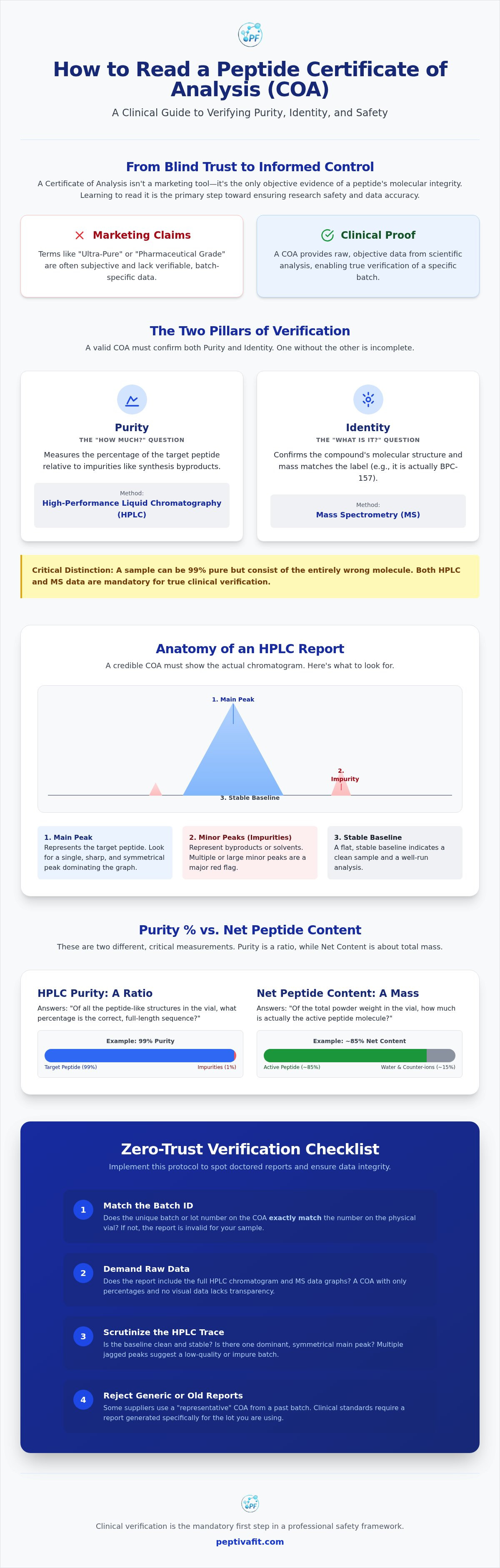
Verification requires two distinct analytical confirmations. Identity confirms that the molecule is exactly what the label claims, such as Tesamorelin or BPC-157, based on its molecular mass. Purity measures the percentage of that target peptide relative to synthesis byproducts or residual solvents. It's a common misconception that a high purity percentage guarantees the correct substance. A sample can be 99% pure but consist of the entirely wrong molecule. This is why a clinical report must include both High-Performance Liquid Chromatography (HPLC) and Mass Spectrometry (MS) data to be considered valid.
Why Clinical Standards Demand Batch-Specific Reporting
Precision in research depends on the specific lot being utilized. A COA is only valid for a single, specific batch number. Some suppliers provide "representative" or generic reports that were generated months or years prior for a different production run. This practice is a significant red flag. Generic COAs often hide batch-to-batch variability that can compromise your data or lead to unexpected biological responses. You must verify that the batch ID printed on the physical vial matches the ID on the report exactly.
Even minor variations in the synthesis process can introduce new impurities or alter the net peptide content. Clinical standards reject any document that doesn't provide a direct, verifiable link to the specific unit in your possession. Ultimately, understanding how to read a certificate of analysis for peptides is the primary gatekeeper for maintaining protocol safety. It ensures your research remains untainted by manufacturing inconsistencies or deceptive documentation practices.
Decoding HPLC Chromatograms: Measuring Peptide Purity
High-Performance Liquid Chromatography (HPLC) is the analytical gold standard for quantifying the chemical purity of a peptide batch. This process separates individual molecules within a sample based on their varying degrees of hydrophobicity. As the sample passes through the chromatographic column, different compounds elute at specific retention times, creating the visual peaks seen on a report. Understanding how to read a certificate of analysis for peptides requires you to look beyond the final percentage and examine the raw HPLC trace itself.
The purity value is derived from the Area Under the Curve (AUC). By integrating the area of the main peak and comparing it to the total area of all detected peaks, laboratories calculate the percentage of the target molecule present. A credible COA must display the actual chromatogram trace. A numerical claim without the accompanying graph lacks the transparency required for clinical verification. If you're following a disciplined framework like the Peptiva Protocol, verifying this data is your first responsibility.
Reading the Main Peak: Signal-to-Noise Ratios
The "Main Peak" represents your target peptide molecule eluting at its designated time. Any smaller peaks appearing before or after the primary signal are classified as "noise" or "minor peaks," which typically represent truncated sequences, deletion peptides, or residual solvents. A clean chromatogram consists of one dominant, symmetrical peak that rises sharply from a stable baseline. If you observe multiple jagged peaks or a "shoulder" on the main signal, the batch likely contains significant synthesis byproducts that could compromise your research data.
The 98% Threshold: Standards for Metabolic Research
In professional research environments, a purity level of 98% or higher is the accepted industry standard. While 95% might appear sufficient to the untrained eye, it implies that 5% of the vial consists of unknown impurities. These uncharacterized molecules can interfere with biological assays or trigger unpredictable systemic responses. Rigorous manufacturing also involves Controlling Endotoxin Contamination to ensure the sample is free from pyrogens that could compromise your findings.
Maintaining high purity is also critical for ensuring molecular integrity during reconstitution, as impurities can catalyze peptide degradation once the powder is liquidated. When you master how to read a certificate of analysis for peptides, you gain the ability to reject sub-standard batches before they enter your protocol. This level of scrutiny isn't optional; it's the foundation of sophisticated performance optimization.
Mass Spectrometry and Identity: Ensuring the Correct Molecule
While HPLC quantifies the volume of impurities, it cannot verify the chemical identity of the substance itself. Mass Spectrometry (MS) is the definitive analytical method used to determine the molecular mass of a peptide, acting as a molecular fingerprint. Without MS data, a report is incomplete; you might possess a substance that is 99% pure, yet it could be the entirely wrong compound. Mastery of how to read a certificate of analysis for peptides requires a dual verification of both purity and identity. A report that omits the MS graph should be viewed with immediate suspicion.
The FDA Good Manufacturing Practice Guidance emphasizes that a valid COA must include specific laboratory data to ensure clinical integrity. Reports that omit MS graphs fail to meet these professional standards. When you examine a report, you're looking for the correlation between the intended molecule and the physical sample tested in the lab.
Molecular Weight Matching: Comparing Theoretical vs. Observed Mass
Every peptide has a fixed "Theoretical Mass" calculated from its unique amino acid sequence. For instance, the theoretical molecular weight of BPC-157 is 1419.5 Da, while Tesamorelin is approximately 5135.9 Da. The "Observed Mass" on your report must align with these values within a strict tolerance level. Modern LC-MS/MS instruments typically provide accuracy within 5 parts per million (ppm). You'll often see peaks labeled as [M+H]+ or [M+Na]+, representing the peptide molecule plus a hydrogen or sodium ion. Even a deviation of a few Daltons can indicate a different peptide or a significant synthesis error.
The Danger of Truncated Sequences
Errors during the solid-phase peptide synthesis process often result in truncated sequences. These occur when one or more amino acids fail to attach to the chain, creating "short" or incomplete molecules. These fragments can sometimes elute at nearly the same time as the target peptide during HPLC, potentially masking their presence in a purity-only test. Mass spectrometry is the only tool that reliably catches these fragments by identifying their lower molecular weight.
Ensuring your batch is free from these incomplete chains is vital for the precision required in the Peptiva Protocol. Using misidentified or incomplete peptides doesn't just stall progress; it introduces unquantified risks into your metabolic research. A disciplined researcher never assumes identity based on a label; they verify it through the mass-to-charge ratio provided in the data.
Beyond the Basics: Net Peptide Content and Endotoxin Testing
A comprehensive understanding of how to read a certificate of analysis for peptides requires moving beyond simple purity percentages. High chemical purity, as confirmed by HPLC, only measures the ratio of the target peptide against synthesis byproducts. It doesn't account for the total mass of the lyophilized powder, which includes non-peptide components. To maintain clinical precision in your research, you must distinguish between the purity of the molecule and the actual quantity of peptide present in the vial.
This distinction is the primary reason why professional protocols demand a higher level of analytical scrutiny. While purity focuses on the "what," net content and endotoxin testing focus on the "how much" and the biological safety of the sample. For researchers who prioritize data integrity, these metrics are as vital as the chemical sequence itself.
Net Peptide Content: Why Your Vial Isn’t 100% Peptide
Net Peptide Content (NPC) represents the actual fraction of peptide relative to the total weight of the freeze-dried powder. It's standard for research-grade peptides to have an NPC ranging from 70% to 85%. The remaining mass consists of residual water and counter-ions, such as Acetate or Trifluoroacetic acid (TFA), which are necessary for stabilizing the peptide during the synthesis and purification stages. This salt content is a normal, expected part of the chemical process.
This distinction is critical for accurate dosage calculations. If a vial contains 5mg of lyophilized powder with an NPC of 80%, you're only working with 4mg of the actual peptide. Ignoring this variable can lead to significant under-dosing in a research protocol. For those seeking absolute precision, we recommend utilizing lab tested peptides that clearly state the net peptide content to ensure your metabolic calculations remain accurate.
Endotoxin Levels: The Critical Safety Metric
Endotoxins are lipopolysaccharides found in the cell walls of Gram-negative bacteria. They're among the most common contaminants in laboratory environments and can remain present even if the peptide itself is 99% pure. A standard COA should include a Limulus Amebocyte Lysate (LAL) test result to quantify these pyrogens. High endotoxin levels can trigger systemic inflammation, fever, and unintended immune responses, which effectively ruins the integrity of any metabolic study.
Acceptable endotoxin limits for research-grade peptides are typically less than 5 EU/mg. If a report lacks an endotoxin value, you're introducing an unmonitored biological variable into your system. Professional oversight and data monitoring are the only ways to mitigate these risks effectively. Mastering how to read a certificate of analysis for peptides means looking for these biological safety markers as diligently as you look for chemical purity peaks.
The Verification Protocol: Spotting Fakes and Doctored Reports
A "Zero Trust" policy is the only disciplined approach to peptide sourcing. In an industry where marketing claims often outpace regulatory oversight, a Certificate of Analysis must be treated as a technical document requiring active validation. Mastering how to read a certificate of analysis for peptides means looking beyond the data to verify the document's provenance. Every credible report must contain specific, non-negotiable fields to ensure research fidelity:
- Compound name and specific chemical sequence
- Unique Batch ID or Lot Number
- Issuing Laboratory name and verifiable contact information
- Exact date of the analysis
- Full-scale HPLC chromatogram and MS mass spectrum graphs
You must cross-reference the batch number printed on the physical vial with the number on the report. If these identifiers don't match precisely, the document is irrelevant to the sample in your possession. This level of scrutiny serves as the primary gateway for maintaining protocol safety. For those serious about performance optimization, personalized medical assessments are recommended to oversee the clinical integration of these compounds and ensure they align with your metabolic profile.
Red Flags: How to Identify Altered or Generic Certificates
Visual inconsistencies are often the first sign of a doctored report. Look for "blurred" text, mismatched fonts, or irregular alignment around the purity percentages; these often indicate Photoshop alterations or "cut-and-paste" data. Avoid "Generic COAs" that lack a specific batch number or testing date. Stability is a significant factor in peptide efficacy. A COA dated more than 12 to 18 months ago is a significant red flag, as it suggests the supplier is using old data for a potentially degraded batch. Analytical validation must be current to be clinically meaningful.
Third-Party Validation: Verifying with Independent Labs
Authenticity cannot be assumed. You should contact the issuing laboratory, such as MZ Biolabs or Janoshik, to verify that the report number exists in their database. Modern analytical facilities often include a "Verification Code" or a QR code that links directly to the original PDF on the lab's secure server. If a supplier hesitates to provide high-resolution, verifiable documents, they're likely hiding synthesis errors or batch inconsistencies. A reputable source doesn't just tolerate third-party scrutiny; they welcome it as a marker of their own clinical standards. Verification isn't a sign of distrust; it's a requirement for sophisticated data monitoring.
Implementing a Standard of Analytical Excellence
Mastering the analytical nuances of how to read a certificate of analysis for peptides is the ultimate safeguard for your metabolic research. By prioritizing dual-pillar verification, combining HPLC purity with MS identity confirmation, you eliminate the variables that compromise research fidelity. A disciplined approach rejects the ambiguity of generic reports and blurred data in favor of batch-specific transparency. This technical proficiency allows you to operate with a level of control that separates serious optimization from speculative experimentation. It's the difference between blind trust and clinical certainty.
True metabolic health requires more than just raw data; it demands professional oversight and clinical-grade standards. We provide the framework necessary to integrate these findings into a cohesive, safe, and effective strategy. You can Access the Peptiva Protocol for Lab-Verified Metabolic Optimization to leverage our expert medical assessments and 1-on-1 coaching available throughout the United States. Take command of your wellness journey with the precision and personal responsibility your performance deserves.
Frequently Asked Questions
What is the difference between HPLC and Mass Spectrometry on a COA?
HPLC (High-Performance Liquid Chromatography) quantifies the purity of a batch by separating molecules, while Mass Spectrometry (MS) confirms the specific chemical identity of the peptide. A standard report requires both. HPLC tells you how much of the substance is there, but MS proves that the substance is actually what's claimed. Relying on only one of these metrics is a clinical failure in any research protocol.
What is a "good" purity percentage for research peptides?
The industry standard for research-grade peptides is a purity level of 98% or higher. While some suppliers claim 95% is acceptable, this leaves a 5% margin for uncharacterized impurities that could interfere with your metabolic data. Learning how to read a certificate of analysis for peptides means identifying these thresholds. High-quality manufacturing targets 99% to minimize biological variables before beginning any sequence.
Can I trust a COA provided directly by the peptide seller?
You should only trust a COA if it's batch-specific and issued by a reputable third-party laboratory. Internal reports from a seller often carry a conflict of interest. Always verify the document's authenticity by checking the report number or QR code on the issuing lab's official website. A transparent supplier will always provide these verifiable third-party credentials to support their quality claims and ensure research fidelity.
What should I do if the batch number on my vial doesn’t match the COA?
If the batch ID on your vial doesn't match the COA, the document is technically irrelevant to the sample in your possession. You must contact the supplier immediately for the correct report or return the product. Using a peptide without a matching, batch-specific analysis introduces unquantified risks into your research. Precision requires a direct, verifiable link between the physical vial and the laboratory data provided.
Does a high purity COA mean the peptide is safe for human use?
High purity is a prerequisite for quality, but it doesn't automatically guarantee safety for any specific individual. Safety depends on your unique metabolic profile, dosage, and professional oversight. This is why the Peptiva Protocol emphasizes the necessity of a personalized medical assessment. Technical data from a COA is only one part of a comprehensive, medically supervised safety framework that prioritizes long term wellness over quick fixes.
Why does my COA show 99% purity but only 80% net peptide content?
Purity measures the ratio of the target peptide against synthesis byproducts, while net peptide content accounts for the total mass of the powder. Lyophilized peptides naturally contain residual water and counter-ions like TFA or Acetate. A 99% pure peptide can have 80% net content because the remaining 20% is non-peptide mass. This distinction is vital for calculating accurate dosages and maintaining the integrity of your research calculations.
What are endotoxins and why should I care about them in a COA?
Endotoxins are pyrogenic lipopolysaccharides from bacterial cell walls that can trigger systemic inflammation or fever. Even a highly pure peptide can be contaminated with these toxins if the manufacturing environment isn't strictly controlled. Quality reports should show endotoxin levels below 5 EU/mg. Monitoring these levels is essential to ensure your research outcomes aren't skewed by an unintended immune response or other systemic complications during the protocol.
How can I tell if a peptide COA has been faked or photoshopped?
Detecting a faked COA requires a disciplined visual inspection. Look for mismatched fonts, blurred text around the purity percentage, or irregular alignment, which often signal Photoshop alterations. Check the date; a report older than 18 months is a significant red flag for batch stability. When in doubt, contact the issuing laboratory directly to confirm that the report number and data match their official records exactly.

![Shelf Life of Reconstituted Peptides: A Clinical Reference Guide [2026]](https://getautoseo.com/storage/hero_images/shelf-life-of-reconstituted-peptides-a-clinical-reference-guide-2026.jpg?v=b8ed5173acaa)
