
In 2026, the question "is peptide therapy safe" is no longer a matter of anecdotal opinion; it's a rigorous calculation of molecular purity and clinical oversight. You're likely here because you've encountered a fragmented landscape of conflicting online advice and unregulated research-grade products. It's natural to feel a sense of caution when the market is flooded with under-dosed compounds and questionable sterility standards. This skepticism isn't just valid; it's a necessary component of a disciplined approach to metabolic optimization.
This clinical review provides an objective, data-driven analysis of the current safety landscape. We'll move past the marketing noise to examine the specific risks associated with unverified sources and the critical importance of pharmaceutical-grade standards. You'll gain a clear understanding of potential side effects and the regulatory shifts affecting compounding eligibility for agents like BPC-157 and TB-500. We'll preview the mandatory HPLC and mass spectrometry benchmarks required for 99% purity, alongside a professional checklist for verifying quality. By the end of this investigation, you'll have a safe, medically-informed path toward performance enhancement that prioritizes long-term biological integrity over short-term fixes.
Key Takeaways
- Learn why 99% molecular purity, verified through HPLC and Mass Spectrometry, is the non-negotiable benchmark for avoiding contaminants and heavy metals.
- Understand how to evaluate "is peptide therapy safe" for your unique profile through baseline biomarker audits and personalized medical oversight.
- Navigate the 2026 regulatory landscape to distinguish between legally compounded peptides and the systemic risks of unregulated research-grade products.
- Identify the difference between transient side effects and serious health risks caused by molecular impurities or incorrect concentrations.
- Establish a structured path toward metabolic optimization using a closed-loop system of lab-tested supplies and professional coaching.
Understanding Peptide Therapy Safety: Beyond the Buzz
The discussion regarding "is peptide therapy safe" often suffers from a lack of categorical nuance. Peptides are short-chain amino acids that serve as biological signaling molecules. While the body produces thousands of these endogenously, therapeutic applications often utilize synthetic analogs. These analogs are engineered to resist rapid enzymatic degradation, allowing for sustained physiological effects. When we analyze safety, we must distinguish between these precision-engineered molecules and the broad-spectrum pharmacological agents of the past.
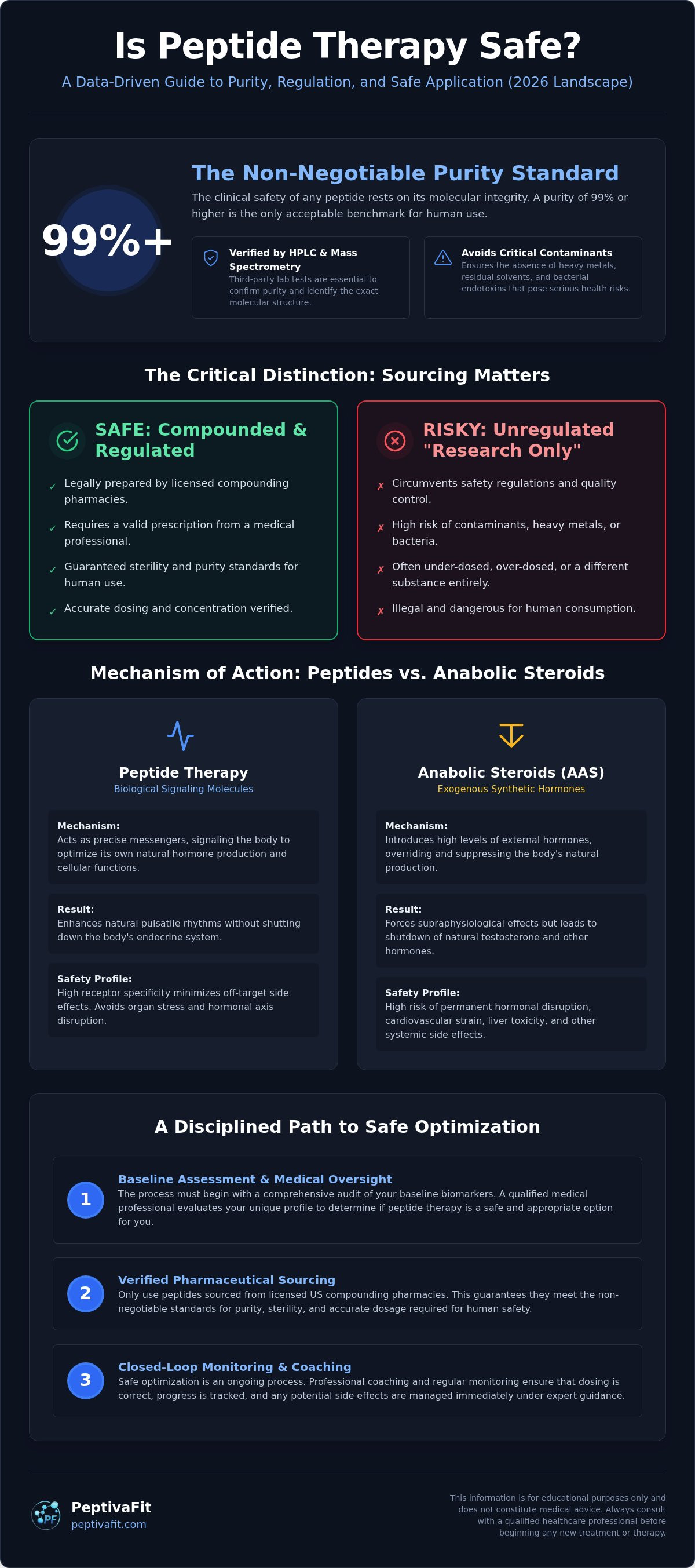
In 2026, the regulatory landscape has matured significantly. The FDA’s Pharmacy Compounding Advisory Committee (PCAC) held critical reviews in July 2026 to determine compounding eligibility for key molecules like BPC-157 and TB-500. Earlier this year, 14 of the 19 previously restricted peptides were moved back to Category 1. This shift allows licensed compounding pharmacies to legally prepare these agents for patients with a valid prescription. It's vital to separate administrative legality from clinical safety. A substance's regulatory status reflects its current legal classification, whereas safety is a function of molecular purity and professional oversight.
Safety profiles also vary significantly across different classes of peptides. Healing peptides, such as BPC-157, focus on tissue repair and localized recovery. In contrast, metabolic peptides like Tesamorelin target growth hormone secretion and fat oxidation. Determining if peptide therapy is safe for a specific individual requires an understanding of these distinct mechanisms and how they interact with a person's baseline biomarkers.
The Biological Mechanism of Peptides
Peptides function as precise cellular messengers, initiating specific cascades without the systemic "noise" associated with traditional drugs. They operate via a lock and key mechanism, binding only to targeted receptors. This minimizes off-target interactions and reduces the likelihood of systemic toxicity. The high receptor specificity of peptides typically results in a wider therapeutic index compared to broad-spectrum pharmacological agents.
Peptides vs. Anabolic Steroids: Clearing the Confusion
Mainstream media often conflates peptide therapy with anabolic-androgenic steroids (AAS), yet the mechanisms are fundamentally different. AAS introduce exogenous hormones that suppress the body's natural endocrine production, which often leads to permanent axis disruption and organ stress. Peptides, particularly secretagogues, encourage the body to optimize its own production through natural pulsatile rhythms. This distinction is critical for those prioritizing long-term health. Peptides offer a sophisticated method of metabolic signaling that avoids the aggressive side effects and hormonal shutdown associated with traditional interventions.
The Science of Purity: Why Lab-Verified Peptides Are Non-Negotiable
The determination of whether is peptide therapy safe rests fundamentally on the molecular integrity of the compound in the vial. While the regulatory landscape provides a legal framework, the physical reality of the "gray market" remains a significant clinical hazard. Many online vendors bypass pharmaceutical standards by labeling products as "for research purposes only." This designation allows them to circumvent the rigorous sterility and purity requirements mandatory for human use. These unregulated products often contain residual solvents, heavy metals, or bacterial endotoxins that can trigger systemic inflammatory responses or localized tissue damage.
Price-shopping for these compounds is a high-stakes gamble. Lower price points usually indicate a lack of third-party verification or the use of industrial-grade synthesis rather than pharmaceutical-grade processes. In 2026, the industry standard for safety is a minimum purity of 99%, confirmed by independent analytical chemistry. Anything less introduces unknown variables into your metabolic profile. Relying on unverified substances negates the benefits of peptide signaling and introduces unnecessary biological stress.
How to Read a Certificate of Analysis (COA)
A valid COA is the only objective proof of quality. High-Performance Liquid Chromatography (HPLC) is used to determine the exact purity percentage by separating the components of the mixture. If the HPLC chromatogram shows multiple peaks outside the primary substance, the product is contaminated. Mass Spectrometry (MS) then confirms the molecular identity by measuring the mass-to-charge ratio of the ions. This ensures the substance is actually the peptide it claims to be, rather than a cheaper analog or an inert filler.
Watch for these specific red flags in lab reports:
- Outdated testing dates; anything older than six months indicates a lack of current batch control.
- Missing or obscured batch numbers that prevent traceability back to the manufacturer.
- Forged signatures or reports from labs that don't appear in the 2026 registry of accredited analytical facilities.
The PeptivaFit Commitment to Lab-Tested Peptides
We maintain a zero-tolerance policy regarding molecular impurities. Every batch utilized within our protocols undergoes a multi-stage verification process. We source only from facilities that provide transparent, third-party HPLC and MS data for every single lot. This ensures that the concentration listed on the label matches the physiological dose delivered to the client. Our internal process involves rigorous batch-testing to mitigate the risks found in standard consumer channels.
Understanding Why Lab-Tested Peptides Are Essential for Safety is the first step in our disciplined approach to performance. By removing the variable of contamination, we allow for a pure focus on metabolic optimization. If you are ready to move beyond the uncertainty of unregulated markets, our team provides the professional oversight necessary for a secure protocol.
Common Side Effects vs. Serious Risks: A Clinical Breakdown
Determining if is peptide therapy safe requires a clear distinction between expected physiological responses and genuine adverse events. Many users mistake transient biological signals for safety failures. For instance, injection site redness or mild flushing are common localized reactions to the subcutaneous administration of signaling molecules. These usually resolve within minutes. Similarly, mild water retention can occur as the body adjusts to altered growth hormone levels, particularly during the initial phase of a protocol.
Peptide-specific effects also play a role in the clinical profile. Growth Hormone Releasing Peptides (GHRPs) often trigger intense hunger by mimicking ghrelin, while Growth Hormone Releasing Hormones (GHRHs) might cause transient lethargy in some individuals. These aren't necessarily risks; they're manifestations of the peptide's specific mechanism of action. Understanding these nuances is essential for any disciplined approach to wellness.
Expected Physiological Responses
A "side effect" is often a sign the peptide is successfully engaging its target receptor. A slight increase in body temperature or a nocturnal "flush" frequently indicates a growth hormone pulse. Managing these minor discomforts involves precise dosage timing and optimized injection techniques. For those utilizing tissue repair protocols, our BPC-157 Peptide: A Comprehensive Clinical Reference Guide details how to navigate specific localized responses while maximizing the therapeutic index.
When to Discontinue Use: Serious Red Flags
While transient effects are manageable, certain "red flags" demand immediate cessation. Systemic inflammation, hives, or difficulty breathing indicate a potential allergy to the peptide or a residual contaminant from an unverified source. Long-term safety also hinges on monitoring insulin sensitivity. Certain metabolic peptides can elevate fasting blood glucose if used continuously without strategic breaks. This is why we mandate "cycling" protocols. Constant receptor stimulation leads to desensitization, rendering the therapy ineffective and potentially stressing metabolic pathways.
Serious risks often stem from supra-physiological dosing. The belief that "more is better" is a dangerous fallacy in peptide science. Excessive doses don't accelerate results; they increase the likelihood of edema, joint pain, and peripheral neuropathy. Regarding oncogenic concerns, current clinical data suggests that peptides don't cause cancer, but their mitogenic properties mean they could theoretically accelerate existing undiagnosed pathologies. This underscores the absolute necessity of baseline medical screening and professional oversight before initiating any protocol.
The Safety Framework: Assessment, Dosing, and Oversight
The determination of whether is peptide therapy safe cannot be resolved in a vacuum. Safety isn't a static attribute of the molecule itself; it's a function of the individual’s unique physiological environment. A robust safety framework begins with a baseline biomarker audit. This isn't a mere formality. It's a diagnostic necessity to identify contraindications such as active malignancy or uncontrolled metabolic dysfunction. Without this data, introducing signaling molecules like GHRPs or GHRHs is clinically irresponsible and potentially hazardous.
Our disciplined approach follows a structured four-step process. Step 1 involves extensive bloodwork to establish a baseline for insulin sensitivity, kidney function, and liver enzymes. Step 2 requires selecting the specific molecule that aligns with these findings and your metabolic goals. Step 3 moves into the technical phase of precise reconstitution and administration protocols. Finally, Step 4 ensures the protocol remains effective through ongoing monitoring and adjustment. This closed-loop system allows for data-driven refinements rather than the guesswork found in unregulated communities.
The Role of Personalized Medical Assessments
A "one-size-fits-all" approach to peptides is inherently unsafe. Every individual responds differently to secretagogues and tissue repair agents based on their current hormonal status and age. Screening for contraindications, such as a history of proliferative retinopathy or active cancer, is mandatory. The Peptiva Protocol integrates these personalized medical assessments as the foundation of every engagement. This ensures that the chosen intervention complements your biological profile rather than disrupting it. Ongoing monitoring includes tracking markers like IGF-1 and fasting glucose every 8 to 12 weeks to ensure the body maintains homeostatic balance.
Dosage Precision and Reconstitution
The risk of "math errors" in home administration is a primary cause of adverse reactions. Accurate dosing requires a precise understanding of concentration per milliliter. Our technical guide on How to Reconstitute Peptides: A Clinical Guide to Molecular Integrity provides the standards for this process. Using bacteriostatic water and maintaining a sterile field are non-negotiable requirements. Compromising on these steps introduces the risk of infection or molecular degradation, rendering the therapy both dangerous and ineffective. If you require professional guidance to navigate these complexities, our personalized medical assessment provides the data-driven foundation you need to proceed with confidence.
The Peptiva Protocol: A Disciplined Approach to Optimization
Safety is not a static property of a molecule; it's the result of a rigorous clinical system. The Peptiva Protocol represents this system, functioning as a closed-loop framework that eliminates the variables of the unregulated market. We've established that the answer to the question "is peptide therapy safe" depends entirely on the ecosystem surrounding the administration. By integrating lab-verified peptide supplies with personalized medical assessments, we provide a level of security that the gray market cannot replicate. This synergy ensures that every signaling molecule introduced into your system is both pure and physiologically appropriate for your specific metabolic profile.
In 2026, this disciplined methodology has become the gold standard for metabolic fat loss. We move beyond the speculative nature of "research chemicals" to deliver results through professional oversight. Our protocol doesn't just provide access to compounds; it provides a structured path toward optimization that respects the complexity of human biology. This transition from unregulated experimentation to data-driven results is what separates the Peptiva Protocol from standard consumer offerings. We prioritize the integrity of your endocrine system by using only HPLC and mass spectrometry-verified agents, ensuring that what you're administering is exactly what's required for your goals.
Expert 1-on-1 Coaching and Consultations
Professional oversight is the final, critical layer of our safety framework. Our 1-on-1 coaching serves as a scientific mentorship, providing the high-level expertise needed to navigate receptor sensitivity and protocol adjustments. This individual attention prevents the common pitfalls of self-administration, such as incorrect dosing or the failure to recognize subtle physiological signals. Having a mentor ensures that your journey is guided by data rather than guesswork. For those specifically focused on body composition, the Peptiva Protocol Fat Loss Peptide Guide offers a comprehensive analysis of the metabolic agents we utilize within our programs.
Taking the First Step Safely
Our philosophy is rooted in a commitment to data over hype and clinical safety over marketing sensation. We operate with a sense of exclusivity because we understand that high-level performance optimization requires a mature, disciplined intent. We offer a single consultation call to serve as an initial screening process. This allows us to verify your suitability for the protocol and ensure that your metabolic baseline is prepared for the intervention. This selective approach maintains the high standards of our results and the safety of our clients. If you're ready to move toward a professional standard of care, you can apply for the Peptiva Protocol and Medical Assessment to begin your transition into a secure, results-oriented program.
Secure Your Metabolic Future Through Clinical Precision
The question of is peptide therapy safe is ultimately answered by the standards of the protocol you choose to follow. We've established that safety is a variable controlled through 99% molecular purity and rigorous clinical oversight. By moving away from the "gray market" and adopting a disciplined, data-driven framework, you eliminate the risks of contamination and supra-physiological dosing. True optimization requires a transition from speculative research to a closed-loop system that respects your unique biological profile.
The Peptiva Protocol provides this necessary structure by integrating lab-verified peptide supplies, confirmed through HPLC and mass spectrometry, with comprehensive medical assessments. Every step of our process is designed to mitigate risk while maximizing metabolic efficiency. You don't have to navigate these complexities alone; professional guidance ensures your journey is both secure and effective. Our comprehensive metabolic fat loss guide and expert coaching provide the scientific mentorship required for lasting results.
Take control of your performance with a strategy built on scientific integrity. You can access the Peptiva Protocol and Professional Medical Assessment to begin your transition toward a safer, more sophisticated approach to wellness. We look forward to guiding your metabolic optimization.
Frequently Asked Questions
Is peptide therapy safer than TRT or other hormone therapies?
Peptide therapy is often considered safer than TRT because it utilizes signaling molecules to stimulate endogenous production. Unlike exogenous hormones, which can cause permanent endocrine suppression, peptides like GHRHs maintain natural pulsatile rhythms. This reduces the risk of long-term dependency and hormonal shutdown. However, the question of whether is peptide therapy safe depends on the specific compound and the individual’s baseline endocrine health, making professional oversight a critical component of any protocol.
Can I buy peptides safely online without a prescription in 2026?
Buying peptides online without a prescription is inherently unsafe due to the lack of regulatory oversight on "research-grade" products. These substances frequently bypass the sterility and purity standards mandatory for clinical use. In 2026, the FDA has tightened restrictions on unapproved sales to mitigate the risk of contaminants and heavy metals. Secure, lab-verified peptides are only available through licensed compounding pharmacies that adhere to strict pharmaceutical manufacturing protocols and third-party verification.
What happens if I accidentally inject too much of a peptide?
Injecting an excessive dose of a peptide typically leads to an escalation of physiological side effects rather than acute toxicity. For secretagogues, this might manifest as severe water retention, joint pain, or peripheral neuropathy. For GHRPs, it can trigger intense, uncontrollable hunger. While rarely life-threatening, supra-physiological dosing disrupts metabolic homeostasis and can lead to receptor desensitization. If an overdose occurs, discontinue use immediately and consult your medical supervisor to re-evaluate your reconstitution math.
Are there any long-term studies on the safety of peptides like BPC-157?
Longitudinal human studies for newer peptides like BPC-157 are still maturing, though decades of animal data and clinical trials exist for growth hormone secretagogues. The 2026 reclassification of 14 peptides back to Category 1 by the FDA suggests a level of confidence in their safety when used under physician supervision. Safety data is continuously updated as the global peptide therapeutics market expands. We rely on current clinical research to guide our dosing durations and mandatory cycling periods.
Do peptides cause cancer or promote tumor growth?
Peptides do not cause cancer, but their role as growth signaling molecules requires caution. If an undiagnosed malignancy is already present, mitogenic peptides could theoretically accelerate the growth of existing abnormal cells. This is why a personalized medical assessment and baseline biomarker audit are non-negotiable before starting any protocol. Individuals with a personal or strong family history of active tumors must undergo specific screening to determine if peptide therapy is safe for their profile.
Is it safe to stack multiple peptides together?
Stacking multiple peptides is safe and often more effective when the molecules are chosen for their synergistic mechanisms. For example, combining a GHRH with a GHRP maximizes the growth hormone pulse through different pathways. However, random stacking without clinical oversight increases the risk of metabolic "noise" and cumulative side effects. A disciplined approach ensures that each component of the stack serves a specific purpose without overtaxing the body’s signaling receptors or endocrine balance.
How do I know if my peptides have "gone bad" or lost potency?
Visual changes like cloudiness or the presence of particulates in a reconstituted vial are primary indicators that a peptide has degraded or become contaminated. Peptides are fragile signaling molecules that require strict temperature control. If a vial is left at room temperature for extended periods or exposed to direct light, it may lose its molecular integrity. A lack of expected physiological response, such as the typical GH pulse, also suggests the compound has lost its potency.
Can peptides interact with my current prescription medications?
Peptides can interact with prescription medications, particularly those affecting blood glucose or blood pressure. Since metabolic peptides can influence insulin sensitivity, individuals on diabetic medications must monitor their levels closely to avoid hypoglycemia. Similarly, tissue repair agents may interact with certain anti-inflammatory drugs. A comprehensive medical assessment is the only way to identify these potential contraindications and ensure that your peptide protocol complements your existing pharmacological regimen without causing adverse interactions.

![Shelf Life of Reconstituted Peptides: A Clinical Reference Guide [2026]](https://getautoseo.com/storage/hero_images/shelf-life-of-reconstituted-peptides-a-clinical-reference-guide-2026.jpg?v=b8ed5173acaa)
