

The traditional "eat less, move more" model fails to account for the biological reality of metabolic adaptation, where your body actively defends its fat stores against your best efforts. You've likely hit a wall where progress stalls despite perfect adherence to diet and exercise; it's a frustrating plateau that generic weight loss advice simply cannot resolve. Achieving elite body composition requires a transition from standard lifestyle modifications to a sophisticated, data-driven investigation of your own physiology. This guide provides the clinical blueprint for a custom peptide protocol for fat loss, moving beyond simple caloric deficits to target direct lipolysis and mitochondrial efficiency simultaneously.
We'll analyze the science of multi-mechanism stacking and the critical necessity of lab-verified purity in an unregulated market. You'll learn how to navigate complex dosage synergies and implement a structured approach to metabolic optimization that respects your body's regulatory systems. By the end of this analysis, you'll possess the knowledge to verify peptide quality and master a protocol designed for precise, sustainable results. We're moving past the hype and focusing on the rigorous standards required for high-level performance and long-term metabolic flexibility.
Key Takeaways
- Understand the mechanism of peptides as precision signaling molecules designed to bypass the biological defense of metabolic adaptation.
- Learn the methodology for designing a custom peptide protocol for fat loss that sequences appetite control, lipolysis, and mitochondrial efficiency.
- Differentiate between primary lipolytic agents like Tesamorelin and Ipamorelin based on their specific physiological targets and safety profiles.
- Establish rigorous standards for peptide reconstitution to preserve molecular integrity throughout the investigative process.
- Recognize the necessity of clinical oversight and the monitoring of biomarkers like IGF-1 to ensure a data-driven approach to body composition.
The Science of Custom Peptide Protocols for Fat Loss
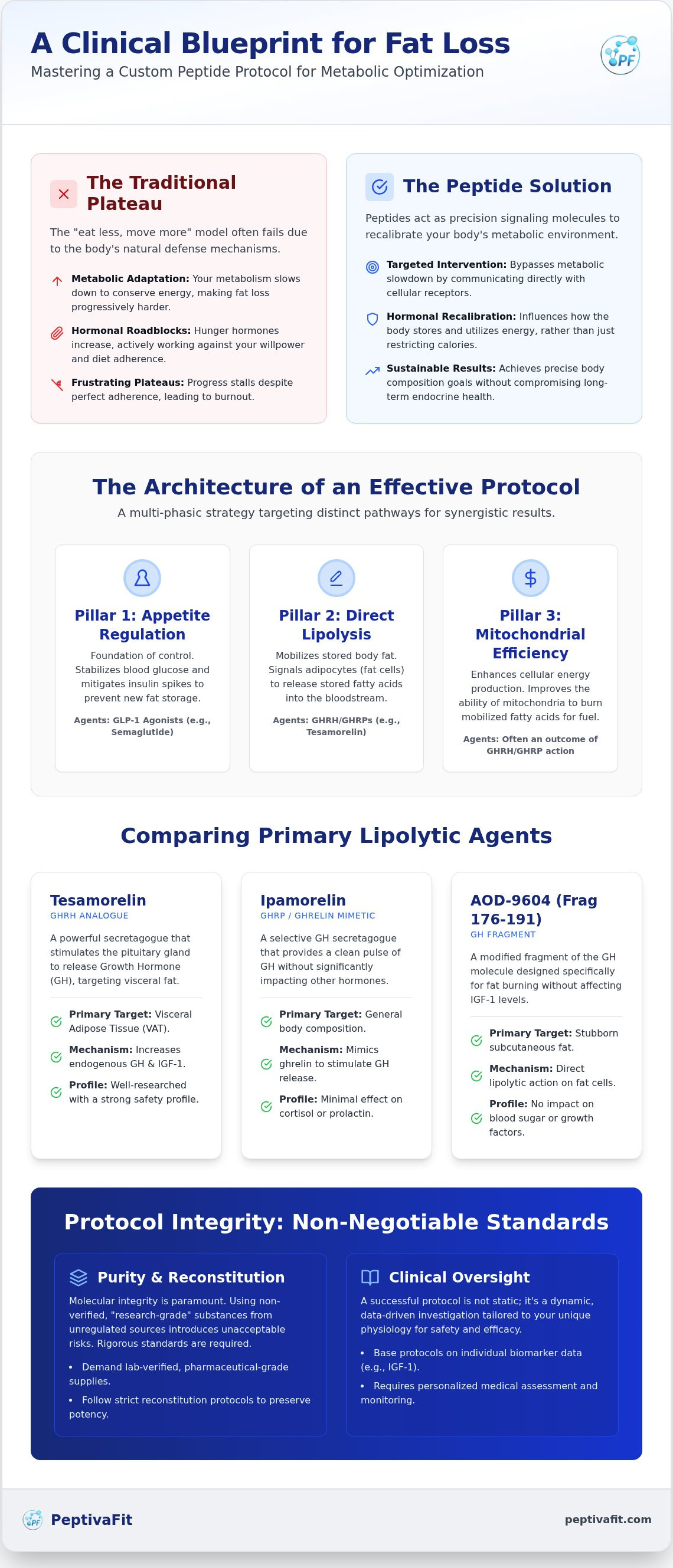
Peptides function as high-affinity signaling molecules that communicate directly with cellular receptors to modulate specific biological functions. In the context of body composition, these molecules regulate metabolic rate, lipolysis, and nutrient partitioning with a level of specificity that traditional pharmacology often lacks. A custom peptide protocol for fat loss isn't merely a supplement regimen; it's a targeted intervention designed to recalibrate the body’s endocrine environment. This clinical approach recognizes that fat loss is a complex biochemical process rather than a simple math equation of calories in versus calories out. By utilizing precise molecular signals, we can influence how the body stores and utilizes energy at the cellular level.
Why Traditional Weight Loss Methods Frequently Plateau
The human body is evolutionarily programmed to survive periods of scarcity, triggering a homeostatic defense known as adaptive thermogenesis. When you restrict calories, your metabolic rate drops and hunger hormones increase to protect energy stores. This metabolic slowdown makes long-term success difficult through willpower alone. Peptides can bypass these hormonal roadblocks by directly stimulating growth hormone secretion or modulating glucose metabolism. Metabolic flexibility is the physiological capacity to transition between fuel sources, such as glucose and fatty acids, based on availability and demand. Understanding The Science of GLP-1 illustrates how these signaling pathways influence satiety and insulin sensitivity at a foundational level, providing a mechanism to overcome the body's natural resistance to weight reduction.
The Clinical Advantage of Peptide Synergy
Relying on a single mechanism often leads to rapid adaptation and diminishing returns. True metabolic optimization requires a multi-phasic strategy where different compounds target distinct pathways simultaneously. For instance, while one peptide might focus on mobilizing adipose tissue, another may enhance mitochondrial function or suppress appetite. This synergy ensures that every aspect of the metabolic engine is functioning at peak efficiency. It's essential to understand the broader context of peptides for metabolism and fat loss before attempting to stack various compounds for synergistic effects. Appetite suppression serves as a vital anchor, but it's only one component of a comprehensive strategy that prioritizes fat oxidation and muscle preservation.
Effective protocols are built on individual biomarkers, including fasting insulin, IGF-1 levels, and body composition data. A custom peptide protocol for fat loss must be tailored to these specific data points to ensure safety and prevent systemic desensitization. There is also a critical distinction between "research-grade" peptides found on unregulated websites and pharmaceutical-grade supplies subject to rigorous clinical oversight. Using non-verified substances introduces unacceptable risk regarding purity and potency. High-level performance demands scientific-grade standards, which requires moving beyond mass-market advice toward data-driven, personalized investigation. This level of discipline ensures that the protocol achieves precise body composition goals without compromising long-term endocrine health.
The Architecture of the Peptiva Protocol
A successful custom peptide protocol for fat loss requires a structured, multi-phasic architecture. Rather than treating peptides as isolated tools, we view them as components of a precision-engineered system. The Peptiva Protocol serves as the clinical blueprint for this integration, ensuring that each molecule supports the others. This strategy is dynamic; it adapts to your biological feedback rather than following a static, predetermined prescription. By sequencing these phases correctly, you can achieve maximum efficacy while maintaining systemic balance.
Pillar 1: Hormonal and Appetite Regulation
The foundation of metabolic control begins with appetite regulation, primarily through GLP-1 agonists like Semaglutide or Tirzepatide. These compounds stabilize blood glucose levels, which effectively prevents the storage of new adipose tissue by mitigating insulin spikes. While appetite suppression is a powerful anchor, it's distinct from metabolic enhancement. This phase creates the necessary caloric environment for more aggressive lipolytic agents to function without the interference of compensatory hunger signals. Establishing this baseline is the first step in any sophisticated custom peptide protocol for fat loss.
Pillar 2: Growth Hormone Secretagogues and Lipolysis
Once hormonal stability is established, the focus shifts to mobilizing stored energy. Growth hormone secretagogues, such as CJC-1295 and Tesamorelin, stimulate the endogenous release of growth hormone to trigger direct lipolysis. This process involves the breakdown of triglycerides within fat cells. For precise application, clinicians often consult the Tesamorelin dosage guide to understand the nuances of administration and timing. It's vital to review Tesamorelin FDA Information to recognize its specific clinical history, particularly in reducing visceral adipose tissue in specialized populations.
Pillar 3: Mitochondrial Efficiency and Energy Expenditure
The final pillar involves optimizing the cellular machinery responsible for energy production. The MOTS-C peptide functions as an exercise mimetic, sending signals that enhance glucose uptake and improve insulin sensitivity within muscle tissue. By increasing mitochondrial biogenesis, these peptides help maintain a high basal metabolic rate (BMR), even during periods of fat loss. This ensures that the body remains metabolically flexible and efficient. To ensure these phases are sequenced correctly for your specific physiology, consider a personalized medical assessment to establish your data-driven baseline.
Comparing Lipolytic Peptides: Tesamorelin vs. Ipamorelin vs. Frag 176-191
Selecting the precise signaling molecule is the most critical step in developing a custom peptide protocol for fat loss. While many peptides influence growth hormone (GH) pathways, their affinity for specific adipose tissues and their secondary metabolic effects vary significantly. Understanding these distinctions allows for the surgical application of peptide therapy to address specific body composition challenges. We'll evaluate three primary candidates: Tesamorelin, Ipamorelin, and Frag 176-191 to determine which fits your specific metabolic profile.
Visceral Fat Targeting with Tesamorelin
Visceral adipose tissue is metabolically active and uniquely dangerous; it surrounds vital organs and drives systemic inflammation. Tesamorelin is a growth hormone-releasing hormone (GHRH) analogue with a high affinity for reducing this specific fat type. Clinical trials have demonstrated that Tesamorelin can reduce visceral adipose tissue by approximately 15-18% compared to a placebo. This makes it the superior choice for candidates whose fat distribution is primarily centered in the trunk or abdominal region. It's particularly effective for those who've reached a plateau where subcutaneous fat has diminished but stubborn visceral deposits remain. The ideal candidate for a Tesamorelin-based protocol is an individual with high levels of trunk fat who requires a potent GHRH analogue to shift deep, stubborn deposits.
HGH Frag 176-191: The Pure Lipolysis Option
HGH Frag 176-191 is a stabilized analogue of the factor that mediates fat-burning in the human growth hormone molecule. Unlike full-spectrum secretagogues, this fragment is a non-hormonal lipolytic agent. It targets adipose tissue without stimulating the pituitary gland or elevating IGF-1 levels. This distinction is vital for individuals concerned about insulin resistance, as the fragment doesn't negatively impact blood sugar levels. While some clinical trials for obesity didn't show significant weight loss compared to a placebo, its mechanism remains focused on mimicking the fat-burning portion of the GH molecule. Timing is crucial here; administration must occur during fasted states to maximize fat oxidation. It's a tactical tool for those wanting to avoid any impact on the endocrine axis or glucose metabolism.
Ipamorelin and the Safety Baseline
Ipamorelin stands out for its high safety profile and selectivity. As a ghrelin mimetic and growth hormone secretagogue, it stimulates GH release without the significant cortisol or prolactin spikes seen in older generations of peptides. Crucially, it doesn't trigger the intense appetite stimulation often associated with other secretagogues. This makes Ipamorelin a versatile anchor for a custom peptide protocol for fat loss. It's better suited for those seeking a gradual, sustainable improvement in body composition with minimal side effects. Ipamorelin provides a steady, safe elevation of endogenous GH for overall metabolic support, making it an excellent baseline for long-term optimization strategies.
Protocol Implementation: Reconstitution and Safety Standards
The efficacy of a custom peptide protocol for fat loss depends entirely on the stability of the molecules being administered. Peptides are delicate chains of amino acids held together by fragile bonds that are easily disrupted. Any deviation from strict handling protocols can lead to denaturation, rendering the compound biologically inactive and wasting the clinical potential of the therapy. This phase of implementation requires a level of disciplined precision that matches the sophistication of the protocol itself. You must ensure that every tool and environment used meets scientific-grade standards to preserve the integrity of your metabolic intervention.
Maintaining Molecular Integrity
Precision begins with the reconstitution process. When introducing bacteriostatic water to a lyophilized peptide cake, you must avoid direct impact on the powder. The diluent should be aimed at the side of the glass vial, allowing it to trickle down slowly to prevent foaming. Shaking the vial is strictly prohibited; instead, a gentle swirling motion is required to dissolve the powder completely. Shaking creates mechanical shear forces that can physically break the peptide chains. Bacteriostatic water is the required solvent in this setting, as it contains 0.9% benzyl alcohol to inhibit microbial growth and ensure the solution remains sterile throughout its use-life.
Once reconstituted, the shelf-life of these compounds is significantly reduced. Most peptides remain stable for only 20 to 30 days when stored under ideal conditions. Light sensitivity and temperature fluctuations are the primary drivers of rapid degradation. You must store all reconstituted vials in a dedicated refrigeration unit at constant temperatures between 36°F and 46°F (2°C to 8°C). For a comprehensive breakdown of these technical requirements, refer to our peptide reconstitution guide to ensure total molecular integrity during your research.
Dosage Precision and Administration
Calculating the correct volume for administration requires an accurate understanding of milligram-to-microgram conversions. For example, if a 5mg vial is reconstituted with 2ml of bacteriostatic water, each 10 units on a standard U-100 syringe will deliver 250mcg of the peptide. Utilizing a reconstitution calculator is an essential step to eliminate mathematical errors that could lead to sub-therapeutic or excessive dosing. Accuracy is the hallmark of a high-level custom peptide protocol for fat loss.
Administration is typically performed via subcutaneous injection into adipose tissue, which allows for steady absorption into the systemic circulation. Proper technique involves rotating injection sites to prevent localized tissue irritation or lipodystrophy. This level of technical execution can be complex for those transitioning from standard wellness advice to clinical-grade optimization. If you require professional guidance to master these procedures and ensure your data remains valid, our 1-on-1 coaching provides the necessary oversight to ensure your administration is safe, accurate, and effective.
Clinical Oversight: The Role of Personalized Medical Assessments
A "one-size-fits-all" approach to metabolic optimization is not only ineffective; it is clinically irresponsible. Every individual possesses a unique endocrine signature that dictates how they will respond to specific signaling molecules. Implementing a custom peptide protocol for fat loss requires a transition from speculative experimentation to data-driven investigation. Without a baseline established through rigorous medical assessment, you risk systemic desensitization or secondary metabolic complications. Clinical oversight ensures that your protocol remains aligned with your specific physiological needs and long-term health objectives.
Objective monitoring centers on key biomarkers that reflect your metabolic and hormonal health. Hemoglobin A1c (HbA1c) provides a critical look at your long-term glucose regulation, which is essential when utilizing peptides that influence insulin sensitivity. Simultaneously, monitoring Insulin-like Growth Factor 1 (IGF-1) levels allows for the precise titration of growth hormone secretagogues. These data points act as a regulatory compass, ensuring that the protocol stays within safe physiological boundaries while maximizing fat oxidation. This level of scrutiny is what separates a professional-grade intervention from mass-market weight loss advice.
Identifying Lab-Verified Peptide Supplies
The research peptide market is often saturated with low-quality substances that lack clinical transparency. To maintain the integrity of your custom peptide protocol for fat loss, you must possess the ability to verify your supply. A Certificate of Analysis (COA) is the only objective evidence of a peptide’s purity and molecular identity. High-level standards require third-party testing that confirms a purity level of 99% or higher. You should avoid vendors that exhibit "red flags," such as a lack of batch-specific testing, vague labeling, or the absence of a verifiable chain of custody. PeptivaFit strictly utilizes lab-tested peptides to ensure that every molecule administered meets rigorous pharmaceutical-grade standards for identity and potency.
The Value of Professional Coaching and Consultations
Professional oversight bridges the gap between clinical data and daily application. Our 1-on-1 coaching provides a disciplined framework for adjusting your protocol based on real-time biological feedback. This specialized attention prevents common errors, such as improper administration timing or the failure to recognize early signs of metabolic adaptation. A coach acts as a scientific mentor, ensuring that your journey toward body composition goals is both efficient and sustainable. For experienced individuals who require a focused review of their current strategy, a Single Consultation Call offers a high-level technical session to refine specific protocol nuances.
Success in metabolic optimization is reserved for those who prioritize data over hype and safety over sensation. By anchoring your strategy in a personalized medical assessment, you gain a sophisticated level of control over your own performance. This disciplined approach ensures that your efforts result in precise body composition changes without compromising your endocrine health. Schedule your personalized medical assessment today to begin the development of your custom protocol and secure your metabolic future.
Mastering Your Metabolic Evolution
Achieving elite body composition requires a transition from standard weight loss methodologies to a rigorous, data-driven framework. You've seen how a custom peptide protocol for fat loss functions by targeting multiple physiological pathways simultaneously, from direct lipolysis to mitochondrial efficiency. Success isn't found in generic advice but in the disciplined application of lab-verified molecules and the continuous monitoring of clinical biomarkers. By prioritizing purity and professional oversight, you eliminate the variables that lead to metabolic plateaus and systemic adaptation.
The path to superior performance is a long-term process that demands high levels of personal responsibility and scientific-grade standards. We provide the elite architecture necessary to achieve these results with uncompromising safety and technical precision. It's time to move past the hype and embrace a clinical blueprint for optimization that respects your unique biological signature.
Access the Peptiva Protocol and Personalized Coaching to benefit from our lab-verified peptide purity standards, personalized medical oversight, and expert 1-on-1 coaching. Your evolution into peak performance begins with a commitment to clinical excellence.
Frequently Asked Questions
What is the best peptide for losing stubborn belly fat?
Tesamorelin is widely considered the most effective option for targeting stubborn visceral fat. Clinical data indicates it can reduce abdominal fat by approximately 15% to 18% in specific populations. While other compounds like Ipamorelin provide systemic metabolic support, Tesamorelin's affinity for trunk fat makes it the preferred choice for those addressing deep, metabolically active adipose tissue. It should be integrated into a broader strategy that accounts for your specific body composition and hormonal baseline.
Can I stack multiple peptides for fat loss safely?
Stacking multiple peptides is often necessary to address the various pathways of metabolic adaptation. A custom peptide protocol for fat loss typically combines an appetite regulator with a lipolytic agent and a mitochondrial optimizer. This multi-mechanism approach ensures that you aren't just eating less but are also actively mobilizing stored fat and maintaining a high basal metabolic rate. Professional oversight is required to ensure these compounds are sequenced correctly to avoid systemic desensitization or secondary effects.
How long does it take to see results from a custom peptide protocol?
Most individuals begin to observe measurable changes in body composition within 4 to 12 weeks of consistent administration. While initial physiological shifts in insulin sensitivity and appetite occur rapidly, the mobilization of deep fat stores is a steady, cumulative process. Your specific timeline depends on the accuracy of your dosing, your metabolic starting point, and your adherence to the structured Peptiva Protocol. Regular data monitoring ensures that the protocol is adjusted in real-time to maintain progress and bypass potential plateaus.
Do fat loss peptides have side effects I should be aware of?
Potential side effects vary by compound but commonly include localized injection site irritation, mild water retention, or joint sensitivity. Some growth hormone secretagogues can influence glucose metabolism, which is why monitoring your HbA1c and fasting insulin levels is a clinical necessity. Because peptides are precision signaling molecules, any adverse reaction is often a sign that the dosage or timing requires professional adjustment. This is why we prioritize medical assessments to identify individual sensitivities before the protocol begins.
Why is a medical assessment required before starting the Peptiva Protocol?
A personalized medical assessment serves as the essential gateway to safe and effective optimization. It allows us to analyze critical biomarkers and identify any underlying contraindications that might compromise your results. Without this data-driven baseline, any protocol is merely speculative and carries unnecessary risk. We use these assessments to ensure your custom peptide protocol for fat loss is precisely calibrated to your unique endocrine environment, moving you beyond the limitations of mass-market, "one-size-fits-all" advice.
How do I know if the peptides I am buying are actually lab-tested?
Verifying the quality of your supply requires a batch-specific Certificate of Analysis (COA) from an independent third-party laboratory. This document must confirm both the identity of the molecule and a purity level of at least 99%. Many research chemical vendors offer vague labeling or outdated testing reports, which are significant red flags. PeptivaFit maintains strict exclusivity by only providing peptides that have undergone rigorous verification, ensuring that every molecule in your protocol meets clinical-grade standards for potency and safety.
Will I gain the weight back once I stop the peptide protocol?
Weight maintenance after a protocol depends on the successful improvement of your metabolic flexibility and the establishment of new homeostatic set points. Peptides are designed to bypass hormonal roadblocks and recalibrate your metabolic engine, but they aren't a substitute for long-term lifestyle discipline. By utilizing the Peptiva Protocol to optimize mitochondrial function and insulin sensitivity, you create a physiological environment where your body is better equipped to maintain its new composition without the need for permanent pharmacological intervention.
Is HGH Fragment 176-191 better than Tesamorelin for weight loss?
Neither molecule is universally "better" as they serve distinct physiological purposes. HGH Fragment 176-191 is a non-hormonal agent that targets lipolysis without affecting blood sugar or IGF-1 levels. In contrast, Tesamorelin is a potent GHRH analogue with a proven track record for reducing metabolically dangerous visceral fat. Your choice depends on whether you require a targeted strike on abdominal fat or a lipolytic tool that avoids any impact on your endocrine axis. Professional coaching helps determine the optimal candidate for each.

![Shelf Life of Reconstituted Peptides: A Clinical Reference Guide [2026]](https://getautoseo.com/storage/hero_images/shelf-life-of-reconstituted-peptides-a-clinical-reference-guide-2026.jpg?v=b8ed5173acaa)
