

Most individuals treat metabolic optimization as a game of chance; however, the difference between a stalled plateau and a total physiological shift is a matter of molecular precision. When analyzing peptide therapy before and after results, it's evident that elite body composition isn't a byproduct of effort alone, but of a disciplined adherence to clinical-grade protocols and verified purity. In an era where unregulated research chemicals saturate the market, moving beyond anecdotal evidence requires a commitment to data-driven standards and professional metabolic monitoring.
You've likely experienced the frustration of strict dieting that seems to target your muscle mass rather than your stubborn visceral fat. It's a common failure point that occurs when the body's metabolic signaling isn't aligned with its caloric intake, leaving you fatigued and depleted. This review provides a data-driven analysis of the physiological transformations, specific timelines, and safety protocols necessary to achieve elite results while maintaining strict regulatory compliance.
We'll examine the impact of the February 2026 HHS regulatory shifts, the necessity of sourcing through licensed 503A compounding pharmacies, and the measurable benchmarks for muscle preservation. You'll gain a clear understanding of how to transition from metabolic confusion to a state of sophisticated, data-backed performance optimization.
Key Takeaways
- Distinguish between simple weight reduction and the sophisticated optimization of metabolic profiles through Growth Hormone Secretagogues.
- Analyze the physiological shifts that define peptide therapy before and after results, moving beyond anecdotal claims to data-driven cellular signaling benchmarks.
- Understand the critical role of HPLC and Mass Spectrometry testing in ensuring molecular integrity and avoiding the dangers of impure research chemicals.
- Follow a precise week-by-week metabolic breakdown to manage expectations regarding fat oxidation, sleep quality, and muscular recovery.
- Learn how the Peptiva Protocol and personalized medical assessments create a secure environment for achieving elite body composition.
Defining Realistic Peptide Therapy Before and After Results
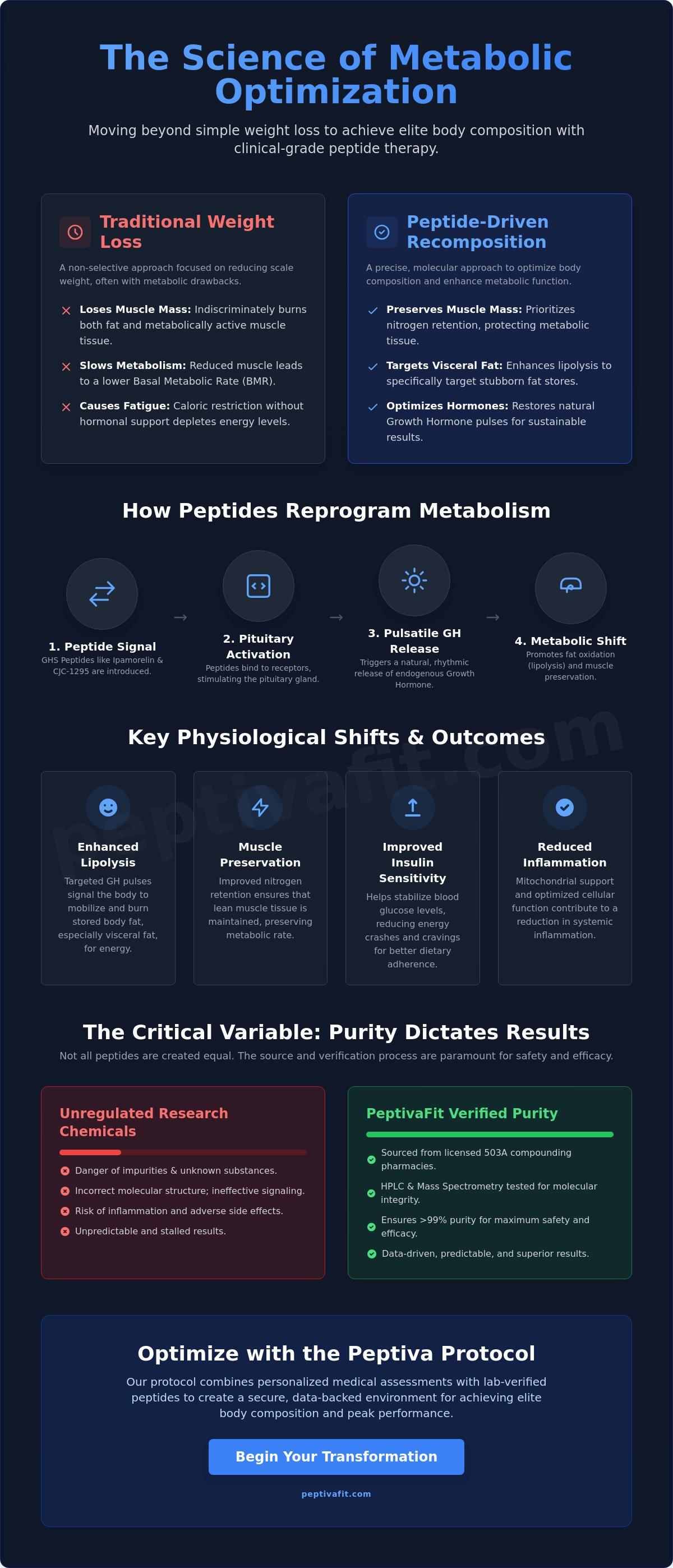
Standard consumer marketing often reduces complex biological shifts to a side-by-side photograph. This approach is fundamentally flawed. When evaluating peptide therapy before and after results, the primary focus must shift from the scale to the precise reorganization of body composition. Traditional weight loss often involves a non-selective reduction of both adipose tissue and lean skeletal muscle. In contrast, clinical-grade peptide protocols prioritize the preservation of metabolic tissue while aggressively targeting visceral fat stores.
The field of Peptide therapeutics has evolved to target specific signaling pathways that control how the body utilizes stored energy. Success isn't measured solely by a decrease in pounds, but through verifiable clinical markers such as optimized IGF-1 levels and a reduction in the waist-to-hip ratio. Before and after imagery frequently fails to capture the cellular-level rejuvenation occurring within the mitochondria and the endocrine system. These internal shifts are what sustain long-term results rather than temporary water weight fluctuations.
Metabolic Flexibility vs. Simple Weight Loss
Peptides restore the body's natural lipolytic signaling, allowing for a more efficient breakdown of triglycerides. This process is crucial for those who find fat loss difficult despite strict caloric deficits. Preserving lean muscle mass is a non-negotiable requirement for metabolic health; muscle is the primary driver of glucose disposal and resting energy expenditure. Metabolic flexibility is the physiological capacity to efficiently transition between fuel sources, specifically the oxidation of fatty acids and glucose, dictated by hormonal signaling.
The Role of Growth Hormone Secretagogues
Growth Hormone Secretagogues (GHS), such as Ipamorelin and CJC-1295, function by stimulating the pituitary gland to release endogenous growth hormone in a pulsatile manner. This natural rhythm is superior to synthetic HGH, which can lead to receptor desensitization and metabolic side effects. By enhancing the natural GHRH-GH axis, individuals often see a significant shift in their basal metabolic rate (BMR). These mechanisms ensure that the body remains in a state of high-efficiency energy utilization, rather than descending into a catabolic state that sacrifices muscle for energy.
Key physiological shifts include:
- Enhanced lipolysis through targeted growth hormone pulses.
- Improved nitrogen retention for muscle tissue maintenance.
- Stabilized blood glucose levels through improved insulin sensitivity.
- Reduction in systemic inflammation through mitochondrial support.
This disciplined approach to peptide therapy before and after results ensures that the transformation is both visible and metabolically sustainable. By focusing on the underlying hormonal architecture, you're not just losing weight; you're fundamentally altering your metabolic profile for long-term performance.
The Science of Cellular Signaling: How Peptides Reshape Composition
Peptides function as biological keys, unlocking specific cellular pathways to modulate metabolic behavior. Unlike traditional stimulants that force a physiological response, these signaling molecules instruct the body to optimize its existing systems. This is why peptide therapy before and after results often demonstrate a level of muscular density and fat loss that feels sustainable; the changes are rooted in fundamental cellular reorganization rather than temporary chemical manipulation.
The primary mechanism for body composition shifts involves the GHRH-GH axis. By binding to specific receptors in the pituitary gland, secretagogues like Ipamorelin trigger a pulsatile release of endogenous Growth Hormone. This pulse initiates a signaling cascade that prioritizes the mobilization of fatty acids for fuel. However, the precision of this signaling depends entirely on molecular integrity. Many individuals overlook the , which often contain truncated sequences or impurities that fail to bind correctly to target receptors, potentially leading to systemic inflammation instead of metabolic optimization.
Administration timing is another critical variable. Synchronizing peptide delivery with the body's natural circadian rhythms, particularly the nocturnal growth hormone pulse, maximizes the signaling effect. This strategic timing ensures that the body remains in a lipolytic state during rest, facilitating recovery and fat oxidation without disrupting the delicate endocrine balance.
Lipolysis and Targeted Fat Oxidation
Precision fat loss is often achieved by isolating specific molecular fragments. HGH Fragment 176-191, for example, targets the lipolytic region of the growth hormone molecule. It facilitates the breakdown of adipose tissue without the hyperglycemic risks or insulin resistance often associated with full-length growth hormone. This allows for a significant reduction in body fat while simultaneously improving insulin sensitivity. For a technical analysis of these pathways, refer to our guide on Peptides for Metabolism and Fat Loss: A Clinical Overview [2026].
Mitochondrial Health and Energy Production
The aesthetic "after" result is essentially a visible reflection of mitochondrial efficiency. Mitochondrial-derived peptides, such as MOTS-C, regulate metabolic homeostasis by enhancing glucose utilization and increasing exercise capacity. When cellular energy production is optimized, the body becomes more resilient to the stresses of a caloric deficit, preserving lean tissue while burning fat. Detailed insights into these mechanisms can be found in our reference on MOTS-C Peptide: A Comprehensive Reference on Mitochondrial-Derived Metabolic Regulation.
Achieving these outcomes requires a structured, data-driven approach. The Peptiva Protocol offers the clinical framework necessary to navigate these complex signaling pathways with professional-grade precision.
The Critical Variable: Why Lab-Verified Purity Dictates Your Results
The variance in peptide therapy before and after results among different users is frequently traceable to a single factor: molecular integrity. In a market saturated with "research-grade" chemicals, the distinction between a high-affinity signaling molecule and an inert or contaminated substance is absolute. Achieving elite body composition requires more than just the correct sequence; it demands a level of purity that prevents the formation of dimers and truncated chains which can trigger an adverse immune response rather than the desired metabolic shift.
Clinical-grade results are predicated on the use of peptides that have undergone rigorous High-Performance Liquid Chromatography (HPLC) and Mass Spectrometry testing. These analytical methods ensure that the peptide sequence is exact and that the purity exceeds the 99% threshold. Anything less introduces biological noise that can stall progress or cause systemic inflammation. For a deeper understanding of these molecular mechanisms, review the peer-reviewed research on The Science of Cellular Signaling: How Peptides Reshape Composition, which details the necessity of precise receptor binding for therapeutic efficacy.
Identifying Quality in a Saturated Market
Third-party lab verification is the only objective safeguard against the inconsistencies of the global supply chain. Many vendors operate with total anonymity, providing either no Certificate of Analysis (COA) or outdated reports that don't correspond to the current batch. You should consider any lack of transparent, batch-specific data as a definitive red flag. Verifying the legitimacy of your source is the first step in ensuring your protocol remains safe and effective. You can learn more about these standards in our report on Why Lab-Tested Peptides Are Essential for Safety.
Molecular Integrity and Bioavailability
Peptide molecules are notoriously fragile, held together by delicate amide bonds that are susceptible to degradation from heat, light, and kinetic shock. Even a 99% pure peptide can yield zero progress if the reconstitution process is handled incorrectly. The use of "dead" peptides is a primary reason why some individuals fail to see measurable peptide therapy before and after results. Preserving the structural stability of the molecule from the moment of synthesis to the point of administration is vital for maintaining high bioavailability. For precise instructions on preserving these bonds, consult our How to Reconstitute Peptides: A Clinical Guide to Molecular Integrity.
Ultimately, your metabolic transformation is an output of the data you provide your body. When the input is a lab-verified, high-purity signaling agent, the physiological response is predictable, measurable, and profound. Discipline in sourcing is as important as discipline in dosing.
The Transformation Timeline: A Week-by-Week Metabolic Breakdown
Achieving superior peptide therapy before and after results requires an understanding of biological latency. Physiological shifts don't occur in a vacuum; they follow a predictable sequence dictated by the half-lives of the signaling molecules and the rate of cellular turnover. Success isn't found in the first forty-eight hours, but in the cumulative effect of consistent, pulsatile signaling over several months. A disciplined approach to tracking these benchmarks ensures that you're making progress at the cellular level long before the scale reflects your efforts.
During Weeks 1 and 2, the primary shifts are acute and systemic. You won't see significant fat loss in this window; instead, you'll observe improvements in sleep architecture and a reduction in systemic inflammation. These are the necessary precursors to metabolic optimization. By Weeks 3 through 6, the body shifts into an active state of fat oxidation. Muscle fullness becomes more apparent as nitrogen retention improves, creating a harder, more defined aesthetic even if your total body weight remains stable. This is the period where the reorganization of body composition begins in earnest.
The peak results typically manifest between Months 3 and 6. This phase represents a systemic metabolic resetting, where the body's set point for fat storage is fundamentally altered. However, maintaining these results requires a strategic cycling protocol. Continuous administration can lead to receptor desensitization, where the pituitary gland becomes less responsive to the peptide signal. Implementing a structured "off" period, such as a five-day-on, two-day-off schedule, preserves the sensitivity of the GHRH receptors and ensures long-term efficacy.
Phase 1: Priming the System (Weeks 1-4)
In this initial phase, the focus is on stabilizing your internal environment. Early indicators of success include enhanced REM sleep and a noticeable decrease in joint discomfort due to reduced inflammation. These markers signal that your body is responding to the GH secretagogue signaling. It's vital to monitor these initial responses closely to determine if minor dosage adjustments are required to optimize your specific metabolic baseline. Patience during this priming window is non-negotiable.
Phase 2: Visible Transformation (Weeks 8-12)
This is the window where peptide therapy before and after results become undeniable. You can expect measurable shifts in waist circumference and a significant reduction in visceral fat percentage. The synergy between the protocol and a structured resistance training program is most potent during these weeks, as the peptides facilitate faster recovery and superior nutrient partitioning. If you encounter a progress plateau, it's often a signal to adjust the Peptiva Protocol to better align with your evolving metabolic needs.
Navigating this timeline with precision requires professional oversight to ensure you're hitting every metabolic benchmark. To secure a high-level strategy tailored to your physiology, you can apply for a personalized medical assessment to begin your optimization journey.
Optimizing Outcomes with the Peptiva Protocol and Professional Guidance
Execution is the final barrier between theoretical knowledge and physiological reality. While understanding the GHRH-GH axis and the necessity of 99% purity provides a foundation, the actualization of peptide therapy before and after results depends on a structured, multi-variable strategy. Passive administration rarely yields elite outcomes; instead, success requires the integration of dosing precision with metabolic monitoring and lifestyle synchronization. This is where the transition from a casual observer to a disciplined practitioner occurs.
The complexity of human physiology means that a "one size fits all" approach to signaling molecules is fundamentally ineffective. Achieving a significant reduction in visceral fat while preserving skeletal muscle requires a protocol that adapts to your specific metabolic rate and hormonal baseline. By moving away from the anecdotal noise of online forums and into a professional-grade framework, you ensure that every injection serves a precise biological purpose.
The Peptiva Protocol Framework
The Peptiva Protocol serves as a rigorous architectural plan for metabolic health. It moves beyond the simple selection of compounds to address the environmental factors that dictate signaling efficacy. By following The Peptiva Protocol: A Clinical Guide to Fat Loss, individuals manage the critical intersections of nutrition, circadian-aligned sleep, and exact dosage timing. This framework ensures that the peptides are operating within an optimized physiological context, preventing the "noise" of poor lifestyle choices from blunting the hormonal signal.
Key components of the framework include:
- Strategic nutrient partitioning to support lean tissue preservation.
- Sleep hygiene protocols to maximize the nocturnal growth hormone pulse.
- Precision dosage adjustments based on individual metabolic feedback.
- Rigorous adherence to lab-verified sourcing to maintain molecular integrity.
Professional Oversight and Consultations
Navigating complex peptide stacks without professional guidance introduces unnecessary risk and metabolic guesswork. Personalized medical assessments are non-negotiable for those seeking elite results, as they establish the baseline blood markers necessary for safe and effective optimization. A data-driven approach is the only way to ensure peptide therapy before and after results translate into long-term metabolic flexibility rather than temporary aesthetic shifts.
1-on-1 coaching provides the tactical depth required to troubleshoot plateaus and refine protocols in real-time. Single consultation calls act as a high-level resource for specific troubleshooting, ensuring that every variable remains within clinical safety parameters. Ongoing monitoring of blood markers, specifically IGF-1 and fasting insulin, is essential for long-term success. The shift from researching to executing requires a commitment to these high-level standards. To begin your own transformation with a clinical foundation, you can apply for the Peptiva Protocol and access lab-verified peptides today.
Executing Your Metabolic Transformation
Achieving elite peptide therapy before and after results isn't a passive outcome; it's a direct consequence of clinical-grade precision and disciplined protocol execution. This review has established that molecular integrity, verified through rigorous HPLC testing, is the non-negotiable foundation for any successful metabolic shift. By synchronizing your administration with biological rhythms and adhering to a proven framework, you move beyond the limitations of standard fat loss and into a state of superior metabolic flexibility.
The transition from gathering data to implementing a high-stakes health strategy requires more than just access to compounds. It demands a structured environment that includes personalized medical assessments and professional oversight to ensure long-term safety and efficacy. The Peptiva Protocol provides this necessary architecture, offering a proven metabolic framework designed for those who value scientific standards over industry hype. You're now equipped with the knowledge to move from metabolic confusion to a state of sophisticated, data-backed performance.
Your journey toward physiological optimization begins with a commitment to quality and professional guidance. Secure Your Peptiva Protocol & Lab-Verified Peptides to start your disciplined transformation today.
Frequently Asked Questions
How long does it take to see visible results from peptide therapy?
Visible changes in body composition typically manifest between weeks 8 and 12 of a disciplined protocol. While acute improvements in sleep architecture and systemic recovery are observable within the first 14 days, the structural reorganization of adipose tissue requires cumulative signaling. Achieving peak peptide therapy before and after results generally necessitates a three to six month commitment to ensure a complete metabolic reset and the stabilization of new physiological set points.
Can I achieve before and after results without exercise?
While peptides can facilitate fat oxidation through enhanced lipolytic signaling, elite results are rarely achieved without structured resistance training. Mechanical tension remains the fundamental requirement for muscle hypertrophy and preservation. Peptides act as a powerful metabolic catalyst, but they function best when paired with the stimulus of exercise to optimize nutrient partitioning. Relying on signaling alone without physical stress limits the body's capacity for total physiological transformation.
Are the fat loss results from peptides permanent?
The fat loss achieved is sustainable if the user maintains the metabolic flexibility and hormonal balance established during the protocol. Peptides function by altering the body's energy utilization set point, but they don't grant immunity to future metabolic dysfunction. If you return to poor nutritional habits or sedentary behavior, the body will eventually revert to its previous state. Long term success depends on using the therapy as a foundation for permanent lifestyle shifts.
What is the best peptide stack for body transformation?
A combination of Ipamorelin and CJC-1295 is widely considered the gold standard for comprehensive body transformation. These secretagogues work in tandem to maximize endogenous growth hormone pulses without the side effects of synthetic alternatives. This stack targets stubborn visceral fat while simultaneously supporting the repair of lean skeletal muscle. However, the specific efficacy of any stack depends on the precision of the dosage and the individual's unique baseline blood markers.
Is a medical assessment required before starting the Peptiva Protocol?
A personalized medical assessment is mandatory for anyone seeking to utilize the Peptiva Protocol safely and effectively. This assessment provides the clinical data required to tailor the protocol to your specific physiology and metabolic needs. Attempting to navigate complex signaling pathways without a baseline understanding of your blood markers introduces unnecessary risk. Professional oversight ensures that the therapy remains within regulated safety boundaries while maximizing your potential for metabolic optimization.
How do I know if my peptides are high quality and lab-tested?
Verification requires batch-specific High-Performance Liquid Chromatography (HPLC) and Mass Spectrometry reports that confirm a purity level of 99% or higher. You should treat any vendor that fails to provide transparent, third-party lab results as a significant safety risk. High quality peptides are never sold as anonymous "research chemicals" without documentation. Ensuring molecular integrity is the only way to guarantee that the peptides will bind correctly to their target receptors.
What happens if I stop taking peptides after achieving my results?
When you cease administration, your pituitary gland will return to its baseline level of hormone production without a withdrawal phase. Unlike exogenous hormones that suppress natural function, secretagogues encourage the body's own signaling pathways. The metabolic improvements and body composition shifts you've achieved can be maintained through disciplined nutrition and exercise. The goal of the protocol is to catalyze a lasting shift in your metabolic profile that persists after the therapy ends.
Can peptides help with muscle growth as well as fat loss?
Peptides are exceptionally effective at facilitating muscle growth and preservation through enhanced nitrogen retention and optimized IGF-1 levels. Many users specifically monitor peptide therapy before and after results to track their ability to gain or maintain lean tissue during aggressive fat loss phases. This capacity for body recomposition is what separates peptide protocols from standard weight loss programs, allowing for a denser, more athletic physique by prioritizing muscle health.

![Shelf Life of Reconstituted Peptides: A Clinical Reference Guide [2026]](https://getautoseo.com/storage/hero_images/shelf-life-of-reconstituted-peptides-a-clinical-reference-guide-2026.jpg?v=b8ed5173acaa)
