

The biological reality of peptide therapy is a measured cascade of cellular signaling that requires disciplined adherence before it manifests as physical change. It’s understandable to feel frustrated when your physical progress doesn't immediately reflect the precision of your protocol. You are likely asking how quickly do you see results from peptides because you want to distinguish between genuine physiological shifts and the noise of anecdotal marketing. This frustration often stems from a misunderstanding of the three stage biological timeline: signaling, metabolic adjustment, and structural transformation.
We'll provide a realistic clinical roadmap based on the latest June 2026 data and recent HHS reclassifications. You'll learn why initial improvements in sleep and energy often surface within the first two to four weeks, while significant fat loss and muscle growth typically require a window of four to twelve weeks to become visible. This article previews the specific variables of efficacy and explains why peak structural results are generally achieved at the six month mark. By the end, you will have a data driven framework to validate your protocol and manage your expectations with scientific rigour.
Key Takeaways
- Define the biological latency between initial administration and measurable physiological changes to establish a disciplined roadmap for progress.
- Analyze the specific clinical timelines for fat loss, muscle growth, and tissue repair to understand exactly how quickly do you see results from peptides.
- Evaluate the impact of molecular purity and individual biological markers on the predictability and speed of your metabolic optimization.
- Explore strategic stacking methodologies that target multiple metabolic pathways to enhance efficacy without compromising safety or regulatory compliance.
- Learn how to integrate professional medical assessments and lab-tested materials into your protocol for sustainable, high-level performance results.
The Biological Latency of Peptide Therapy: Signaling vs. Outcome
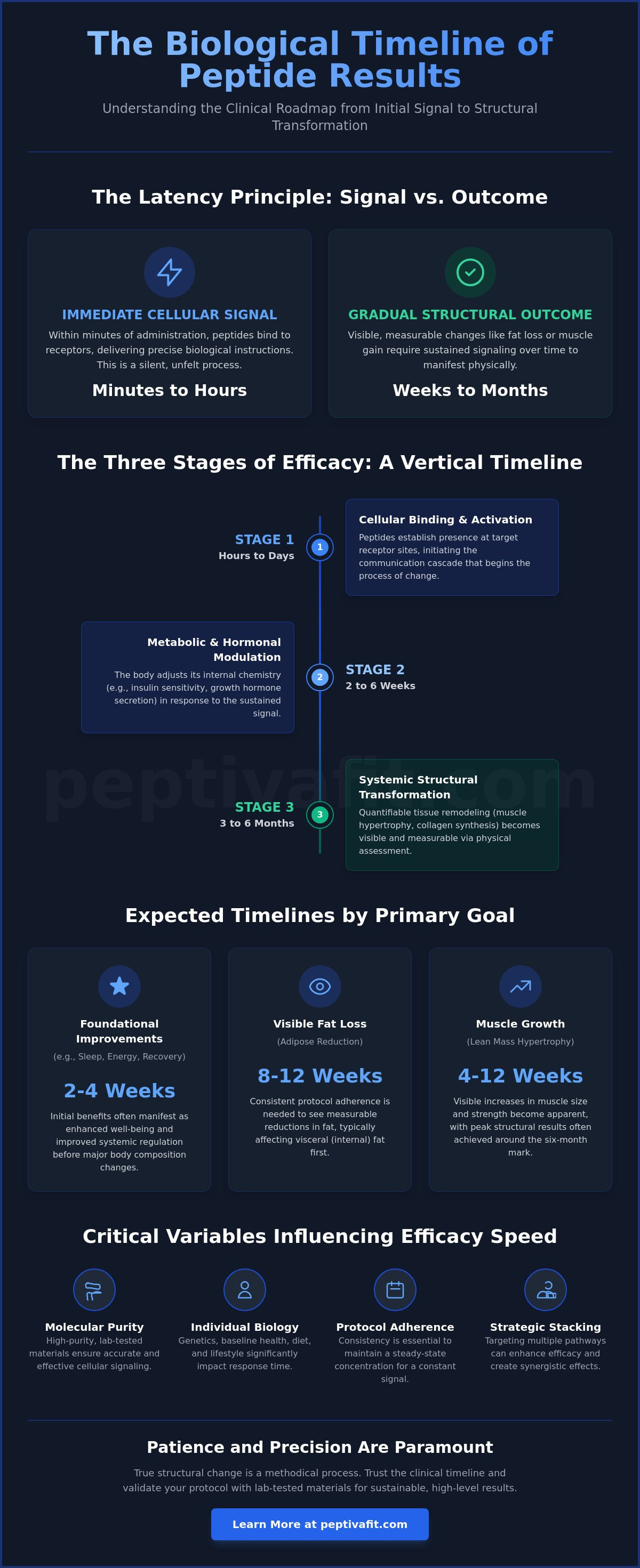
Peptides are high-precision signaling molecules. Unlike macronutrients that provide raw metabolic fuel, Peptide therapeutics function as specific instructions delivered to cellular receptors. The "Signaling Phase" begins almost immediately, often within minutes of administration, as these short chains of amino acids bind to target sites. However, a common point of confusion for those asking how quickly do you see results from peptides is the distinction between this immediate signaling and the eventual physiological outcome. The body requires time to accumulate secondary messenger signals and initiate the complex biological cascades that lead to visible changes.
Many researchers expect a tangible sensation to confirm efficacy. This is a clinical misconception. Efficacy isn't defined by a "buzz" or an immediate physical rush; it's defined by the steady modulation of biological pathways. A protocol is working even when you don't "feel" it, provided the materials are of sufficient purity and the dosage is calibrated to your baseline. Relying on subjective feelings often leads to premature discontinuation or unnecessary dosage escalations that can disrupt the very feedback loops you're trying to optimize.
The Three Stages of Peptide Efficacy
Biological transformation occurs through a structured progression that cannot be bypassed. Stage 1 involves Cellular Binding and Receptor Activation, occurring within hours to days. During this phase, the peptide establishes its presence at the target receptor sites and begins the communication process. Stage 2, Metabolic and Hormonal Modulation, typically spans weeks two through six. This is when the body begins adjusting its internal chemistry, such as insulin sensitivity or growth hormone secretion, in response to the sustained signal. Finally, Stage 3 is Systemic Structural Transformation, occurring between months three and six. This final stage is where actual tissue remodeling, such as muscle hypertrophy or collagen synthesis, becomes quantifiable through physical assessment or diagnostic imaging.
Why Results Are Not Overnight
Clinical patience is a requirement. For a protocol to be effective, the peptide must reach a "steady-state" concentration in the bloodstream. This means the rate of administration matches the rate of elimination, providing a constant signal to the body. Endogenous feedback loops also play a critical role. Your body’s natural regulatory systems often attempt to maintain homeostasis before accepting a new metabolic baseline. Rapid changes within the first 48 hours are often a result of shifts in water retention or glycogen storage rather than genuine tissue repair. True structural change is a methodical process that rewards consistency over intensity. Understanding this latency is essential for long-term success and prevents the common pitfall of protocol hopping.
Timelines by Category: Fat Loss, Muscle, and Recovery
The physiological destination determines the duration of the journey. While signaling begins instantly at the cellular level, the time required to witness a measurable change in body composition differs significantly from the time required to modulate inflammation. Understanding how quickly do you see results from peptides requires a categorical approach. Therapeutic peptides interact with distinct receptors, each possessing its own temporal threshold for systemic expression.
Fat Loss and Lipolysis Timelines
Adipose reduction is a metabolic marathon rather than a sprint. Protocols involving AOD-9604 or Frag 176-191 initiate internal metabolic shifts within the first four weeks of administration. However, visible adipose reduction usually requires eight to twelve weeks of strict adherence. Fasted administration is a critical variable in this category. Applying these signaling molecules while in a fasted state accelerates lipolytic signaling by minimizing insulin interference. You'll likely observe visceral fat reduction, which surrounds the internal organs, before subcutaneous changes become apparent to the naked eye. This methodical process is the core of the Peptiva Protocol, where metabolic optimization precedes aesthetic transformation.
Muscle Growth and GH Secretagogues
Growth Hormone (GH) secretagogues follow a cumulative curve for body composition. When utilizing combinations like CJC-1295 and Ipamorelin, subjective improvements in sleep quality and recovery times often emerge within the first one to two weeks. These are the "early signals" of biological efficacy. In contrast, quantifiable increases in lean mass and strength gains typically require twelve or more weeks of disciplined adherence. For those targeting specific metabolic goals, reviewing a tesamorelin dosage guide can provide a more granular timeline for abdominal fat reduction and muscle maintenance.
Injury Repair and Systemic Healing
Systemic healing and injury repair offer the fastest subjective feedback in the peptide landscape. Peptides such as BPC-157 and TB-500 can reduce acute inflammation within three to seven days. This rapid response is often mistaken for complete healing, which is a dangerous assumption for an athlete. True connective tissue and tendon repair are more methodical, generally requiring six to eight weeks of focused application to ensure structural integrity. If you're managing a specific injury, the BPC-157 clinical guide details the necessary duration for long-term recovery. For personalized guidance on these specific timelines, consider a single consultation call to refine your approach.
Critical Variables Influencing the Speed of Efficacy
The clinical timelines established in previous sections are not universal constants. They represent an optimized scenario. When evaluating how quickly do you see results from peptides, you must account for the precision of your materials and the state of your internal biological environment. A protocol is only as effective as the signal it generates. If that signal is weak, inconsistent, or obscured by poor metabolic health, the timeline for visible transformation will inevitably expand. Efficacy is a product of molecular accuracy meeting cellular receptivity.
Protocol discipline is a primary driver of predictable outcomes. Peptides rely on the cumulative effect of repeated signaling to trigger systemic shifts. Every missed dose or significant deviation in timing disrupts the biological signaling clock. This forces the body to re-initiate the priming phase rather than progressing toward structural change. Additionally, your lifestyle serves as the medium through which these signals travel. Factors such as circadian rhythm alignment and micronutrient density can either amplify or muffle the peptide's message. A body in a state of chronic sleep deprivation or nutritional deficiency will naturally prioritize basic survival over the elective optimization of muscle growth or fat loss.
The Necessity of Lab-Tested Peptides
Molecular purity is the cornerstone of any predictable physiological response. Impure or under-dosed research materials don't just pose a safety risk; they stall progress by providing insufficient or distorted cellular instructions. Utilizing lab tested peptides is a non-negotiable requirement for those seeking to optimize their biology with clinical rigour. A legitimate Certificate of Analysis (COA) must confirm a purity level of 99% or higher. Red flags, such as missing batch numbers, lack of HPLC data, or inconsistent mass spectrometry, indicate a lack of quality control that will compromise the speed of your results. Predictability requires high-purity standards.
Metabolic Baseline and Response Rate
Your metabolic baseline serves as the foundation for efficacy. Insulin sensitivity, in particular, dictates the speed of fat loss peptide outcomes. If your body is in a state of chronic insulin resistance, the lipolytic signals sent by peptides may be less effective until the underlying metabolic dysfunction is addressed. Systemic inflammation also acts as a biological "noise" that can delay tissue repair signals. This is why a comprehensive pre-protocol assessment is vital for setting realistic expectations. It allows you to identify these internal roadblocks and adjust your strategy to ensure your cells are primed to respond to the signaling cascade as efficiently as possible.
Strategic Optimization: Accelerating Results Safely
Optimization is a data driven process that rejects the "more is better" fallacy common in amateur research circles. True acceleration of efficacy comes from targeting multiple metabolic pathways simultaneously through strategic stacking. For instance, pairing a Growth Hormone secretagogue with a specific lipolytic fragment creates a synergistic environment that addresses both fat oxidation and muscle preservation. The question of how quickly do you see results from peptides is often answered by the sophistication of the strategy employed rather than the sheer volume of material used. By layering these signals, researchers can often compress the timeline for visible changes while maintaining systemic balance.
Professional oversight is the primary differentiator between those who see consistent results and those who remain stuck in a cycle of trial and error. Validating a protocol requires monitoring specific biomarkers, such as IGF 1 levels or inflammatory markers, to confirm that the peptides are functioning as intended long before physical changes manifest. This internal validation provides the scientific confidence necessary to maintain a protocol during the initial latency phase. Without this data, researchers often make premature adjustments that disrupt the signaling cascade.
The Value of 1-on-1 Coaching
Engaging in 1-on-1 Coaching provides the real time feedback required to make precision adjustments to a protocol. Small administration errors, such as improper reconstitution or poor storage conditions, can compromise molecular integrity and stall progress for weeks. An expert guide identifies these variables immediately, ensuring that every administration delivers a potent signal. This level of support also helps maintain psychological momentum, preventing the common mistake of abandoning a protocol just as it reaches the threshold of systemic expression. Expert guidance ensures that the latency phase is managed with discipline rather than doubt.
Medical Assessments and Protocol Tailoring
A personalized medical assessment is the final step in transitioning from a general guide to a precision engineered protocol. Identifying underlying deficiencies, such as suboptimal thyroid function or micronutrient imbalances, is critical. These deficiencies often act as biological brakes that counteract the benefits of peptide therapy. Individualized metabolic screening ensures that your internal environment is primed to receive and execute the signaling instructions provided by the protocol. You can access a personalized medical assessment to ensure your biological foundation is ready for high level optimization.
Implementing the Peptiva Protocol for Long-Term Success
Achieving a superior biological state requires more than just access to compounds; it requires a disciplined framework. The Peptiva Protocol is engineered for individuals who prioritize clinical-grade results over the erratic outcomes of the mass market. This is a selective environment designed for those who value privacy and high-level expertise. By integrating high-purity research materials with professional medical assessments, this methodology moves beyond speculative use. When you consider how quickly do you see results from peptides, you must recognize that speed is a function of protocol precision. Sustainable metabolic optimization isn't an overnight event. It's the result of a calibrated signaling cascade that respects the body's natural regulatory thresholds. This approach ensures that the changes you achieve are structural and lasting rather than transient fluctuations in water weight or temporary metabolic spikes.
Accessing the Fat Loss Peptide Guide
The Peptiva Protocol: Fat Loss Peptide Guide serves as a comprehensive roadmap for navigating the complexities of metabolic health. It provides the structure necessary to move from fragmented information to a cohesive clinical investigation. A critical component of this process is ensuring molecular integrity during preparation. You must understand how to reconstitute peptides to maintain maximum potency and prevent degradation. Improper handling can render a high-purity peptide ineffective, leading to stalled results and wasted resources. Structuring your first 12 weeks with this level of detail ensures that you're not just administering a substance, but initiating a targeted physiological shift. This initial window is the priming phase where your receptors reach the sensitivity required for Stage 3 transformation. Without this foundational structure, the biological signaling is often too inconsistent to produce measurable adipose reduction.
Commitment to the Scientific Method
Adopting this protocol means treating your health journey as a rigorous scientific investigation. There's no room for guesswork in high-level performance optimization. Data monitoring is essential for validating that your internal environment is responding to the signaling molecules. By tracking internal biomarkers and adhering to a consistent schedule, you provide the body with the stable environment it needs to manifest structural changes. Long-term adherence is the only path to the peak benefits seen at the six-month mark. This level of discipline separates the serious researcher from the casual consumer. It's a commitment to data over hype and safety over sensation. Your transition from education to clinical investigation begins by securing the right resources and professional support. Access the Peptiva Protocol and Lab Tested Peptides to establish your baseline and begin a precision-engineered journey toward metabolic excellence.
Advancing Your Biological Investigation
Your progress is directly linked to the precision of your strategy and the purity of your materials. We provide the necessary infrastructure for this high level optimization through lab verified peptide supplies, personalized medical assessments, and expert 1-on-1 coaching packages. By removing the variables of uncertainty, you can focus on the data driven execution of your protocol. Access the Peptiva Protocol and Lab-Verified Peptides to begin your transition into a more sophisticated state of performance. Your commitment to this methodical process will yield the lasting physiological outcomes you seek.
Frequently Asked Questions
Can I see peptide results in just one week?
One week is sufficient for initial cellular signaling and acute inflammation reduction but is generally insufficient for structural transformation. While you may notice subtle shifts in sleep quality or a reduction in localized joint pain within days, visible changes in body composition require a longer cumulative signaling window. True physiological progress is a result of sustained instruction to your cells rather than a single week of administration.
Does the method of administration change how quickly peptides work?
Subcutaneous injection is the clinical standard for maximizing bioavailability and the speed of systemic delivery. Oral administration often subjects fragile peptide chains to gastric degradation, which can significantly delay or diminish the intended signal. Choosing a delivery method that bypasses the digestive tract ensures the molecule reaches target receptors without structural compromise, leading to more predictable and efficient outcomes.
What happens if I stop taking peptides before the 8-week mark?
Discontinuing a protocol before the 8-week mark prevents the body from reaching a metabolic steady state. This premature cessation usually results in a rapid return to your biological baseline as the cumulative signaling cascade is interrupted before any structural changes can solidify. You effectively reset the biological clock, losing the priming benefits achieved during the initial weeks of the protocol.
Why do some people see results faster than others on the same protocol?
Variability in response rates is primarily driven by individual receptor sensitivity and your baseline metabolic health. Factors such as insulin sensitivity and systemic inflammation levels dictate how efficiently your cells interpret and execute the peptide signal. This is why how quickly do you see results from peptides varies between individuals, even when they are utilizing identical protocols and high purity materials.
Are there specific foods that speed up peptide efficacy?
Nutritional choices act as a critical modulator for peptide signaling and can either amplify or muffle the message. For Growth Hormone secretagogues, fasted administration is essential to prevent insulin from blunting the pulse. A diet focused on micronutrient density and anti-inflammatory markers supports the cellular environment required for rapid tissue repair and metabolic shifts, ensuring the body has the resources to execute the peptide's instructions.
How do I know if my peptides are actually working if I don’t feel anything?
Objective data through laboratory monitoring is the only reliable way to validate a protocol when subjective sensations are absent. Tracking specific biomarkers, such as IGF 1 levels or C-reactive protein, provides clinical evidence of internal physiological shifts. These data points confirm efficacy and receptor engagement long before physical changes, such as adipose reduction or muscle hypertrophy, become quantifiable through physical assessment.
Is it possible for peptides to stop working after a few months?
Diminishing returns can occur due to a process known as receptor downregulation or tachyphylaxis. This is a biological defense mechanism where the body becomes less responsive to a constant, unchanging signal. Implementing strategic cycles and planned "off periods" is a standard practice to maintain receptor sensitivity and ensure the long term efficacy of your chosen protocol.

![Shelf Life of Reconstituted Peptides: A Clinical Reference Guide [2026]](https://getautoseo.com/storage/hero_images/shelf-life-of-reconstituted-peptides-a-clinical-reference-guide-2026.jpg?v=b8ed5173acaa)
