

The lowest price per milligram often represents the highest risk to your biological baseline. In a market saturated with research-grade substances and shifting regulatory boundaries, prioritizing the sticker price over molecular integrity is a tactical error. You likely feel overwhelmed by the vast price gap when researching the peptide therapy cost for weight loss 2026. It's a common frustration for those seeking serious metabolic results without compromising safety or purity; with insurance coverage for off-label protocols remaining below 15 percent, the burden of due diligence falls entirely on the individual.
This clinical guide provides a disciplined breakdown of the financial and biological investment required for high-grade metabolic optimization. You'll gain a transparent cost-benefit analysis of the current market, including the impact of the July 2026 FDA PCAC regulatory updates on compounded availability. We'll define a rigorous framework for identifying elite providers and outline a predictable 3-6 month financial roadmap, ensuring your capital is deployed toward verified physiological outcomes rather than marketing hype.
Key Takeaways
- Analyze the evolution of metabolic signaling in 2026, moving beyond basic GLP-1s to specialized peptides designed for targeted adipose tissue reduction.
- Gain clarity on the total peptide therapy cost for weight loss 2026 by factoring in mandatory medical assessments, baseline lab work, and recurring supply fees.
- Identify the critical role of HPLC testing in verifying molecular integrity, ensuring your investment yields safe and predictable biological results.
- Establish a disciplined 12-to-24-week financial roadmap that distinguishes between high-dose induction and long-term maintenance phases.
- Recognize how a guided protocol prevents the financial waste associated with unmonitored experimentation and suboptimal stacking strategies.
Understanding the 2026 Landscape of Peptide Therapy for Weight Loss
Peptide therapy functions as a targeted system of metabolic signaling designed to trigger adipose tissue reduction at a cellular level. Unlike traditional pharmacological stimulants that force physiological changes, these short chains of amino acids communicate directly with specific receptors to optimize biological efficiency. As we progress through 2026, the clinical landscape has moved beyond the foundational use of Semaglutide toward a more nuanced application of specialized fat loss agents. This shift necessitates a broader understanding of the peptide therapy cost for weight loss 2026, which now encompasses a comprehensive suite of diagnostic and monitoring services rather than just the medication itself.
Strategic optimization requires viewing peptides for metabolism and fat loss as a long-term health investment rather than a temporary expense. A professional protocol prioritizes molecular integrity and physiological safety above all else. True cost analysis must account for the necessity of personalized medical assessments and frequent lab verification to ensure efficacy. With insurance coverage for off-label peptide protocols remaining below 15 percent, the responsibility for financial and biological due diligence rests firmly with the individual seeking high-grade results.
The Evolution of Metabolic Peptides
The current clinical standard focuses on precision lipolysis rather than generic weight reduction. While early adopters relied solely on GLP-1 agonists, 2026 protocols frequently incorporate growth hormone secretagogues to preserve lean muscle mass while targeting stubborn visceral fat stores. This evolution demands higher purity levels than the industry accepted in previous years. Substandard products often fail to meet the rigorous HPLC (High-Performance Liquid Chromatography) standards now required for clinical-grade outcomes. Precision body composition requires precision chemistry; anything less is a waste of both capital and biological potential.
Why Price Varies Across the Industry
Discrepancies in the peptide therapy cost for weight loss 2026 often stem from the source of the material and the level of professional oversight provided. Clinical-grade protocols utilize lab-verified substances produced under strict quality controls. In contrast, unverified research chemicals lack third-party oversight and often contain impurities that can trigger adverse immune responses. A Scientific Mentor approach to budgeting prioritizes data over hype. Personalized data monitoring and medical assessment fees are essential components that prevent the biological and financial waste of an unmonitored cycle. Investing in high-purity peptides ensures that your physiological ROI remains high while minimizing the risk of systemic inflammation.
Calculating the Total Investment: Consultations, Supplies, and Monitoring
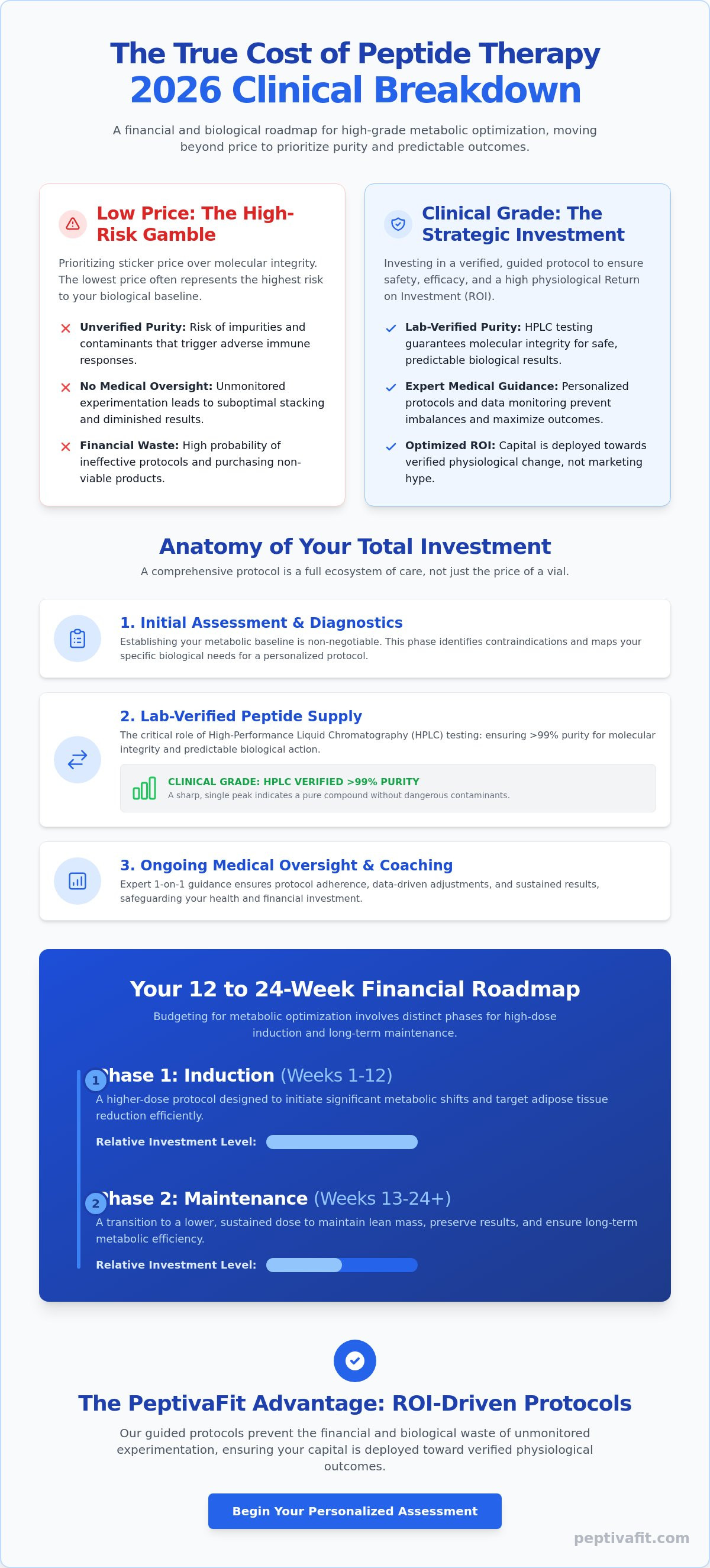
Understanding the total peptide therapy cost for weight loss 2026 requires a shift from transactional purchasing to clinical budgeting. A vial of lyophilized powder is merely a single component of a larger physiological strategy. True optimization demands an ecosystem of medical oversight, diagnostic precision, and expert guidance. Attempting to bypass these foundational elements often results in diminished metabolic returns or systemic imbalances. Professional 1-on-1 coaching serves as a critical safeguard, ensuring that protocol adherence remains high and that adjustments are made based on objective data rather than guesswork.
Initial Assessment and Diagnostic Fees
Before any metabolic signaling begins, a baseline must be established. A personalized medical assessment is the primary mechanism for identifying contraindications and metabolic bottlenecks. This phase involves comprehensive blood panels focusing on HbA1c, fasting insulin, and lipid profiles. These diagnostic markers are essential for mapping the current research on peptides for obesity treatment to your specific biological needs. While a one-time consultation provides a starting point, ongoing oversight ensures that your markers move in the desired direction. Skipping this step to save on initial fees is a high-risk gamble with your endocrine health.
Monthly Supply Costs by Peptide Category
The recurring financial commitment varies significantly based on the selection of lipolytic peptides versus growth hormone secretagogues. Agents like AOD-9604 focus on targeted adipose reduction, while Tesamorelin addresses visceral fat through more complex signaling pathways. Your monthly budget will fluctuate based on dosage frequency and the decision to stack multiple agents for synergistic effects. Stacking increases the peptide therapy cost for weight loss 2026, but it often accelerates the timeline to reach a maintenance-dose phase. High-purity, lab-verified peptides carry a premium because they guarantee the molecular integrity required for these sophisticated interactions.
Efficiency also depends on technical proficiency. Hidden costs frequently arise from improper reconstitution or storage errors. If a peptide is exposed to high temperatures or agitated aggressively during mixing, its molecular structure may degrade, rendering the investment useless. Utilizing lab-tested peptides is only half the battle; proper handling is the other. For those seeking a structured roadmap, a single consultation call can clarify the necessary logistical requirements for a successful cycle. This professional guidance prevents the expensive trial-and-error mistakes that plague unmonitored users.
The Price of Purity: Why Lab-Verified Peptides Influence Your ROI
The financial delta between unverified research chemicals and clinical-grade agents is a direct reflection of molecular verification. When calculating the peptide therapy cost for weight loss 2026, you aren't merely paying for the amino acid chain; you're investing in the rigorous testing protocols that ensure its structural integrity. High-Performance Liquid Chromatography (HPLC) and Mass Spectrometry (MS) are the clinical standards for this verification. These processes identify the exact purity levels and molecular mass of the substance, confirming that what you inject matches the prescribed sequence without degradation or residual solvents.
Opting for "cheap" alternatives often results in a negative return on investment. Under-dosed vials force you to increase frequency or volume to achieve the desired signaling, effectively doubling your long-term spend while introducing unknown variables. Furthermore, the risk of heavy metal contamination or bacterial endotoxins in unverified products can trigger systemic inflammation, stalling the very metabolic progress you're attempting to accelerate. Prioritizing lab-tested peptides for safety is the only way to ensure your biological capital isn't being liquidated by poor-quality manufacturing.
Regulatory Standards in 2026
The regulatory environment has matured significantly as of mid-2026. Following the FDA Pharmacy Compounding Advisory Committee (PCAC) meeting on July 23-24, 2026, the industry has seen a shift toward standardized compliance for peptides like BPC-157 and others under review for the 503A Bulk Drug Substances List. These increased testing requirements have stabilized the peptide therapy cost for weight loss 2026 by removing low-tier, non-compliant actors from the market. Third-party verification has transitioned from an optional luxury to a mandatory consumer protection tool, providing a transparent audit trail for every batch produced.
The Biological Cost of Inferior Products
Using unverified peptides represents a significant "wasted spend" that extends beyond your bank account. If a peptide is only 80 percent pure, the remaining 20 percent consists of unknown byproducts that your immune system must process. This creates a state of low-grade physiological stress that can desensitize your receptors and blunt the efficacy of future cycles. Scientific-grade standards are the only acceptable baseline for fat loss because they protect the delicate endocrine balance required for sustained lipolysis. A disciplined investor understands that a higher upfront cost for purity prevents the much higher cost of correcting systemic inflammation or metabolic stalling later.
Strategic Budgeting for Metabolic Optimization Cycles
Successful metabolic optimization is a product of strategic capital allocation rather than impulsive spending. To master the peptide therapy cost for weight loss 2026, you must view your cycle as a multi-phased project with distinct financial requirements. A disciplined approach prevents the common pitfall of starting a protocol only to have it interrupted by unforeseen supply costs or diagnostic needs. Planning your investment ensures that physiological signaling remains consistent, which is the primary driver of adipose tissue reduction.
- Step 1: Define your temporal scope. Most significant metabolic shifts occur within a 12-week or 24-week window. Shorter cycles often fail to cement permanent changes; conversely, excessively long cycles can lead to receptor desensitization.
- Step 2: Phase-specific allocation. Budget for a high-dose induction phase to kickstart signaling, followed by a lower-cost maintenance phase. This transition preserves your results while reducing recurring expenses as your body reaches a new homeostatic baseline.
- Step 3: Account for ancillary logistics. Don't overlook the cost of high-quality bacteriostatic water and medical-grade syringes. These are essential for maintaining the sterility and molecular integrity of your lab-tested peptides.
- Step 4: Mid-cycle monitoring. Reserve funds for follow-up blood work around the six-week mark. This data allows for precise protocol adjustments, ensuring your biological investment stays aligned with your goals.
Titration and Dosage Precision
Dosage management is the most effective lever for controlling your total spend. For instance, tesamorelin dosage adjustments based on your initial physiological response can significantly alter your monthly budget. Starting with the lowest efficacious dose allows you to assess sensitivity and minimize side effects before scaling up. This methodical titration prevents "peptide fatigue" and ensures that every milligram of your peptide therapy cost for weight loss 2026 contributes to a measurable outcome. Strategic cycling, rather than constant use, protects both your endocrine system and your financial resources.
The Efficiency of the Wolverine Stack and Other Synergies
Evaluating the ROI of synergistic stacks often reveals better value than high-dose monotherapy. Incorporating recovery peptides like BPC-157, often referred to as the Wolverine Stack, can enhance systemic recovery and protect your metabolic investment. While adding a second peptide increases the upfront cost, the resulting synergy often accelerates fat loss and improves body composition faster than a single agent alone. This efficiency reduces the total number of cycles required to reach your target, ultimately lowering your long-term expenditure. For those ready to move from theory to implementation, you can access lab tested peptides through a verified source to begin your protocol with confidence.
The Peptiva Advantage: ROI of the Peptiva Protocol
The distinction between purchasing a single vial and investing in a comprehensive protocol is the difference between speculation and clinical optimization. While many consumers focus on the raw peptide therapy cost for weight loss 2026, the true value lies in the strategy that governs the application of these molecules. The Peptiva Protocol serves as the master blueprint for this process; it provides a structured sequence that eliminates the expensive trial-and-error mistakes common in unmonitored cycles. By following a guided framework, you ensure that every milligram is utilized with maximum bio-availability and physiological intent.
Professional 1-on-1 coaching transforms a collection of chemicals into a precision metabolic instrument. This oversight allows for real-time adjustments based on your specific response, preventing the wasted expenditure of staying on a suboptimal dose. Peptide therapy isn't a quick fix; it's a disciplined investment in your future metabolic self. It requires a commitment to data-driven decision-making over mass-market trends to achieve a permanent shift in body composition.
Exclusive Access and Scientific Mentorship
PeptivaFit operates as a selective entity, deliberately limiting its client base to maintain a high-touch clinical standard. This exclusivity ensures that every participant receives the rigorous oversight necessary for high-stakes performance optimization. A single consultation call provides the tactical space needed to refine your protocol based on emerging lab data or lifestyle shifts. This level of professional mentorship significantly reduces the long-term cost of metabolic dysfunction. By addressing the root causes of adipose retention through precise signaling rather than temporary stimulants, you protect your biological capital.
Final Financial Roadmap
A successful 2026 transformation requires a clear financial roadmap that accounts for the totality of the clinical experience. Your budget must encompass the initial diagnostic baseline, the acquisition of lab-verified peptides, and the ongoing expert monitoring required to maintain safety. While the upfront peptide therapy cost for weight loss 2026 may be higher than unverified alternatives, the return on investment is measured in permanent metabolic health and the avoidance of systemic inflammation. Serious individuals ready for clinical-grade results should prioritize the integrity of the protocol above all else. To begin your optimization journey, you can secure a personalized medical assessment and adopt the Peptiva Protocol as your definitive roadmap.
Securing Your Metabolic Future Through Disciplined Investment
Transitioning from fragmented, unverified purchasing to a structured protocol is the only way to ensure physiological safety and molecular integrity in a shifting regulatory landscape. You now understand that the true peptide therapy cost for weight loss 2026 includes the essential overhead of HPLC/MS lab verification and dedicated clinical oversight. These are not optional additions; they are the fundamental safeguards that protect your biological capital from the systemic risks of impure or under-dosed substances. By prioritizing data over marketing hype, you position yourself within a selective group of individuals committed to scientific-grade self-optimization.
Accessing a master blueprint for your transformation ensures that your financial and biological resources are deployed with maximum efficiency. Don't settle for the uncertainty of trial and error when you can leverage a proven framework built on precision and privacy. Apply for the Peptiva Protocol and Secure Your Clinical Assessment to gain exclusive access to 1-on-1 coaching and the comprehensive guide designed for serious metabolic results. Your commitment to this methodical, data-driven process is the definitive first step toward a permanent and sophisticated metabolic evolution.
Frequently Asked Questions
How much does a typical 3-month peptide weight loss program cost in 2026?
A standard three-month cycle requires a budget that accounts for both the biological agents and clinical oversight. Self-pay patients utilizing manufacturer discounts for FDA-approved medications may spend between $150 and $450 monthly; while compounded protocols often range from $200 to $500 per month. These figures provide a baseline for the recurring peptide therapy cost for weight loss 2026, though they exclude initial diagnostic fees and ancillary supplies.
Will my health insurance cover the cost of peptide therapy for fat loss?
Insurance coverage depends entirely on the classification of the medication and your specific diagnosis. Most major commercial plans cover FDA-approved GLP-1 medications for a clinical diagnosis of obesity, but coverage rates for compounded or off-label protocols remain below 15 percent. Patients should verify their specific plan's formulary, as many elite performance clinics do not accept insurance for specialized metabolic optimization programs.
Why are some peptides significantly more expensive than others?
Price discrepancies are primarily driven by the complexity of the amino acid sequence and the rigor of the purification process. Peptides like Tesamorelin require more sophisticated synthesis than simpler chains, which increases production costs. Additionally, the inclusion of third-party HPLC and Mass Spectrometry testing ensures molecular integrity. This carries a premium over unverified, mass-produced substances that lack documented purity standards or structural verification.
Is there a difference in cost between oral and injectable peptides?
The introduction of oral formulations in early 2025 created a distinct pricing tier within the metabolic market. Oral Wegovy currently offers manufacturer-discounted rates starting as low as $149 monthly for self-paying patients, while injectable versions typically maintain a higher price point due to manufacturing and delivery hardware costs. While oral options provide convenience, injectables often remain the clinical preference for maximizing systemic bio-availability and signaling precision.
Can I save money by buying peptides from research chemical websites?
Attempting to reduce expenses by purchasing from research chemical platforms introduces significant biological risk and often diminishes your total results. These substances are not intended for human consumption and lack the clinical-grade testing required to ensure they are free from heavy metals or bacterial byproducts. The perceived savings are often negated by the cost of treating systemic inflammation or the lack of efficacy from under-dosed products.
What is the average cost of a medical consultation for peptide therapy?
Initial medical consultations for professional peptide programs generally range from $100 to $300 across the industry. This fee covers the comprehensive review of your medical history and the development of a tactical protocol. Some telehealth platforms bundle this into a monthly subscription fee, but a standalone, high-touch assessment from a specialized clinic typically requires a separate upfront investment to ensure rigorous clinical safety standards.
Are there ongoing maintenance costs after I reach my weight loss goal?
Maintenance phases typically require a reduced financial commitment compared to the active induction phase. Once you achieve a homeostatic baseline, dosage frequency often decreases, and the need for intensive medical monitoring subsides. However, budgeting for periodic lab work remains essential to ensure metabolic markers stay within optimal ranges. These ongoing costs are a necessary investment to protect the physiological progress achieved during the primary peptide therapy cost for weight loss 2026 cycle.
How much should I budget for lab testing and blood work?
A comprehensive baseline blood panel typically requires a budget between $200 and $500 in 2026. These diagnostics are non-negotiable for identifying metabolic bottlenecks and ensuring the protocol is tailored to your specific endocrine profile. Mid-cycle follow-up labs may cost an additional $75 to $150. This data provides the necessary information for precise titration and ensures that your biological investment yields a high ROI without compromising health.

![Shelf Life of Reconstituted Peptides: A Clinical Reference Guide [2026]](https://getautoseo.com/storage/hero_images/shelf-life-of-reconstituted-peptides-a-clinical-reference-guide-2026.jpg?v=b8ed5173acaa)
