
![Peptides for Belly Fat: Metabolic Remodeling Protocols [2026]](https://getautoseo.com/storage/hero_images/peptides-for-belly-fat-metabolic-remodeling-protocols-2026.jpg?v=eb6673c4b49d)
Traditional caloric restriction is often a biological mismatch for the unique endocrine environment of visceral adipose tissue. You've likely experienced the frustration of disciplined training and strict nutrition failing to move the needle on midsection adiposity. It's common to feel that your metabolism has reached a stalemate, particularly when age or chronic stress begins to dictate your hormonal profile. This resistance isn't a lack of willpower; it's a signaling failure within your metabolic architecture.
This investigation explores the precise application of peptides for stubborn belly fat, moving beyond surface-level weight loss into the realm of molecular metabolic remodeling. We'll examine the scientific mechanisms behind growth hormone secretagogues and specific analogs like Tesamorelin, which target resistant visceral fat at its source. You'll gain a clear understanding of how these molecules function and receive a verified protocol to follow. This guide provides the data-driven clarity required to transition from metabolic stagnation to a state of optimized body composition with clinical precision.
Key Takeaways
- Analyze the biological resistance of visceral adipose tissue and why its endocrine activity prevents traditional fat loss.
- Evaluate the efficacy of specific peptides for stubborn belly fat, focusing on the molecular signaling of Tesamorelin and the AOD-9604 fragment.
- Determine the optimal synergy between GHRH and GHRP analogs to improve muscle-to-fat ratios and metabolic drive.
- Identify the critical markers of molecular purity by interpreting lab-verified Certificates of Analysis for HPLC and Mass Spectrometry.
- Implement a disciplined metabolic remodeling strategy through the structured framework of the Peptiva Protocol and specialized oversight.
The Biological Resistance of Visceral Fat: Why Standard Dieting Fails
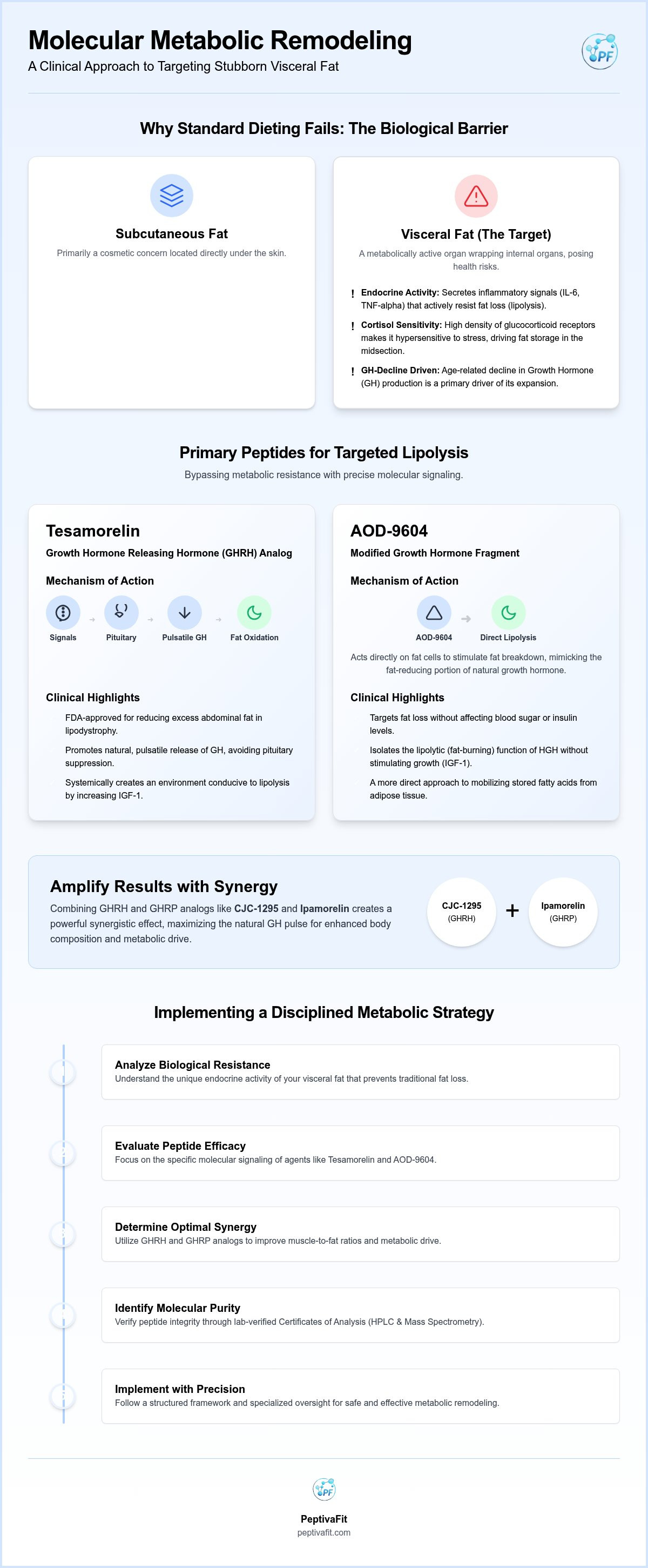
Visceral adipose tissue is often misunderstood as passive energy storage. It functions as a highly active endocrine organ that secretes bioactive molecules. These substances, including inflammatory cytokines like IL-6 and TNF-alpha, create a protective microenvironment that actively resists lipolysis. When you attempt traditional caloric restriction, these inflammatory signals can override systemic fat-burning cues. It's this biological barrier that keeps central fat deposits intact while you lose muscle mass or water weight. This resistance explains why standard dieting often fails to address midsection adiposity.
The regulation of these processes relies heavily on Peptide hormones, which serve as the primary messengers for metabolic signaling. Understanding this molecular hierarchy isn't just a suggestion; it's essential when selecting peptides for stubborn belly fat. Without addressing the underlying signaling errors, targeted fat loss remains biologically improbable. Shifting the focus from systemic weight loss to targeted fat oxidation requires a sophisticated understanding of how these chemical messengers interact with adipose receptors.
Visceral vs. Subcutaneous Fat: A Molecular Distinction
Subcutaneous fat sits directly under the skin and is primarily a cosmetic concern. Visceral fat, however, wraps around internal organs and possesses a much higher density of glucocorticoid receptors. This makes it hypersensitive to cortisol. When stress levels remain elevated, cortisol drives fat storage specifically into the visceral region. Traditional cardio often increases systemic cortisol without providing the specific signaling required to mobilize these deep, organ-bound lipid stores. This distinction explains why you don't see results in the midsection even when losing weight elsewhere.
Growth Hormone Deficiency and the Metabolic Plateau
The most significant driver of age-related midsection expansion is the decline in endogenous growth hormone (GH) production. As GH levels drop, the body loses its ability to effectively mobilize fatty acids for energy. This creates a metabolic plateau where even intense exercise yields diminishing returns. Peptide therapy offers a disciplined solution by restoring the natural, pulsatile release of GH. Unlike synthetic growth hormone, which can suppress natural production, specific secretagogues encourage the pituitary gland to resume its youthful signaling patterns. This approach yields several key benefits:
- Enhanced Lipolysis: Direct signaling to adipose tissue to release stored fatty acids for oxidation.
- Lean Mass Preservation: Preventing the muscle wasting that often accompanies aggressive caloric deficits.
- Metabolic Recalibration: Shifting the body's primary fuel source from glucose to stored lipids.
By utilizing peptides for stubborn belly fat, you move from a strategy of general depletion to one of clinical metabolic remodeling. This ensures that the fat lost is the metabolically active, dangerous visceral tissue rather than essential skeletal muscle.
Primary Peptides for Targeted Lipolysis: Tesamorelin and AOD-9604
Targeting visceral adipose tissue requires agents that can bypass standard metabolic resistance. While many compounds claim to assist in weight loss, only a selective group of molecules provides the specific signaling necessary to mobilize deep abdominal stores. Within clinical research, two primary peptides for stubborn belly fat have emerged as the most effective tools for metabolic remodeling: Tesamorelin and AOD-9604. These agents operate through distinct biological pathways, offering a multi-faceted approach to body composition optimization.
Tesamorelin: Mechanisms of Action and Clinical Data
Tesamorelin is a synthetic analog of Growth Hormone Releasing Hormone (GHRH) that stimulates the pituitary gland to increase the pulsatile secretion of endogenous growth hormone. This increase subsequently drives hepatic production of IGF-1, creating a systemic environment conducive to lipolysis. Because of its potent hormonal signaling, maintaining a precise tesamorelin dosage is critical to avoid receptor desensitization and ensure consistent metabolic results. Tesamorelin is FDA-approved for the reduction of excess abdominal fat in HIV-infected patients with lipodystrophy. In broader clinical investigations, participants using this peptide have shown significant reductions in deep belly fat over a 26-week period compared to placebo groups.
AOD-9604: The Fragment 176-191 Advantage
AOD-9604 represents a more targeted approach to fat oxidation. It's a stabilized fragment of the C-terminus of the human growth hormone molecule, specifically the 176-191 sequence. This fragment mimics the lipolytic effects of raw HGH without the associated risks of insulin resistance or glucose intolerance. This makes it an ideal candidate for individuals sensitive to blood sugar fluctuations. To maximize the lipolytic flux, AOD-9604 should be administered in a fasted state, as the presence of insulin can blunt its fat-burning potential. This compound serves as a cornerstone in many personalized medical assessments focused on metabolic efficiency.
According to a Scientific Review of Peptides for Obesity, the efficacy of these treatments depends on consistent molecular signaling rather than rapid, unsustainable weight loss. While AOD-9604 provides direct lipolytic signaling at the adipocyte level, Tesamorelin orchestrates a broader hormonal shift. Data suggests that meaningful changes in waist circumference generally manifest within 12 to 26 weeks of consistent protocol adherence. Understanding these timelines helps set realistic expectations for those committed to a long-term metabolic strategy.
Synergistic Stacks: CJC-1295 and Ipamorelin for Body Composition
While targeted agents like Tesamorelin provide specific lipolytic signaling, the synergy between CJC-1295 and Ipamorelin focuses on optimizing the endogenous growth hormone (GH) environment. This combination is frequently referred to as the 'Wolverine Stack' due to its dual capacity for metabolic drive and accelerated tissue repair. For individuals researching peptides for stubborn belly fat, this stack offers a sophisticated method for overcoming the biological resistance of visceral tissue by amplifying the body's natural endocrine pulses. This approach doesn't just push the body toward fat loss; it recalibrates the hormonal landscape to favor a leaner, more resilient physique.
The Science of Receptor Synergy
The efficacy of this protocol lies in the interaction between two distinct classes of molecules: Growth Hormone Releasing Hormones (GHRH) and Growth Hormone Releasing Peptides (GHRP). CJC-1295 acts as a GHRH analog, while Ipamorelin functions as a selective GHRP that mimics the hormone ghrelin. When administered together, they trigger a more significant GH release than either could achieve alone. Ipamorelin specifically targets the pituitary gland to initiate a pulse while simultaneously suppressing somatostatin, the inhibitory hormone that normally blunts GH secretion. Unlike earlier generations of peptides, such as GHRP-6, Ipamorelin is highly selective and doesn't cause a hunger spike or elevate cortisol and prolactin levels. This selectivity ensures that metabolic benefits aren't undermined by increased caloric intake or systemic hormonal instability.
Optimizing the Metabolic Window
Timing is a critical variable in the success of any metabolic remodeling protocol. Administering these peptides at night, ideally in a fasted state before sleep, aligns with the body's natural circadian rhythm. Nocturnal GH pulses are the primary drivers of fat oxidation and lean mass preservation during the fasting hours of sleep. CJC-1295 without DAC is the preferred choice for this protocol because its shorter half-life preserves the natural, pulsatile rhythm of the pituitary gland rather than forcing an unnatural, constant GH bleed. This disciplined approach to timing maximizes the efficiency of peptides for stubborn belly fat by leveraging the body's existing biological machinery.
Integrating peptides for metabolism and fat loss into a comprehensive wellness strategy requires a commitment to data-driven protocols. As PBS News Explains Peptides, the landscape of molecular optimization is complex and demands high standards of purity and clinical oversight. Transitioning from generic weight loss attempts to a focused metabolic strategy ensures that fat loss is targeted, sustainable, and biologically sound.
Molecular Integrity: Lab Verification and Reconstitution Precision
The efficacy of peptides for stubborn belly fat is entirely dependent on molecular integrity. In an unregulated research market, many products contain heavy metals, residual solvents, or sequence errors that render the protocol useless or, worse, hazardous. Metabolic remodeling requires clinical-grade precision; therefore, sourcing must be treated with the same discipline as the administration itself. A high-quality peptide isn't defined by marketing claims but by its Certificate of Analysis (COA).
A COA provides two essential data points: High-Performance Liquid Chromatography (HPLC) and Mass Spectrometry (MS). HPLC determines the purity level by separating the components of the sample, while MS verifies the molecular weight to confirm the peptide sequence is correct. Without these independent verifications, you're operating on guesswork rather than data. PeptivaFit prioritizes lab-tested peptides to ensure that every metabolic intervention meets the highest standards of safety and sequence accuracy.
Identifying High-Quality Research Peptides
Selectivity is the hallmark of professional optimization. Red flags in sourcing include the absence of third-party testing or COAs that are outdated or lack batch-specific numbers. For clinical-grade results, a purity threshold of 99% or higher is the standard. Anything less introduces unknown impurities that may cause systemic inflammation, blunting the very fat-loss signals you're trying to amplify. A personalized medical assessment through our platform ensures that your protocol is built on a foundation of verified science rather than experimental risk.
The Masterclass in Reconstitution
Peptides are delicate chains of amino acids held together by fragile bonds. Rough handling or improper temperature regulation can cause the peptide to denature, stripping it of its biological activity. Learning how to reconstitute peptides is a necessary skill for any serious researcher. This process involves slowly introducing a solvent into the lyophilized powder without creating excessive turbulence. Bacteriostatic water is a sterile preparation containing 0.9% benzyl alcohol that functions as a preservative to inhibit the growth of bacteria within the vial. Once reconstituted, these molecules remain sensitive to light and heat; they must be stored in a temperature-controlled environment to prevent degradation.
Securing the integrity of your metabolic strategy requires both education and high-quality supplies. To ensure your research yields valid results, explore our range of lab-tested peptides and professional oversight options.
The Peptiva Protocol: Implementing Your Metabolic Strategy
Transitioning from theoretical understanding to practical implementation requires a structured framework that accounts for individual biological variability. Most optimization attempts fail not due to a lack of intent, but due to a lack of clinical structure. The Peptiva Protocol provides this necessary architecture, serving as an operational manual for those utilizing peptides for stubborn belly fat. By integrating these molecular signals with targeted resistance training and protein-sparing modified fasts, you create a synergistic environment that prioritizes the oxidation of visceral adipose tissue while protecting lean skeletal muscle.
Monitoring your progress demands a shift away from the standard scale. Total body weight is a blunt metric that often masks the nuances of metabolic remodeling. We advocate for the use of DEXA scans and specialized visceral fat tracking to verify that your body composition is shifting in the desired direction. This data-driven approach allows for objective assessment of the protocol's efficacy. If progress plateaus, 1-on-1 coaching offers the expert oversight required to troubleshoot metabolic stalls and recalibrate administration variables in real-time.
Personalized Medical Assessment and Oversight
Your unique blood chemistry is the primary determinant of protocol selection. A personalized medical assessment is essential to identify specific endocrine deficiencies and signaling gaps before beginning a cycle. This assessment dictates whether your biology is better suited for a GHRH/GHRP synergy or a direct lipolytic fragment like AOD-9604. Additionally, a single consultation call can provide the necessary clarity for protocol fine-tuning and lifestyle integration. Long-term success also necessitates disciplined cycling. Continuous administration without strategic breaks can lead to receptor desensitization, which blunts the metabolic response. We implement specific "off" periods to preserve pituitary sensitivity and ensure the sustained effectiveness of the peptides.
Next Steps for Metabolic Optimization
Success in metabolic remodeling requires a controlled environment and a commitment to clinical precision. Before initiating your cycle, ensure you have secured the necessary materials for sterile reconstitution and temperature-regulated storage. You can access the fat loss peptide guide for a detailed breakdown of dosing schedules and advanced administration protocols. This resource removes the ambiguity often associated with peptides for stubborn belly fat, providing a clear path toward your goals.
Your transition toward an optimized body composition is a long-term investment in biological performance and metabolic health. By adhering to a disciplined, science-backed framework, you move beyond the limitations of traditional dieting into a space of sophisticated metabolic control. Optimize your body composition with the Peptiva Protocol today to initiate your data-driven transformation under expert guidance.
Mastering Your Metabolic Architecture
Achieving a significant reduction in visceral adipose tissue requires a transition from generic caloric restriction to precise molecular signaling. You now understand that visceral fat acts as a resistant endocrine organ, necessitating the use of specific peptides for stubborn belly fat to override inflammatory barriers. Success in metabolic remodeling is not a matter of intensity but of data-driven consistency and high-grade molecular integrity. By verifying purity through HPLC reports and following a disciplined protocol, you ensure your interventions are both safe and effective.
Professional optimization demands more than just education; it requires a structured environment for implementation. PeptivaFit provides the necessary gatekeeper services, including personalized medical assessments and expert 1-on-1 coaching, to guide your transformation. You're no longer guessing at metabolic outcomes but orchestrating them with clinical precision. Secure your clinical-grade Fat Loss Peptide Guide and Protocol here to begin your journey toward a resilient, optimized body composition. Your commitment to scientific standards is the final step in reclaiming metabolic control.
Frequently Asked Questions
Which peptide is best for targeting visceral belly fat specifically?
Tesamorelin is widely recognized as the clinical gold standard for visceral adipose tissue reduction. It's a GHRH analog that specifically targets deep abdominal fat by stimulating endogenous growth hormone pulses. While other options exist, Tesamorelin's FDA approval for lipodystrophy underscores its unique efficacy. For those seeking peptides for stubborn belly fat, it remains the primary choice for metabolic remodeling, provided it's administered under professional oversight and with precise, data-driven dosing protocols.
How long does it take to see results from peptides for fat loss?
Clinical expectations should be set for the long term to ensure sustainable success. Meaningful changes in waist circumference and visceral fat volume typically manifest between 12 and 26 weeks of consistent protocol adherence. This timeline reflects the methodical nature of biological remodeling rather than a temporary weight fluctuation. Rapid results often indicate water loss, whereas peptide therapy aims for permanent changes in body composition through sustained molecular signaling and hormonal recalibration.
Can I use peptides for fat loss without exercising?
While peptides can stimulate lipolysis independently, using them without resistance training is suboptimal for body composition. Exercise provides the necessary stimulus to preserve skeletal muscle while the peptides mobilize fatty acids for oxidation. Without metabolic demand, the body doesn't efficiently utilize the released lipids. Integrating these protocols with a protein-sparing approach ensures that the reduction in midsection adiposity doesn't come at the expense of your metabolic engine, which is your muscle mass.
Are peptides for belly fat safe for long-term use?
Safety in peptide therapy is achieved through disciplined cycling and expert medical oversight. Continuous administration of certain peptides can lead to receptor desensitization, blunting the metabolic response over time. Most protocols involve specific "off" periods to allow the pituitary gland and peripheral receptors to reset. Long-term health is prioritized by monitoring blood chemistry and using lab-verified supplies to avoid the systemic inflammation associated with low-purity research chemicals found in unregulated markets.
Do I need a prescription for peptide therapy in the United States?
In the United States, obtaining peptides for clinical use requires a prescription from a licensed healthcare provider. While "research chemicals" are sold online without a prescription, these products aren't intended for human consumption and lack regulatory oversight regarding purity or safety. PeptivaFit bridges this gap by requiring a personalized medical assessment and providing lab-verified supplies, ensuring that your protocol remains within a strictly compliant and medically supervised framework for optimal safety.
What is the difference between AOD-9604 and HGH Frag 176-191?
AOD-9604 is a stabilized, more biologically available analog of the HGH Fragment 176-191. While both target the fat-burning tail of the growth hormone molecule, AOD-9604 was specifically developed to enhance stability and metabolic half-life. Both compounds offer the advantage of stimulating lipolysis without the adverse effects on insulin sensitivity or blood glucose levels often seen with raw human growth hormone, making them excellent peptides for stubborn belly fat for sensitive individuals.
How do I know if my peptides are high quality and lab-tested?
Verification of molecular integrity is only possible through independent third-party testing. High-quality peptides must be accompanied by a Certificate of Analysis (COA) featuring High-Performance Liquid Chromatography (HPLC) and Mass Spectrometry (MS) reports. These documents confirm that the purity exceeds 99% and that the amino acid sequence is correct. PeptivaFit acts as a gatekeeper by supplying only lab-verified peptides, protecting you from the heavy metals and sequence errors common in unregulated research supplies.
Can peptides help with insulin resistance and belly fat simultaneously?
Certain peptides are uniquely suited to address these dual concerns by improving metabolic flexibility. AOD-9604, for example, promotes fat oxidation without impacting insulin sensitivity, making it a safe choice for those with metabolic syndrome. Additionally, GHRH analogs can improve overall metabolic health, which indirectly reduces the inflammatory signals that drive insulin resistance. Addressing the endocrine activity of visceral fat is the first step in restoring systemic insulin sensitivity and a healthy metabolic profile.

![Shelf Life of Reconstituted Peptides: A Clinical Reference Guide [2026]](https://getautoseo.com/storage/hero_images/shelf-life-of-reconstituted-peptides-a-clinical-reference-guide-2026.jpg?v=b8ed5173acaa)
