

Most fitness enthusiasts treat fat loss and muscle gain as a sequential struggle, yet the molecular reality of 2026 proves these processes don't have to be mutually exclusive. Strategic peptide stacking for body recomposition allows for a simultaneous metabolic shift that traditional dieting alone cannot replicate. You've likely experienced the frustration of stubborn visceral fat that resists every calorie deficit, or the disheartening loss of lean muscle mass during a standard cutting phase. It's a common plateau where the body's survival mechanisms prioritize fat preservation over performance.
This protocol provides the definitive roadmap to mastering metabolic optimization through the use of lab-verified research materials. You'll learn how to leverage specific molecular signals to pivot your physique from fat storage toward active, lean tissue growth. We'll examine the latest 2026 regulatory updates following the July Pharmacy Compounding Advisory Committee findings, identify the most effective combinations for tissue synthesis, and establish the clinical standards required for a disciplined transformation. By applying a data-driven approach, you can move beyond the limitations of "gray market" guesswork and gain sophisticated control over your own physiological outcomes.
Key Takeaways
- Understand why traditional bulking and cutting cycles are metabolically inefficient and how to trigger simultaneous fat loss and hypertrophy through molecular signaling.
- Master the synergistic application of Growth Hormone Secretagogues and lipolytic fragments through advanced peptide stacking for body recomposition.
- Leverage The Peptiva Protocol to synchronize timing and dosage precision, maximizing the anabolic window during high-intensity training phases.
- Identify the critical markers of molecular integrity by utilizing only lab tested peptides and verifying purity through professional Certificate of Analysis interpretation.
- Transition from speculative research to a clinical roadmap by integrating a personalized medical assessment and 1-on-1 coaching for sustainable metabolic optimization.
The Physiology of Body Recomposition and the Role of Peptides
Body recomposition is defined as the simultaneous reduction of adipose tissue and hypertrophy of lean muscle mass. This dual objective challenges the traditional binary of fitness cycles. While many believe you must choose between losing weight or gaining size, peptide stacking for body recomposition offers a more sophisticated approach. It creates a metabolic state where the body prioritizes fat oxidation while maintaining nitrogen balance for muscle synthesis. This precision allows for a physique transformation that bypasses the common pitfalls of extreme weight fluctuations.
Peptides act as precise signaling molecules that modulate growth hormone secretion and insulin sensitivity. Understanding The Physiology of Peptides is essential for anyone looking to optimize nutrient partitioning. This process determines whether ingested calories are stored in adipocytes or utilized for muscle tissue repair. By leveraging these molecular signals, you can instruct your body to divert energy toward protein synthesis rather than fat storage, even in a controlled caloric environment.
The Metabolic Pivot: Fat Oxidation vs. Muscle Synthesis
The endocrine system manages cellular energy allocation through a complex web of hormonal signals. As we age, natural growth hormone production often downregulates. This shift significantly hinders the body's ability to repair muscle and mobilize fat stores. Metabolic stress further compounds this issue, often leading to a state where muscle tissue is sacrificed during fat loss phases. For a deeper dive into these mechanisms, refer to our Peptides for Metabolism and Fat Loss: A Clinical Overview [2026]. Effective recomposition requires a "metabolic pivot" where the body's primary fuel source shifts to stored lipids while maintaining an anabolic environment for skeletal muscle.
Why Traditional Methods Often Fail at Recomposition
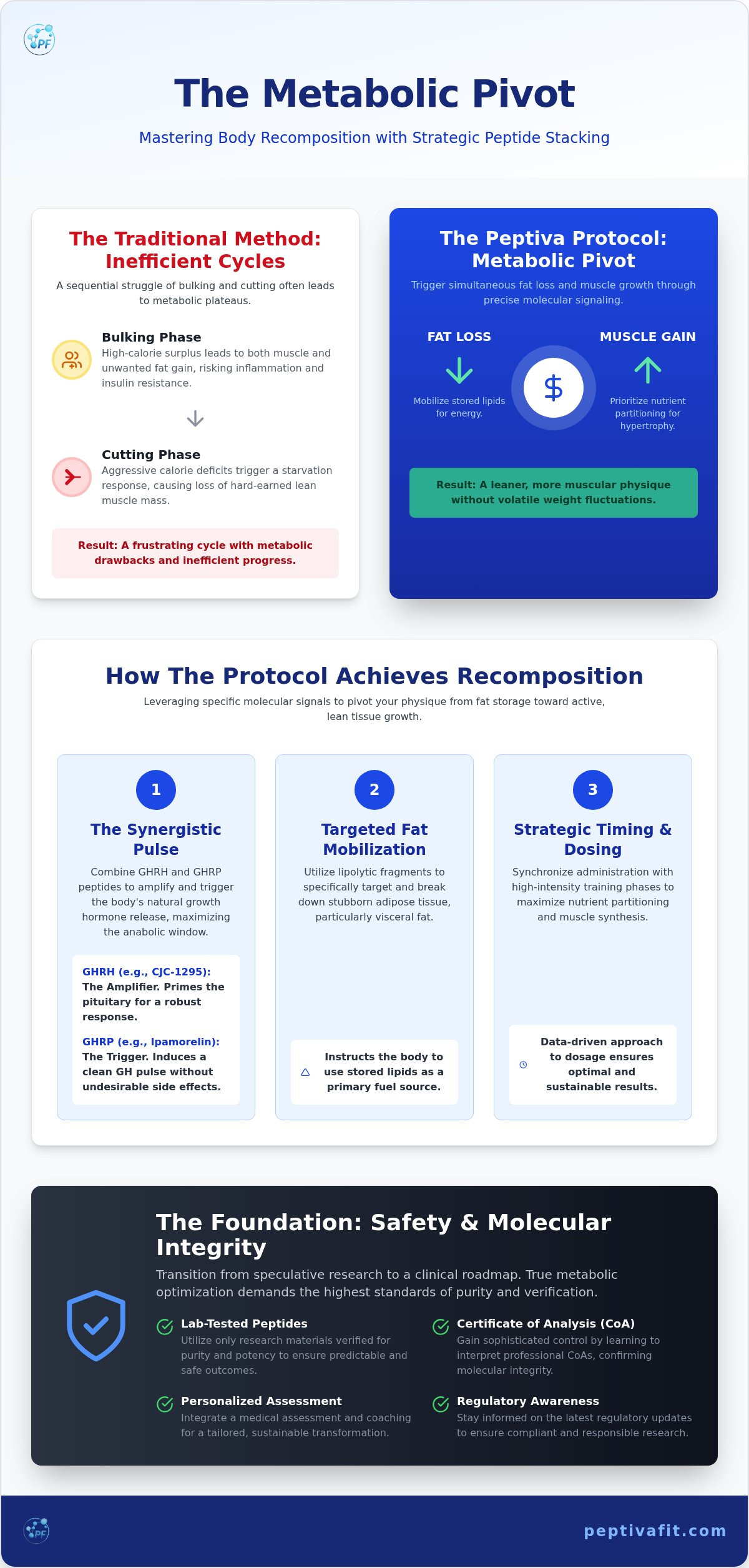
Standard bulking and cutting cycles are often inefficient for long-term metabolic health. Aggressive caloric deficits frequently trigger a starvation response. In this state, the body actively wastes muscle tissue to preserve fat as a survival mechanism. Conversely, high-calorie dirty bulks often lead to systemic inflammation and insulin resistance. These metabolic hurdles make it increasingly difficult to shed fat in subsequent phases. Peptide stacking for body recomposition serves as the necessary bridge between these extremes. It provides a disciplined method to achieve a leaner, more muscular physique without the volatile weight fluctuations that stress the cardiovascular and metabolic systems. By focusing on molecular integrity and signaling, you can maintain a steady state of progress that respects your body's long-term health markers.
Growth Hormone Secretagogues and Lipolytic Fragments for Metabolic Pivot
Transitioning from theoretical physiology to practical application requires analyzing specific signaling agents. Growth Hormone Secretagogues (GHS) represent the primary toolset for shifting the body's metabolic priority. Unlike exogenous hormones that can suppress natural production, these peptides encourage the pituitary gland to optimize its own output. In the context of peptide stacking for body recomposition, the focus remains on maintaining physiological harmony while achieving specific aesthetic and performance goals. Understanding the Safety and Benefits of Peptides is essential for any individual operating at this level of self-optimization.
GHRH vs. GHRP: Understanding the Synergistic Pulse
Effective peptide stacking for body recomposition often begins with the combination of a Growth Hormone Releasing Hormone (GHRH) and a Growth Hormone Releasing Peptide (GHRP). CJC-1295, a prominent GHRH, functions as an amplifier. It increases the duration and strength of the growth hormone signal, ensuring the pituitary gland is primed for a robust response. Conversely, Ipamorelin acts as the trigger. By mimicking ghrelin, it induces a GH release without the undesirable cortisol or prolactin spikes often associated with older generation peptides. Stacking these two classes creates a superior physiological response. The GHRH sets the stage, while the GHRP initiates the pulse, resulting in a significantly more potent output than using either compound in isolation.
Targeted Fat Loss: The Fragment 176-191 and AOD-9604 Advantage
Standard secretagogues provide systemic metabolic support, but lipolytic fragments offer a more surgical approach to adipose reduction. HGH Frag 176-191 and AOD-9604 are derived from the terminal end of the human growth hormone molecule. They target fat cells directly, specifically those in stubborn visceral regions, without affecting blood glucose levels or insulin sensitivity. This metabolic neutrality makes them ideal for individuals who prioritize long-term health alongside fat loss. For those specifically managing abdominal adiposity, mastering the Tesamorelin Dosage: A Clinical Guide to Metabolic Optimization Protocols is crucial for achieving clinical-grade results.
Fat metabolism is also deeply tied to mitochondrial efficiency. Integrating insights from the MOTS-C Peptide: A Comprehensive Reference on Mitochondrial-Derived Metabolic Regulation can further enhance the metabolic pivot by improving cellular energy expenditure. It's important to ensure these protocols are safely integrated into your current health status. A personalized medical assessment is the recommended first step in any serious recomposition journey, providing the data necessary to move forward with confidence and precision.
Strategic Stacking: The Peptiva Protocol Approach
The Peptiva Protocol serves as the definitive architecture for individuals who demand a unified strategy rather than fragmented advice. While general fitness circles often treat supplementation as an additive process, this methodology treats it as a precise metabolic intervention. The efficacy of peptide stacking for body recomposition depends entirely on the synchronization of molecular signals with your body's natural circadian rhythms. Timing and dosage precision are paramount to maximizing the "recomposition window" during high-intensity training. This protocol is not a generalized template for a mass audience; it's a data-backed framework designed for those who value clinical standards and rigorous self-optimization.
Achieving a simultaneous pivot from fat storage to muscle growth requires more than just high-quality compounds. It demands a disciplined understanding of how different peptide classes interact with your unique endocrine profile. Before any regimen begins, a personalized medical assessment is required to establish a baseline of health and safety. This approach ensures that every intervention is targeted, effective, and respectful of long-term metabolic health.
Designing the Recomposition Stack: Fat Loss + Muscle Retention
An effective stack for body recomposition must address two distinct physiological goals at once. A typical framework within the protocol involves combining a Growth Hormone secretagogue, such as the CJC-1295 and Ipamorelin blend, with a targeted lipolytic agent like HGH Frag 176-191. These compounds work in tandem to shield lean muscle tissue from catabolism while accelerating the oxidation of stored lipids. This synergy allows for a tighter, more defined physique even when caloric intake is strictly controlled. Because biological responses vary between individuals, 1-on-1 coaching is utilized to interpret physical feedback and adjust protocols in real time. This expert oversight prevents the common plateaus associated with unguided research.
The Role of Personalized Medical Assessments in Protocol Design
Baseline blood work and a comprehensive medical history are non-negotiable prerequisites for safety and efficacy. A personalized medical assessment provides the necessary data to determine which specific peptides will yield the best results for your current metabolic state. Individual markers, such as fasting insulin levels and IGF-1 concentrations, influence the choice and concentration of compounds within your stack. Peptide stacking for body recomposition is only as effective as the data supporting it. PeptivaFit remains committed to high-end clinical standards, ensuring that every protocol is overseen with professional care. This methodical approach transforms speculative self-experimentation into a controlled, professional journey toward metabolic mastery.
Safety, Molecular Integrity, and Lab-Verified Standards
The efficacy of peptide stacking for body recomposition is entirely dependent on the molecular integrity of the compounds utilized. The market is currently saturated with "research chemicals" that lack regulatory oversight and clinical validation. Utilizing materials from unverified sources introduces significant risks; these include heavy metal contamination and truncated amino acid sequences that fail to elicit the desired physiological response. For the disciplined individual, prioritizing lab tested peptides is a matter of safety and performance. A Certificate of Analysis (COA) serves as the primary document for verifying purity, yet its value is only as high as the laboratory's testing frequency and third-party transparency.
A legitimate research laboratory must demonstrate consistency through rigorous data monitoring. When evaluating a source, you should verify that they provide batch-specific HPLC (High-Performance Liquid Chromatography) and MS (Mass Spectrometry) reports. Legitimate suppliers maintain purity levels exceeding 99% and undergo frequent third-party audits to ensure their catalog remains free from degraded sequences. This level of scrutiny separates professional-grade materials from mass-market alternatives that prioritize profit over scientific precision.
Identifying Red Flags in Peptide Sourcing
Low-quality suppliers often exhibit specific warning signs that indicate a lack of clinical standards. Vague labeling that omits batch numbers or expiration dates is a primary red flag. Unrealistically low pricing often suggests that the peptides were mass-produced in facilities without proper purification protocols, leading to potential systemic inflammation upon administration. Contaminants in non-verified products can cause localized reactions or, more severely, unpredictable endocrine disruptions. PeptivaFit positions its lab-verified supplies as the gold standard, ensuring that every vial meets the technical requirements for human investigation and metabolic optimization.
Precision in Reconstitution and Administration
Maintaining the bioactivity of these delicate molecules requires adherence to strict handling protocols. You must master how to reconstitute peptides using bacteriostatic water and sterile measurement tools. Improper agitation or exposure to fluctuating temperatures can render expensive compounds biologically inactive before they are even administered. Dosage errors are common among those who lack precise tools, which can lead to suboptimal results in your peptide stacking for body recomposition protocol.
Recovery is another critical pillar of the recomposition journey. Many advanced stacks integrate the "Wolverine" protocol for tissue repair, which centers on the BPC-157 Peptide: A Comprehensive Clinical Reference Guide (2026). Whether you are focusing on fat loss or systemic recovery, improper storage in non-refrigerated environments will compromise the peptide's structural stability. To ensure your transformation is supported by clinical-grade materials, you should access lab-verified peptides through a trusted, professional resource.
Conclusion: Executing Your Metabolic Optimization Journey
Executing a successful transformation requires more than just access to molecular compounds; it demands the integration of these tools into a rigorous lifestyle framework. Peptide stacking for body recomposition represents the pinnacle of metabolic optimization, but its efficacy is contingent upon a foundation of high-level training and precision nutrition. The Peptiva Protocol provides the necessary clinical roadmap to navigate this complex landscape, moving serious individuals away from speculative mass-market advice toward an elite, data-driven experience. By utilizing lab tested peptides within a structured environment, you ensure that every physiological signal is maximized for lean tissue growth and adipose reduction.
The transition from fat storage to lean tissue synthesis is a methodical process that requires patience and high-grade materials. This isn't a "quick fix" for the uncommitted, but a sophisticated intervention for those who prioritize data over hype. By following a disciplined protocol, you gain a level of control over your physique that traditional dieting cannot provide. Empowerment in the 2026 landscape is defined by your ability to access and apply scientific-grade information with professional precision.
Integrating Peptides into a Disciplined Lifestyle
It's essential to recognize that peptides function as optimizers rather than replacements for fundamental health practices. Sustainable body composition changes require a long-term methodology that respects the body's adaptive pace. Relying solely on chemistry without addressing metabolic demand through resistance training and caloric control will yield suboptimal results. This is where 1-on-1 coaching becomes invaluable. Professional oversight allows for the interpretation of biological feedback, enabling you to make data-informed adjustments to your protocol. This level of discipline ensures that your metabolic pivot remains healthy, efficient, and permanent.
Next Steps: Accessing the Peptiva Protocol
For those ready to transition from casual interest to clinical execution, the path forward is clearly defined. You can begin by reviewing the Comprehensive Fat Loss Peptide Guide, which outlines the current 2026 standards for metabolic optimization. The onboarding process for new clients is designed to prioritize safety and precision. Every journey begins with a personalized medical assessment to determine your unique biological baseline. This data ensures that your peptide stacking for body recomposition strategy is tailored to your specific needs, utilizing only lab tested peptides from verified research sources.
To initiate your personalized medical assessment and discuss your specific goals with an expert, you should schedule a single consultation call. This is the first step in moving beyond the noise of the fitness industry and entering a space defined by scientific education and professional PeptivaFit oversight. Empowerment comes through sophisticated control; we provide the data, the materials, and the roadmap, but the execution remains a testament to your personal responsibility and serious intent.
Mastering Your Metabolic Evolution
Achieving a simultaneous shift from fat storage to lean tissue growth requires more than generic fitness advice; it demands a clinical approach to molecular signaling. We've established that effective peptide stacking for body recomposition leverages synergistic pulses between secretagogues and lipolytic fragments to optimize nutrient partitioning. By prioritizing lab-verified peptide purity and adhering to precise administration protocols, you move beyond the limitations of standard dieting. The path to a refined physique is defined by data-driven decisions and professional oversight.
It's time to transition from speculative research to a structured, clinical roadmap. You can Secure Your Personalized Medical Assessment and Access the Peptiva Protocol to ensure your strategy is backed by professional 1-on-1 coaching and the highest scientific standards. This clinical-grade guide represents the definitive roadmap for those serious about their long-term performance. Your journey toward metabolic mastery starts with a commitment to excellence. We're here to provide the expertise required for your success.
Frequently Asked Questions
What are the best peptides for body recomposition?
The most effective compounds for this objective typically include Growth Hormone Releasing Hormones (GHRH) like CJC-1295 and Growth Hormone Releasing Peptides (GHRP) like Ipamorelin. These agents work synergistically to enhance natural growth hormone pulses. Additionally, lipolytic fragments such as HGH Frag 176-191 or AOD-9604 are utilized for targeted fat oxidation. Successful peptide stacking for body recomposition involves selecting high-purity, lab-verified research materials that align with your specific metabolic profile and training intensity.
Can I lose fat and build muscle simultaneously with peptide therapy?
Yes, peptide therapy facilitates simultaneous fat loss and muscle gain by optimizing nutrient partitioning and cellular signaling. While traditional methods often force a choice between catabolic cutting or anabolic bulking, specific peptides allow the body to prioritize fat oxidation while maintaining a positive nitrogen balance for muscle synthesis. This metabolic pivot ensures that ingested calories are diverted toward lean tissue repair rather than adipose storage, provided you maintain a disciplined nutritional foundation.
How long does it take to see results from a body recomposition peptide stack?
Physiological changes typically become noticeable within 8 to 12 weeks of consistent protocol adherence. Initial metabolic shifts, such as improved sleep quality and recovery, often occur within the first 21 days. However, visible changes in body composition, such as increased muscle density and reduced visceral fat, require a longer duration to manifest. This timeline is heavily influenced by the precision of your dosage, the quality of your training, and your baseline metabolic health.
Are lab-tested peptides safer than standard research chemicals?
Lab tested peptides are significantly safer and more effective because they undergo rigorous third-party verification for purity and structural integrity. Standard "research chemicals" often lack batch-specific Certificates of Analysis (COA), which increases the risk of heavy metal contamination or truncated amino acid sequences. Using unverified substances can lead to systemic inflammation or unpredictable endocrine responses. Professional protocols prioritize materials that exceed 99% purity to ensure predictable and safe physiological outcomes.
Do I need a personalized medical assessment before starting the Peptiva Protocol?
Yes, a personalized medical assessment is a non-negotiable requirement for anyone seeking to utilize The Peptiva Protocol safely. This assessment establishes your biological baseline through blood work and medical history, allowing for the customization of peptide concentrations and timing. Without this data, you risk applying an inefficient or potentially unsafe strategy. Professional oversight ensures that your protocol is tailored to your unique metabolic markers, maximizing efficacy while minimizing the risk of adverse effects.
What is the difference between GHRH and GHRP peptides in a stack?
GHRH peptides, such as CJC-1295, function as amplifiers that increase the strength and duration of a growth hormone pulse. GHRP peptides, like Ipamorelin, act as the trigger that initiates the release by mimicking the hormone ghrelin. When used in peptide stacking for body recomposition, these two classes create a synergistic effect that is far more potent than using either alone. The GHRP signals the release, while the GHRH ensures that the resulting pulse is robust and sustained.
How do I ensure my peptides remain biologically active during storage?
Maintaining molecular integrity requires strict adherence to temperature control and handling procedures. Lyophilized peptides should be stored in a freezer for long-term stability, while reconstituted peptides must be kept refrigerated at temperatures between 36°F and 46°F. You should avoid exposing the vials to direct sunlight or vigorous agitation, as the delicate peptide bonds can easily degrade. Using bacteriostatic water for reconstitution is essential to prevent bacterial growth and maintain the compound's bioactivity over time.
Is 1-on-1 coaching necessary for achieving metabolic optimization?
While the protocol provides the roadmap, 1-on-1 coaching is essential for interpreting biological feedback and making precise adjustments. A professional coach helps you navigate plateaus by analyzing your physical response and fine-tuning your dosages or timing. This expert oversight ensures that you remain disciplined and focused on long-term outcomes rather than short-term fixes. Metabolic optimization is a complex, data-driven process that benefits significantly from the guidance of an experienced mentor who understands the nuances of peptide signaling.

![Shelf Life of Reconstituted Peptides: A Clinical Reference Guide [2026]](https://getautoseo.com/storage/hero_images/shelf-life-of-reconstituted-peptides-a-clinical-reference-guide-2026.jpg?v=b8ed5173acaa)
