

By 2026, the distinction between research grade and clinical grade has become the literal line between metabolic optimization and systemic failure. You recognize that peptides offer unparalleled potential for fat loss and physiological recovery, yet the current landscape remains a minefield of unverified compounds and contradictory dosing schedules. It's natural to feel concerned about the risks of contaminated sourcing or the potential for permanent hormonal suppression. This guide establishes a rigorous peptide therapy safety protocol designed for the disciplined individual who demands scientific-grade results without compromising long-term health.
You'll master the professional standards for sourcing lab-verified compounds and implementing a precise roadmap for baseline and intra-cycle blood work. We'll examine the exact clinical framework for monitoring metabolic markers, ensuring your protocol remains effective and safe. This overview covers everything from HPLC purity verification to the specific metrics required to achieve optimized fat loss with zero adverse events. By following these established medical standards, you can move forward with the confidence that your performance optimization is backed by data and professional oversight.
Key Takeaways
- Identify the critical distinctions between clinical-grade peptides and unregulated research chemicals by utilizing HPLC purity verification standards.
- Establish a rigorous peptide therapy safety protocol that prioritizes personalized medical assessments and comprehensive baseline blood work before your first dose.
- Distinguish the unique dosing and safety margins required for lipolytic peptides compared to systemic repair agents to maintain metabolic balance.
- Implement sterile reconstitution techniques and the 28-day bacteriostatic water rule to ensure the integrity of your administration field.
- Learn how the Peptiva Protocol formalizes these standards through 1-on-1 coaching and lab-verified supplies for predictable, high-performance outcomes.
The Hierarchy of Peptide Sourcing: Ensuring Molecular Integrity
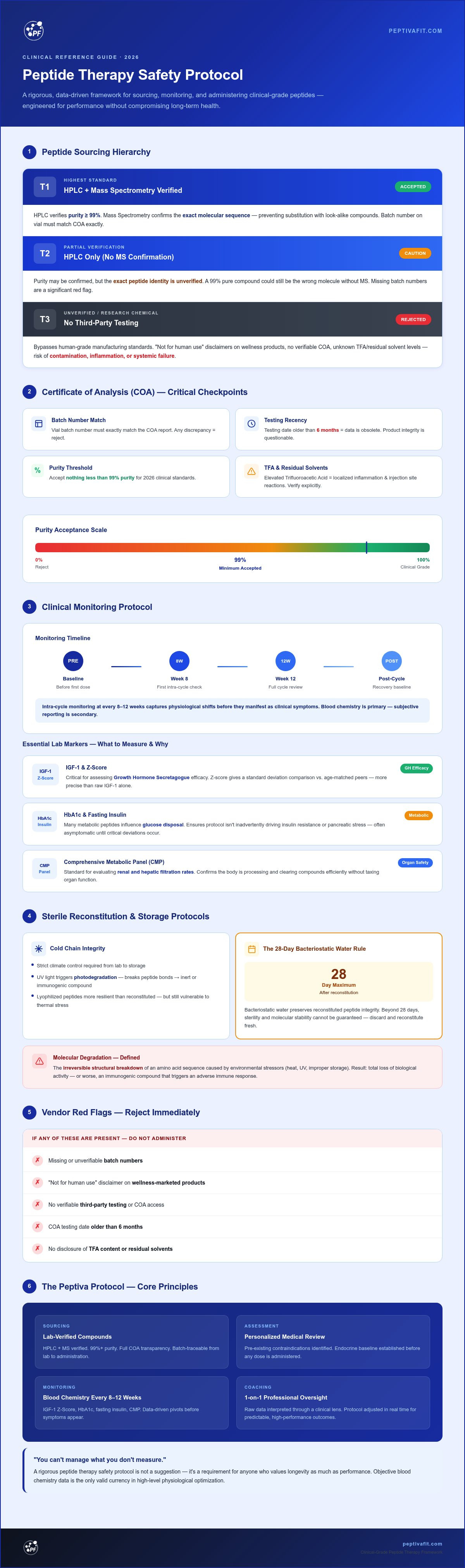
Clinical peptide therapy requires a rigorous hierarchy of sourcing to mitigate systemic risk. Most products marketed as "research chemicals" bypass the manufacturing standards required for human administration. These substances often lack the oversight found in elite clinical settings. A robust peptide therapy safety protocol demands that every compound undergoes High-Performance Liquid Chromatography (HPLC) to verify purity and Mass Spectrometry (MS) to confirm the exact molecular sequence. Without MS, a vendor might provide a 99% pure substance that isn't the specific peptide you ordered. Red flags include missing batch numbers, "not for human use" disclaimers on products marketed for wellness, and a lack of verifiable third-party testing.
Reading a Certificate of Analysis (COA)
Interpreting a Certificate of Analysis is a non-negotiable skill for any serious practitioner. First, verify that the batch number on your vial matches the report exactly. If the testing date is older than six months, the data is likely obsolete and the product's integrity is questionable. Focus on the purity percentage; for 2026, you should accept nothing less than 99%. Scrutinize the report for Trifluoroacetic Acid (TFA) content and residual solvents. Elevated TFA levels often cause localized inflammation or adverse injection site reactions. Legitimate vendors provide transparent access to these data points to ensure you aren't injecting industrial byproducts.
Cold Chain Logistics and Storage
Peptides are inherently fragile. Their delicate amino acid chains are highly susceptible to thermal stress and UV exposure. While lyophilized (freeze-dried) peptides are more resilient than reconstituted solutions, they still require strict climate control. UV light can trigger photodegradation, which breaks the peptide bonds and renders the compound inert or potentially immunogenic. Molecular degradation is the irreversible structural breakdown of an amino acid sequence caused by environmental stressors, leading to a total loss of biological activity. Implementing a comprehensive peptide therapy safety protocol necessitates a deep understanding of how these molecules are handled before they reach your possession. Maintaining a strict cold chain from the laboratory to your storage facility is essential for preserving the compound's molecular integrity.
Clinical Baseline and Intra-Cycle Monitoring Protocols
Objective data is the only valid currency in high-level physiological optimization. A personalized medical assessment serves as the diagnostic anchor for any serious peptide therapy safety protocol. Without a clear baseline, you're essentially conducting an uncontrolled experiment on your own endocrine system. This assessment identifies pre-existing contraindications that subjective "wellness" often masks. It's a gatekeeping mechanism designed to ensure your body is actually prepared for the metabolic demands of peptide administration. A robust peptide therapy safety protocol isn't a suggestion; it's a requirement for those who value longevity as much as performance.
Intra-cycle monitoring must occur at strategic intervals, typically every 8 to 12 weeks, to capture physiological shifts before they manifest as clinical symptoms. Subjective reporting is a secondary metric, often dwarfed by the precision of blood chemistry. Many systemic stressors, such as elevated liver enzymes or declining insulin sensitivity, remain asymptomatic until significant deviations occur. Data provides the clarity needed to pivot or pause before health is compromised. You can't manage what you don't measure.
Essential Lab Markers for Peptide Users
- IGF-1 and Z-Score: These are critical for assessing the efficacy of Growth Hormone Secretagogues. A Z-score provides a standard deviation comparison against your age-matched peers, offering a more precise safety margin than raw IGF-1 numbers alone.
- HbA1c and Fasting Insulin: Many metabolic peptides influence glucose disposal. Monitoring these markers ensures your protocol isn't inadvertently driving insulin resistance or pancreatic stress.
- Comprehensive Metabolic Panel (CMP): This is the standard for evaluating renal and hepatic filtration rates. It ensures the body is processing and clearing compounds efficiently without taxing organ function.
The Role of Professional Oversight
Raw data requires a clinical lens for accurate interpretation. Professional 1-on-1 coaching provides the expertise necessary to distinguish between expected physiological adaptations and genuine red flags. For instance, a spike in high-sensitivity C-reactive protein (hs-CRP) might necessitate an immediate dosage adjustment to manage systemic inflammation. This level of oversight allows for the identification of 'over-responders' who may require micro-dosing to avoid side effects, and 'non-responders' whose receptor sensitivity may require a different therapeutic pathway. Securing a personalized medical assessment ensures your journey toward optimization is both data-driven and strictly risk-mitigated.
Category-Specific Safety: Fat Loss vs. Tissue Repair
Effective implementation of a peptide therapy safety protocol requires a granular understanding of how different molecular classes interact with human physiology. Lipolytic agents, such as HGH Frag 176-191 and Tesamorelin, prioritize fat oxidation but can inadvertently shift glucose metabolism if mismanaged. In contrast, systemic repair agents like BPC-157 peptide focus on angiogenesis and collagen synthesis. Stacking these categories without a pharmacokinetic framework is a significant safety risk. You shouldn't combine multiple secretagogues or bioregulators without understanding their competing half-lives and receptor affinities. Perpetual use is another common failure; receptors require "washout" periods to prevent downregulation and maintain systemic sensitivity.
GH Secretagogue Safety (CJC-1295 / Ipamorelin)
Growth hormone secretagogues demand a "pulsed" dosing strategy to mimic natural circadian rhythms and avoid the "GH bleed" associated with synthetic HGH. Continuous stimulation can lead to desensitization of the pituitary gland. It's also vital to monitor for elevations in prolactin and cortisol, which can occur with lower-purity compounds or excessive dosages. When optimizing fat loss, the tesamorelin dosage must be carefully calibrated against fasting insulin levels. Exceeding clinical thresholds often triggers transient insulin resistance, necessitating a strategic pause or dosage reduction to maintain metabolic health.
Bioregulator and Longevity Peptide Safety
Bioregulators operate on a different temporal scale than metabolic peptides. Epithalon, for instance, is typically administered in short, intense cycles to support telomere health rather than as a daily supplement. Mitochondrial derived peptides like MOTS-C peptide require specific attention to exercise timing and carbohydrate intake to maximize efficacy. A critical component of any peptide therapy safety protocol is the screening for active oncological concerns. Peptides that promote cellular proliferation or angiogenesis, while beneficial for tissue repair, are strictly contraindicated for individuals with active malignancies or undiagnosed growths. Safety in this category isn't just about avoiding side effects; it's about respecting the biological boundaries of cellular signaling.
Sterile Technique and Reconstitution Protocols
Maintaining a sterile administration field is a fundamental requirement of a professional peptide therapy safety protocol. You must approach every session with a "clean room" mindset, ensuring the workspace is sanitized with 70% isopropyl alcohol and environmental air movement is minimized. Bacteriostatic water is the mandatory solvent for multi-use vials because it contains 0.9% benzyl alcohol to inhibit microbial growth. Conversely, sterile water lacks this preservative and must be discarded immediately after its initial use. Following the "28-day rule" for opened bacteriostatic water is critical; once this window closes, the preservative's efficacy diminishes, significantly increasing the risk of microbial contamination.
Proper disposal of biohazardous materials is the final step in maintaining clinical standards. Used needles must be placed immediately into a puncture-resistant sharps container, never in standard trash receptacles. This discipline prevents accidental needle sticks and ensures your optimization journey doesn't create external health hazards. Neglecting these procedural details undermines the molecular integrity of your compounds and introduces unnecessary systemic risk.
The Reconstitution Process
Precision during reconstitution protects delicate amino acid chains from mechanical damage. When learning how to reconstitute peptides, you must avoid allowing the diluent to spray directly onto the lyophilized powder. The vacuum within the vial can pull the water in too forcefully, causing "shearing" of the molecules. Instead, angle the needle so the water drips slowly down the glass wall. Adhere to the strict "no-shake" rule; gently swirl the vial until the solution is clear. Calculating precise international units (IU) versus micrograms (mcg) requires absolute focus to prevent dosing errors that could lead to hormonal suppression or metabolic instability.
Injection Site Rotation and Skin Health
Most therapeutic peptides are administered subcutaneously into adipose tissue, though specific protocols may require intramuscular delivery. Rotating injection sites is essential to prevent lipohypertrophy, a condition where localized fat cells harden and thicken due to repeated trauma. If you notice persistent redness, heat, or swelling, it's vital to distinguish between a transient localized histamine reaction and a genuine infection. A "safety-first" approach involves documenting every injection site to maintain skin health and ensure consistent absorption rates. To ensure you're utilizing the highest quality equipment and compounds, secure your supplies through lab-verified peptide sources to match the clinical standards of your protocol.
The Peptiva Protocol: Integrating Safety and Performance
The Peptiva Protocol represents the final evolution of performance optimization, where clinical standards and metabolic data converge. It formalizes a rigorous peptide therapy safety protocol by eliminating the dangerous variables inherent in unregulated sourcing. While the industry is flooded with "research chemicals" of dubious origin, our methodology relies exclusively on lab-verified peptides that meet a minimum 99% HPLC purity threshold. This transition from blind experimentation to clinical optimization is essential for those who view their physiology as a high-stakes asset. A comprehensive fat loss peptide guide must be anchored by medical oversight to prevent the systemic imbalances that often plague unguided users.
This framework doesn't just suggest safety; it mandates it. By integrating the sourcing standards, lab monitoring, and sterile techniques discussed in previous sections, the protocol creates a closed-loop system of self-optimization. It replaces the anxiety of the unknown with the confidence of laboratory verification. You aren't just taking a compound; you're participating in a data-driven biological intervention designed for maximum metabolic efficacy. Every dose is backed by a clinical rationale, ensuring that your pursuit of performance never compromises your health.
A Selective Approach to Metabolic Health
PeptivaFit functions as a restricted and selective entity. We don't cater to a mass-market audience looking for shortcuts. Instead, we prioritize serious researchers and individuals who respect the complexity of their own endocrine systems. Our "Data-First" mandate requires every participant to submit to a personalized medical assessment before any protocol initiation. This gatekeeper quality ensures that only those prepared for a disciplined, scientific-grade approach enter the program. We bridge the gap between elite performance and clinical safety by demanding personal responsibility and rigorous data monitoring from every participant. Our 1-on-1 coaching provides the necessary oversight to interpret these metrics accurately.
Next Steps for Serious Individuals
Moving from curiosity to clinical-grade optimization requires a commitment to objective measurement. Your first step is booking a single consultation call to review your baseline labs and evaluate your metabolic readiness. This initial assessment determines if your current markers align with the requirements of the Peptiva Protocol. Once cleared, you'll receive the roadmap for fat loss and metabolic regulation, supported by professional guidance to manage your ongoing data. The long-term vision of metabolic health isn't achieved through luck; it's the result of disciplined peptide use and uncompromising safety standards.
Establishing Your Standard of Metabolic Excellence
Clinical peptide therapy is a high-stakes endeavor that demands more than casual interest; it requires a commitment to molecular integrity and data-driven oversight. By prioritizing lab-verified sourcing and rigorous intra-cycle monitoring, you move beyond the risks of the unregulated market. You now understand that a comprehensive peptide therapy safety protocol is the only way to ensure maximum metabolic efficacy without compromising your long-term health. This discipline separates those who merely experiment from those who achieve sustainable optimization.
The Peptiva Protocol formalizes these standards through a selective, clinical framework. Our methodology is built on lab-verified peptide purity reports and physician-backed metabolic assessments. With elite 1-on-1 performance coaching, you gain the professional oversight required to interpret your data accurately and pivot when necessary. You don't have to navigate the complexities of peptide science alone.
Secure your clinical medical assessment and begin the Peptiva Protocol today. You're ready to transition from experimentation to a professional standard of metabolic excellence. Your body deserves the discipline of data and the security of clinical verification.
Frequently Asked Questions
Is peptide therapy safe for long-term use?
Safety in long-term use is contingent upon strategic cycling and rigorous monitoring. Perpetual administration of any compound can lead to receptor desensitization and endocrine feedback loops. A professional peptide therapy safety protocol mandates specific washout periods to allow your biological receptors to reset. This prevents the physiological diminishing returns often seen in unguided use. Long-term success is a byproduct of discipline rather than continuous stimulation.
What are the most common side effects of peptide therapy?
Side effects are typically dose-dependent and class-specific. Users of growth hormone secretagogues frequently report transient water retention, mild joint discomfort, or increased lethargy if dosages are too high. Injection site reactions, such as localized redness or itching, can also occur due to residual solvents or poor technique. Maintaining clinical-grade standards and precise dosing significantly reduces the incidence of these systemic and localized adverse events.
Can peptides cause cancer or tumor growth?
Peptides don't typically initiate oncogenesis, but they can influence the environment of existing cells. Compounds that promote angiogenesis or cellular proliferation are strictly contraindicated for individuals with active or undiagnosed malignancies. These molecules can theoretically support the growth of existing tumors by increasing blood flow or signaling. A comprehensive medical assessment before initiation is the only way to screen for these underlying risks effectively.
Do I need a prescription for peptide therapy in the US?
In the United States, the legal landscape for peptides is complex and strictly regulated. While many vendors sell these compounds as research chemicals not intended for human consumption, clinical-grade administration requires a valid prescription from a licensed healthcare provider. Using unregulated substances bypasses the safety standards required for human health. Engaging with a physician ensures that your protocol remains compliant with current federal and state medical regulations.
How do I know if my peptides are real and pure?
Verification of molecular integrity requires two specific laboratory tests: High-Performance Liquid Chromatography (HPLC) and Mass Spectrometry (MS). HPLC measures the purity of the sample, which should exceed 99% for 2026 standards, while MS confirms the exact amino acid sequence. You shouldn't accept a product without a verifiable Certificate of Analysis (COA) that includes a batch number matching your specific vial. Transparency in testing is the hallmark of a legitimate supplier.
What happens if I skip the blood work monitoring?
Neglecting blood work monitoring removes the objective data needed to ensure systemic safety. You can't subjectively feel a rise in fasting insulin or a decline in renal filtration rates until significant physiological deviations have occurred. Monitoring metabolic markers is the core of a peptide therapy safety protocol, providing the clarity to adjust or pause a cycle. Without this data, you're essentially gambling with your long-term endocrine and organ health.
Are there any peptides that should never be stacked together?
Stacking peptides from the same functional class without a pharmacokinetic rationale is a common safety failure. For instance, combining multiple growth hormone secretagogues can lead to pituitary exhaustion or unwanted spikes in prolactin and cortisol. You must understand the receptor affinity and half-life of each compound before considering a stack. A disciplined approach prioritizes synergistic effects over redundant stimulation to maintain internal homeostasis and prevent adverse events.
Can peptide therapy interfere with other medications?
Peptide therapy frequently interacts with medications that regulate glucose disposal, thyroid hormones, and blood pressure. Because peptides influence core metabolic pathways, they can inadvertently amplify or diminish the efficacy of other pharmaceutical treatments. This interaction makes professional oversight and a full medical history non-negotiable. You must disclose all current medications to your clinician to prevent dangerous contraindications or metabolic instability during your protocol.

![Shelf Life of Reconstituted Peptides: A Clinical Reference Guide [2026]](https://getautoseo.com/storage/hero_images/shelf-life-of-reconstituted-peptides-a-clinical-reference-guide-2026.jpg?v=b8ed5173acaa)
