

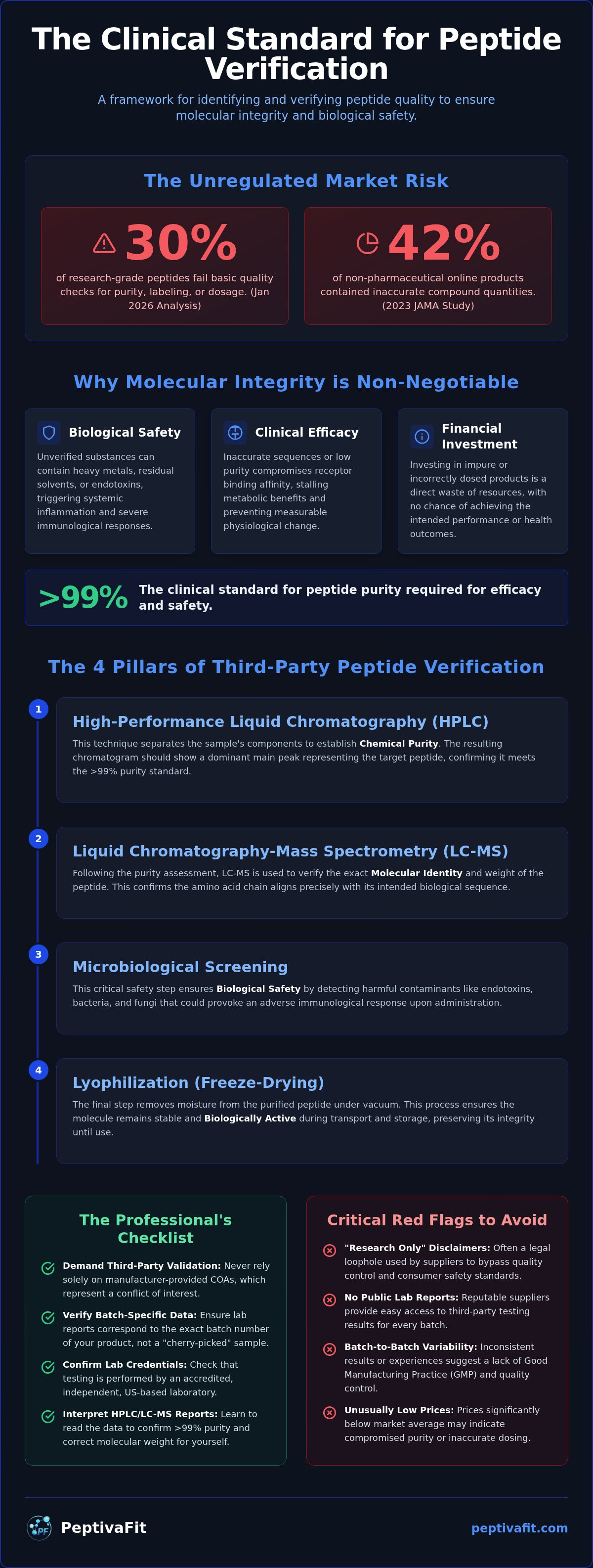
A January 2026 analysis revealed that three in ten research-grade peptide products fail basic quality checks for purity, labeling, or dosage. For those committed to a disciplined metabolic optimization journey, this represents more than a wasted investment; it's a direct compromise of biological safety. You likely understand that precision is the foundation of performance, yet the current marketplace often forces you to choose between high-stakes experimentation and total confusion. Verifying third-party tested peptides is the only way to bridge the gap between clinical intent and actual physiological results.
You deserve a sophisticated level of control over what enters your body. This guide provides a definitive framework for identifying and verifying peptide quality, ensuring you don't have to guess about molecular integrity again. We'll examine the latest July 2026 FDA advisory recommendations, the specific USP standards for synthetic peptides, and the exact steps for reading complex laboratory reports. By following this clinical standard, you'll gain the confidence to eliminate the risk of heavy metal contamination and ensure your supplies meet the highest scientific benchmarks.
Key Takeaways
- Understand why independent validation is the only reliable method for confirming molecular integrity in an unregulated landscape.
- Learn how to interpret HPLC and LC-MS results to ensure the chemical identity and purity of your supplies meet clinical standards.
- Identify the critical red flags of "research only" suppliers and the legal loopholes that compromise consumer safety.
- Follow a professional checklist to verify third-party tested peptides, focusing on batch-specific data and accredited laboratory credentials.
- Discover the advantages of integrating lab-verified molecules into a comprehensive, medically overseen performance protocol.
The Critical Necessity of Third-Party Tested Peptides in 2026
The current peptide market operates in a regulatory gray area that often resembles a digital "Wild West." While consumer interest in metabolic optimization has surged, the quality of available supplies hasn't always kept pace. A 2023 study in JAMA found that 42% of products from non-pharmaceutical online sources contained inaccurate quantities of the listed compound. This data highlights the absolute necessity of utilizing third-party tested peptides. This process involves independent validation by an accredited laboratory that maintains no financial interest in the product's sale. Without this unbiased oversight, you risk introducing substances into your system that may trigger systemic inflammation or severe immunological responses.
Clinical efficacy depends on a purity threshold of at least 99%. Anything less introduces truncated sequences or residual solvents that can interfere with biological pathways. These impurities don't just reduce the product's effectiveness; they can actively harm your progress. High-level performance requires adherence to Good Manufacturing Practice (GMP) standards, which establish the foundational systems for quality control that independent testing is meant to verify. When purity drops even slightly below the clinical standard, the risk of an adverse reaction increases exponentially.
The Distinction Between Manufacturer Testing and Third-Party Verification
Internal lab reports or Certificates of Analysis (COAs) provided directly by a manufacturer represent a fundamental conflict of interest. A factory's primary objective is throughput and profit, which can lead to the suppression of negative data or the use of "cherry-picked" samples. Independent, US-based laboratories serve as an essential safety layer by conducting an unbiased audit of every batch. This rigorous scrutiny protects you from the batch-to-batch variability that is rampant among unverified suppliers. Reliability isn't a luxury; it's a prerequisite for any serious metabolic intervention.
Molecular Integrity and Its Impact on Fat Loss Results
Using unverified supplies can completely stall the metabolic benefits outlined in our fat loss peptide guide. If the peptide sequence is even slightly inaccurate, its receptor binding affinity is compromised. This means the molecule may occupy a receptor without triggering the desired biological response, or worse, trigger an unintended one. Molecular integrity is the exact alignment of the peptide amino acid chain with its intended biological sequence. When this alignment is precise, the body can utilize the compound as intended, ensuring that your investment in third-party tested peptides translates into measurable physiological change.
Decoding the Laboratory Process: How Peptides Are Verified
Verification is not a singular event but a multi-stage analytical sequence designed to confirm molecular truth. This process mirrors the rigorous quality control systems outlined in FDA's CGMP regulations, which ensure that pharmaceutical products are manufactured to strict standards of identity and strength. For the elite researcher, understanding these laboratory methods is essential for maintaining sophisticated control over their metabolic protocols. The validation of third-party tested peptides relies on three pillars: chemical purity, molecular identity, and biological safety.
Chemical purity is established through High-Performance Liquid Chromatography (HPLC). This technique separates the components of a sample to determine the concentration of the target molecule relative to any impurities. Following purity assessment, Liquid Chromatography-Mass Spectrometry (LC-MS) is employed to verify the exact molecular weight. Finally, microbiological screening detects the presence of endotoxins, bacteria, and fungi that could trigger an adverse immunological response. Once these standards are met, lyophilization (freeze-drying) is utilized to remove moisture, ensuring the peptide remains stable and biologically active during storage.
Understanding the HPLC Chromatogram
The HPLC report is a visual representation of chemical integrity. You should look for a dominant "main peak" that represents the target peptide. In high-purity peptides for metabolism and fat loss, this peak should account for at least 99% of the total area. Secondary peaks, often appearing as small blips on the graph, indicate synthesis leftovers or degradation products. A clean, flat baseline in the chromatogram is a hallmark of superior refinement. If you're serious about your results, you can access lab-verified peptides that consistently meet these exacting analytical benchmarks.
Mass Spectrometry: Confirming Molecular Identity
Mass spectrometry provides the substance's molecular fingerprint. It's used to compare the "observed mass" of the sample against the "theoretical mass" of the intended peptide sequence. This comparison is critical because it prevents the substitution of expensive peptides with cheaper, similar-weight analogs. A discrepancy of even a few Daltons indicates an incorrect or contaminated sequence. It's a blunt, uncompromising tool for ensuring you're receiving the exact molecule you ordered. Always verify that the batch number on the mass spec report corresponds directly to the batch number on your specific vial to ensure data continuity.
The integration of third-party tested peptides into your regimen eliminates the variables that lead to wasted investment and physical risk. Data, not marketing, should drive your decisions.
Red Flags and Regulatory Gaps: Why "Research Only" Isn't Enough
The label "for research use only" is frequently misinterpreted as a mark of clinical grade quality. In reality, this designation serves as a legal shield for vendors to bypass the consumer protection standards mandated for therapeutic substances. This regulatory gap creates a landscape where the burden of verification falls entirely on the individual. Without third-party tested peptides, you're essentially participating in an unmonitored experiment with your own biology. Accessing third-party tested peptides is the only way to ensure you're receiving the exact molecule required for your protocol.
Identifying red flags is the first step in sophisticated supply chain management. The most prominent warning sign is a supplier's refusal to provide batch-specific Certificates of Analysis (COAs). Many vendors rely on "evergreen" reports; they might display a single high-quality test result from 2023 to sell a completely different batch produced in 2026. This practice ignores the inherent variability of chemical synthesis. Additionally, forged reports are becoming increasingly common. You should scrutinize documents for inconsistencies in font styles, pixelated laboratory logos, or mismatched dates that suggest a report has been digitally altered.
The Ethics of Peptide Sourcing in a Clinical Context
PeptivaFit operates as an elite gatekeeper, prioritizing transparency over the cost-cutting measures common in the gray market. We maintain rigorous standards by vetting third-party laboratories to ensure they possess the necessary accreditation and equipment for precise analysis. A critical component of our oversight involves cross-referencing reports. You can verify the authenticity of a COA by contacting the testing laboratory directly with the specific batch ID. This direct communication eliminates the possibility of manufacturer deception and ensures the data you're reviewing is legitimate.
Detecting Counterfeit and Under-dosed Vials
A common misconception in the research community is that the physical appearance of the "cake," the lyophilized powder inside the vial, indicates purity or dosage. This is a dangerous fallacy. Suppliers often use "filler" agents like mannitol to create a larger, more uniform cake, which can mask an under-dosed or impure product. These bulking agents can also complicate the testing process if the laboratory isn't using advanced separation techniques. True verification only happens at the molecular level, not through visual inspection. By focusing on molecular integrity rather than physical volume, you ensure your metabolic journey is backed by science rather than marketing aesthetics.
The Professional’s Checklist for Sourcing Lab-Verified Peptides
Acquiring third-party tested peptides is an exercise in analytical rigor. It requires a systematic approach to document verification that goes beyond glancing at a percentage on a screen. For those operating within a clinical or high-performance framework, the following five-step checklist serves as the minimum standard for supply chain validation.
- Step 1: Batch-Date Synchronization. Verify that the date on the Certificate of Analysis (COA) aligns with the current production cycle. A report older than six months often indicates the supplier is coasting on outdated data from a previous, possibly superior, batch.
- Step 2: Laboratory Accreditation. Ensure the testing facility is an independent, accredited entity. Labs like MZ Biolabs or Janoshik have established reputations for neutrality. Avoid reports from "in-house" labs or facilities with no verifiable physical address.
- Step 3: HPLC Purity Thresholds. Analyze the High-Performance Liquid Chromatography (HPLC) results. You should reject any sample showing a purity percentage below 98%. For metabolic optimization, the 99% threshold remains the objective clinical standard.
- Step 4: Identity Validation via Mass Spectrometry. A purity report is useless if the substance is the wrong molecule. Confirm that a Mass Spectrometry report is present and that the observed molecular weight matches the theoretical mass of the peptide.
- Step 5: Safety Screening. Check for secondary reports covering endotoxins and heavy metals. These contaminants can cause chronic low-grade inflammation, undermining the very metabolic health you're working to improve.
Evaluating the Testing Laboratory’s Reputation
The reliability of your data is only as good as the lab that produced it. The professional biohacking community prioritizes ISO-certified laboratories because they adhere to internationally recognized quality management systems. Unaccredited facilities lack the standardized protocols necessary for consistent accuracy. While international labs provide valuable data, US-based testing is often preferred for domestic reliability and easier direct communication. If you're ready to bypass the complexity of manual vetting, you can secure lab-tested peptides through our pre-vetted supply chain.
Maintaining Integrity After the Purchase
Molecular integrity doesn't end at the laboratory door; it's a continuous process that extends to your storage and preparation protocols. Peptides are fragile chains of amino acids that degrade when exposed to heat, light, or kinetic shock. For example, maintaining strict temperature control is vital for preserving the structure of BPC-157 peptide. Once you've verified your supply, refer to our how to reconstitute peptides guide to ensure your preparation methods don't compromise the purity you worked so hard to verify. Precision in the vial must be matched by precision in the syringe.
Beyond the Vial: Integrating Verified Peptides into the Peptiva Protocol
PeptivaFit functions as a selective gatekeeper, removing the analytical burden of verification from the individual. While the ability to identify third-party tested peptides is a vital skill for any researcher, the Peptiva Protocol provides a comprehensive framework that integrates these verified supplies with professional medical oversight. Raw data from a laboratory is merely a starting point. True metabolic optimization requires a sophisticated synthesis of high-purity molecules, personalized medical assessments, and disciplined performance monitoring. This approach ensures that your biological investment isn't just safe, but strategically aligned with your specific physiological profile.
The synergy between molecular integrity and expert guidance is what separates a standard fat loss attempt from a clinical-grade transformation. We provide access to pre-vetted, lab-verified peptides, eliminating the high-stakes guesswork associated with unverified gray-market vendors. The Peptiva Protocol is built on four disciplined pillars:
- Access to high-quality, lab-verified peptide supplies.
- Comprehensive personalized medical assessments.
- 1-on-1 coaching to adjust protocols based on metabolic response.
- Continuous data monitoring to ensure long-term safety and efficacy.
Even the purest compound requires a precise application strategy. This is why 1-on-1 coaching is a non-negotiable component of our methodology. It allows for the real-time adjustment of dosages and timing based on your unique metabolic markers, ensuring that every variable is optimized for both efficiency and safety. You don't have to navigate the complexities of peptide science alone.
The Role of Expert Oversight in Peptide Therapy
A laboratory report confirms what is in the vial, but it cannot tell you how that substance will interact with your specific endocrine system. Medical context is the essential second half of the safety equation. PeptivaFit consultants possess the expertise to interpret complex data sets and adjust protocols to maximize client results. For those just beginning their optimization journey, a single consultation call offers the opportunity to establish a baseline and define clear, data-backed objectives. This level of professional scrutiny prevents the common pitfalls of self-administration and ensures a disciplined path toward your performance goals.
Achieving Elite Results with Scientific Precision
Long-term body composition goals depend on the consistent use of verified sequences. When you utilize only the highest grade of third-party tested peptides, you eliminate the inflammatory noise that often stalls progress. Purity directly dictates the efficacy of growth hormone secretagogues. For instance, the metabolic impact of Tesamorelin is entirely dependent on its ability to bind precisely to specific receptors without interference from synthesis byproducts. By adhering to the Peptiva Protocol, you're choosing a framework built on scientific precision rather than trial and error. Join the Peptiva Protocol today to begin your clinical-grade metabolic transformation.
Advancing Toward Clinical Excellence in Metabolic Health
Achieving a sophisticated standard for your wellness requires more than intent; it demands an uncompromising commitment to data and safety. You now possess the analytical framework to distinguish between high-risk research supplies and clinical-grade molecules. By utilizing the professional checklist and demanding batch-specific COAs, you ensure your biological integrity is never compromised by synthesis leftovers or inaccurate sequences. True optimization only occurs when you bridge the gap between laboratory verification and personalized application.
The Peptiva Protocol provides this essential bridge, offering a disciplined environment where scientific data meets clinical oversight. We eliminate the variables of the gray market by providing exclusive access to our fat loss guide and pre-vetted supplies. Every protocol is managed by medical professionals who interpret your data to maximize performance and safety. Third-party tested peptides are the foundation of this process, but expert interpretation is what drives the results.
Access the Peptiva Protocol and Lab-Verified Peptides to secure your supplies and begin a journey defined by medical precision. You've mastered the theory of verification; now it's time to execute your protocol with total confidence.
Frequently Asked Questions
What does "third-party tested" actually mean for peptides?
Third-party testing refers to the independent validation of a substance by a laboratory that possesses no financial interest in the product's sale. This process provides an objective audit of chemical purity and molecular identity, ensuring that the researcher receives exactly what is advertised. For those utilizing third-party tested peptides, this layer of oversight is the primary defense against the batch-to-batch variability common in unregulated markets.
How can I tell if a Certificate of Analysis (COA) is real or forged?
Authenticating a Certificate of Analysis (COA) requires direct communication with the issuing laboratory. You should cross-reference the batch ID and test date on the report with the lab's internal database. Visual indicators of forgery often include inconsistent font styles, pixelated logos, or signs of digital manipulation. Suppliers who operate with clinical transparency will encourage this level of scrutiny rather than obstructing it.
Is 95% purity good enough for peptide research?
A 95% purity level is insufficient for serious metabolic research. While it may appear high, the remaining 5% represents unknown impurities that could include truncated peptide sequences, residual solvents, or heavy metals. The clinical standard for third-party tested peptides is a minimum of 99% purity. This threshold ensures that the biological response is triggered by the target molecule rather than unintended contaminants.
Why are third-party tested peptides more expensive than others?
The increased cost of verified peptides reflects the significant financial investment required for high-resolution analytical testing. Characterization services such as HPLC and LC-MS can cost between $800 and $5,000 per sample depending on the complexity. This premium also accounts for the rejection of batches that fail to meet clinical standards. You're not just paying for the molecule; you're paying for the certainty of its integrity.
Which laboratories are considered the gold standard for peptide testing?
MZ Biolabs and Janoshik are currently recognized as the leading independent facilities for peptide characterization. These laboratories are valued for their neutrality and their use of sophisticated equipment like High-Performance Liquid Chromatography. Choosing an ISO-certified facility is also critical. These labs follow internationally recognized quality management systems, providing a level of reliability that unaccredited or in-house facilities simply cannot match.
Can I send my own peptides to a lab for testing?
Individuals can send samples to independent labs, though the high cost often makes this prohibitive for single-vial research. Most labs require a specific sample volume and a significant fee for each analytical method performed. This is why many choose to work with elite gatekeepers like PeptivaFit. We manage the testing process at scale, ensuring that every molecule in our protocol has been pre-vetted by accredited facilities.
Does third-party testing guarantee the peptide will work for fat loss?
Testing guarantees the identity and purity of the molecule, not a specific physiological outcome like fat loss. Biological results are the product of the molecule's interaction with your unique metabolic profile. This is why the Peptiva Protocol emphasizes personalized medical assessments and 1-on-1 coaching alongside verified supplies. Purity is the prerequisite for success, but the protocol is the engine that drives the transformation.
How often should a supplier update their lab reports?
Suppliers must update their laboratory reports with every new production batch. A report is only valid for the specific batch it analyzed; using an "evergreen" report from a previous year is a major red flag. You should always verify that the batch number on your vial corresponds exactly to the number on the provided COA. Data continuity is the only way to ensure the current supply meets clinical standards.

![Shelf Life of Reconstituted Peptides: A Clinical Reference Guide [2026]](https://getautoseo.com/storage/hero_images/shelf-life-of-reconstituted-peptides-a-clinical-reference-guide-2026.jpg?v=b8ed5173acaa)
