
![CJC-1295 vs. Ipamorelin for Fat Loss: A Clinical Comparison [2026]](https://getautoseo.com/storage/hero_images/cjc-1295-vs-ipamorelin-for-fat-loss-a-clinical-comparison-2026.jpg?v=3c647bd37b30)
The assumption that a single peptide can override a stalled metabolism is a common misconception in high-level performance circles. You've likely reached a point where strict caloric deficits and disciplined resistance training no longer yield the body composition changes they once did. It's a frustrating plateau that often leads to the pursuit of unverified research chemicals without a clear understanding of the underlying endocrinology. This clinical analysis of cjc 1295 vs ipamorelin for fat loss provides the data-driven clarity required to move beyond guesswork and into precise metabolic optimization.
We'll examine the synergistic relationship between GHRH analogs and ghrelin mimetics, explaining why a dual-pathway approach is often superior for targeting stubborn visceral fat. This guide clarifies the critical distinctions between CJC-1295 versions, evaluates the 2026 clinical consensus on growth hormone secretagogues, and establishes a protocol for verifying molecular purity. By the end of this technical comparison, you'll possess a scalable framework for integrating these tools into a professional wellness strategy that prioritizes safety and measurable data over industry hype.
Key Takeaways
- Identify the pharmacological distinctions between GHRH analogs and selective ghrelin receptor agonists to effectively modulate the pituitary gland for metabolic optimization.
- Evaluate the clinical data regarding cjc 1295 vs ipamorelin for fat loss to determine which molecular sequence is most effective for reducing visceral adipose tissue.
- Master the "Double Signal" theory to implement a synergistic peptide stack that maximizes lipolysis while supporting favorable nutrient partitioning.
- Apply the rigorous standards of the PeptivaFit Protocol to verify peptide potency and ensure research integrity through lab-tested supplies.
The Growth Hormone Axis: How CJC-1295 and Ipamorelin Regulate Fat Loss
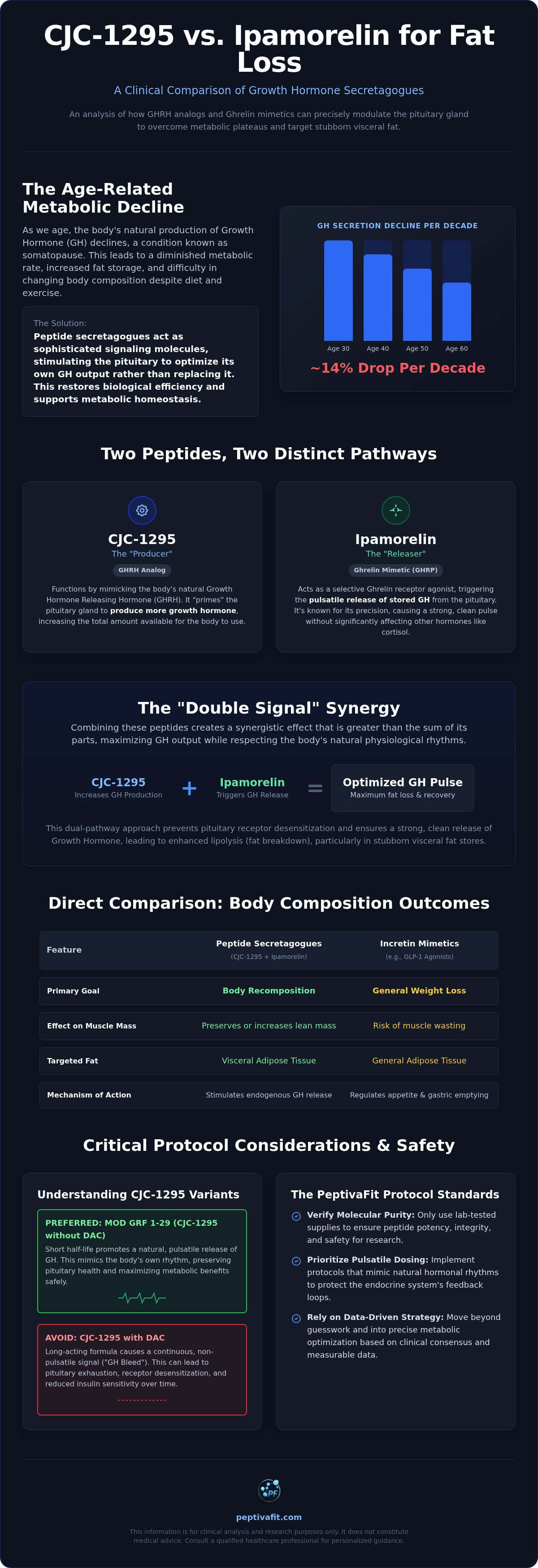
The pituitary gland serves as the primary regulatory hub for the endocrine system, orchestrating the pulsatile release of endogenous growth hormone (GH). This somatotropic activity is vital for maintaining metabolic homeostasis, yet it's subject to a physiological decline known as somatopause. By the time an individual reaches their fourth decade, GH secretion often drops by as much as 14 percent per decade, leading to a diminished metabolic rate and increased adiposity. Understanding the nuances of cjc 1295 vs ipamorelin for fat loss requires a shift in perspective; these compounds aren't exogenous hormones that replace natural production. Instead, they function as sophisticated secretagogues, or signaling molecules, that stimulate the pituitary to optimize its existing output. This precision is why GH optimization remains a foundational pillar in peptides for metabolism and fat loss, offering a method to restore biological efficiency without the risks of total hormone replacement.
The Role of Somatotropic Signaling in Lipolysis
Lipolysis, the biochemical process of breaking down stored triglycerides into free fatty acids, is directly influenced by GH levels. When GH binds to receptors on adipocytes, it initiates a cascade that inhibits the uptake of circulating lipids while simultaneously promoting the mobilization of stored fat. This creates a favorable environment for improved insulin sensitivity and glucose management. The result is a documented metabolic shift where the body transitions from a glucose-dependent state to one that prioritizes lipid oxidation for energy. For those analyzing cjc 1295 vs ipamorelin for fat loss, this mechanism explains why these peptides are specifically effective at reducing visceral fat. Visceral adipose tissue is more metabolically active and sensitive to GH signaling than subcutaneous fat, making it the primary target in clinical fat loss protocols.
Incretin vs. Secretagogue: Distinguishing Fat Loss Pathways
The 2026 clinical landscape often conflates GH secretagogues with incretin mimetics like GLP-1 receptor agonists. While GLP-1s primarily regulate appetite and gastric emptying to induce weight loss, peptides like CJC-1295 and Ghrelin Receptor Agonists operate through the growth hormone axis to improve body composition quality. Incretins are effective for general weight reduction, but secretagogues are often preferred for body recomposition because they help preserve lean muscle mass during a caloric deficit. This distinction is critical for individuals seeking metabolic optimization without the muscle wasting sometimes associated with aggressive incretin therapy. GH-focused protocols offer a non-invasive, targeted approach to fat loss that respects the body's natural regulatory feedback loops while supporting structural integrity.
Mechanism of Action: GHRH Analogs vs. Ghrelin Receptor Agonists
The efficacy of cjc 1295 vs ipamorelin for fat loss resides in their distinct yet complementary biochemical pathways. CJC-1295 is classified as a Growth Hormone Releasing Hormone (GHRH) analog, which initiates the production phase of GH within the pituitary. Conversely, Ipamorelin acts as a selective Ghrelin receptor agonist, often referred to as a Growth Hormone Releasing Peptide (GHRP), which triggers the actual secretion or "pulse" of the stored hormone. Maintaining a pulsatile rhythm is essential for safety; it prevents the desensitization of pituitary receptors and preserves the body's natural feedback loops. This dual-signal approach ensures that the pituitary isn't just producing GH, but also releasing it in a manner that mimics human physiology.
A critical distinction in research circles involves the "GH Bleed" phenomenon. This occurs when long-acting versions, specifically CJC-1295 with DAC (Drug Affinity Complex), provide a continuous, non-pulsatile signal to the gland. While this increases total GH levels, it can lead to pituitary exhaustion and reduced insulin sensitivity over time. For those prioritizing metabolic health, the shorter half-life of Mod GRF 1-29 (CJC-1295 without DAC) is typically preferred to avoid these risks. Using a personalized medical assessment is the most reliable way to determine which molecular structure aligns with your specific metabolic baseline.
CJC-1295: Stimulating the GHRH Pathway
CJC-1295 functions by mimicking the endogenous GHRH signal, effectively "priming" the pituitary gland to produce more growth hormone. Clinical studies on GHRH suggest that this class of peptides is particularly effective at reducing visceral adipose tissue while improving overall metabolic stability. By using the version without DAC, researchers can achieve a half-life of approximately 30 minutes, allowing for precise control over the timing of GH release. This stability is a key factor when evaluating cjc 1295 vs ipamorelin for fat loss in a clinical setting, as it allows the body to return to baseline between pulses, preventing the downregulation of somatotropic receptors.
Ipamorelin: The Selective Secretagogue
Ipamorelin is frequently cited as the most refined secretagogue available in the 2026 clinical landscape. Unlike earlier iterations such as GHRP-2 or GHRP-6, Ipamorelin is highly selective. It doesn't stimulate the release of cortisol or prolactin, nor does it significantly impact appetite. It mimics the action of ghrelin on the pituitary without the uncomfortable hunger pangs associated with other agonists. This selectivity makes it a "clean" option for individuals focused on body composition rather than just weight loss. By avoiding the gastric side effects common in older secretagogues, Ipamorelin allows for consistent protocol adherence during rigorous fat loss phases.
Direct Comparison: Fat Loss Velocity and Body Composition
Clinical observation of cjc 1295 vs ipamorelin for fat loss reveals a distinct hierarchy in how these secretagogues address adipose tissue distribution. While both compounds facilitate lipolysis, CJC-1295 acts as a consistent driver for systemic GH elevation, whereas Ipamorelin provides the acute secretagogue signal necessary to capitalize on specific metabolic windows. This distinction is critical when analyzing the "nutrient partitioning" effect. By optimizing the somatotropic axis, these peptides encourage the body to divert ingested calories toward muscle protein synthesis rather than triglyceride storage. Comparative data in our fat loss peptide guide indicates that this shift is most pronounced when the protocol is tailored to the individual's existing hormonal baseline.
Visceral Fat Targeting and Metabolic Health
Visceral adipose tissue, the deep abdominal fat surrounding internal organs, is uniquely sensitive to growth hormone signaling. Research from the Harvard Gazette confirms that increasing growth hormone release significantly reduces abdominal fat by targeting these metabolically active cells. This process is mediated by the liver’s production of IGF-1, which serves as the primary systemic effector for GH. The lipolytic threshold in secretagogue therapy is defined as the specific concentration of circulating GH required to initiate the breakdown of triglycerides without inducing peripheral insulin resistance. Targeting this threshold allows for the reduction of visceral fat without the systemic inflammation often associated with metabolic syndrome.
Preserving Lean Muscle Mass During Caloric Deficits
The primary challenge of any fat loss phase is the prevention of catabolism. GH secretagogues provide a protective mechanism by promoting nitrogen retention and protein synthesis, effectively shielding lean tissue during a caloric deficit. This preservation ensures that the basal metabolic rate (BMR) remains elevated, preventing the metabolic adaptation that often stalls weight loss. When evaluating cjc 1295 vs ipamorelin for fat loss, clinical reports suggest that recovery times for connective tissue and muscular inflammation are noticeably shorter with the CJC-1295 component, while Ipamorelin excels at improving sleep architecture. Deep, slow-wave sleep is the physiological requirement for endogenous GH pulses, creating a feedback loop that further supports long-term body composition goals. Beyond metabolic changes, the ancillary benefits to skin elasticity and hair density serve as external markers of restored somatotropic health.
Optimal Protocols: Dosing, Titration, and Synergy
Most clinical research indicates that monotherapy with either agent yields only a fraction of the potential metabolic results. The "Double Signal" theory posits that combining these peptides creates an exponential physiological response that surpasses the capabilities of a single-molecule approach. CJC-1295 acts as the GHRH analog that increases the total pool of GH produced within the pituitary, while Ipamorelin acts as the selective trigger that releases those stores into the bloodstream. Understanding the nuances of cjc 1295 vs ipamorelin for fat loss requires a protocol that respects this biological hierarchy. When these signals are synchronized, the resulting pulse mimics a youthful endocrine profile more effectively than isolated administration.
A standard research-grade benchmark often utilizes a 1:1 ratio, typically 100mcg of each peptide administered simultaneously. Timing is a non-negotiable variable; administration must occur in a strictly fasted state, usually at least two hours after the last meal. High levels of circulating insulin or blood glucose will effectively blunt the pituitary's secretagogue response, rendering the protocol inefficient. Achieving this level of precision requires a mastery of how to reconstitute peptides to ensure that the molecular integrity of the solution is maintained for accurate volumetric dosing. Any degradation during the mixing process can lead to inconsistent results and stalled fat loss progress.
The Synergy of the Combination Protocol
The combination protocol effectively "primes" the pituitary pump with CJC-1295 before Ipamorelin "triggers" the secretagogue pulse. This balanced approach significantly reduces the risk of receptor desensitization compared to aggressive, high-dose monotherapy. By 2026, the clinical standard for metabolic optimization has shifted toward intermittent schedules, such as five days of administration followed by two days of rest. This "5/2" or "6/1" cadence allows the pituitary to maintain its natural rhythm without the risk of external overstimulation, ensuring long-term protocol sustainability.
Titration and Side Effect Mitigation
Initial administration may cause a transient "head rush" or localized facial flushing, which is a standard vasodilatory response to the GH pulse. Users should monitor for signs of peripheral edema or minor joint sensitivity, as these markers often indicate a need for dose titration rather than protocol termination. Utilizing personalized medical assessments allows for the precise calibration of these variables based on individual blood markers and physiological response rates. To ensure your protocol is built on lab-verified data rather than anecdotal evidence, consider a Single Consultation Call with our metabolic experts to review your specific requirements.
Clinical Standards: Lab Purity and the Peptiva Protocol
The pursuit of metabolic optimization via cjc 1295 vs ipamorelin for fat loss is often undermined by the prevalence of "gray market" research chemicals. These unregulated supplies frequently harbor heavy metals, bacterial endotoxins, and significant variances in peptide concentration, ranging from severe under-dosing to total molecular misidentification. Bacterial endotoxins are particularly hazardous; these lipopolysaccharides can trigger acute immune responses or chronic low-grade inflammation, which directly opposes the goal of adipose reduction. The Peptiva Protocol serves as a rigorous framework to mitigate these risks, ensuring that every research cycle is built upon lab-verified supplies. This transition from surface-level fat loss to deep mitochondrial optimization requires a commitment to clinical discipline and 1-on-1 coaching to navigate the complexities of long-term endocrine health.
Verifying Peptide Purity: COA Analysis
In the 2026 research landscape, a Certificate of Analysis (COA) is the minimum requirement for establishing molecular integrity. High-Performance Liquid Chromatography (HPLC) and Mass Spectrometry (MS) reports must be scrutinized for purity levels exceeding 99 percent. A single, sharp peak on an HPLC graph indicates a homogeneous substance, whereas multiple smaller peaks suggest synthesis byproducts or residual solvents that can provoke systemic inflammation. The Peptiva Standard for molecular integrity dictates that only peptides with third-party verification of both sequence identity and absolute purity are eligible for clinical protocols. Anything less compromises the empirical nature of your research and introduces unnecessary physiological variables.
Integrating Ancillary Peptides for Recovery
While the growth hormone axis is the primary lever for adipocyte reduction, systemic repair often requires a multi-peptide approach to sustain performance. Integrating BPC-157 peptide alongside your secretagogue stack can address the systemic inflammation and connective tissue stress that often accompany rapid changes in body composition. Refining this metabolic stack is best achieved through a Single Consultation Call, where specific blood markers such as IGF-1 and fasting glucose are analyzed to ensure the protocol remains within safe physiological limits. Continuous data monitoring is the hallmark of a professional-grade strategy, moving beyond anecdotal feedback toward empirical results. This methodical approach ensures that your use of cjc 1295 vs ipamorelin for fat loss remains a precise tool for long-term health rather than a temporary fix.
Precision Protocols for Long-Term Metabolic Success
Navigating the complexities of cjc 1295 vs ipamorelin for fat loss requires more than anecdotal evidence; it demands a clinical understanding of the somatotropic axis. You've seen how the "Double Signal" theory leverages GHRH and Ghrelin mimetics to maximize lipolysis while shielding lean muscle mass. However, the efficacy of any protocol is strictly dependent on the molecular integrity of the compounds used. Transitioning from a stalled metabolism to a state of optimized lipid oxidation isn't a matter of chance. It's the result of disciplined titration, fasted-state administration, and the use of lab-verified supplies.
Success in 2026 relies on shifting from "gray market" guesswork to data-driven standards. By prioritizing 99%+ purity and professional oversight, you ensure that your physiological response remains predictable and safe. You're ready to take control of your metabolic health through a framework that values science over hype. Optimize your fat loss with the Peptiva Protocol and Lab-Tested Peptides to secure 99%+ pure lab-verified peptides, professional medical assessments, and exclusive 1-on-1 metabolic coaching. You're now equipped to bridge the gap between clinical theory and tangible body composition results.
Frequently Asked Questions
Is CJC-1295 or Ipamorelin better for fat loss?
Neither peptide is objectively superior; instead, they serve distinct roles within the somatotropic axis. CJC-1295 functions as a GHRH analog that increases the total pool of growth hormone, while Ipamorelin acts as the secretagogue that triggers the actual pulse. When comparing cjc 1295 vs ipamorelin for fat loss, clinical data suggests that the combined Double Signal protocol is more effective for reducing visceral adipose tissue than either compound used as monotherapy.
Why are CJC-1295 and Ipamorelin often taken together?
Combining these peptides creates a synergistic effect that mimics the body's natural physiological growth hormone release. CJC-1295 primes the pituitary gland by increasing hormone synthesis, while Ipamorelin provides the selective signal to release those stores into the bloodstream. This dual action prevents the pituitary from becoming desensitized and ensures a more potent, pulsatile rhythm. This strategic combination is a foundational element of the Peptiva Protocol for those seeking metabolic optimization through precise endocrine signaling.
What is the best time of day to take CJC-1295 and Ipamorelin for fat loss?
The most effective timing for administration is typically late evening, shortly before sleep, or in the early morning. Both windows require a strictly fasted state to ensure that circulating insulin and blood glucose levels don't blunt the secretagogue response. Administering the protocol at night capitalizes on the body's natural circadian pulses. This timing supports deep, slow-wave sleep, which is essential for reaching the lipolytic threshold required to mobilize stubborn visceral fat.
Does Ipamorelin increase hunger like other GH secretagogues?
Ipamorelin is highly selective and doesn't significantly increase hunger, unlike earlier secretagogues such as GHRP-2 or GHRP-6. It targets the ghrelin receptor without the gastric side effects or the stimulation of cortisol and prolactin. This selectivity makes it the preferred clean secretagogue in the 2026 clinical market. It allows individuals to maintain strict caloric control during a fat loss phase without the distracting appetite surges common in less refined peptide sequences.
How long does it take to see fat loss results on a CJC/Ipa protocol?
Measurable changes in body composition typically manifest within a three to six month period of consistent protocol adherence. While initial improvements in sleep quality and systemic recovery often occur within the first few weeks, the lipolytic effects on visceral fat require sustained optimization. This is a methodical process rather than a quick fix. Success depends on integrating the protocol with disciplined resistance training and metabolic data monitoring to verify the rate of fat loss velocity.
What is the difference between CJC-1295 with DAC and without DAC?
The primary distinction lies in the half-life and the resulting pattern of growth hormone release. CJC-1295 with DAC (Drug Affinity Complex) has a half-life of several days, leading to a continuous hormone bleed that can cause pituitary exhaustion. CJC-1295 without DAC, also known as Mod GRF 1-29, has a half-life of approximately 30 minutes. This shorter duration allows for a more natural, pulsatile rhythm, which is safer and more effective for long-term metabolic health.
Are lab-tested peptides necessary for research safety?
Lab-verified peptides are an absolute requirement for research integrity and physiological safety. Unregulated gray market supplies often contain bacterial endotoxins, heavy metals, or incorrect molecular concentrations that can provoke systemic inflammation. Utilizing 99%+ pure peptides, as mandated by the Peptiva Protocol, ensures that your results are based on the intended molecular sequence. Verifying purity through HPLC reports is the only way to eliminate dangerous variables and ensure the accuracy of your cjc 1295 vs ipamorelin for fat loss data.
Can I use CJC-1295 and Ipamorelin while on a ketogenic diet?
A ketogenic diet is highly compatible with secretagogue therapy because low baseline insulin levels enhance the pituitary's response. Growth hormone promotes a metabolic shift toward lipid oxidation, which aligns perfectly with the fat-burning state of ketosis. This combination can accelerate the reduction of visceral adipose tissue while helping to preserve lean muscle mass during a caloric deficit. Our 1-on-1 coaching can help refine your macronutrient ratios to maximize the synergy between your diet and the peptide protocol.

![Shelf Life of Reconstituted Peptides: A Clinical Reference Guide [2026]](https://getautoseo.com/storage/hero_images/shelf-life-of-reconstituted-peptides-a-clinical-reference-guide-2026.jpg?v=b8ed5173acaa)
