

The primary risk of metabolic optimization isn't the peptide itself; it's the absence of clinical oversight and molecular purity. As the FDA continues to adjust the regulatory status of substances like BPC-157 and MOTS-C throughout 2026, the distinction between pharmaceutical-grade protocols and unregulated experimentation has become the defining factor in patient safety. You're likely concerned about the side effects of fat loss peptides, specifically regarding potential hormonal disruption or the conflicting anecdotes found in digital forums. It's a rational fear when the market remains saturated with "research only" products that lack rigorous quality control and professional transparency.
We agree that your health shouldn't be a subject of guesswork or social media trends. This clinical reference provides a comprehensive, science-backed analysis of the adverse effects associated with metabolic peptides and details how to mitigate these risks through professional-grade protocols. We'll examine class-specific side effects, establish a framework for monitoring essential health markers, and provide the criteria for selecting lab-verified supplies. By the end, you'll have the data-driven confidence required to manage your performance optimization with precision, safety, and a clear understanding of the latest 2026 regulatory standards.
Key Takeaways
- Understand that adverse reactions are often predictable physiological responses to exogenous signaling, making receptor affinity a critical factor in protocol design.
- Distinguish between the specific profiles of peptide classes, such as the water retention risks of secretagogues compared to the lower side effect potential of lipolytic fragments.
- Recognize how lab-verified purity standards mitigate the side effects of fat loss peptides caused by residual solvents and contaminants found in grey-market supplies.
- Learn to implement a clinical monitoring framework that utilizes baseline bloodwork and precise titration to maintain metabolic health and hormonal balance.
- Discover how a supervised medical assessment within the Peptiva Protocol identifies individual contraindications to ensure your fat loss journey remains both safe and effective.
The Biological Mechanism of Peptide Side Effects
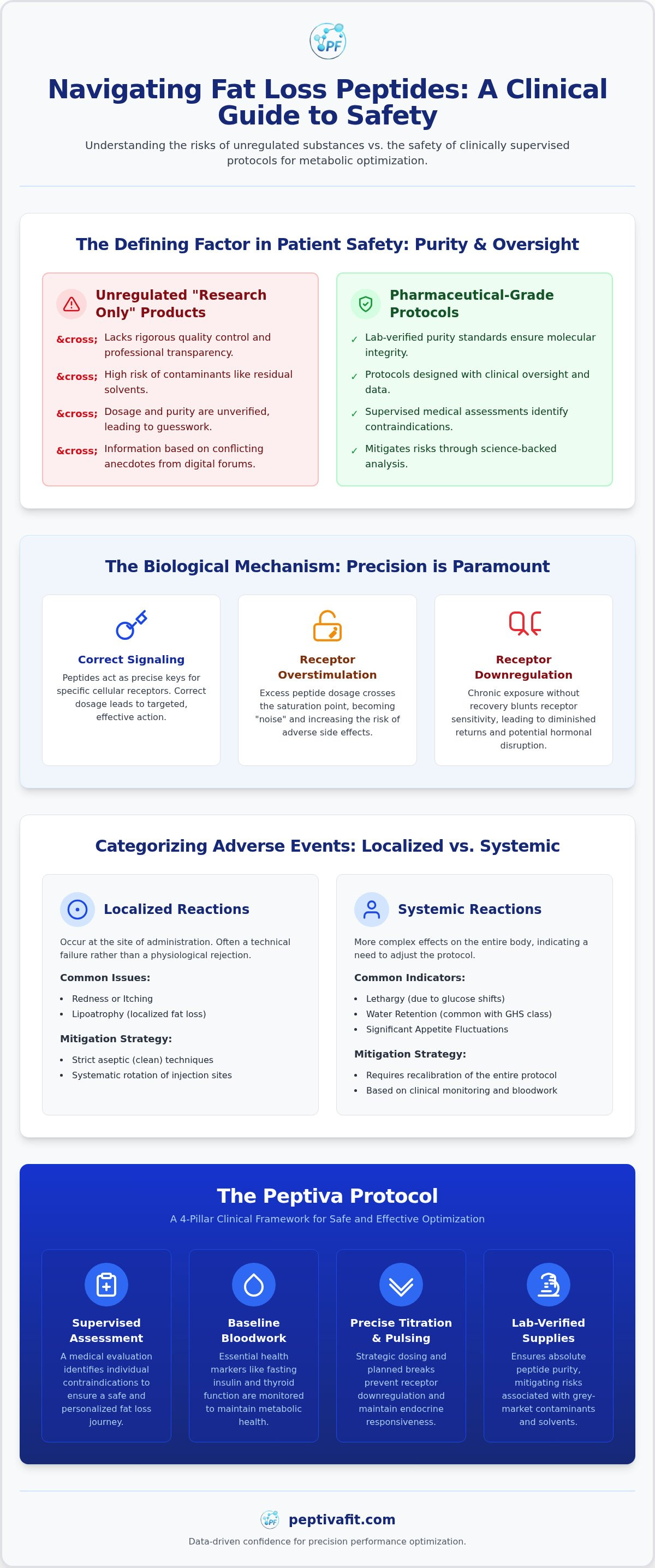
Peptide-based fat loss isn't a passive process; it's a deliberate manipulation of the endocrine system. When we discuss the side effects of fat loss peptides, we're really discussing the body's physiological response to exogenous hormonal signaling. These molecules act as precise keys for specific cellular receptors. If the dosage or frequency is miscalculated, these signals become noise, leading to off-target effects that compromise wellness. Precision is the priority.
Receptor affinity determines how strongly a peptide binds to its target. Many users mistakenly believe that higher dosages accelerate fat oxidation. In reality, receptors have a saturation point. Once that threshold is crossed, the excess peptide doesn't improve the metabolic rate; it simply increases the likelihood of adverse events. This is why metabolic optimization requires a disciplined, data-driven approach rather than aggressive escalation. Your baseline health markers, such as fasting insulin and existing thyroid function, dictate how severely your body reacts to these shifts. A person with high baseline inflammation will likely experience more pronounced side effects of fat loss peptides than an individual with a stable metabolic profile.
Receptor Overstimulation and Downregulation
Chronic exposure to exogenous peptides without adequate recovery periods can lead to receptor downregulation. This is a survival mechanism where cells reduce their sensitivity to a specific hormone to prevent overstimulation. For example, constant stimulation of growth hormone secretagogues can blunt the body's natural GH pulses, leading to diminished returns and potential long-term hormonal disruption. Sensitivity is a finite resource.
The Peptiva Protocol addresses this by emphasizing strategic pulsing. By introducing planned breaks in the administration schedule, we maintain receptor health and ensure the endocrine system remains responsive. This methodology protects long-term metabolic function while minimizing the risk of hormonal fatigue. It's a professional alternative to the "more is better" mentality often found in unregulated circles.
Systemic vs. Localized Adverse Events
Adverse reactions generally fall into two categories: localized and systemic. Localized issues occur at the site of administration. Users might experience redness, itching, or lipoatrophy, which is the localized loss of fat tissue due to repeated trauma. These are often mitigated through rotation of injection sites and strict aseptic techniques. Systemic shifts are more complex. When analyzing Semaglutide side effects, researchers often observe gastrointestinal distress as a primary systemic response to slowed gastric emptying. Common systemic indicators include:
- Lethargy: Often caused by rapid shifts in glucose metabolism or insulin sensitivity.
- Water Retention: A frequent occurrence with growth hormone secretagogues due to sodium-potassium balance shifts.
- Appetite Fluctuations: Desired signals that can become adverse events if they lead to severe caloric deficits or malnutrition.
Distinguishing between these categories is essential for effective risk mitigation. Localized irritation is often a technical failure, whereas systemic reactions require a recalibration of the entire protocol. Monitoring these markers is not optional; it's a prerequisite for any serious optimization strategy.
Categorizing Side Effects by Peptide Class
A disciplined approach to metabolic optimization requires a granular understanding of how different chemical structures interact with the body. The side effects of fat loss peptides are not uniform across the board; they are class-specific and dictated by the primary biological pathway they activate. Grouping these substances by their mechanism of action allows for more precise monitoring and risk management. While some classes influence the pituitary gland, others target gastric motility or mitochondrial efficiency, each presenting a distinct profile of potential adverse events.
Growth Hormone Secretagogue (GHS) Specifics
Growth hormone secretagogues like Ipamorelin and Tesamorelin function by stimulating the pituitary gland to release endogenous growth hormone. The most frequent physiological response to this signaling is water retention, or peripheral edema. This occurs because elevated growth hormone levels can alter the sodium-potassium balance, leading to fluid accumulation in the extremities. In many cases, users report carpal tunnel-like symptoms, such as numbness or tingling in the hands, which is typically caused by fluid pressure on the nerves. These issues are often exacerbated by an improper Tesamorelin dosage, where exceeding the saturation point leads to systemic swelling rather than localized lipolysis.
Incretin Mimetics: GLP-1 and Beyond
Incretin mimetics, including GLP-1 and GIP agonists, have redefined medical weight loss but carry significant gastrointestinal considerations. Nausea, vomiting, and delayed gastric emptying are common as the body adjusts to slower digestion. There are also broader Peptide safety concerns regarding the risk of sarcopenia, or muscle wasting, if protein intake and resistance training are not prioritized during rapid weight loss. Long-term users must also remain vigilant about gallbladder and pancreatic health, as these organs are heavily involved in the metabolic pathways these peptides influence. Clinical titration is non-negotiable to avoid the acute distress often labeled as "Ozempic-face," which is simply the result of rapid subcutaneous fat loss in the malar region.
The Safety Profile of Lipolytic Fragments
Lipolytic fragments, such as Frag 176-191, offer a more targeted profile compared to full-length HGH. Their primary advantage is the avoidance of insulin resistance and glucose intolerance, which are common risks with traditional growth hormone therapy. When comparing Frag 176-191 vs. AOD-9604, both show a high degree of safety, though some users report temporary lethargy or mild irritation at the injection site. Because these fragments do not stimulate the IGF-1 pathway as aggressively as GHS peptides, they are often considered the entry point for those sensitive to systemic hormonal shifts. For those seeking a guided path through these complexities, a personalized medical assessment can clarify which class aligns with your specific biological markers.
Mitochondrial peptides like MOTS-C represent a newer frontier in 2026. These compounds primarily influence metabolic flexibility and exercise capacity. While generally well-tolerated, they can cause temporary flushing or a mild, transient elevation in heart rate immediately following administration. These responses are typically short-lived but underscore the importance of baseline cardiac monitoring before beginning any mitochondrial-focused protocol.
The Impurity Factor: Grey Market Risks vs. Lab-Tested Standards
Many individuals confuse the biological side effects of fat loss peptides with symptoms of acute chemical poisoning. "Grey market" vendors sell research-only chemicals that lack the regulatory oversight required for human administration. These products often contain residual solvents from the manufacturing process. Trifluoroacetic acid (TFA), a common reagent used in peptide synthesis, can remain in the final lyophilized powder if not properly removed. Injecting TFA leads to localized tissue damage and systemic toxicity, which users frequently misidentify as standard reactions to the peptide itself. Precision in manufacturing is as vital as precision in dosing.
Bacterial endotoxins represent an even more immediate threat to the user. When unverified vials are produced in non-sterile environments, they can harbor microscopic contaminants that trigger a massive immune response. This often manifests as "peptide flu," characterized by sudden chills, fever, and systemic inflammation. Using lab tested peptides is the only definitive way to ensure your symptoms are physiological responses to the hormone rather than a reaction to bacterial debris. Without third-party verification, you're unable to distinguish between a metabolic shift and a low-grade infection.
Heavy Metals and Cross-Contamination
Overseas laboratories operating without clinical-grade standards often fail to screen for heavy metals like lead or arsenic. These elements accumulate in the body over time, leading to neurological and organ damage that remains silent until it becomes critical. Cross-contamination is equally dangerous. A vial labeled as a fat loss fragment might contain traces of Melanotan or other potent signaling molecules if produced in a facility that lacks dedicated lines. We rely on High-Performance Liquid Chromatography (HPLC) and Mass Spectrometry (MS) to verify both molecular identity and absolute purity. These tests ensure that the side effects of fat loss peptides remain predictable rather than chaotic.
The Importance of Molecular Integrity
Molecular integrity is fragile. Degraded peptides resulting from heat exposure or improper storage don't just lose efficacy; they can become inflammatory irritants. The process of peptide reconstitution is a critical step where safety is often compromised through the use of improper diluents or aggressive handling. PeptivaFit demands a Certificate of Analysis (COA) for every batch to confirm that the molecular structure is intact and free from degradation byproducts. This level of scrutiny is necessary because even a minor structural change can shift a peptide from a beneficial messenger to a biological liability. You shouldn't accept anything less than documented purity when your metabolic health is the primary stake.
Clinical Monitoring and Side Effect Mitigation
Managing the side effects of fat loss peptides requires a transition from passive observation to active clinical monitoring. Mitigation is not a reactive process; it's a structured framework that begins before the first administration. By following a disciplined four-step approach, you can ensure that metabolic signaling remains within a safe physiological range while maximizing the efficacy of the protocol. A failure to monitor is a failure to optimize.
- Step 1: Baseline Bloodwork. Tracking HbA1c, fasting insulin, and IGF-1 levels is essential. These markers provide a map of your current metabolic health and serve as a reference point for all future adjustments.
- Step 2: Titration. We advocate for a "start low, go slow" mandate. Introducing peptides at sub-maximal dosages allows the endocrine system to adapt without triggering acute distress.
- Step 3: Lifestyle Support. Physiological shifts must be countered with precise dietary adjustments. Managing sodium intake and maintaining high protein levels are critical for controlling edema and preserving lean mass.
- Step 4: Real-time Adjustment. Protocols are dynamic. Utilizing 1-on-1 coaching allows for immediate pivots when biomarkers or subjective feelings deviate from the expected path.
For individuals serious about their long-term health, a personalized medical assessment is the most effective way to establish these baselines and mitigate risks before they manifest.
Managing Glucose and Insulin Sensitivity
Monitoring blood glucose is a non-negotiable requirement when using growth hormone secretagogues. Because these peptides can influence hepatic glucose production, tracking fasting levels daily ensures that insulin sensitivity remains intact. If fasting glucose markers rise consistently above your baseline, the protocol must be suspended immediately to prevent metabolic fatigue. Some users utilize natural glucose disposal agents (GDAs) like berberine or alpha-lipoic acid to complement their protocol, but these should only be used under professional guidance to avoid hypoglycemic events. Data must always supersede intuition.
Countering Water Retention and Joint Discomfort
GHS-induced edema is often the result of shifts in the sodium-potassium pump. To manage this, we recommend increasing hydration and considering natural diuretics like dandelion root. Adjusting the dosing frequency to a "5 days on, 2 days off" schedule is another effective strategy; it allows the body to flush excess fluid and prevents systemic buildup. It's also vital to distinguish between beneficial joint lubrication, caused by increased synovial fluid, and pathological swelling that restricts movement. If discomfort persists despite these adjustments, the dosage must be recalibrated to a lower threshold. Consistent monitoring allows for these subtle but necessary corrections.
The Peptiva Protocol: A Supervised Approach to Safety
The Peptiva Protocol represents the clinical evolution of metabolic optimization. It moves beyond the anecdotal noise of social media and the inherent risks of unregulated experimentation. By integrating rigorous medical oversight, this approach ensures that the side effects of fat loss peptides are managed through objective data rather than subjective guesswork. This is the professional alternative for individuals who value their long-term health as much as their aesthetic goals. Precision is the only acceptable standard.
A personalized medical assessment serves as the primary defense against adverse events. It allows for the identification of specific contraindications, such as subclinical thyroid dysfunction or cardiac irregularities, which might otherwise go unnoticed in a self-administered protocol. This level of individual attention helps mitigate the side effects of fat loss peptides by ensuring the chemical signaling matches your body's current capacity. Without this screening, even high-purity peptides can trigger adverse responses if they interact poorly with your unique biological baseline. This transition from "researcher" to "informed user" is what separates those who achieve lasting results from those who suffer avoidable setbacks.
The Role of Professional Consultations
Professional oversight transforms the user from an experimentalist into a disciplined participant in their own wellness. A single consultation call can prevent months of improper dosing and unnecessary physiological stress. During these clinical reviews, we analyze your health history to select the most appropriate molecule for your specific metabolic profile. This level of individual attention ensures you aren't just following a generic template. You're executing a strategy tailored to your physiology, supported by a clinical mentor who understands the complexities of peptide therapy.
Long-term Safety and Maintenance
Sustainability is the ultimate metric of any metabolic intervention. The Peptiva Protocol emphasizes the necessity of periodic washout phases to restore endogenous hormonal balance and maintain receptor sensitivity. These planned breaks are essential to avoid the metabolic "rebound" often associated with unsupervised peptide use. Our final recommendation is a commitment to health longevity. A structured fat loss peptide guide provides the roadmap necessary to achieve high-performance results without compromising your future well-being. By prioritizing safety today, you protect your metabolic flexibility for the years to come.
Mastering Metabolic Precision and Long-Term Safety
Achieving fat loss through peptide therapy requires a departure from the chaotic, unregulated methods of the past. You now understand that the side effects of fat loss peptides are largely manageable when you account for receptor saturation and molecular purity. By distinguishing between physiological signaling and the toxic residues of unverified labs, you've gained the intellectual framework necessary for safe optimization. This knowledge transforms you from a passive consumer into an informed participant in your own wellness.
True metabolic transformation is a long-term process that demands disciplined monitoring and professional guidance. Relying on lab-verified supplies and personalized medical assessments ensures that your protocol remains a tool for health rather than a liability. With expert-led 1-on-1 coaching, you can adjust your strategy in real-time, maintaining the delicate balance of your endocrine system while pursuing your performance goals with absolute clarity.
Take the final step toward disciplined, data-driven optimization. Download the Peptiva Protocol for a Safe, Clinical Path to Fat Loss to access a framework built on clinical excellence and scientific integrity. Your health longevity is the ultimate reward for your commitment to professional standards.
Clinical Guidance: Frequently Asked Questions
Do fat loss peptides cause permanent hair loss?
Fat loss peptides don't directly cause permanent hair follicle destruction. Any observed thinning is usually telogen effluvium, a temporary shedding phase triggered by rapid caloric deficits or significant metabolic shifts. Maintaining adequate protein intake and micronutrient levels is essential during a protocol. If hair loss persists, it's often a symptom of underlying nutritional deficiencies or hormonal imbalances rather than a direct side effect of the peptide itself.
Can peptides for weight loss lead to thyroid issues?
Peptides don't typically cause direct thyroid pathology, but they can influence the broader endocrine environment. Rapid fat loss can lead to a compensatory down-regulation of T3 levels as the body attempts to conserve energy. We recommend a personalized medical assessment to establish baseline thyroid function before beginning any protocol. Monitoring these markers ensures that your metabolic rate remains stable and that the side effects of fat loss peptides don't include secondary endocrine fatigue.
What should I do if I experience extreme fatigue on a peptide protocol?
Extreme fatigue is often a signal of hypoglycemia or electrolyte depletion rather than a direct toxic effect. You should immediately monitor your fasting blood glucose and increase your intake of trace minerals and water. If lethargy persists, it's a sign that your dosage may be exceeding your current metabolic capacity. Professional coaching can help you pivot your protocol or introduce a washout phase to restore your natural energy levels and systemic balance.
Are the side effects of Ipamorelin different from Tesamorelin?
Yes, the profiles differ based on their potency and receptor affinity. Ipamorelin is generally considered more selective and carries a lower risk of affecting prolactin or cortisol. Tesamorelin is more powerful and carries a higher incidence of peripheral edema and carpal tunnel symptoms due to its aggressive growth hormone stimulation. Understanding these distinctions is vital for selecting the correct molecule. We emphasize precise titration to manage the specific side effects of fat loss peptides within these classes.
How long do peptide side effects usually last after stopping the protocol?
Most acute side effects, such as injection site irritation or mild flushing, resolve within 48 to 72 hours of cessation. Systemic responses like water retention or altered appetite signaling typically normalize within 7 to 14 days as the body restores its natural hormonal rhythm. If symptoms persist beyond two weeks, it suggests that the issues may be related to product impurities or an underlying health condition rather than the peptides themselves.
Is it normal to feel "hungry" after taking growth hormone secretagogues?
Increased hunger is a common physiological response to certain growth hormone secretagogues that mimic ghrelin, the body's primary hunger hormone. While Ipamorelin is designed to be more selective, some users still experience a transient rise in appetite following administration. This is a normal signaling event. Managing this response through disciplined meal timing ensures that your fat loss goals aren't compromised by the temporary increase in metabolic demand or psychological cravings.
Can fat loss peptides cause anxiety or heart palpitations?
Anxiety and heart palpitations can occur, particularly with mitochondrial peptides like MOTS-C or during rapid shifts in glucose metabolism. These symptoms often indicate an over-activation of the sympathetic nervous system or a sensitivity to the peptide's metabolic signaling. You should immediately lower your dosage and consult with a clinical mentor to review your cardiac markers. Palpitations are a clear signal that your current protocol is exceeding your body's threshold for safe optimization.
What are the red flags that mean I should stop my peptide protocol immediately?
Discontinue your protocol immediately if you experience severe abdominal pain, jaundice, or chest tightness. These suggest serious complications like organ stress. Other red flags include:
- Fasting blood glucose levels consistently above your baseline.
- Signs of systemic infection such as high fever or chills.
- Severe, localized allergic reactions or systemic hives.
Immediate cessation is the only responsible course of action when facing these high-stakes biological signals.

![Shelf Life of Reconstituted Peptides: A Clinical Reference Guide [2026]](https://getautoseo.com/storage/hero_images/shelf-life-of-reconstituted-peptides-a-clinical-reference-guide-2026.jpg?v=b8ed5173acaa)
