

Liposuction is a localized cosmetic finish, yet it remains fundamentally incapable of addressing the systemic metabolic dysfunction that drives fat accumulation. You may have struggled with stubborn visceral fat that resists traditional diet and exercise, leading to a frustrating cycle of effort without visible results. When weighing the merits of liposuction vs peptide therapy, the choice is between a mechanical extraction of cells and a sophisticated regulation of your biological pathways.
We recognize that true body composition optimization requires a disciplined approach that prioritizes data over temporary aesthetic shifts. This clinical comparison explores the differences between surgical intervention and peptide-driven metabolic optimization to help you determine the most effective path for your goals. You'll gain an objective understanding of how these methods differ in terms of safety, long-term efficacy, and metabolic health. We will examine why a metabolic prerequisite is essential for anyone seeking permanent fat loss and improved muscle definition in 2026.
Key Takeaways
- Distinguish between the mechanical removal of subcutaneous fat and the systemic biological signaling used in peptide therapy to induce natural lipolysis.
- Evaluate the clinical trade-offs of liposuction vs peptide therapy to determine if your goals require localized contouring or a systemic metabolic overhaul.
- Examine why surgical extraction fails to address high-risk visceral fat and how peptide-driven regulation targets the adipose tissue that surgery cannot reach.
- Understand the essential role of the Growth Hormone axis in adult fat distribution and how to leverage signaling molecules for improved muscle definition.
- Learn why establishing a metabolic foundation through the Peptiva Protocol is a necessary prerequisite before considering invasive procedures to ensure sustainable results.
Mechanical Extraction vs. Metabolic Regulation: The Core Difference
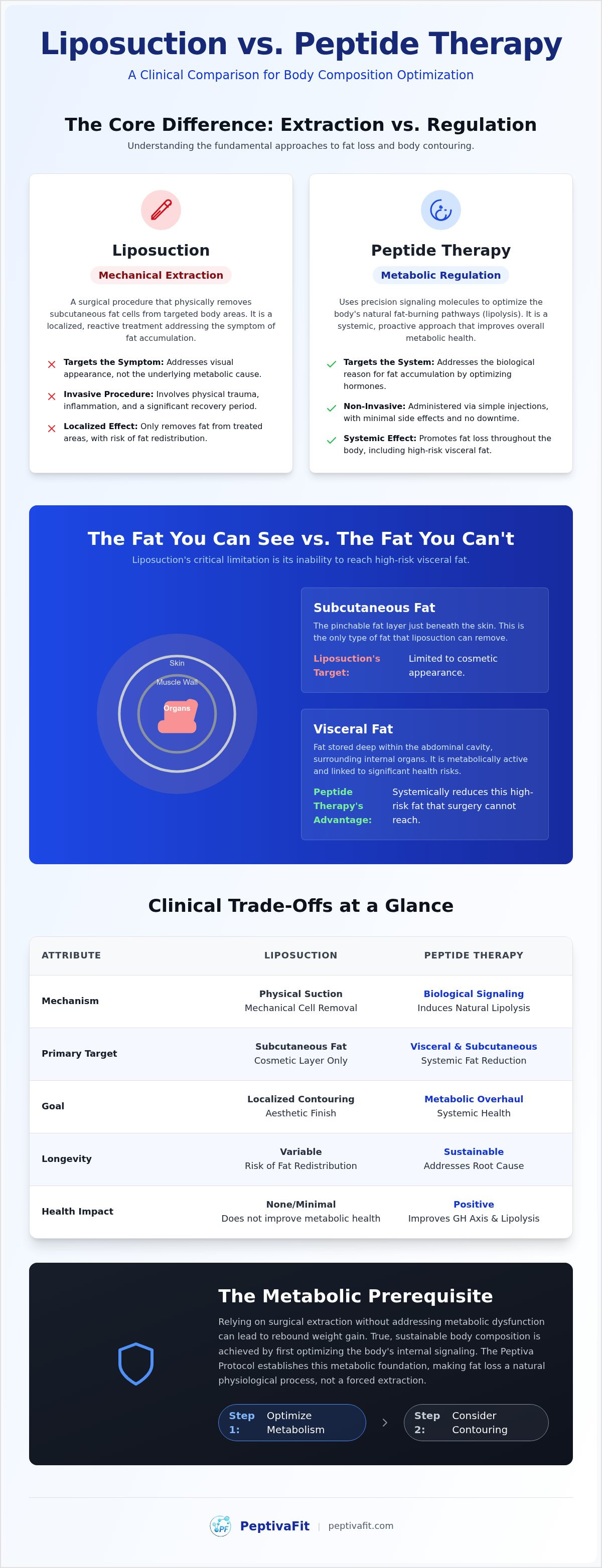
Understanding the fundamental difference between liposuction vs peptide therapy requires a shift from viewing fat as a static mass to recognizing it as an active endocrine organ. Liposuction is a surgical procedure designed to mechanically extract subcutaneous fat cells, or adipocytes, from specific regions of the body. Conversely, peptide therapy utilizes precision signaling molecules to initiate endogenous processes of lipolysis and fat oxidation. This creates a clear distinction between an "outside-in" mechanical intervention and an "inside-out" metabolic optimization. By 2026, clinical standards have moved toward prioritizing metabolic health, as removing a cell does not address the biological reason why that cell grew in the first place.
How Liposuction Targets the Symptom
Liposuction functions through the physical disruption and suction of adipose tissue via a hollow tube called a cannula. While this method provides immediate changes to body contour, it's a reactive treatment that addresses the visual symptom of fat accumulation. It is strictly limited to the subcutaneous layer, which means it cannot reach the visceral fat that surrounds internal organs and contributes to metabolic risk. The procedure involves significant physical trauma to the connective tissue and the vascular system, necessitating a recovery period for the body to manage inflammation and tissue remodeling.
How Peptide Therapy Targets the System
When comparing liposuction vs peptide therapy, it's essential to view peptides as sophisticated messengers rather than simple fat-burning agents. These short chains of amino acids act as biological keys, instructing the body to mobilize stored energy and improve overall metabolic flexibility. Growth hormone secretagogues are particularly relevant here; they stimulate the pituitary gland to release endogenous growth hormone, which plays a pivotal role in adult fat distribution and muscle maintenance. This systemic approach ensures that fat loss is a byproduct of improved physiological function. Peptides don't just reduce the volume of a specific area; they optimize the metabolic foundation to prevent future fat accumulation.
The choice between these two paths depends on whether the goal is a temporary cosmetic finish or a permanent metabolic overhaul. While surgery offers a rapid change in silhouette, peptide therapy provides a disciplined route to systemic health. A sophisticated approach to wellness in 2026 recognizes that long-term body composition is maintained through data-driven regulation, not just extraction. Relying solely on mechanical removal without addressing metabolic dysfunction often leads to fat redistribution or rebound, as the body's internal signaling remains unchanged.
The Physiology of Fat Loss: How Peptides Influence Lipolysis
Lipolysis is the metabolic process of breaking down fats by lipases to release fatty acids. This biochemical pathway is the fundamental engine of natural fat loss, yet it is often the first system to fail during metabolic aging. When evaluating liposuction vs peptide therapy, it's vital to recognize that surgery creates a physical void in the subcutaneous layer, an "empty space" that the body's homeostatic mechanisms often attempt to refill or compensate for elsewhere. Peptides, however, function by restoring the signaling integrity of the Growth Hormone (GH) axis. This axis is the primary regulator of adult fat distribution; when it's optimized, the body is naturally inclined to mobilize adipose tissue for energy rather than storage.
Targeted Lipolysis with AOD-9604 and Frag 176-191
Specific peptides are engineered to isolate the fat-burning effects of human growth hormone without the undesirable side effects of systemic GH elevation. HGH Fragment 176-191 is a truncated version of the GH molecule that specifically stimulates fat oxidation. It bypasses the receptors that influence blood sugar and insulin sensitivity, making it a highly targeted tool for adipose reduction. Clinical data surrounding AOD-9604 suggests it functions similarly as a potent anti-obesity agent by mimicking the C-terminal end of the GH molecule. While GLP-1 agonists have gained mainstream attention, as seen in the FDA information on semaglutide, these targeted peptides offer a direct pathway for shrinking fat cells through intracellular signaling. Lipolysis is the metabolic process of breaking down fats by lipases to release fatty acids.
Systemic Regulation via Tesamorelin and CJC-1295
For individuals dealing with visceral fat, which is the high-risk adipose tissue surrounding internal organs, systemic regulation is required. A precise Tesamorelin dosage has been clinically proven to reduce visceral adipose tissue by stimulating the pituitary gland's natural pulsatile release of growth hormone. This synergy between GHRH (Growth Hormone Releasing Hormone) analogs like CJC-1295 and the body's own rhythms creates a sustainable environment for body composition changes. Because these molecules are highly sensitive, ensuring molecular integrity and lab testing is paramount for achieving a consistent physiological response. Without verified purity, the signaling remains unreliable, leading to suboptimal metabolic outcomes.
Establishing this biological foundation is a prerequisite for any serious body composition goal. If you're ready to move beyond temporary fixes, a personalized medical assessment can provide the data necessary to align your protocol with your specific physiological needs. Unlike the trauma of surgical extraction, peptide-driven regulation works with your biology to ensure that the fat lost is not simply moved, but utilized by the system.
Subcutaneous vs. Visceral Fat: Why Liposuction is Not a Weight Loss Solution
Fat is not a uniform substance. It exists in distinct compartments with vastly different physiological impacts. While subcutaneous fat is the visible layer addressed by surgery, visceral fat remains tucked deep within the abdominal cavity, wrapping around vital organs. This distinction is the primary reason why the debate of liposuction vs peptide therapy is not just about aesthetics, but about clinical safety and long-term metabolic health. Removing fat cells via surgery does not improve your systemic profile; it merely alters your silhouette.
| Feature | Subcutaneous Fat | Visceral Fat |
|---|---|---|
| Location | Directly under the skin | Deep within the abdominal cavity |
| Primary Concern | Cosmetic and aesthetic contour | Metabolic and cardiovascular risk |
| Extraction Method | Surgical Liposuction | Metabolic Regulation (Peptides) |
| Health Impact | Relatively inert | Highly inflammatory |
Many "skinny fat" individuals possess low subcutaneous levels but high visceral fat, putting them at risk for insulin resistance despite a lean appearance. A medical overview of liposuction clarifies that the procedure targets specific areas and is not a weight loss solution. When fat cells are mechanically removed, the body often compensates by storing future calories in visceral depots or untreated areas. This phenomenon, often called the "liposuction rebound," occurs because the underlying metabolic drive to store energy hasn't been corrected.
The Danger of Neglecting Visceral Fat
Visceral fat is metabolically active tissue that secretes inflammatory cytokines, which are linked to systemic inflammation and chronic disease. Unlike surgery, which ignores this layer, metabolic optimization protocols utilize signaling molecules to mobilize these deep stores. Tesamorelin is specifically approved for the reduction of visceral adipose tissue because it addresses the hormonal root of the accumulation. By optimizing the biological environment, you reduce the fat that actually poses a threat to your longevity.
Why Surgery Can Cause Metabolic Compensation
The human body maintains a biological "set point" through complex hormonal feedback loops. Sudden mechanical fat loss is often perceived by the brain as a starvation event, rather than a cosmetic improvement. This triggers a compensatory rise in ghrelin, the hunger hormone, and a sharp drop in leptin. Without the systemic regulation provided by peptide therapy, post-surgical patients often find themselves fighting an uphill battle against their own biology. Peptides help smooth this transition by maintaining signaling integrity, ensuring the body doesn't trigger a storage-first response to the trauma of surgery.
Strategic Implementation: When Peptide Therapy Outperforms Surgical Intervention
Choosing between liposuction vs peptide therapy requires an honest assessment of your primary objectives and your tolerance for clinical risk. Surgery offers a one-time mechanical solution for localized subcutaneous fat, but it carries the inherent risks of general anesthesia, infection, and significant downtime. Peptide therapy represents a systemic investment in biological signaling that prioritizes metabolic health over immediate cosmetic changes. To determine the most effective path, consider the following decision framework:
- Aesthetic Contouring: If your goal is the removal of a specific, stubborn fat pocket that resists all intervention, surgery provides a predictable result.
- Metabolic Health: If you're struggling with visceral fat, systemic inflammation, or a sluggish metabolism, peptides are the only viable clinical path.
- Recovery Constraints: Surgery requires weeks of restricted activity. Peptide protocols allow for uninterrupted performance and training.
- Long-Term Maintenance: Peptides address the hormonal "set point," whereas surgery merely removes the cells, leaving the underlying storage drive intact.
The Non-Surgical Body Composition Protocol
Peptide therapy allows for a "recomposition" effect that is physiologically impossible to achieve through mechanical extraction alone. While liposuction removes mass, it does nothing to protect or enhance lean muscle tissue. Specific protocols utilizing growth hormone secretagogues enable the body to mobilize adipose tissue while simultaneously supporting nitrogen retention in the muscles. This results in a "sculpted" appearance that looks natural and athletic. Achieving these results requires strict adherence to proper reconstitution techniques to ensure the molecular integrity of the signaling proteins. For those focused on systemic longevity, utilizing BPC-157 in systematic repair ensures that the body's connective tissues remain resilient during the fat loss phase.
Combining Modalities: The Hybrid Approach
In 2026, the most sophisticated clinicians often recommend a hybrid approach. This involves a metabolic "prep" phase using the Peptiva Protocol to reduce visceral fat and optimize insulin sensitivity before any surgical intervention. If you do choose the surgical route, the "Wolverine Stack" (BPC-157 + TB-500) is frequently used to accelerate tissue remodeling and minimize post-operative inflammation. Additionally, copper peptides like GHK-Cu are integrated to tighten the skin and prevent the sagging that often follows rapid fat removal. Navigating these complex protocols is most effective when guided by 1-on-1 coaching, which provides the oversight necessary to transition from active fat loss to long-term metabolic maintenance. This disciplined strategy ensures that liposuction vs peptide therapy is not an "either/or" choice, but a coordinated effort toward peak composition.
Optimizing Your Metabolic Foundation with the Peptiva Protocol
Sustainable body composition is not achieved through the mere subtraction of tissue, but through the precise calibration of your metabolic signaling. While the debate of liposuction vs peptide therapy often centers on speed, the elite standard in 2026 prioritizes long-term biological stability. The Peptiva Protocol serves as the definitive fat loss peptide guide, offering a structured, data-driven alternative to invasive surgery. This approach recognizes that every individual possesses a unique physiological profile, making a personalized medical assessment a non-negotiable prerequisite for any successful intervention.
Adopting a disciplined, clinical perspective allows you to move beyond the limitations of mechanical extraction. By focusing on metabolic optimization, you address the root causes of adipose accumulation rather than just the visual symptoms. This systemic strategy ensures that your results are not only significant but maintainable through advanced biofeedback and professional oversight. It's a shift from reactive correction to proactive performance management.
The Importance of Lab-Verified Purity
The marketplace is saturated with "research-grade" substances that lack the necessary oversight for human optimization. Utilizing peptides without third-party COAs (Certificates of Analysis) exposes your system to unknown contaminants and inconsistent molecular structures. PeptivaFit maintains an exclusive, lab-verified supply chain to ensure every batch meets rigorous clinical standards for molecular purity. Purity is the single most important factor in peptide safety. Without lab-verified integrity, the physiological response becomes unpredictable, undermining the very metabolic stability you seek to build.
Professional Oversight and Coaching
Navigating advanced biological signaling requires more than just access to high-grade molecules; it requires expertise. A single consultation call can save you months of trial and error by aligning your protocol with your specific biomarkers and goals. Through 1-on-1 coaching, dosages are adjusted in real-time based on your body's biofeedback, ensuring maximum efficacy with minimal risk. This level of individual attention is what separates a generic attempt from a successful metabolic overhaul. When deciding between liposuction vs peptide therapy, choose the path of metabolic mastery over the mechanical quick-fix. True transformation is a long-term process rooted in science and personal responsibility.
Securing Your Metabolic Foundation in 2026
Choosing between liposuction vs peptide therapy is a decision between a localized cosmetic correction and a systemic biological overhaul. We've established that mechanical extraction cannot address the underlying metabolic dysfunction or the high-risk visceral fat that compromises long-term health. True body composition optimization requires a disciplined, data-driven approach that prioritizes molecular signaling and internal regulation over temporary aesthetic shifts.
Achieving sustainable results necessitates professional oversight and the highest standards of molecular purity. Every protocol we provide is supported by personalized medical assessments and lab-verified peptide purity with COA availability to ensure clinical integrity. Our 1-on-1 metabolic coaching provides the necessary biofeedback to navigate this complex landscape with precision. You're now equipped to move beyond temporary mechanical fixes and take sophisticated control of your biological performance.
Access the Peptiva Protocol: Your Clinical Path to Metabolic Mastery. Your commitment to a rigorous, science-based strategy is the most reliable path to a resilient and optimized physique.
Frequently Asked Questions
Can peptide therapy replace liposuction for stubborn belly fat?
Peptide therapy serves as a systemic alternative for individuals prioritizing metabolic health and the reduction of visceral fat over immediate mechanical removal. While liposuction offers rapid subcutaneous extraction, it fails to address the hormonal signaling that causes fat to accumulate in the first place. For those struggling with deep abdominal fat that surrounds the organs, peptides provide the only clinical solution for internal regulation and long-term metabolic flexibility.
How long does it take to see fat loss results with the Peptiva Protocol?
Significant physiological shifts typically manifest within 8 to 12 weeks of consistent protocol adherence. Metabolic optimization is a deliberate, long-term process that relies on steady biological signaling rather than the immediate trauma of surgical intervention. Results are cumulative; as your metabolic flexibility improves through the protocol, your body becomes more efficient at mobilizing and oxidizing stored adipose tissue for energy.
Is it safe to use peptides if I am planning to have surgery later this year?
Utilizing specific peptides as a metabolic prerequisite is often recommended to optimize your baseline health before any surgical procedure. Reducing visceral fat and improving insulin sensitivity can lead to more stable post-operative results and a smoother recovery process. You must disclose all signaling molecules to your surgical team to ensure total coordination with anesthesia and inflammatory management protocols during your recovery phase.
What happens to my fat cells when I use peptides like AOD-9604?
Peptides such as AOD-9604 stimulate the natural process of lipolysis, which is the biochemical breakdown of triglycerides into free fatty acids. In the context of liposuction vs peptide therapy, peptides instruct your existing cells to release stored energy for oxidation rather than physically removing the cells. This process reduces the volume of adipocytes without disrupting the surrounding connective tissue architecture or vascular systems.
Does liposuction remove visceral fat or only subcutaneous fat?
Liposuction is strictly limited to the mechanical extraction of subcutaneous fat located directly beneath the skin. It cannot safely reach or remove visceral fat, which is the metabolically active tissue tucked deep within the abdominal cavity. This is a vital distinction for your health, as visceral fat is the primary driver of systemic inflammation and cardiovascular risk that surgery simply cannot address.
Are the results from peptide therapy permanent or do I need to stay on them forever?
Results are sustainable when the protocol is used to establish a new biological "set point" and a foundation of metabolic health. Peptide therapy is a disciplined tool for regulation, not a lifelong dependency. Once you achieve your body composition goals and optimize your metabolic markers, maintenance is managed through data-driven lifestyle choices and periodic monitoring to ensure your signaling remains balanced.
Can I combine different peptides for a more aggressive fat loss effect?
Synergistic stacking of peptides is a common clinical practice used to target multiple metabolic pathways simultaneously. For instance, combining GHRH analogs with specific lipolytic fragments can enhance fat oxidation while protecting lean muscle mass from degradation. These advanced protocols require professional oversight to ensure that the signaling molecules work in harmony without causing receptor desensitization or other physiological imbalances.
Why is a medical assessment required before starting the Peptiva Protocol?
A personalized medical assessment is mandatory to establish your baseline biomarkers and ensure the safety of your specific protocol. Generic, "one-size-fits-all" dosing often leads to suboptimal results and potential signaling interference. Data-driven optimization requires a clear understanding of your unique physiological needs to determine the precise molecular concentrations necessary to reach your composition goals safely and effectively.

![Shelf Life of Reconstituted Peptides: A Clinical Reference Guide [2026]](https://getautoseo.com/storage/hero_images/shelf-life-of-reconstituted-peptides-a-clinical-reference-guide-2026.jpg?v=b8ed5173acaa)
