

The traditional belief that the human body cannot simultaneously prioritize muscle hypertrophy and adipose oxidation is a physiological limitation that modern molecular signaling is now challenging. Achieving a true body recomposition requires more than just disciplined training; it demands a precise orchestration of endogenous growth hormone pulses. You've likely faced the metabolic wall where stubborn visceral fat remains despite a strict deficit, or worse, you've watched your lean mass percentage drop as you try to get lean. This frustration is often what leads serious individuals to investigate the clinical application of peptides for building lean muscle and burning fat.
We understand that the current landscape is clouded by "gray market" risks and shifting 2026 regulatory updates, such as the upcoming July 23-24 PCAC reviews of substances like BPC-157 and MOTS-c. This article promises a disciplined, data-driven analysis of how specific peptide protocols can enhance recovery and metabolic efficiency. You'll gain a clear understanding of the difference between FDA-approved options like Tesamorelin and compounded research sequences. We will preview the essential lab testing standards that ensure your source meets scientific-grade purity, giving you the confidence to make an informed decision for your long-term performance and health.
Key Takeaways
- Understand how peptides function as precise signaling molecules that direct cellular behavior to overcome the metabolic challenges of body recomposition.
- Identify why the synergy between CJC-1295 and Ipamorelin is a preferred clinical protocol when utilizing peptides for building lean muscle and burning fat.
- Evaluate the efficacy of Tesamorelin for the targeted lipolysis of visceral fat that remains resistant to standard caloric deficits.
- Learn the non-negotiable standards for lab tested peptides, focusing on the role of third-party HPLC and MS testing in verifying chemical purity.
- Discover the implementation of the Peptiva Protocol, a structured approach to metabolic optimization supported by 1-on-1 coaching.
The Science of Peptide-Mediated Body Recomposition
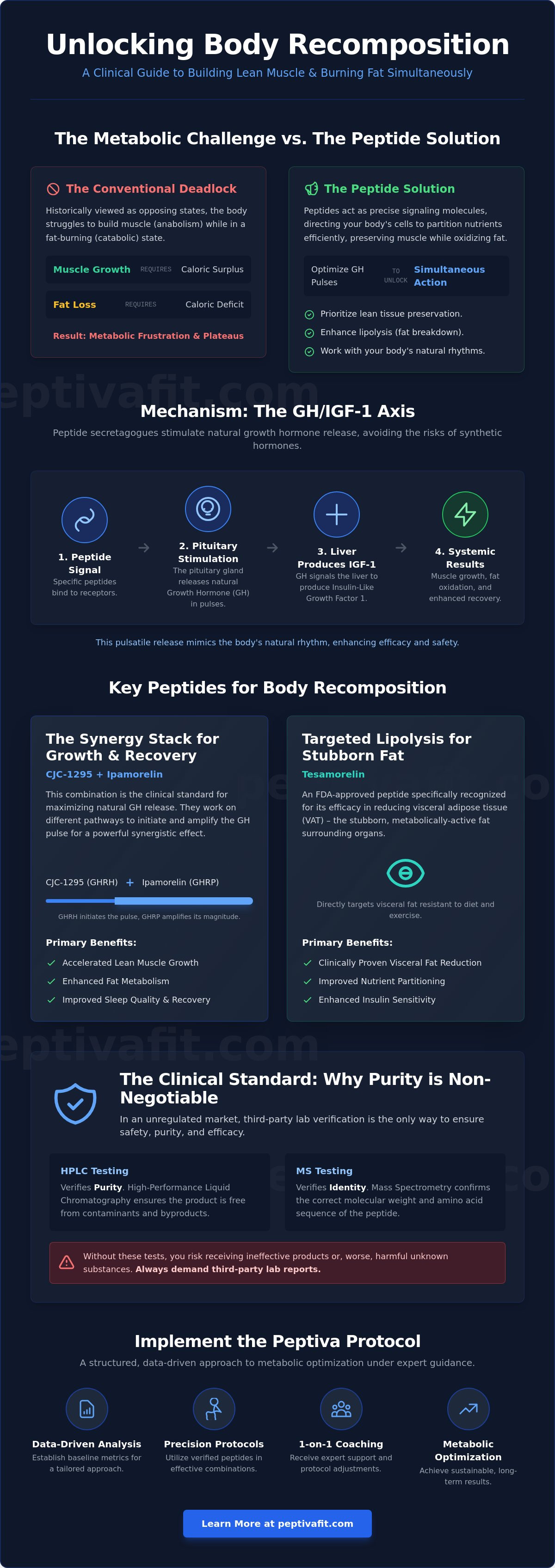
Peptides are often misunderstood as mere supplements or synthetic hormones. In a clinical context, they are short-chain amino acids that function as primary signaling molecules. They don't replace your body's natural chemistry; they direct it. By understanding The Science of Peptide Hormones, we see how these sequences bind to specific receptors to initiate cellular responses. This molecular precision is the foundation of using peptides for building lean muscle and burning fat, moving beyond the limitations of traditional exogenous administration.
Body recomposition represents the metabolic challenge of achieving muscle hypertrophy while simultaneously facilitating fat oxidation. Historically, these were viewed as opposing physiological states: anabolism requiring a caloric surplus and catabolism requiring a deficit. Peptides bridge this gap by altering how the body partitions nutrients. They prioritize the preservation of lean tissue even when the body is in a lipolytic state, allowing for a shift in body composition that doesn't compromise structural integrity.
Distinguishing between exogenous hormone replacement and peptide therapy is vital for clinical safety. Anabolic steroids are exogenous hormones that often suppress the body's natural production and carry significant risks of endocrine disruption. Peptide therapy, specifically the use of secretagogues, works within the body's existing regulatory loops. This makes it a more sustainable option for individuals focused on long-term wellness and performance rather than temporary, high-risk gains.
Mechanism of Action: The GH/IGF-1 Axis
Peptide secretagogues function by stimulating the anterior pituitary gland to release endogenous growth hormone. This triggers the liver to produce Insulin-Like Growth Factor 1 (IGF-1), which is the primary driver of protein synthesis and cellular repair. Unlike synthetic HGH, which creates a static, supra-physiological elevation, peptides encourage a pulsatile release. This mimics the body's natural circadian rhythm, reducing the risk of receptor desensitization and maintaining long-term endocrine health.
Metabolic Signaling and Fat Oxidation
Growth hormone is a potent regulator of lipolysis. When GH levels rise through targeted signaling, the body increases the breakdown of triglycerides within adipose tissue. This process enhances insulin sensitivity, allowing for more efficient nutrient partitioning. Metabolic signaling is the process of directing energy substrates toward muscle repair instead of fat storage. By optimizing these pathways, an individual can maintain high performance while reducing stubborn fat stores that are typically resistant to exercise alone.
Growth Hormone Secretagogues: Building Lean Tissue and Enhancing Recovery
Peptide secretagogues achieve physiological optimization by leveraging the synergy between Growth Hormone Releasing Hormones (GHRH) and Growth Hormone Releasing Peptides (GHRP). While a GHRH initiates the signaling for a growth hormone pulse, the GHRP amplifies the magnitude of that pulse. This dual action approach is why CJC-1295 is almost universally paired with Ipamorelin in protocols involving peptides for building lean muscle and burning fat. By using these two classes together, the resulting growth hormone release is significantly greater than the sum of its parts.
Maintaining the body's natural circadian rhythm is a primary clinical objective. Older generations of secretagogues often caused a "GH bleed," where growth hormone levels remained elevated in a non-pulsatile manner, which can lead to receptor desensitization. Modern protocols prioritize "no-bleed" peptides that preserve natural spikes, particularly during deep-wave sleep. Enhanced sleep quality isn't merely a side effect; it's a critical component of the recovery phase where the majority of muscle repair and protein synthesis occurs. Without high-quality nocturnal recovery, the metabolic signals for hypertrophy remain largely unanswered.
The 2026 regulatory environment has increased scrutiny on these substances, making source verification more critical than ever. Understanding the risks and legality of peptide hormones is essential for any serious individual, as many unregulated sources lack the molecular integrity required for safe administration. For those seeking a disciplined framework for their health journey, exploring the 1-on-1 coaching options at peptivafit.com can provide the necessary oversight for metabolic optimization.
CJC-1295 (With and Without DAC)
The distinction between CJC-1295 with Drug Affinity Complex (DAC) and the version without DAC, often referred to as Mod GRF 1-29, centers on the half-life. DAC extends the peptide's presence in the bloodstream for several days, whereas the No-DAC version lasts approximately 30 minutes. Clinical preference often leans toward the No-DAC version for body recomposition because it allows for more precise control over the timing of growth hormone pulses. This controlled administration helps protect pituitary health by preventing the constant stimulation that can lead to hormonal fatigue over long-term use.
Ipamorelin: The Selective GHRP
Ipamorelin is widely regarded as the most selective GHRP available. Unlike its predecessors, GHRP-2 and GHRP-6, it doesn't trigger a significant increase in ghrelin, the hormone responsible for hunger. It also avoids the collateral elevation of cortisol and prolactin. This selectivity makes it ideal for lean muscle preservation, especially during the caloric restrictions necessary for fat loss. Dosage precision is paramount; administering the peptide in a fasted state is required because elevated blood glucose or insulin levels can significantly blunt the growth hormone response.
Targeted Lipolysis: Peptides for Fat Oxidation and Visceral Reduction
Effective body recomposition requires a sophisticated approach to fat loss that transcends simple caloric restriction. While systemic fat loss occurs across the body, visceral adipose tissue remains notoriously resistant to traditional interventions. Addressing this specific metabolic challenge is a primary utility of peptides for building lean muscle and burning fat. By utilizing targeted signaling, it's possible to accelerate lipolysis in these stubborn regions while preserving the lean tissue built through the secretagogue protocols discussed previously. This level of precision is necessary for individuals who have reached a plateau where diet and exercise alone no longer yield measurable changes in body composition.
Understanding the clinical realities of peptide therapy is essential when transitioning from general recovery to active fat oxidation. This involves moving beyond surface-level aesthetics and focusing on metabolic health markers that define long-term performance. These protocols are often detailed within a comprehensive fat loss peptide guide, which provides the necessary structure for individuals aiming for precise body composition changes through informed molecular signaling.
Tesamorelin: The Visceral Fat Specialist
Tesamorelin is the clinical gold standard for the reduction of ectopic fat. Originally developed to treat lipodystrophy, its ability to selectively target abdominal adiposity makes it a cornerstone of advanced metabolic protocols. Tesamorelin specifically targets the GHRH receptors to reduce visceral adiposity without negatively impacting glucose metabolism. Beyond the aesthetic benefits, adhering to a precise Tesamorelin dosage has been shown to improve lipid profiles, providing a cardiovascular advantage that few other interventions can match. It's a potent tool for those prioritizing metabolic health alongside physical optimization.
AOD-9604: The Fragment Advantage
AOD-9604 is a stabilized analog of the factor-releasing C-terminus of human growth hormone, specifically the 177-191 amino acid sequence. It was initially researched as an anti-obesity drug due to its ability to stimulate lipolysis and inhibit lipogenesis. Unlike full-sequence HGH or certain secretagogues, AOD-9604 doesn't affect blood sugar levels or IGF-1 production. This makes it an ideal option for individuals who are sensitive to the systemic effects of growth hormone but still require potent fat-burning signaling. It functions by mimicking the way natural growth hormone regulates fat metabolism without the anabolic side effects on non-adipose tissues.
Metabolic Synergy: Stacking for Fat Loss
The most effective recomposition results often come from stacking GH secretagogues with targeted lipolytic fragments. While CJC-1295 and Ipamorelin provide the anabolic environment for muscle preservation, AOD-9604 or Tesamorelin accelerates the breakdown of stored fats. This combination helps manage energy levels during a caloric deficit, ensuring that exercise performance doesn't suffer as body fat percentages drop. The Peptiva Protocol provides the disciplined framework required to organize these stacks, ensuring that each molecular signal is timed for maximum metabolic synergy and safety.
Clinical Standards: Why Molecular Purity and Lab Verification are Non-Negotiable
The proliferation of online vendors has created a "gray market" where the burden of verification falls entirely on the individual. Many products labeled for "scientific investigation" bypass the rigorous quality controls required for human application. Using unverified peptides for building lean muscle and burning fat introduces systemic risks that can undermine your metabolic health. Following the April 23, 2026 reclassification of several peptides, the requirement for pharmaceutical-grade standards has only intensified. Precision matters. Without third-party verification, you are essentially injecting an unknown chemical sequence into your endocrine system.
True lab tested peptides are defined by more than just a label. They require a transparent chain of custody and rigorous analytical testing. High-Performance Liquid Chromatography (HPLC) determines the purity level, while Mass Spectrometry (MS) confirms the molecular weight to ensure the sequence hasn't been truncated or improperly synthesized. Red flags in sourcing are often easy to spot if you know where to look. Lack of batch numbers, missing Certificates of Analysis (COAs), and pricing that seems too low to cover the costs of high-end synthesis are immediate indicators of sub-standard quality. Impurities like residual solvents or bacterial endotoxins can trigger immune responses that lead to chronic inflammation or localized tissue damage.
Interpreting a Certificate of Analysis (COA)
A COA is a technical snapshot of a peptide's molecular integrity. While a purity percentage of >99% is the clinical standard, it doesn't tell the whole story. You must also verify that Trifluoroacetic acid (TFA) residues and endotoxin levels are within safe limits. TFA is often used during the synthesis process, but high residual amounts can be toxic. Molecular weight verification is equally critical. If the weight shown on the MS report doesn't match the known sequence for a peptide like Ipamorelin, the product is either degraded or a different substance entirely.
The Necessity of Professional Oversight
Data monitoring is the difference between a high-stakes gamble and a clinical protocol. A personalized medical assessment ensures that your baseline biomarkers are compatible with secretagogue use. We prioritize the monitoring of fasting blood glucose, IGF-1 levels, and thyroid function to prevent metabolic drift. Professional medical consultations allow for the adjustment of dosages based on real-time data rather than guesswork. To ensure your protocol is built on a foundation of safety and precision, you should book a personalized medical assessment to review your specific biomarkers.
Implementing the Peptiva Protocol for Body Recomposition
The Peptiva Protocol is not a temporary intervention or a marketing-driven "quick fix." It is a disciplined, multi-phase framework designed for individuals who prioritize data over hype and clinical precision over general advice. Navigating the nuances of peptides for building lean muscle and burning fat requires more than just a list of compounds; it demands a structured approach that accounts for your unique metabolic baseline. True body recomposition is a methodical, long-term process that relies on the consistent application of molecular signaling to shift your physiological state from fat storage to lean tissue accrual.
1-on-1 Coaching is a central component of this framework. Peptide therapy is highly individualized, and what works for one metabolic profile may be ineffective for another. Professional oversight ensures that your protocol remains aligned with your biomarkers as they evolve. This level of exclusivity and expert guidance provides a sense of sophisticated control, allowing you to make informed adjustments based on data rather than guesswork. Without this oversight, individuals often fall into the trap of improper dosing or poor timing, which can blunt the efficacy of even the highest-quality peptides.
The Peptiva Protocol Framework
The protocol is executed in three distinct phases to ensure safety and maximum metabolic impact. Phase 1 involves a comprehensive metabolic assessment and baseline biomarker tracking to identify your current physiological status. Once this data is established, we move to Phase 2: Protocol design. This is where we select the specific molecular stack tailored to your body composition goals. Finally, Phase 3 focuses on execution and adjustment. Through consistent professional oversight, we monitor your progress and refine the protocol to maintain optimal signaling and prevent plateaus.
Maximizing Results Through Lifestyle Integration
Peptides act as a catalyst, but they don't operate in a vacuum. Nutrient partitioning is a primary benefit of these protocols; peptides change the way your body utilizes macronutrients by directing energy toward muscle repair rather than adipose storage. To leverage this, your nutrition must be as precise as your molecular signaling. Training adjustments are equally vital. Because these sequences enhance your recovery capacity, you can often handle higher training volumes or intensities. For those who need to troubleshoot specific hurdles or refine their current strategy, a Single Consultation Call can provide the technical clarity required to maintain progress. You can optimize your body composition with the Peptiva Protocol by integrating these advanced molecular tools with a disciplined lifestyle approach.
Securing Your Path to Advanced Body Recomposition
The evolution of clinical signaling has redefined the parameters of physical optimization. By leveraging specific peptides for building lean muscle and burning fat, you can bypass the metabolic plateaus that often accompany traditional training. This analysis has detailed the synergy between secretagogues like Ipamorelin and targeted lipolytic agents such as Tesamorelin. However, the efficacy of these protocols relies entirely on the foundation of molecular purity and professional oversight.
Navigating the 2026 regulatory environment requires a disciplined approach to source verification and biomarker monitoring. We've established that lab-verified molecular integrity and personalized medical assessments are mandatory for maintaining long-term endocrine health. Success in body recomposition isn't a result of high-stakes experimentation; it's the outcome of a methodical framework. Expert 1-on-1 coaching provides the necessary guardrails to ensure your metabolic signaling remains precise and effective.
Take the next step in your performance journey with a structured, data-driven approach. Access the Peptiva Protocol for Metabolic Optimization to begin your transformation with the highest clinical standards. You possess the tools to command your metabolic future.
Frequently Asked Questions
Is it possible to build muscle and lose fat at the same time with peptides?
Yes, achieving simultaneous hypertrophy and fat oxidation is possible through the precise application of peptides for building lean muscle and burning fat. These molecules act as signaling agents that prioritize protein synthesis while accelerating the breakdown of adipose tissue. This dual metabolic state is typically difficult to maintain through diet alone; however, it becomes viable when growth hormone pulses are clinically optimized to improve nutrient partitioning.
How long does it take to see results from peptides for body recomposition?
Physiological changes at the cellular level require a methodical approach rather than a quick fix. While some individuals report improved sleep and recovery within the first few weeks, significant changes in body composition usually manifest between three and six months of consistent protocol adherence. This timeline allows for the gradual accumulation of lean tissue and the steady oxidation of stubborn visceral fat stores through sustained signaling.
Can peptides like CJC-1295 and Ipamorelin cause side effects?
While CJC-1295 and Ipamorelin are generally well-tolerated due to their selective nature, they can cause side effects if not properly managed. Potential reactions include localized irritation at the injection site or temporary water retention. Some individuals report a slight tingling sensation in the extremities or mild lethargy if dosages aren't accurately calibrated. Professional oversight is essential to monitor these biomarkers and adjust the protocol to maintain balance.
What is the difference between peptides and anabolic steroids for muscle growth?
Anabolic steroids are exogenous hormones that replace natural testosterone, often suppressing the body's own endocrine production. In contrast, peptide secretagogues stimulate the pituitary gland to release endogenous growth hormone within its natural regulatory loops. This makes peptide therapy a more sustainable option for long-term health, as it avoids the severe endocrine disruption and organ stress associated with traditional, high-risk anabolic agents.
How much do peptides for fat loss and muscle gain typically cost?
The total investment for a body recomposition protocol depends on the specific peptide sequences and the required frequency of administration. Costs are primarily influenced by the requirement for pharmaceutical-grade synthesis and the necessary clinical oversight to ensure safety. You should also account for the expense of comprehensive diagnostic lab work and professional consultations. These components are essential for ensuring the molecular signals are correctly calibrated for your profile.
Is a medical assessment required before starting a peptide protocol?
A personalized medical assessment is a non-negotiable requirement for any disciplined protocol involving peptides for building lean muscle and burning fat. This baseline diagnostic allows for the monitoring of critical biomarkers like IGF-1, fasting glucose, and thyroid function. Without this data, it's impossible to tailor the molecular signaling to your specific needs or ensure that the therapy is compatible with your current physiological state.
Can I use peptides if I am currently taking other medications?
Potential interactions between peptides and other medications must be evaluated by a qualified physician before beginning a protocol. While peptides are short-chain amino acids, they can influence insulin sensitivity and metabolic rate, which may affect the efficacy of certain prescriptions. A thorough review of your current medical regimen during a consultation is the only way to ensure that a peptide protocol won't interfere with your existing health management.
How do I know if the peptides I am buying are lab-tested and pure?
Verification of molecular integrity requires a current Certificate of Analysis from an independent third-party laboratory. This document must include High-Performance Liquid Chromatography results to confirm purity levels above 99% and Mass Spectrometry to verify the correct molecular weight. Any source that cannot provide batch-specific testing data should be considered a significant risk. We only utilize lab tested peptides to ensure the highest standards of safety and efficacy.

![Shelf Life of Reconstituted Peptides: A Clinical Reference Guide [2026]](https://getautoseo.com/storage/hero_images/shelf-life-of-reconstituted-peptides-a-clinical-reference-guide-2026.jpg?v=b8ed5173acaa)
